

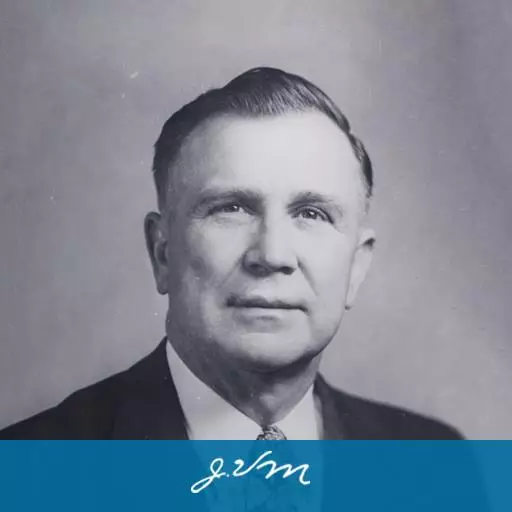
From Prison to the Palace


Betrayed by his brothers, sold into slavery, falsely accused, and locked away in prison, Joseph’s suffering was real. Yet Dr. J. Vernon McGee shows that so was the hand of God. As Joseph’s story unfolds, we’re reminded that even in seasons of waiting and confinement, God is working behind the scenes—moving His servant, in His perfect time, from the prison to the palace.
Steve Swetz: What does it feel like when God is working, even in the darkest, most forgotten places of life? Welcome to the Sunday Sermon on Thru the Bible. I'm Steve Swetz, and this time we've got a never before aired message from Dr. J. Vernon McGee. Now, in this sermon, "From Prison to the Palace," Dr. McGee brings us back to Joseph, one of the clearest Old Testament pictures of the Lord Jesus Christ.
Joseph's life takes one painful turn after another: betrayed by his brothers, sold into slavery, falsely accused, and locked away in prison. Yet again and again, God works behind the scenes. The prison is real, but so also is the hand of God. And at just the right moment, the Lord moves Joseph from confinement to influence, from waiting to purpose, from prison to the palace.
Before we get to Dr. McGee's message, let's hear from a few listeners who hop aboard the Bible Bus this time in French. More than 300 million people speak French in over 25 countries. That's a lot. From Europe and Africa to the Caribbean and Canada. And recently, we've seen a noticeable rise in emails and messages and phone calls from listeners in these places. Each note feels like a small window into a quiet, steady work that God's doing through His word in hearts and communities around the world. Now, here's just a glimpse of what we're hearing.
Vivian: Thank you for the strategies to know the Word better and better. Thank you for these ideas. I didn't know about them before. My reading and meditation on the Gospels have become a routine so I can understand the life of Jesus and identify with His words. I was focusing only on Paul and his teaching, but I also need to meditate on Jesus. The Old Testament lessons are very engaging as well. I will begin organizing myself this way now. May God bless you. Every time I hear this program, there is always a message from the Lord to me.
Lillian: Please continue to keep me in your prayers. By God's grace and the knowledge I've gained from you, I'm able to share the Gospel in my area. May the Lord continue to guide my steps toward these lost souls so that they may encounter Jesus.
Loc: I listen attentively to the program Thru the Bible and am very impressed by the inspiration, the content, and the way these biblical teachings are presented. It greatly benefits me spiritually, edifying me and focusing my understanding of biblical doctrine. I ask the Lord to bless you all who work for His name.
Bryce: Thank you for your support and help. On Sunday, December 28th, we went through neighborhoods in our city to proclaim the Gospel. We were amazed to see how many men and women responded to the call of our Lord Jesus Christ. Thank you for helping us bring these new brothers and sisters into prayer so they may grow in the knowledge of Christ. We told them about your program and hope they will listen.
Adrien: May God bless you abundantly. I'm a student and what I'm learning through this program goes deeper than anything I've studied before. The Bible feels completely new to me. God's Word is reshaping the way I think, not just about faith, but about life itself, from relationships and work to the way I see the world around me.
Steve Swetz: Do you hear the thread that's running through all these stories? God is at work in the lives of people. And that includes you. You're a part of a worldwide family that God is shaping through His Word. So if you've never joined our World Prayer Team, well, this is a simple and meaningful way to stand with other believers and take part in what God's doing around the globe. Every weekday, you'll receive an email with that day's destination, updates on our ministry there, and information on how you can best pray for listeners, producers, our in-country follow-up teams, and home groups in places where the Gospel is taking root. You can join the World Prayer Team right from our app or online at TTB.org.
And we'd love to hear from you as well. So tell us your story. Maybe you first came to know the Lord by going through the Bible with us. Or maybe you've got a story to tell about how something you've learned in God's Word has changed the way you live. Would you write to us? You can write to us from our app, at biblebus@ttb.org, or send a letter to Box 7100, Pasadena, California, 91109. In Canada, Box 25325, London, Ontario, N6C 6B1. And another option is to call anytime and leave a message at 1-800-65-BIBLE. Now you'll get some options, and one of them is for leaving your Bible Bus story. That's what you want. From there, it's just as simple as listening to the prompt and recording your voicemail, and just make it like you're talking to one person. That number again is 1-800-652-4253.
Now as we turn to God's Word, maybe you're listening in a season that feels a little like Joseph's: unfair, uncertain, or just stuck. Well, if so, this message is for you because the same God who met Joseph in the prison still meets His people today, and He's never finished writing the story. Let's pray. Father, thank you for your Word that reaches across languages, nations, and generations. Thank you for the way that you're drawing people to yourself all around the world. As we study, Lord, would you quiet our hearts, open our ears, and strengthen our faith. In Jesus' name we pray. Amen. Here now is the Sunday Sermon on Thru the Bible with Dr. J. Vernon McGee.
Dr. J. Vernon McGee: Our subject today is "From Prison to the Palace," and we're to consider today another episode in the life of Joseph. Perhaps some of you today though feel like the little boy after his first day in school. He was asked how he liked it and he said he didn't care too much for it; he had to go back tomorrow. And I'm sure that there are some of you that feel like we ought to be getting out of the story of Joseph, but I have I'm afraid for you bad news. We have several messages concerning this most unusual man in the Old Testament, who is probably more like the Lord Jesus than any other.
We are to consider this morning the third tragic misfortune that came to him before he was finally elevated to a position that was next to the throne of Pharaoh himself. Now his life, I think so far, it's one hair-raising experience after another, and you wonder whether he's going to escape. His life was in danger. We are going to see how God continually delivered him out of all of his troubles.
He narrowly escaped death in two previous experiences that he had had. You'll recall first of all his brothers. They put him down in the pit with the full intention of killing him, and they were to as they ate their lunch, they were to discuss how they were to dispose of him. And God marvelously intervened at that particular time and prevented them from murdering him.
And then we find he was sold to Potiphar, and the wife of Potiphar brought a false accusation against Joseph. He was actually framed. And you would fully expect Potiphar to put him to death. He would have, because Joseph was a Hebrew slave and his wife has brought this accusation against him, and in the normal course of events, he would have been put to death. But all was not well in the household of Potiphar. It was not a happy home.
And we find out that the wife's estimate of Potiphar himself was not very high. Back in the 39th chapter of Genesis, verse 14, that she called unto the men of her house and spake unto them saying, "See, he hath brought in a Hebrew unto us to mock us." And immediately when she uses that kind of language, you know that she despises her husband. She doesn't say it's Mr. Potiphar or she doesn't speak of him in any high regard. When a wife begins to talk about "him" and about "he," then you can be sure that she does not have a very high regard.
That is obvious, but that isn't the whole story at all. You find out that Potiphar had no confidence in his wife whatsoever. It came to pass when his master heard the words of his wife, which she spake unto him saying, "After this manner did thy servant to me," that his wrath was kindled. And Joseph's master took him and put him into the prison, a place where the king's prisoners were bound, and he was there in the prison.
Now normally, why he would have put him to death. But instead of doing that, he put him in a prison and he intended to forget about him. Why did he do that? Well, he had no confidence in her. He knew that she was not to be trusted at all, and I'm not sure that this was the first or the last affair that she had had. And therefore this man had no confidence, and therefore he would not put this Hebrew slave to death.
The writer to the Proverbs says a very wonderful thing concerning the right kind of a wife in Proverbs 31:11, "The heart of her husband doth safely trust in her." We have today quite a few bright little experts that come out of our seminaries that go about lecturing on the home today, and they have some clever little things to say. But any man that's a pastor today knows that the home is breaking up in this country, and these clever little things that are said are not the answer to it.
My friend, until there is a man and a woman in that home, and if it's a Christian home, a Christian, and who are folk of integrity and whom you can have confidence in, then I don't care how many family altars and I don't care what kind of a little ritual you go through, it's merely a mockery. Because we need today integrity in the Christian home today as well as the home in the world. I have a letter that came this past week from the Bay Area, from the wife of a pastor even. And her comment is: the folk in the church think everything is all right. We keep up a front, but it's tragic, our home.
May I say to you that's the thing that's happening all over today. And that was the thing about Potiphar. He took this boy Joseph and put him in prison and forgot about him for appearance's sake, to preserve a front. And poor Joseph had to suffer. But actually, friends, all of this worked out to the advantage of Joseph. And we see in this a clear-cut parallel to the life of the Lord Jesus. Joseph and Jesus are very, very much alike.
Now will you notice something this morning? And this is a picture that I wish I could put in every Christian home and take down Solomon's head of Christ, because this is the picture that we need. Joseph's brethren hated him without a cause. They delivered him to the Gentiles. You see, that's the way Christ was betrayed from the inside out. And that's the only way the church can be hurt today. There's not anything outside of the church can hurt it today; it's being hurt from the inside.
And so you find that our Lord was first betrayed to the religious rulers by one of His own. They in turn turned Him over to the Gentiles. And that's the way Joseph got down into the land of Egypt. His own brethren delivered him. And then he found that he could not defend himself. He's unjustly accused. But what is the word of a slave against the word of the wife of an official down in the land of Egypt?
The Lord Jesus Christ was delivered by His own to the hands of the Gentiles, and we find that's exactly the way our Lord said it would be. In Matthew 20, verse 18 and 19, let me read: "Behold, we go up to Jerusalem; and the Son of man shall be betrayed unto the chief priests and unto the scribes, and they shall condemn him to death, and shall deliver him to the Gentiles to mock, and to scourge, and to crucify him: and the third day he shall rise again." Our Lord put down His program before He even got to Jerusalem, the thing that would happen, and it parallels the life of Joseph.
Again the prophet had already said, Isaiah 53:7, "He was oppressed, and he was afflicted, yet he opened not his mouth: he is brought as a lamb to the slaughter, and as a sheep before her shearers is dumb, so he openeth not his mouth." Our Lord did not defend Himself because He had come as the Lamb of God, and it would have been useless for Joseph to have defended himself also.
Now Pilate, just like Potiphar, did not believe the accusation against the Lord Jesus. Potiphar didn't believe his wife's accusation at all. And therefore Pilate found the Lord Jesus innocent. He said, "I find no cause, no accusation against this just man at all." And he scourged him. He'd had no right to do that if He was innocent, but he scourged him thinking that would satisfy His accusers. But it did not.
And you know, Joseph suffered at the hand of the Gentiles. And you won't get that from the Genesis record. You'll have to look elsewhere for it. And you will find that when Stephen was reciting the history of these people before the Sanhedrin, he included Joseph, and he said this in Acts 7:9 and 10, and I'm reading: "And the patriarchs, moved with envy, sold Joseph into Egypt: but God was with him, and delivered him out of all his afflictions, and gave him favour and wisdom in the sight of Pharaoh king of Egypt; and he made him governor over Egypt and all his house."
Now this man Stephen says God delivered him out of his afflictions. And you do not find that in the Genesis record at all. And when we turn back to the Psalms, it's quite interesting. We're told exactly what happened to him. In Psalm 105:17 and 18, it reads: "He sent a man before them, even Joseph, who was sold for a servant: whose feet they hurt with fetters: he was laid in iron." So that Joseph was put in the prison. He found favor, it's true, but he was made to suffer in that prison.
What a parallel to the life of the Lord Jesus Christ, if you please. And the very interesting thing is that Joseph found favor in sight of the jailer. In verse 21 of chapter 39 of Genesis: "But the Lord was with Joseph, and shewed him mercy, and gave him favour in the sight of the keeper of the prison." And isn't it an interesting thing to see this Roman centurion that crucified Christ. He was carrying out orders just as that jailer carried out orders to persecute and to put this boy Joseph in fetters and his legs in irons. But he found favor with him.
But this Roman centurion, we're told: "Now when the centurion saw what was done, he glorified God, saying, Certainly this was a righteous man," in Luke 23:47. So that even the man who put Christ to death acknowledged that He was not only a righteous man, but he called Him the Son of God. Therefore this centurion didn't have a course in theology, he'd never read any books, and he'd never been to a Bible study. But he knew enough to take his place beneath the cross of Christ.
And you know, that's all God's ever asked any sinner to do. He never asked him to be a theologian; He just asked him to take his place beneath the cross of Christ and trust Him as Savior. And that's exactly what the jailer did. Now we find that Joseph here is numbered with the transgressors. Will you notice the 40th chapter? It says and Pharaoh was wroth against two of his officers, against the chief of the butlers and against the chief of the bakers, and he put them in ward in the house of the captain of the guard into the prison, the place where Joseph was bound.
So that now Joseph has two cellmates. He has two that are there with him. And he became a blessing to the butler, and he pronounced a judgment on the baker. It's quite interesting to note that, for these two men had dreams. And Joseph interpreted them and said for the butler it'll mean your salvation, and for the baker it'll mean your death. And Christ was crucified between two thieves. One of the thieves He said to him, "Today thou shalt be with me in paradise."
And then we find that Joseph ascribes all glory to God. You find that when he was able to interpret the dreams of these two men, the baker and the butler of the Pharaoh of Egypt, he said this to them when they wanted to applaud him: "Do not interpretations belong to God? tell me them, I pray you." So that he gives God the glory, and you'll find out that he continually did that even when he went into the presence of Pharaoh.
And that's exactly even what our Lord did when He was here upon this earth. Have you ever noticed that He always gave God the Father credit for everything? In other words, God must get the glory. Listen to Him in John 12:49 and 50: "For I have not spoken of myself; but the Father which sent me, he gave me a commandment, what I should say, and what I should speak. And I know that his commandment is life everlasting: whatsoever I speak therefore, even as the Father said unto me, so I speak."
The Lord Jesus, when He was upon this earth, never did anything, made any decision according to His own judgment, and He had the ability of course. But He always did it because He said, "This is God's will, and I've come to speak the things that represent Him." God got the glory. And as far as Joseph was concerned, everything he did, he gave God the credit, he gave God the glory.
And I'm wondering if that's one of the reasons the blessing of God is being withheld today from the church. We have so many individuals that are seeking for prominence and recognition even in the church today, and God is not getting the glory. My friend, if there's anything being done today that is effective in this world, it's God that's doing it. No man today can do this. And this idea today that this man is talented or that man has ability or that this thing or the other thing. My friend, there's nothing that's effective and eternal that God does not do. And we need to recognize that in this hour. And that was the thing that Joseph did, and even our blessed Lord here upon this earth in the flesh followed that pattern.
Now you will notice that this boy Joseph there in prison, he's forgotten. But he told the butler, he said, "When you're restored back to Pharaoh, you be my attorney. You remember me and say a good word for me there." In Genesis 40, verse 14, "But think on me when it shall be well with thee, and show kindness I pray thee unto me, and make mention of me unto Pharaoh, and bring me out of this house." Isn't it interesting that it's concerning His death that the Lord Jesus said, "This do in remembrance of me"? Don't forget me. Don't forget my death. Don't forget this that I came to do.
And He tells His church today that as often as you do this thing, you do it in remembrance of me. Remember me. Joseph said to this butler, "Remember me." Now today many Christians like to have a picture of Jesus in their home that some human artist has painted, and there's one thing you can be sure: Jesus doesn't look like that picture, and I don't care whose it is. We don't know how He looked at all, and that's withheld from us. But I want to suggest to you that these lovely pictures in the life of Joseph, they're old pictures. It's our Lord in type. We ought to have them on the art gallery of our souls today, and what lovely pictures they are of Him.
Now the butler forgot Joseph. What human gratitude that was. The very man that had given him the one word of encouragement in prison is now forgotten. And isn't that typical of human nature? The Lord Jesus, you can hear Him say: "Were there not ten cleansed? Where are the nine? Where are the nine?" Ten lepers, but only one came back in thanksgiving to the Lord.
But even in all of this, God was overruling the neglect of the butler as He was overruling everything else. Had you ever stopped to think that had Joseph been delivered at that time, suppose the butler had gone in and said to Pharaoh, "Say, I want to tell you there's a man down there in prison that's helped me so much and he interprets dreams and he interpreted my dream and he's God's man and he's been unjustly put in that prison." And I think Pharaoh would have given him his dismissal immediately, he would have had a pardon. And by the time that you get around to where he's needed, Joseph would have been halfway back to Hebron in the Promised Land. And when he was needed in Egypt, he wouldn't have been there.
You see, God's overruling all of this, and He's keeping him in prison to be present at the moment that God will need him. It's amazing how God today moves in the hearts and lives of people even today without us recognizing it at all. We even talk about God being dead, and yet God's moving today in the affairs and lives of men and women.
And so we're now going to leave the prison and go to the palace. We're going to see how the hand of God is beginning to move. And here we do see the hand of God in the life of Joseph. Or let me put it like this: the hand of God's moving in the glove of circumstances now. Or as someone has said, the fortuitous concurrence of circumstances. Well, that's what we have here. Up to this point, everything seemed to work against this boy.
A little later his father, when Benjamin was to go down into Egypt, he said, "All these things are against me." That was Jacob, and Joseph at this time his son could have said it. But Joseph would have been a spoiled brat had he continued in his father's house. Given the role of a favorite son, he'd not only had a coat of many colors, but a silver spoon in his mouth. And that's not what God wanted for this boy. And so he's sold into Egypt, he's put into prison, and he's forgotten. Because God is going to work out something in his life.
The writer of Ecclesiastes says something quite interesting in the seventh chapter, verse 8. Listen to this: "Better is the end of a thing than the beginning thereof." And you know, many of us today that are Christians need to learn that. Better is the end of a thing than the beginning of it. Many of us today because when we start something or we today attempt something and it falls to pieces in our hands, we say, "Oh my, God is against us," and we drop it all together. My friend, today how many are discouraged because they only see the beginning. The writer to Ecclesiastes, it says better's the end than the beginning, and the child of God can always hold on to that. Weeping may endure for the night, but joy comes in the morning.
But someone has said today that some modern philosopher has said let's get all we can right now because tomorrow we shall weep. The Bible says the opposite: that now is the time of weeping, but joy cometh in the morning. Now Pharaoh had a dream also. He called in his wise men, and they didn't have the answer. They very frankly confessed; they said, "We haven't any notion what this could possibly mean." And what a picture it is of the man in the world even today, my beloved.
We are seeing the confusion of the wise men of the world. We can get to the moon today, but we can't solve the problems that are on this earth. Right here in Los Angeles, they're making a rocket that'll go to the moon, but you can't get through the freeway to get out to make the rocket that's going to the moon. We can't even solve local problems today. What a picture of mankind. We have computers today that can go back millions of years, but there's not one of them can tell you about tomorrow. How sad it is to see mankind and men in high places today in apathy and uncertainty and confusion and not knowing what to do today.
The scripture says the secret of the Lord is with them that fear Him. I think that would be a good motto for Washington today. It would be a good motto for the United Nations today. The secret of the Lord is with them that fear Him. Now when Pharaoh had his dream, the wise men came in and they made no contribution whatsoever. The butler remembered. In verse 9 of chapter 41: "Then spake the chief butler unto Pharaoh, saying, I do remember my faults this day."
And so he tells about his experience in prison, he tells about Joseph. And then Joseph is brought out of prison and brought into the presence of Pharaoh. And I think it's interesting how accurate the Word of God is in this connection. It says "he shaved himself." The Hebrews didn't shave, as you know. But the Egyptians did. Go look at any of Egyptian art today, and they're all clean-shaven. If they are member of the nobility, they're given a little goatee. Most of them couldn't grow it. King Tut couldn't, but they gave him one. But they were clean-shaven folk. Now this man changes his raiment and shaves himself. And candidly, I think you have a picture of this man now brought out of prison. The prison can no longer hold him because God's time has arrived.
And I'd like for you to follow that picture right on through now. Here is a picture of the Lord Jesus Christ in resurrection. God raised up Jesus at the appointed time, and all Rome couldn't keep Him there, and all the religious rulers couldn't keep Him in that grave. And when Peter spoke on the day of Pentecost, he went back to that, for that was the very heart of the message and still the heart of the message of the Gospel today: not only that Christ died, but that He rose again. "Whom God hath raised up, having loosed the pains of death: because it was not possible that he should be holden of it," Acts 2:24.
That's Peter's message on the day of Pentecost, and he then came back to it again. "This Jesus hath God raised up, whereof we are all witnesses." That's his message. And then when he was called to go into the home of Cornelius, a Gentile, he brought that message again in Acts 10:40: "Him God raised up the third day, and showed him openly." So that this boy Joseph at God's appointed time, the prison can't hold him. He's brought forth, and he's brought forth at what we would call the psychological moment. And it's on the third day that our Lord came back from the dead as it had been predicted and as He Himself said would take place.
Now we find something else. That Joseph revealed God's plan here. He's very careful when he comes into the presence of Pharaoh to make it clear that it's for nothing in him. Just as Daniel later on, when he's in the presence of Nebuchadnezzar, he said, "I want you to understand it's nothing that's in me, but that God is the one that will show to the king." Now we find this boy speaking to Pharaoh. In the 16th verse of chapter 41, he says: "Joseph answered Pharaoh, saying, It is not in me: God shall give Pharaoh an answer of peace."
He's speaking for God now. And as he speaks for God, he reveals God's plan now, and how that plan is to work out. In verse 25, he says: "And Joseph said unto Pharaoh, The dream of Pharaoh is one: God hath showed Pharaoh what he is about to do." And then down in verse 32 again: "And for that the dream was doubled unto Pharaoh twice; it is because the thing is established by God, and God will shortly bring it to pass." And then further on, we find the message got through to Pharaoh.
And he gave this boy a name. Verse 45: "And Pharaoh called Joseph's name Zaphnath-paaneah." Now there's a name for you. And personally, I think I'll just continue to call him Joe. I think it's much easier than this. But the name in the Coptic, in the Egyptian, means "revealer of secret things." He is revealing God's plan. And this man that's on the throne of Egypt had the intelligence to understand that and to know that, and because of that, the world was preserved in that day.
Now Christ came to this earth not just to reveal God's plan, but actually to reveal God. "He that hath seen me hath seen the Father." What a tremendous statement. "I and the Father, we are one." What a tremendous thing. He came to reveal God. Now not only that, but Joseph redeemed the world from starvation. But my friend, Christ redeemed the world by His salvation.
And have you ever stopped to think this morning, and it might be well to do some thinking today, that He is the only Savior that's in the world today? Oh, how many have attempted to qualify for this, but they haven't been able to qualify. No man in the history of this world has ever been a savior. Now there are many founders of world religions. There, of course, is Buddha, there's Zoroaster, there is Muhammad, there are some of these modern cults. But actually, if you'll look into their teaching, not one of them claims to be a savior of mankind that will save the soul of an individual from sin.
There is none other name under heaven given among men whereby we must be saved. The world, the life of the world hung by a very slim thread, and that was on that boy Joseph. He was able to feed the world over a period of seven years of worldwide famine. He preserved the world. The Lord Jesus after all these years is the only Savior that the world has today.
Will you listen to Him? "For God sent not his Son into the world to condemn the world; but that the world through him might be saved. He that believeth on him is not condemned: but he that believeth not is condemned already, because he hath not believed on the name of the only begotten Son of God." He is the only Savior of the world today. That's the picture I'd like for you to put in the art gallery of your soul today.
Isaiah had predicted this. Isaiah said in the 44th chapter, verse 8: "Is there a God beside me? yea, there is no God; I know not any." If you know today of a savior, you know something that God doesn't know. He said, "I know of none." And again in the 45th chapter of Isaiah, verse 22, he says: "Look unto me, and be ye saved, all ye ends of the earth: for I am God, and there is none else."
That's the verse that God used to save Spurgeon. He was a boy. One morning he was on the way to church in London. There was a snowstorm. He couldn't even get to church. It was just too bad. And he stopped in at a little chapel, and at this chapel, even the preacher couldn't even get there that morning. And a man, Spurgeon said, "I don't know what he was, I think he was a shoemaker," but he says the thing impressed me, he was a very ignorant man. And he said he got up and he took this as his text: "Look unto me, and be ye saved, ye ends of the earth: for I am God, and there is none else."
Spurgeon says that morning that that man didn't take him five minutes to say all he knew about that verse. He said everybody can look, God told us to look, and that's all that He asks you to do, to look in faith. And by that time, he was out of material; he had nothing else to say. And so he made up, well, he made up in thunder what he lacked in lightning. And Spurgeon said he looked out at me, there weren't many there that morning. He looked out at me and he said: "Young man, you look miserable. Look, and you'll be saved!" Spurgeon said, "I looked, and I was saved." He's the only Savior of the world.
Very briefly now in closing, have you looked in faith? He is the only Savior. He says, "Look unto me, all ye ends of the earth." One Savior for one world, one message: faith in Him. Have you looked? Have you trusted Him? As we close this morning, I'm wondering if you've come in here today and you have not yet looked in faith to Christ. You may be looking to a church membership or to your background or to your life or to something, but you're actually not looking to Him this morning. You'd like to say: "I want to look to this Savior. I want to trust Him." Just as the world had to come to Joseph, today the world does not have to come, but it's the only place to come, and you'll have to come of your free will. That's the only way He'll let you come. You have to come if you're coming.
Steve Swetz: As we close today's message, remember that the story of God's faithfulness isn't just something we hear on Sundays. It's something we can walk in every single day. You can make Thru the Bible part of your daily routine as we continue through Genesis and watch God's faithful hand at work in every chapter, lifting our souls, deepening our trust, and reminding us that He never stops caring for His people. Listen whenever it's convenient for you on our app, or at TTB.org, or call 1-800-65-BIBLE to find out if your local Christian radio station carries the program.
And a great option to complement our Thru the Bible study is our Bible Companion for Genesis. It's filled with clear summaries of Dr. McGee's teaching, guided listening prompts, scripture readings, and thoughtful reflection questions. We offer it two ways: as a printed paperback available for purchase or as a free digital download. Now that digital version, you can download anytime right in our app or at TTB.org. And if God's leading you to gather others to study His Word as well, our printed Bible Companions are a fantastic resource. They make it so easy to start a small group study centered on His Word. You can purchase yours by calling 1-800-65-BIBLE or shopping our online store. That address again is TTB.org.
I'm Steve Swetz, and it's been a pleasure traveling through the Bible with you. I hope that you'll hop aboard the Bible Bus next Sunday for another never-before-heard message from Dr. McGee titled, "Israel Faces the Sunset of Life." And now as we go, I leave you with this blessing from Zephaniah 3:17: "The Lord your God in your midst, the Mighty One, will save; He will rejoice over you with gladness, He will quiet you with His love, He will rejoice over you with singing." Amen.
Join us each weekday for our five-year daily study through the whole Word of God. Check for times on this station or look for Thru the Bible in your favorite podcast store, and always at TTB.org.
Featured Offer


Featured Offer
About Thru the Bible - Sunday Sermon
These Sunday Sermon messages form a collection of the most effective and fruitful sermons given by Dr. J. Vernon McGee during his 21-year pastorate (1949-1970) at the historic Church of the Open Door when it was located in downtown Los Angeles.
Other Thru the Bible Programs:
Thru the Bible - Minute with McGee
Thru the Bible - Questions & Answers
About Dr. J. Vernon McGee
John Vernon McGeewas born in Hillsboro, Texas, in 1904. Dr. McGee remarked, "When I was born and the doctor gave me the customary whack, my mother said that I let out a yell that could be heard on all four borders of Texas!" His Creator well knew that he would need a powerful voice to deliver a powerful message.
After completing his education (including a Th.M. and Th.D. from Dallas Theological Seminary), he and his wife came west, settling in Pasadena, California. Dr. McGee's greatest pastorate was at the historic Church of the Open Door in downtown Los Angeles, where he served from 1949 to 1970.
He began teaching Thru the Bible in 1967. After retiring from the pastorate, he set up radio headquarters in Pasadena, and the radio ministry expanded rapidly. Listeners never seem to tire of Dr. J. Vernon McGee's unique brand of rubber-meets-the-road teaching, or his passion for teaching the whole Word of God.
On the morning of December 1, 1988, Dr. McGee fell asleep in his chair and quietly passed into the presence of his Savior.
Contact Thru the Bible - Sunday Sermon with Dr. J. Vernon McGee
info@ttb.org
https://ttb.org/
Mailing Address
Thru the Bible, Inc.
P.O. Box 7100
Pasadena, CA 91109
In Canada:
Box 25325,
London, Ontario
N6C 6B1
Phone Number
(626) 795-4145 or
(800) 65-BIBLE (24253)