

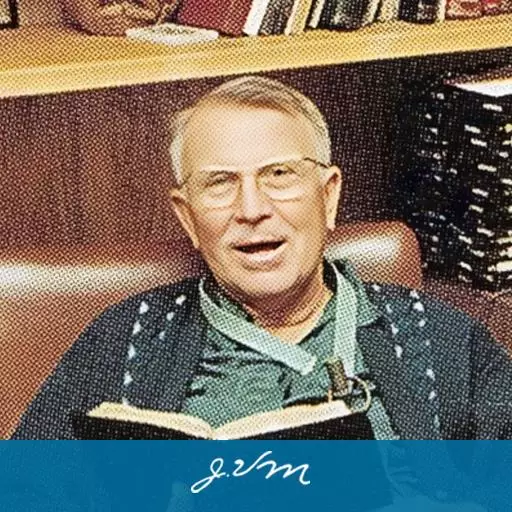
Questions & Answers 3080


1) Why does it seem that your view of psychologists is not very high? What about Christian psychologists?
2) Explain the meaning of "for his name's sake" in Psalm 23:3?
3) Dr. McGee discusses the issue of marriage as taught in 1 Corinthians 7:14-16.
4) Is there a contradiction between Genesis 46:34 and 47:3?
5) What does it mean to grow in grace?
6) How do you explain someone who says they are going to heaven but does not believe in a literal hell?
Guest (Male): Scripture tells us that we are to grow in grace. So what is that mean? And how do you grow in grace? Well, stay with us and find out.
Guest (Male): You're listening to the question and answer program with our Bible teacher Dr. J. Vernon McGee. This is a ministry of the Through the Bible Radio Network. Now our first question today comes from a listener in Houston, Texas who writes about a Christian psychologist. He then asks, why does it seem that your viewpoint of psychologists is not very high? What about the many Christian psychologists?
Dr. J. Vernon McGee: Let me say that I make a blanket statement every now and then that I do not trust psychologists entirely. And I certainly do not trust godless psychologists, but I do trust a great many Christian psychologists and they have made, I believe, a very rich contribution to the ministry today of counseling and of helping those that are in need. And especially if it's mental and if it 's mental that probably needs the services of a professional. It's just like when you break your arm why you want to go to a doctor that knows how to put your arm back together again and to help you.
The same thing would be true if you got a mental quirk. And many of us have those mental quirks. And it be well to go to a man who understood this. And I don't not think that the field of psychology is fully developed today. It's in one sense more or less of a new subject. In college, my second major was psychology. And I was offered at the time of my graduation a scholarship to go to the University of Chicago and work on a doctor's degree and become a psychiatrist or psychologist. And I turned that down because I felt at that time that there were so many shortcomings.
That is, there were so many ways that the psychologist was totally helpless in the presence of certain cases. And then I went to a school that did not put the emphasis upon the things that are Christian. And I discovered that there were Christian psychologists and that some of them were doing a great deal of good. And the one that you mentioned is one of these that does a great deal of good. But there is certain limitation and I feel that most of the problems that are mental problems, that is, unless it's due to that which is not functional, I think that the spiritual can help every functional malady in the mind.
But there of course are certain things that are not functional. It's due to some structural basis of the mind and that sort of thing. And that's the one that I think needs expert attention. You need to go certainly to a reliable one and I'd recommend a Christian one. But I do feel for that emphasis that is spiritual today that the word of God should be brought in and used today. I think that the best pill that you can take is the gospel by the way. And certainly this is a case where it's certainly needed today.
So when I make a blanket statement every now and then, which I do, and I do want to make them aware of the danger of the psychologist, that is the non-Christian psychologist, that he is is not very helpful. And there's a danger of believing that psychology is the answer to all of the quirks. And it's like the Baptist deacon he prayed. He said, Lord, make me right the first time cuz you know I never changed my mind. And I have certainly changed my mind in reference to the Christian psychologist that there are many of them that I consider good.
Guest (Male): Our next question comes to us from a listener in Cincinnati, Ohio. He says, could you please explain the meaning of for his name's sake as found in Psalm chapter 23 verse 3?
Dr. J. Vernon McGee: May I say to you that the whole thought here, and I think it's very important to note it, is that everything in a Christian's life should be for the glory of God. The catechism has it accurately. What is the chief end of man? And the answer is the chief end of man is to glorify God and enjoy him forever. And you're not going to enjoy him until you glorify him. And he wants to lead us in paths of righteousness for his name's sake. And his name's sake it's quite possible for a Christian to disgrace the name of God.
That's exactly what David did. God says that you have caused the heathen to blaspheme my name. And that exactly what happened. And there great many Christians today that feel like that they can enjoy God and God wants us to have a good time. And I believe that by the way that God does. But you see the way the psalmist puts it here is that we are walk in the paths of righteousness because it's for his name's sake. And he leads us in the paths of righteousness so we won't disgrace him. And if we going to disgrace him, we're not going to be able to enjoy him.
Therefore, the chief end of man is to glorify God. And that is exactly what that verse means. We to glorify God and then we can enjoy him forever frivolity that is getting in fundamentalism today. And some want to hold me responsible for part of it that I have introduced the jokes into the pulpit. Well, maybe I have, but I certainly move into that which is serious. And certainly that which is serious should be treated that way. And we can enjoy God unless we're going to glorify him. And that is what the psalmist is trying to tell us.
You touched a very sensitive point, I think, today that we are forgetting about glorifying God. He wants to lead us in the paths of righteousness for his name's sake. He wanted to lead David that way and David broke the seventh commandment and the sixth commandment. He committed adultery. He committed murder. And he disgraced God's name. He caused heathen to blaspheme. And David never had any fun after that, friends. Read the 32nd Psalm and 62nd Psalm. Read some of the Psalms that David wrote where you hear him crying out. His soul is crying out to God.
And that's the revelation of a man that had disgraced God. Today we are looking lightly upon sin. The world does. We expect them to. I'm not disturbed that they want to get rid of the marriage ceremony. It's God's marriage ceremony. They want to do their thing. They want to live it up. They want to do it their way. Isaiah said, every man is turned to his own way, his own way. That's man's problem. He wants to have his own way and not God's way. And today you can live in sin, have sin in your life that's unconfessed, and have joy and the peace of God in your life, friends.
Let's face up to it. The minute I see a person in the name of Christ that's in sin, that calls himself a Christian and is having a big time, a high old time, I know right away we're not dealing with a man that's a Christian because a Christian can't do that and get by with it. God won't let him get by with it, friends. So it's well to consider this question. My I'm tremendously impressed when I get a question like that.
Guest (Male): We come now to a question from a listener in Edwardsville, Pennsylvania. She writes, would you please explain 1 Corinthians chapter 7 verse 15? The idea of a believer being able to remarry after an unbelieving spouse leaves seems to contradict the teachings of Jesus. I am also confused by verses 14 and 16. How does a believer sanctify an unbelieving spouse?
Dr. J. Vernon McGee: Well, this is one of the passages of Scripture that there is some debate about many different interpretations by the way here. And I'll turn now and read this and I'll read all three verses since you've mentioned them, verses 14, 15 and 16 of 1 Corinthians 7. I'm reading now. It says, for the unbelieving husband is sanctified by the wife and the unbelieving wife is sanctified by the husband. Elsewhere your children unclean, but now are they holy. All that he's saying there is that if an unbeliever marries a believer or a believer marries an unbeliever, which he should not do, but if he does that, that does not in any way make the children illegitimate at all.
The marriage still holds and there's no question about that. You see in Paul's day he was faced with the problem that when he came to Corinth and preached the gospel sometimes it would be a wife who would accept Christ and sometimes it'd be a husband in a family. And that presented a problem. Should the unbeliever join to a believer? Are the unbeliever that's become a believer? Should he stay on with the unbeliever? And Paul's answer is yes. The thing is the marriage still stands. The children are legitimate children and you should attempt to make a go of it.
That's exactly what he's saying. But if the unbelieving depart, let him depart. Now if the unbeliever says, look, I don't care about this Christian stuff. I'm tired of it and I'm tired of you talking to me about accepting Christ, so I'm moving out. I'm leaving. Well, let him depart. Nothing you can do about that. I know they have seminars today that solve these problems that poor Paul couldn't solve, but let me say to you Paul says you can't solve them, let him depart. And I take it that Paul knows more than some of these young seminarians that are telling us otherwise.
I think we better get back to Paul. Now will you notice he says, but if the unbelieving depart, let him depart. A brother or sister's not under bondage in such cases, but God has called us to peace. And there are some who believe that that is grounds for divorce, that when the unbeliever has left, has deserted, generally it means deserted the individual, the wife for uh another woman or it's a woman for another man. So that to me that would furnish a grounds for divorce. But I do want to say that there are many fine men today, probably much better exponents of the word of God than I am.
There is a new book out called The Myth of Divorce. And the position of this young man is that divorce is not permissible on any ground whatsoever. Well, I personally could not accept that myself because I think there are grounds for divorce. And to me this is probably one of them. But even in this case I would never accept the word for anyone. I would have to know the case personally before I would even touch it with a 10-ft pole. Now let me read verse 16. For what knowest thou, O wife, whether thou shalt save thy husband?
Or how knowest thou, O man, whether thou wilt save thy wife? So you see Paul is saying, if the unbeliever doesn't depart, don't you depart. You stick it out and try to win that person for Christ. Now that's all that Paul is saying here. And to try to read in something else is to me well, it's just not scriptural at all. And I would feel that today that this should be handled very carefully. I know that in my own ministry I would never outside of the church I don't care who it was or what they said, how long they'd been deserted or anything like that.
I would not have any part in the marriage because my feeling was that you better know these instances and know these are legitimate grounds for the statement that's being made that they have been deserted. So I recognize that this will stir up quite a bit of comment, but very frankly, this is a passage of Scripture that I feel like today that is not as clear to us as it should be. Paul writing in the context of that day I can see the situation then, but it's difficult for me to put the present day situation in the context of that language without coming to the conclusion that there are grounds for divorce.
And then that would raise the question, would the person be able to marry again? And that's another question altogether.
Guest (Male): Upon Ionia, Michigan listener sent us this question. I'm confused with two verses in Genesis. In chapter 46 verse 34 Joseph tells his brothers that they are to explain to the Pharaoh that their occupation is with cattle because being a shepherd is an abomination to the Egyptians. Yet in chapter 47 verse 3 the brothers tell Pharaoh they're shepherds. Can you help me with this?
Dr. J. Vernon McGee: And that of course presents a problem, but I think one that's easily solved. The two verses are actually right together to tell the truth. The 34th verse of the 46th chapter is the last verse of chapter 46. And so in chapter 47 why we come down to verse 3. Now let me read these two verses. Now it is Joseph instructing his brothers what to do and what to say when they come into the court of Pharaoh. We're told now in verse 3 of chapter 47 and Pharaoh said to his brethren, what's your occupation? And they said under Pharaoh, thy servants are shepherds, both we and also our fathers.
Now there are two I think satisfactory explanations for that. First of all I think that the display of the glory of the Pharaoh so startled these young men that they couldn't follow their instructions. They just had to blurt out what they felt was the truth. And they told the truth that they were shepherds and did not follow the instructions of their brother. That is one explanation. The other explanation is simply that when they got into the presence of Pharaoh they felt so comfortable and that Joseph had probably underestimated his influence in the court of Pharaoh.
And actually Pharaoh was willing to accept these brethren even if they were shepherds. And that I think after the appearance of the brethren there and when he got around to asking them what's your occupation, that would be a normal thing why they just came right out with it because there would be no danger in that. By this time they could see that they had a real welcome at the court. Either one of those explanations would be satisfactory, but I've thought of the other side of the coin. I can't imagine 11 of these boys who been out with sheep and been shepherds.
They just didn't have an opportunity to send their suits to the dry cleaners. And I think they smell like sheep to tell the truth. And I think that would have kept them from saying what Joseph wanted them to say. And this reveals by the way that Joseph was not perfect. Joseph is probably the finest type of the Lord Jesus Christ that we have in the Old Testament. But after all he is a human being, has the same nature that you and I have, a fallen human nature. And that they responded in the way that they did probably out of natural fear.
I've always felt that was probably it. They were just so overwhelmed by the glory of this kingdom. That to me would be the explanation of it, but I mentioned the other and suggest rather facetiously that they smell like shepherds. And I'm sure that 11 of them coming in there and that's how many brethren there were, it would be quite obvious what they were. So they did not need to use that as an excuse. May I revert back to saying that Joseph being one of the finest types of Christ and it's certainly here when the Lord Jesus was called before the officials of his day, he did not dissemble at all.
When they asked him, are you the Christ? He said, thou sayest. And thou sayest is an expression which means you said it. That's right. That's who I am.
Guest (Male): Let's now turn our attention to this question from a listener in Camden, New Jersey who writes, could you please explain what it means to grow in grace?
Dr. J. Vernon McGee: Well, over in 2 Peter he is concluding here. And he says in 2 Peter 3 18, but grow in grace and in the knowledge of our Lord and Savior Jesus Christ. To him be glory both now and forever. Amen. Well, a very interesting thing is that Peter makes it very clear how you're to grow in grace and in the knowledge of Christ. If you go back to his first epistle in 1 Peter the second chapter second verse he says, as newborn babes desire the sincere milk of the word that ye may grow thereby. And so he is saying here, if you're babe in Christ, you want to grow in grace, the way that you to grow in grace is to desire the sincere milk of the word of God.
And he says, if so be ye have trusted that the Lord is gracious. That is, if you have been saved, you know that you've been saved by the grace of God. Now you want to grow in that grace. There's not but one way. And that's to study the word of God. Paul told the young preacher, study to show thyself approved under God. A workman needeth not to be ashamed rightly dividing the word of truth. And he's made it very clear that's I think a very simple explanation. And the explanation that is so obvious. Now I know that if you take a baby and start giving that baby milk the baby will grow.
I don't pretend to tell you just how the baby grows. I just know he grows. And I do know that if you give the ones that are just converted, the word of God, I hear so many people say, well, when I was first saved I began to study going through the Bible with you and I've been growing as a Christian. Well, I don't pretend to explain how they do it. I just say that if you study the word of God, take it in like a little baby takes in the milk, well, you going to grow.
And it's just as simple as that.
Guest (Male): Our final question today comes from a listener in Mount Dora, Florida. She writes, what about those who believe they are going to heaven but don't believe in the existence of a literal hell?
Dr. J. Vernon McGee: Well, it would certainly be ironical, wouldn't it, if a person said, I don't believe in hell, but I believe in heaven and they wound up in hell. That would be certainly a very almost ridiculous situation. But the important thing I think to note is that actually hell makes sense, but heaven does not make sense. And this is what I mean that everyone is agreeing now that the criminals should be put in prison and should be punished. That is the viewpoint apparently of the majority of the people in this country that we need to have capital punishment reinstated.
But in our state we've had difficulty getting a governor that would even enforce the law. But I tell you many people had loved ones murdered and there's much of that taken place. I think that capital punishment should be enforced. Now it makes sense to have jails. It makes sense to punish criminals. But suppose that every criminal that came up they'd say, well, we're not going to put you in jail, but we're going to give you a lovely bungalow to live in over in Hawaii. That just wouldn't make sense at all. But that's what the Bible teaches.
The Bible teaches that there's a place called heaven and sinners who are worthy of death and worthy of punishment are forgiven their sins and they're going to a wonderful place. May I say to you heaven doesn't make sense, does it? But it's a reality and thank God for that. But hell makes sense, friends. A place of punishment you might think of it from that direction by the way. And of course the Scripture is very clear in this connection. And for the Christian the Scripture is the final authority. And if that person is a Christian he has to believe that there's a hell.
If he doesn't, he's not a Christian because of the fact Christians one who believes the Bible and one who's trusted the Lord Jesus Christ as his personal Savior, has faith in him, trusted him, and therefore saved on that particular basis. Therefore ye believe what the word of God says.
Guest (Male): And so with that answer we come to the close of another question and answer program. If you like more information on any of the issues that we've mentioned today or for that matter any issue that you'd like to know more about, you can request our resource catalog when you call us anytime. And when you do call be sure to leave your name, address, and the call letters of the station. Now if you'd like to receive a copy of today's program on CD, it can be purchased when you contact our offices. This week we'll continue Dr.
McGee's five-year journey through the whole word of God. And we hope that you'll join us on the Through the Bible Radio program heard every Monday through Friday on this station. So for notes and outlines, CDs, or our catalog be sure to contact us by calling 1 800 65 Bible. Do that Monday through Thursday from 6 a.m. to 3 p.m. Pacific time or by writing to questions and answers in the US box 7100 Pasadena, California 91109 in Canada box 25 325 London, Ontario N6C 6B1. When you visit our website at ttb.org you'll be able to view our online bookstore, download the audio or access our Facebook and Twitter pages.
Now until this time next week we hope and pray that our God will answer all your questions and solve all your problems.
Guest (Male): This program's been brought to you by the faithful friends and supporters of the Worldwide Ministry of Through the Bible Radio Network.
Featured Offer


Featured Offer
About Thru the Bible - Questions & Answers
Questions and Answers offers Dr. J. Vernon McGee's signature wit and wisdom in answering Bible questions sent to him by radio listeners throughout his years of ministry.
Other Thru the Bible Programs:
Thru the Bible - Minute with McGee
Thru the Bible - Sunday Sermon
About Dr. J. Vernon McGee
John Vernon McGeewas born in Hillsboro, Texas, in 1904. Dr. McGee remarked, "When I was born and the doctor gave me the customary whack, my mother said that I let out a yell that could be heard on all four borders of Texas!" His Creator well knew that he would need a powerful voice to deliver a powerful message.
After completing his education (including a Th.M. and Th.D. from Dallas Theological Seminary), he and his wife came west, settling in Pasadena, California. Dr. McGee's greatest pastorate was at the historic Church of the Open Door in downtown Los Angeles, where he served from 1949 to 1970.
He began teaching Thru the Bible in 1967. After retiring from the pastorate, he set up radio headquarters in Pasadena, and the radio ministry expanded rapidly. Listeners never seem to tire of Dr. J. Vernon McGee's unique brand of rubber-meets-the-road teaching, or his passion for teaching the whole Word of God.
On the morning of December 1, 1988, Dr. McGee fell asleep in his chair and quietly passed into the presence of his Savior.
Contact Thru the Bible - Questions & Answers with Dr. J. Vernon McGee
info@ttb.org
https://ttb.org/
Mailing Address
Thru the Bible, Inc.
P.O. Box 7100
Pasadena, CA 91109
In Canada:
Box 25325,
London, Ontario
N6C 6B1
Phone Number
(626) 795-4145 or
(800) 65-BIBLE (24253)