

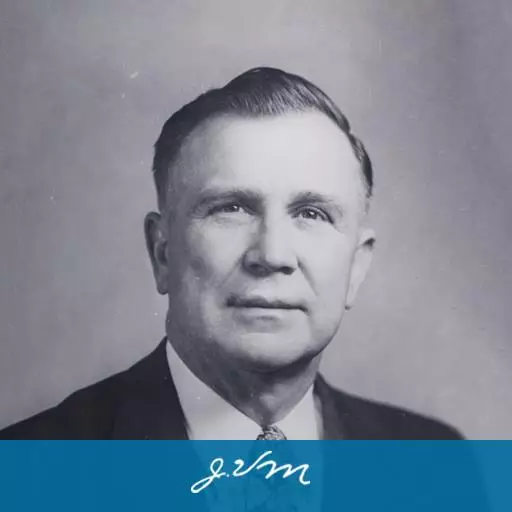
What is Doctrine?


“Doctrine” may sound like a big, churchy word—but its meaning is simple and deeply important. It just means "teaching." Dr. McGee shows why what we believe about God shapes everything—how we live, how we hope, and how we walk with Him each day.
Dr. J. Vernon McGee: A foundation he saints of the Lord is laid for your faith in his excellent word. Is the Bible simply a collection of 66 ancient writings placed side-by-side or is it something far more, a beautifully woven story where every book connects to the next and every truth points us to Jesus. Welcome to the Sunday Sermon on Through the Bible. I'm your host Steve Schwetz and in this message our teacher Dr. J. Vernon McGee gives us a strong foundation for celebrating the most extraordinary event in history.
Dr. J. Vernon McGee: We're letting God's truth wash over us today. That truth brings hope, clarity and grace as we explore the question, what is doctrine? That also happens to be the title of Dr. McGee's message. And don't let the word doctrine scare you off. As Dr. McGee reminds us, doctrine simply means teaching. God revealing who he is, what he has done, and how he calls us to live.
Dr. J. Vernon McGee: So whether you've been on the Bible bus for years or you just joined us, you'll appreciate this clear and helpful review. Before we get started though, we've got just enough time for a powerful note from Anna, a listener to our Turkish studies. She writes this. After hearing your teachings, I have sought the creator with all my heart without prejudice. For the past year, I prayed five times a day, made up my missed prayers, read the Quran and fasted. But Jesus Christ found me. Jesus Christ is the only way, truth and life. I will now be purposeful and steadfast in listening and learning. I want to know everything about him.
Dr. J. Vernon McGee: Well, isn't that amazing? What a savior we serve. And what about you? What is it about God's word that keeps you coming back each day? And if you've been a long-time traveler on the Bible bus, what would you say to a new listener to encourage them to stick with it for the whole journey? Well, you know, we'd love to hear it. You can send your note through our app, you can email Bible bus@ttb.org or write to Box 7100, Pasadena, California 91109. In Canada, Box 25325, London, Ontario, N6C 6B1. And you can even leave us a voicemail at 1-800-65 Bible. It would be so great to hear your story in your own voice. Let's pray.
Dr. J. Vernon McGee: Father in heaven, thank you for this precious time in your word. Would you help us to see you more clearly and know you more deeply and then teach us and guide us and draw our hearts closer to you. In Jesus name we pray. Amen.
Dr. J. Vernon McGee: Now, here's the Sunday Sermon on Through the Bible with Dr. J. Vernon McGee. If you will turn with us in Deuteronomy 32, you have the song of Moses that he gave the children of Israel before his death. And he begins it, Give ear, oh ye heaven, and I will speak and hear, oh earth, the words of my mouth.
Dr. J. Vernon McGee: My doctrine shall drop as the rain. My speech shall distill as the Jew, as the small rain upon the tender herb and as the showers upon the grass. Now, Moses talked about his doctrine that he was going to give the children of Israel doctrines. And over in Proverbs, the fourth chapter, the second verse, it says, For I give you good doctrine.
Dr. J. Vernon McGee: And then when we turn to the New Testament, Paul says in Titus 2:1, but speak thou the things that become sound doctrine. That is, if you're going to be a minister and stand in the pulpit, then you are to rest upon the word of God. That should be your authority and the basis of what you have to say.
Dr. J. Vernon McGee: Now this word doctrine, what does it really mean? Well, I want to show off a little now. That's a Greek word, didaskalia. It means just teaching. Actually, that's all that it means. Teaching. And the the word doctrine and doctor come from the same stem if you please. Actually, a doctor primarily and originally had nothing to do with healing the human body.
Dr. J. Vernon McGee: He was a teacher so that I think really a minister has a better claim to the title doctor, maybe than than the medical doctor has because the original doctor had nothing to do with healing the body. He attempted to improve the brain, not the body. And he was a teacher primarily. And this word doctrine means teaching. That's all in the world that it means. Basically, it means that.
Dr. J. Vernon McGee: Now, there is a a great importance attached to doctrine, the teaching in the scripture. I could turn up an abundance of scriptures here, but I'm merely picking certain ones. And I would like to take Second John, verse 9. Second John, verse 9. Whoso transgresseth and abideth not in the doctrine of Christ, hath not God. He that abideth in the doctrine of Christ, he hath both the Father and the Son.
Dr. J. Vernon McGee: Teaching, you see. Now John went so far, and he apparently wrote his epistles, even after he wrote the book of Revelation, when he wrote this epistle here, it was almost, well, it was about 100 AD. He was about 100 years old. And he's very adamant here, dogmatic. He says that if you do not have the doctrine of Christ, then he says you are not one of his.
Dr. J. Vernon McGee: And if you have the doctrine of Christ, you have both the Father and the Son. And then at the very beginning, we're told at the on the day of Pentecost, when 3,000 were baptized and were brought into the church, we're told, and they continued in the apostle's doctrine, in prayers, in breaking of bread, and in fellowship. Those were the four things they continued in. So that that was the mark of the early church was the apostle's doctrine, their teaching.
Dr. J. Vernon McGee: It was something that was very, very important. Now, doctrine will lead to action, always. You remember the Lord Jesus said this, If any man will do his will, he'll know the doctrine, the teaching, whether it's of God or not. The difficulty today is, it's so easy to deny and to criticize and find fault with the Bible and say, I don't believe that.
Dr. J. Vernon McGee: But God puts down a challenge to you. God says the only way that you can know this is true is by testing it. That's the only way. God says, You pour it into the test tube of your life. And you'll know whether this doctrine that I'm giving you is true or not. That, my friend, is the real test of Christianity, the real test of anything for that matter, will it work?
Dr. J. Vernon McGee: Is this something that will work? Someone has put it like this, doctrine without beauty is a tree without fruit. Beauty without doctrine is a tree without root. You have to have right doctrine before you can have right action. And if you have right doctrine, you're going to have right action. You have to think right before you can act right.
Dr. Vernon McGee: This business today when you hear people say, it doesn't make any difference what you believe, just so you act right. You start thinking about turning off on the left side of the highway or the right side. And you set your blinkers to turn off on the right side, then all of a sudden you do a left. May I say to you, friend, you'll find out that you've got to act like you think.
Dr. Vernon McGee: Are you in for trouble? You you've got to you can't think one thing and do another. You've got to think right if you're going to act right. Doctrine is very important. The teaching is very important. Now if you looked up Webster, you found out that doctrine means principles in any branch of knowledge. And as far as the word of God is concerned, it's the systematic and scientific arrangement of biblical truth under their different subjects.
Dr. Vernon McGee: It's to see what the word of God has to say in a systematic way on any subject. Now, we find Paul saying all scripture is given by inspiration of God and its profitable for doctrine. That's the first thing he mentions. I'd like to give you the the amplified translation of that because there's been so much that has been said about Second Timothy 3:16.
Dr. Vernon McGee: And this I think is about the best translation I've come across. Every scripture is God breathed, given by inspiration and profitable for instruction, for reproof and conviction of sin, for correction of error and discipline and obedience, and for training in righteousness. That is, in holy living in conformity to God's will in thought, purpose and action. That's my I think rather exhausts the meaning of this verse.
Dr. Vernon McGee: Here, this is the thing, the word of God is profitable for doctrine, for organize these great subjects that we have. Now, therefore, doctrine is the arrangement of biblical truth. Now, that brings us, I think now, to our all-important subject for this evening. That was merely preliminary. We come now to the Bible. And we want tonight to talk a little about the Bible.
Dr. Vernon McGee: The first thing I'd like for you to notice is, the Greek word is ho biblos. And it means the book. That's all. Biblos means book. But the early church always put on the scrolls ho biblos, the book. And when they said the book, the is an adjective, ho biblos. It's an adjective. It separated it from all other books.
Dr. Vernon McGee: That it was different from every other book. That should be books, but this is the book. When Walter Scott was dying, he said to his secretary, he said to the young man, he says, Bring me the books. And his secretary looked up at the shelf of all the writings of of Scott. And he said, well, which one of them? Oh, Scott shook his head, he says, when a man's dying, there's only one book.
Dr. Vernon McGee: That's the book, the Bible. And he brought it to him. The early church separated the word of God from all other writings and kept it separate. They called it the book. Now, the book is actually 66 books. And it's interesting how you can remember how they're divided. There are 39 in the Old Testament. Always begin with the Trinity, multiply 3x3 and you get 9, that's 39.
Dr. Vernon McGee: And then you multiply 9x3 and you get 27. And that's the number of books in the New Testament. And you add them up, I think you get 66. It's made up of 66 books. Now, I never did learn the books of the Bible until I went to seminary. And as a result, I forget them from time to time. Maybe you have trouble remembering the books of the Bible.
Dr. Vernon McGee: I'd like to that's a good drawing because it's my hand and if there's anything wrong with it, something's wrong with my hand. And that one I drew, there's nothing wrong with it, but this one, I can't go out tonight and shake hands. I hurt it this week and I can't shake hands. So, I if you'll excuse me for going out in front this evening.
Dr. Vernon McGee: I I don't want to use it to shake hands. But this is my left hand that I just turned over here and I drew it. Now this is putting the Bible on one hand. Now the way you do it, you put the Old Testament on your fingertips. And you put the New Testament down in the valley like this. This is the way I mean. There are five books here that are called the Pentateuch, the five books of Moses.
Dr. Vernon McGee: Then you have 12 historical books, you have five poetical books, and then to get the 12 again, you take the 12 minor prophets, and then you have the five major prophets. Now, that's the way. And that's the way I learned the books of the Bible. I used to walk around the seminary grounds with my hand in my pocket and I'd put it out and I'd say, What's that?
Dr. Vernon McGee: And then I'd answer, you know. And that's the way I remember the books of the Bible to this good day. Let's see if we can go through the Old Testament like that. You may have to help me. Pentateuch. Genesis, Exodus, Leviticus, Numbers, Deuteronomy. That's the sum. Remember that. That's the Pentateuch. Five books. 12 historical books. Joshua, Judges, Ruth, First, Second Samuel, First, Second Kings, First, Second Chronicles, Ezra, Nehemiah, Esther.
Dr. Vernon McGee: Is that right? All right, 12 books there. That's the historical books of the Old Testament. Five poetical books of the Old Testament. Job, Psalms, Proverbs. But it's helping me. All right, if you want to, Ecclesiastes, Song of Solomon. All right. Now here, we come to the 12 minor prophets. Hosea, Joel, Amos, Obadiah, Jonah, Micah, Nahum, Habakkuk, Zephaniah, Haggai, Zechariah, Malachi.
Dr. Vernon McGee: Is that right? Fine. Now the major prophets. They really ought to go first, but you don't get 5, 12, 5, 12, unless you put them around like this. So we have here the major prophets. And you begin with Isaiah, Jeremiah, Lamentations, Ezekiel, Daniel. We got the Old Testament on our fingertips. So you can remember it like that.
Dr. Vernon McGee: You just carry it around with you, ever and on then, I say, what's that? Now, let's put the New Testament down in the valley. You have four gospels, one historical book, 21 epistles, and one prophetic book of the New Testament. That's down in the valley. Now will you look at that? Gospels, Matthew, Mark, Luke, and John. One historical book in the New Testament, the book of Acts.
Dr. Vernon McGee: Make it very important. Now the epistles, here. The preacher says the epistles are the wires of the apostles. So, let's put them down here, only we've got 21 of them. Now, we start off with Romans. First, Second Corinthians, Galatians, Ephesians, Philippians, Colossians, First, Second Thessalonians. Where do I go to from here?
Dr. Vernon McGee: First, Second Timothy, Titus, and Philemon. Then we take up the general epistles. Hebrews, James, First, Second Peter, First, Second, Third John, Jude. Oh, I'm glad to get those 21 out of the way. Now, one prophetic book of the New Testament, that's the book of the Revelation. You've got the whole Bible on one hand. You can never forget it.
Dr. Vernon McGee: If you get it down like that and learn to go right down the list. That's the way I learned the books of the Bible and I learned them after I got to seminary and I didn't even know the books of the Bible. I was invited one night when I was first in seminary, one of the fellows at the table, he said, kidding another one, I bet you never read the 15th chapter of Hezekiah.
Dr. Vernon McGee: Uh, this boy says, you can't fool me. The book of Hezekiah doesn't have 15 chapters. And everybody laughed again, and I laughed again. And so when I got back to my room, I got my Bible to find out how many chapters the book of Hezekiah has. Never have found how many chapters it has, but I did find out that I needed to know the books of the Bible.
Dr. Vernon McGee: And that's when I began, and and we started out putting them on one hand. Now the books of the Bible, uh, these 66 books written over a period of about 1500 years by about 45 different authors. They're a marvelous unity of their writings. How did these books get into the Bible? That's always been a big question. That's called the canon of scripture.
Dr. Vernon McGee: Canon is a Latin word meaning rule or measurement. Actually, parable would be the Greek word. Something put down the measure of books that was put in the Bible. Well, let's look at it like this because of the fact that the the Old Testament. Now, this is interesting to know because the Knights of Columbus have been running uh uh display ads in newspapers saying that the church was the one that kept the books of the Bible together.
Dr. Vernon McGee: And that the church is the authority and not the Bible. May I say that the church never did put the books of the Bible together. Not even the New Testament, but they had nothing in the world to do with the Old Testament. The Old Testament canon of scripture came together during the captivity. What actually happened, Moses wrote the first five books in the Bible.
Dr. Vernon McGee: I think you can sustain that easily today. And I wish that when Bishop Pike comes out with something like he did that the Garden of Eden is a myth and the virgin birth of Christ is not true. He'd he'd get some new arguments. Those arguments he gave were the Graf-Wellhausen hypothesis, and also the Tübingen hypothesis. And both of them are over 100 years old, and I refuse today to call that modernism.
Dr. Vernon McGee: That's old-ism. And I mean it's old-ism. Uh, it's as old as the hills. It's all been answered now, and he apparently is only reading on one side of the fence. These liberals today never read but one side of the question, and yet they are the ones that are talking about being broad-minded today. I think we can sustain the thesis that those have all been answered uh today.
Dr. Vernon McGee: Those questions that were raised by the German higher critical scholars a couple hundred years ago and been added to for a hundred years. And it has caused conservative scholars to do a great deal of research and study, but they do have an answer. Now, Moses wrote the first five books in the Bible. Then Joshua wrote, and it's called a hexateuch, with a roll, a scroll.
Dr. Vernon McGee: And these books were added to the scroll. And when you come to the time of Samuel, Samuel did a great deal in writing and collecting. And then Ezra, during the time of the captivity, gathered together the books of the Bible. By the time of the death of Ezra, you have the Old Testament complete. And the church had nothing in the world to do with that.
Dr. Vernon McGee: May I say to you that I have never tried to sustain the thesis that the arrangement of the books of the Bible was inspired. But I do insist that the putting of certain books in the Bible was inspired by the Holy Spirit and certain books were left out. Now, to show that the Roman Catholic Church had nothing to do with the canon of scripture, there are certain books called apocryphal books that are excluded.
Dr. Vernon McGee: They are in the Roman Catholic Bible, they are not in our Bible today. So the Roman Catholic Church had nothing to do with the arranging of our Bible at all. That is false propaganda in the advertising that the Knights of Columbus are putting out. I think somebody ought to say that today because a great many people are gullible and taken in. Well, you see, the Roman Catholic Church put the Bible together.
Dr. Vernon McGee: They did not put the Bible together, had nothing to do with it. Now when you come to the New Testament, by the end of the first century, all the books of the New Testament had been written. These books were circulating in the church at that time. And these books were uh gradually assembled. And may I say, that gradual assembling of those books was superintended by the Holy Spirit.
Dr. Vernon McGee: And by the time you get to the fourth century, the New Testament is intact and certain books are already excluded. That's the Romanism today. For instance, you will never find anything about purgatory in the New Testament. You ask them where they get it? Well, they get it in one of the books that has been excluded, you see. It's not in the New Testament as we have it at all.
Dr. Vernon McGee: So that they have nothing to do with the arranging of either the Old or the New Testament. That church, which was neither Protestant nor Roman Catholic, nor does it bear any resemblance to any church today, even the church of the Open Door. That early church is the one, under the guidance of the Holy Spirit, these books came together.
Dr. Vernon McGee: May I say that the and you can read the apocryphal books today. And you can read the books of the word of God. You can see the difference immediately. So that when we come to the fourth century, why we have the canon of scripture as we have it today. And we have 66 books that we can have confidence in. Now, I want you to notice tonight four words.
Dr. Vernon McGee: And these four words we're going to talk about tonight and next time. The word that uh the four words are these. Revelation and forget the book of Revelation, for we're not talking about it at all. Revelation, inspiration, illumination, preservation. We need to know the meaning of these words. We need to know the difference in these words because this is where there's so much confusion and this is where the critic today gets in his little blow because people don't know how to make the distinction between revelation, inspiration, illumination, preservation.
Dr. Vernon McGee: Now let me give briefly, just a uh a word or two concerning the meaning of each one of these. Revelation means God hath spoken. That's all it means. Revelation means God hath spoken. That's all. Inspiration guarantees what God is saying. That it is reliable, that it's accurate, that it's without error.
Dr. Vernon McGee: Illumination means that if you are to understand God's revelation, you must have the Holy Spirit to teach you. He alone can illuminate the mind of man to understand it. Now that's the reason that Bishop Pike, and I say these tonight kindly. That Bishop Pike said that the book of Genesis contains myths and the creation story is a myth.
Dr. Vernon McGee: Now I don't expect him. If he had said, he believed the creation story and then it said he denied the virgin birth of Christ. It would have thrown me, really, it would have thrown me into turmoil because I'd have said, why, he's contradicting the Bible. I'm told that the natural man will receive not the things of the spirit of God. They're foolishness unto him, neither can he know them, they're spiritually discerned.
Dr. Vernon McGee: Now, he can learn the history of the Bible and he can learn a great deal about the facts that are in the Bible, and he can appreciate the poetry of the Bible, but you cannot understand its spiritual truth. The only way is by illumination of the Holy Spirit. Preservation is God uh so watching over his word that today he has preserved and it has come down to us.
Dr. Vernon McGee: And we today can know that it is the word of God. That is what preservation means. God has preserved the word of God. Now, I want you to notice these four words and we're going to talk about them. I want to talk about Revelation first tonight. Revelation. That means God has spoken. It means God has revealed himself.
Dr. Vernon McGee: First of all, let me say this, that intelligent creatures always communicate with each other. That's always been true. They have some way of expressing themselves. And apparently, even the animal world does. But it's not an intelligent method of communication. Intelligent creatures find some intelligent way to communicate. It would be a strange thing indeed that man, to whom God has given a certain amount of intelligence, may be very little, and I think very little.
Dr. Vernon McGee: But nevertheless, he's given man a certain amount of intelligence. It would be strange indeed if the creator, the God of this universe, had not revealed himself to man in some way. It would be exceedingly strange. As a matter of fact, turn that over in your mind for a little. You'd never, never expect a creator not to attempt to communicate with his creatures.
Dr. Vernon McGee: May I say that that is such an axiom that if tonight you and I had no revelation from God, I think we could sit right here tonight until God broke through and let us know something. But he'll not break through tonight, at least I don't think he will, unless it's time for the rapture. But I do know this, he'll not break through to reveal us anything because God has already spoken.
Dr. Vernon McGee: Now, he's spoken in two different ways. He's spoken in his natural creation. He's spoken in the cosmos. His natural uh creation. Uh the cosmos about. He has spoken in a supernatural way, and that is the Bible. Now, I want you to notice both of these tonight because God has spoken in both ways, and it's well for us to notice these two ways in which God has revealed himself to us.
Dr. Vernon McGee: He's spoken in a in a natural way. That is, he's spoken through creation. The Psalmist says in Psalm 19, verse 1, The heavens declare the glory of God, and the firmament showeth his handiwork. Day unto day uttereth speech, and night unto night showeth knowledge. Now, the the translation is this, There is no speech, there is no language, but their voice is heard.
Dr. Vernon McGee: Creation doesn't say a word. It doesn't speak Greek or Hebrew or English. It doesn't have an accent. But it's speaking to every creature on top side of God's universe. That's important. The heavens declare the glory of God. This is so important that when Paul began to show that man is a sinner and he doesn't never attempted to prove it, he just stated it.
Dr. Vernon McGee: But there would be someone that would say, well, after all, man started out with no knowledge of God. And after all, the story of man is it's stumbling around in the dark and it's seeking after God. The Bible says that's not true. Paul said, man had a revelation from God, so that he's absolutely without an excuse.
Dr. Vernon McGee: Really, tonight, creation ought to keep man on the track. He ought never to go into idolatry. He ought never to go aside and today, either worship a creature or become an atheist today, as many scientists have become. Why? Well, because of the fact that creation is speaking and saying something. Now, will you listen to him. Romans 1, verse 19, because that which may be known of God is manifest in them, for God hath showed it unto them.
Dr. Vernon McGee: For the invisible things of him from the creation of the world are clearly seen. Now, what is it that's so clear in creation? I think that tonight this universe is yelling its head off, telling man something. What is it telling man? Here is what it's telling man, just two things. Being understood by the things which are made, for the invisible things of him from the creation of the world are clearly seen, being understood by the things that are made, even his eternal power and Godhead, so that they are without excuse.
Dr. Vernon McGee: Now, creation says two things about God. It says, first of all, that back of creation there is a person. Back of the thing is a thinker. Back of phenomena is noumena, is spirit. Back of a creation, there is a creator. Everything's crying out and saying that today. They're without excuse. That's the first thing it says.
Dr. Vernon McGee: And the second thing that it says, that the God of this universe is a God of tremendous power. He has power. His his Godhead, his person, and his power. Those are the only two things you will find in nature. That's all. You won't find anything else. You don't find the love of God in nature. You don't find it there. You go up Yosemite, it's a beautiful spot.
Dr. Vernon McGee: Go to the top, walk up from the floor of the valley to the top. Get to the top of El Capitan and admire it and step off. You think that a God of love will stop you? Well, suppose somebody does it in the dark and didn't know. They're slaughtered just as much. Why? Because you won't find the love of God in nature.
Dr. Vernon McGee: Nature only says two things. It says, that is a God. And I think that this age that untied the little atom and found out that in the smallest thing that there is, there's tremendous power. I think this age will be more responsible to God than any other age. We found out that it's power. Power in creation.
Dr. Vernon McGee: A power they didn't dream of before. And you want to know something? I don't think they've even scratched the surface. I think there is a power resident in this little atom that they haven't even touched today. God's got a whole lot that he hasn't revealed yet. There's a great deal and he has not let man get a hold of. This tremendous universe.
Dr. Vernon McGee: We're going to talk about it in our morning series. How big is it? How far is it over yonder? And how far is it in this direction? How far can you go? Well, this radio telescope out here on the Mojave Desert says, there's no end to it. As far as man is concerned, there's no end. You can't even dream of an end to this universe.
Dr. Vernon McGee: You can't even imagine. What does this universe tell you? That back of this universe there's a creator with infinite power. That's what it's telling you. That's all it'll tell you. That's all it'll tell you. That's all. But when man knew God, they glorified him not as God. They were not thankful. They became vain in their imaginations. Foolish heart was darkened.
Dr. Vernon McGee: Professing themselves to be wise, they became fools. You know what God thinks today of the scientist? That's an atheist. The atheist may say, I don't think there's a God. Now God says, you're a fool. Now, I didn't say that, I'm too nice. God said it. God says, you're a fool. The minute you you are handling the things of this universe and you mean to tell me there's no God?
Dr. Vernon McGee: God says, you're a fool. They don't give degrees like that today, but they ought to in our universities, because a lot of men deserve it. God's given them that degree, professing themselves to be wise, they became fools. Change the glory of the uncorruptible God into an image made like to a corruptible man, to beast, four-footed beast, and creeping things. They went down and down.
Dr. Vernon McGee: That's the picture of man. And the average man, the average man's view of God today, you don't have to go to the the jungles of Africa. Go out here and ask him. Go out in your community and ask him, and he doesn't think much of God. Have you ever seen a beautiful image of God that the heathen made? Have you ever seen anything that was attractive-looking?
Dr. Vernon McGee: They've never thought of God as being attractive. And the average man's view of God today is that he's very unattractive. And may I say if you're a child of God tonight, you ought to be very careful as to whom you criticize and to whom you begin to whine and cry and complain and find fault. Because the unbelievers listen. You know what the word of God says?
Dr. Vernon McGee: God is good. Let the redeemed of the Lord say so. And if the redeemed of the Lord say so, nobody else is going to say so. The redeemed has to say so. God is good. But you you see when you go out in nature, you get a few points that really are a lot brighter to you. Now, let's come briefly, here, and I must stop. Supernatural.
Dr. Vernon McGee: We come to the word of God. And the question is, what about the Bible? Well, may I say to you that uh what saith the scripture? That's the important thing. And the Lord Jesus said, I've given them thy word. Now, will you notice the testimony of the word of God to itself. And I'd like for you to notice our verse again. This is our key verse.
Dr. Vernon McGee: It's Second Timothy 3:16. Every scripture is God breathed. Theopneustos. Pneustos means to breathe. Breath. Theos means God. All scripture is God breathed. Given by inspiration and it's profitable for instruction or doctrine, for reproof and conviction of sin, and so on. But it's God breathed. All scripture is God breathed.
Dr. Vernon McGee: Now, our American translation, unfortunately, gave a wrong translation. It says, every scripture that is inspired. But may I say that that is not the original, nor can you get that from the original at all. Now, I want you to notice another scripture tonight. And this is I think will be the only one we'll have opportunity to turn to.
Dr. Vernon McGee: If you will turn with us to Second Peter 1:21. Let me back up and read verse 20. Knowing this first, that no prophecy of the scripture is of any private interpretation. And that means you don't interpret it by itself. For the prophecy came not in old time by the will of man, but holy men of God spake as they were moved.
Dr. Vernon McGee: And that means they were carried along like a a sailing ship is carried along. They were carried along by the Holy Ghost. Now, that means that the Holy Spirit was the one that moved upon these men. Now, the Bible is a book that claims to be a revelation of God. In the Old Testament, 2,500 times, you find the statement, Thus saith the Lord, or a similar statement.
Dr. Vernon McGee: 2,500 times in the Old Testament. Thus saith the Lord. Now, you'll find that it also it's very specific. It says, for instance, in Numbers 1:1, and the Lord spake unto Moses. And then in Deuteronomy 31:9, and Moses wrote this law. And you find that Jeremiah. And if you have your Bible, turn there for just a moment.
Dr. Vernon McGee: I'd like to spend just a moment there with Jeremiah. This man was called to the prophetic office, actually unwillingly. He was called very young, and then when he got a little older, he wanted to resign and tried to resign. He'd even handed in his resignation to the Lord, and finally had to come back and say, Thy word was a fire within my bones, and when I tried to keep silent, I could not keep silent.
Dr. Vernon McGee: But now you listen to his call. Jeremiah 1:9. Then the Lord put forth his hand, and touched my mouth. And the Lord said unto me, Behold, I have put my words in thy mouth. Now, will you notice that? God says, I have put my words in thy mouth. We believe in what is known as the plenary verbal inspiration of the Bible.
Dr. Vernon McGee: We believe that the words are inspired, and wholly inspired if you please, that the words are inspired. Now, that's important because you and I are living in a day when there's some very tricky interpretations. Neo-orthodoxy today is a very tricky interpretation of inspiration. They they have said the same thing we say.
Dr. Vernon McGee: We believe that the words are inspired. But the thing they did, they went in and emasculated all of the words. They took the meaning out of the words, and they've made the words mean something else. Now, we believe that the words in this Bible are inspired. And when we say the words, we mean the original words. You someone says, well, you're beating around the bush.
Dr. Vernon McGee: We don't have the original words. May I say that I hold in my hand tonight, not the original words. I hold in my hand a translation. But this translation is a reputable translation and one tonight I can have full confidence in. And I can believe it regarding my salvation. And there is no question about any of the great doctrines of the scripture.
Dr. Vernon McGee: There's not a question about the great doctrines of the scripture. No one can argue about them. The word of God is clear to us today on the great doctrines of the word. We believe that in the plenary verbal inspiration of the scripture. Therefore, I say this ahead of time because of the fact that in the when you come to the New Testament, you find that the Lord Jesus Christ put his seal upon the Old Testament in one of the most remarkable ways.
Dr. Vernon McGee: And in closing, now let me turn to that, and I will close with this. Will you turn to the last chapter of the Gospel of Luke. The Lord Jesus was on had met these men on the Emmaus road. And you'll recall that when he made himself known unto them, he said this to them in verse 24 of chapter 24. And certain of them which were with us went to the sepulcher and found it even so as the women had said, but him they saw not.
Dr. Vernon McGee: Then he said unto them, O fools and slow of heart to believe all that the prophets have spoken. Ought not Christ to have suffered these things and to enter into his glory. Now, the thing that he rebuked his own disciples for was the fact that they did not believe the Old Testament concerning his resurrection.
Dr. Vernon McGee: Now, will you notice, he didn't end it with that. You remember his disciples were in the in the room, locked in if you please. And he appeared to them. He held out his hands. He said, Behold my hands. Asked them to feel his side and to make sure. And they he ate with them. And then when he did that, he said unto them, These are the words which I spake unto you, while I was yet with you.
Dr. Vernon McGee: That all things must be fulfilled which were written in the law of Moses and in the prophets and in the psalms concerning me. Then opened he their understanding that they might understand the scriptures. Now, you have actually four things there. You have revelation, you have inspiration, and you have here illumination. He opened their eyes that they might understand.
Dr. Vernon McGee: Now, the thing he rebuked them for is this. He said, you don't know the scripture. If you knew the scriptures, then he went back and he began with Moses. He began with the Pentateuch. Wouldn't you love to have been there that day and have heard him go through the Pentateuch, and then come on through the the poetical books, the Psalms, and then move on through the historical books, and then the prophets.
Dr. Vernon McGee: And and turn to the scriptures that referred to his resurrection. And I think he included his death, his burial, and his resurrection. And he took all these, he said, these are the facts. Now, if you should ask me tonight, and I haven't had time to develop this, but if you come to me tonight and say to McGee, how do you know for sure this is the word of God?
Dr. Vernon McGee: Something you can get your feet in. Something that you can stand on as firm ground and know it's God's word. May I give you something? I'll give you several. I'll give you this in closing. Fulfilled prophecy. Here is a book full with fulfilled prophecy.
Steve Schwetz: If you enjoyed Dr. McGee's teaching, why don't you join us this week for a daily dose of Through the Bible? It's an exciting time to be on the Bible bus as we begin again in Genesis. So hop aboard and invite a friend to travel with you through God's word. Listen on our app or online at ttb.org or call us at 1-800-65 Bible and we'll help you find a local station that carries Through the Bible.
Steve Schwetz: That same number 1-800-65 Bible is also the one to call if we can help you find a resource by Dr. McGee to complement your personal study. And then be sure to meet me back here next Sunday for Dr. McGee's message from Genesis 1, God created. Until then, I'm Steve Schwetz, praying Second Thessalonians 3:5 over you. May the Lord direct your hearts into the love of God and into the patience of Christ.
Steve Schwetz: Jesus made it all. All to Him I owe. Sin had left a crimson stain, He washed it white as snow.
Steve Schwetz: Join us each weekday for our five-year daily study through the whole Word of God. Check for times on this station or look for Through the Bible in your favorite podcast store and always at ttb.org.
Featured Offer


Featured Offer
About Thru the Bible - Sunday Sermon
These Sunday Sermon messages form a collection of the most effective and fruitful sermons given by Dr. J. Vernon McGee during his 21-year pastorate (1949-1970) at the historic Church of the Open Door when it was located in downtown Los Angeles.
Other Thru the Bible Programs:
Thru the Bible - Minute with McGee
Thru the Bible - Questions & Answers
About Dr. J. Vernon McGee
John Vernon McGeewas born in Hillsboro, Texas, in 1904. Dr. McGee remarked, "When I was born and the doctor gave me the customary whack, my mother said that I let out a yell that could be heard on all four borders of Texas!" His Creator well knew that he would need a powerful voice to deliver a powerful message.
After completing his education (including a Th.M. and Th.D. from Dallas Theological Seminary), he and his wife came west, settling in Pasadena, California. Dr. McGee's greatest pastorate was at the historic Church of the Open Door in downtown Los Angeles, where he served from 1949 to 1970.
He began teaching Thru the Bible in 1967. After retiring from the pastorate, he set up radio headquarters in Pasadena, and the radio ministry expanded rapidly. Listeners never seem to tire of Dr. J. Vernon McGee's unique brand of rubber-meets-the-road teaching, or his passion for teaching the whole Word of God.
On the morning of December 1, 1988, Dr. McGee fell asleep in his chair and quietly passed into the presence of his Savior.
Contact Thru the Bible - Sunday Sermon with Dr. J. Vernon McGee
info@ttb.org
https://ttb.org/
Mailing Address
Thru the Bible, Inc.
P.O. Box 7100
Pasadena, CA 91109
In Canada:
Box 25325,
London, Ontario
N6C 6B1
Phone Number
(626) 795-4145 or
(800) 65-BIBLE (24253)