

What Can Believers Do in Days of Apostasy?


We are living in days of apostasy, and the most severe attack on the Word of God, the Christian faith, and the church is coming from within the church itself. What can believers do about it?
Announcer: How firm a foundation, ye saints of the Lord, is laid for your faith in His excellent Word!
Steve Schwetz: On our last Sunday sermon, we shared Dr. J. Vernon McGee's message, "The Amazing, Alarming, and Awful Apostasy." It was a great sermon, but maybe it left you with some questions like these: What can we actually do about apostasy? And then, how do we protect our own faith with the truth?
Through the Bible, I'm Steve Schwetz, and Dr. McGee had these questions in mind as he approached our study in Jude. As a reminder, it's important to know that although the word apostate sounds fancy, it simply means "apart from truth." Dr. McGee's message, "What Can Believers Do in Days of Apostasy?" is both practical and personal. So go ahead and find your seat on the Bible Bus and open your Bible to Jude and let's pray.
Heavenly Father, thank You for Your grace and Your Word that carries us through any storm, even apostasy. Lord, help us to hear Your voice of wisdom and then learn how we can protect ourselves from those who distort Your truth and lead us away from You. In Jesus' name we pray. Amen. Now here's the Sunday sermon on Through the Bible with Dr. J. Vernon McGee.
Dr. J. Vernon McGee: Many of us who have been preaching the fact that there would be an apostasy in the church never believed that we would live to see what has happened in our day and how far along the organized church today is in apostasy. We looked at the Epistle of Jude, and in the Epistle of Jude, we saw that this man, a half-brother of the Lord Jesus, wrote this epistle and intended, as he tells us, to write on one of the common doctrines of the church. It could have been many things or any one of many.
The Spirit of God deterred him and detoured him and caused him to write on the apostasy. That gives a note of alarm to the epistle. The Spirit of God felt like this was such an important subject that it was necessary to turn Jude from writing on what he intended to to write on this particular subject. We saw that an apostasy means to stand away from the truth. It comes from two Greek words: *apo* and *histemi*. *Apo* is a little preposition which means "away from" and *histemi* means "to stand."
An apostasy can only take place in a church or in a so-called believer, or I should call him a professing believer, who professes to believe something and then he moves away from it. He stands away from it and he no longer holds what he professed to believe. Dr. Harry Emerson Fosdick very candidly said at one time that he was a fundamentalist and that he believed that. Most of these men say that. Dr. Eugene Carson Blake in Pasadena told me one time in the locker room at the YMCA that his father taught a class in the Presbyterian church in St. Louis and he taught from a Scofield Reference Bible and that he used it when he started out as a young man.
But there came a day when he absolutely departed from that. And so these men, Jude said, would creep in unawares. They would come in subtly. And that's the way, of course, they've come into the church. They professed at one time to believe something; after they got in, they denied these things altogether. As a result, they had the effect like priest, like people. It had its effect upon the congregations.
And so today you will find many churches that are nothing in the world but a religious club. The man who preaches there does not believe anything, and the people sitting in the pew do not believe anything that relates to the primitive creed of the church. They've departed from the apostle's doctrine, no longer hold the inerrancy of the scripture, and they've come to the point where they today engage in all other things.
Now for a long time this has been gnawing at the foundation of our nation. It's worldwide. A friend of mine who studied in Germany right after World War II told me, he said, of all the professors that I had, I never found one in any university in Germany that believed in the inerrancy of the scripture. So that in Europe today and throughout the world, this is worldwide.
But it has been gnawing at the very vitals of our country for a long time. It's been noted by certain men who are outstanding men, but the average church member, and I would say the average preacher today, has just ignored all of this. I'd like to pass on to you several quotations tonight from certain men that are in a position to speak.
First of all, I'd like to quote Dr. Albert Hyma, who's professor of history at the University of Michigan in Ann Arbor, Michigan. He says, "The United States of America in the past 50 years has been dominated to a large extent by persons who do not understand the spiritual heritage bequeathed by their own ancestors."
And then it was Dr. C. Gregg Singer, who is professor of history at Catawba College in Salisbury, North Carolina—and by the way, he's an outstanding scholar—he says, "The American dream is vanishing in the midst of the terrifying realities and visible signs of decadence in our contemporary society."
And then Dr. Edward A. Strecker, who is a member of the National Research Council, in fact, he's one of the officials, and he is chairman of the Council's psychiatry division. This man, of course, speaks with some authority. Will you listen to what he has to say? He says, "Americans are rapidly disintegrating under the pressure of the world's most materialistic civilization. Surface symptoms of national decay already have appeared. Our national sickness is a dangerous increase in emotional immaturity. This isn't just a psychiatrist's fantasy; it's brutal fact."
And when you see what's happening today on campuses and everywhere else, there is today what this man calls in psychiatry a national sickness and an emotional immaturity. I'm sure that you recognize that. And I don't mean to be ugly tonight, but Dr. Spock ought to go someplace and sit down. He can't help babies anymore and he can't help them after they grow up either. And I wish he would, but that's the type of emotional immaturity that we see in our land.
Now this thing has come into the church. And the writer here in the Epistle to Jude said these men that would come in, they would be ungodly men—that would be denying God. They would also be men turning the grace of our God into lasciviousness and denying not only the only Lord God, but our Lord Jesus Christ. Now these would be some of the marks. That was not all.
As we saw last time, he called them likewise also these filthy dreamers who defile the flesh. And you notice several times here their immorality is emphasized. They despise dominion. We saw last time that that means they reject authority. They're lawless, they engage in lawless things, and they speak evil of dignities. Now we have seen today that sort of thing taking place in the church.
And I would not want to bore you tonight with quotations, but I sure could do it. I would like to quote a man that is not a Christian—I happen to know he's not—it's Mr. David Lawrence, who is a reputable writer. He winters every year at Sarasota, Florida. His wife is a Presbyterian and attends the church down there where I've held meetings for five years. They are always present. He has an open mind. He's not a Christian and he has not and says that he doesn't see it that way yet.
But he's a man that anyone recognizes as an authority today as a columnist and writing on the conditions of this country. I'm quoting him now. "Many of our clergymen and national church organizations, unfortunately, are so preoccupied with political and economic controversy on the domestic front that they have missed their opportunity to mobilize throughout the world the spiritual power of our nation and of other nations. Must laymen head up the new crusade?"
Quite interesting coming from a man, a Jew, not a Christian, but attends with his wife who is by the way a Christian, lovely Christian, and she attends this church in the wintertime. He comes along with her most of the time. And in some of our evening services, McNair, the pastor there—he and I had been in college together and seminary—he'd nudge me and say, "He's here again tonight."
And I said, "Man, to take me for two nights and straight, that's difficult." And yet that man was there. Very sympathetic to the gospel. Now I'll quote him again. He says, "Today we wish to submit the companion thought that we find it difficult to understand why clergymen who support such wild talk and wild demands think they're helping their churches or contributing to the cause of religion. Among the elements of religion are order, authority, charity, and peace, and we find none of these in campaigns of civil insurrection. Of 441 persons arrested in recent street disturbances, 61 of the adult males, 26%, were clergymen."
And believe me, he had a great deal to say about that. I'll not quote anymore from him. Now the other thing is not only lawlessness that's come into the church, but immorality has come into the church. Now it can come in in many different ways today. I have quit getting these clippings in the cities that I'm in, but there's not a city that I've been in in the past couple of years that I could not have taken a headline like this. This one I got in Portland, and it was the first one that I got a little over two years ago.
And it made the front page of the paper, and there was a woman captain in the police department that did some undercover work to find out where all these girls were getting the pill and getting drugs. And do you know where they were getting them? At the Federation of the Churches, which was the liberal churches in Portland, they were engaged in this.
She said that one girl that the parents had sent for—she was a delinquent or runaway, and they knew that she had been seen in Portland, and she was trying to find her, not to arrest her, but to send her back to her home—and the church leader hid this girl and kept the police from getting her. My friend, can we have anything more lawless than that and immoral than that in our land today when the church becomes the place of that sort of thing?
Now dishonesty is something else, and it's in the church, by the way. And I think the most notable or notorious incident is the story of a few years ago of this man, Billy Sol Estes, a fellow Texan. Now listen to this statement that the *Time Magazine*, even as hardboiled and liberal as it is.
"The man who made the mess is a bundle of contradictions and paradoxes who makes Dr. Jekyll seem almost wholesome. Billy Sol never smoked or drank. He considered dancing immoral. He often delivered sermons as a Church of Christ lay preacher, but he ruthlessly ruined business competitors, practiced fraud and deceit on a massive scale, and even victimized Church of Christ schools that he was supposed to be helping as a fundraiser and financial advisor. And he ended up $12 million bankrupt."
Now if that was just an isolated incident, it'd be one thing. But unfortunately, today there are many, in fact, one would be too many, but there are too many of these incidents today. Now the thing, of course, that to me is alarming is the theological liberalism that has swept over this land. The inerrancy of the scripture is denied today in many of our seminaries and so-called fundamental seminaries.
I don't think they like the term fundamental; they like to be known as evangelical. That's a very popular term today. I always suspect anybody who says he's evangelical; I feel like he's trying to walk a tightwire and not fall off on either side. He'd like to go with both the hare and the hounds. I will not go into this, this is rather complicated, but the rabbis that are very highly organized—and I have their quotation from their paper—in which they found out that a member of the former moderator of the United Presbyterian Church fell into open anti-Semitism.
And the thing that these rabbis could not understand was that these men felt that God was through with the Jew, and since He's through with the Jew, they ought to permit the Arabs to go in and take the land. And these men were frightened that they had no more theological discernment than to understand that Israel's one thing and the church is entirely something else. Fundamental thing. Amazing thing that today liberalism that boasts of being intellectual, and yet that which boasts of being intellectual today has no discernment whatsoever.
I think we're moving into an era where it is going to cost you to be a Christian. It'll cost you something to take a stand. It won't be easy. Samuel Rutherford in his day put it like this: he says, "If you were not strangers here, the hounds of the world would not bark at you." And they're barking at us today. And there are great many that are caving in and capitulating.
And this is a statement that's worth passing on: "There is no greater mistake than to suppose that Christians can improve the world by agreeing with it." And many are attempting now to agree with it. That'll never get us anywhere. Way back in the days, however, of Bernard of Clairvaux, that wonderful saint of God—and he was that—he says, "The days are very evil, the times are waxing late. Be sober and keep vigil, the Judge is at the gate. The Judge who comes in mercy, the Judge who comes with might to terminate the evil and diadem the right."
Now these are the days we're living in, and the question is, what can believers do in days of apostasy and revolution? What can we do today? Well, Jude tells us. His epistle is not negative. He tells us that there are seven things that believers can do in these days. He says, first of all—and these are not the seven things, but these are things that the believer is to have in mind—"But, beloved, remember ye the words which were spoken before of the apostles of our Lord Jesus Christ; how that they told you there should be mockers in the last time, who should walk after their own ungodly lusts."
Now he says, you've already been told. Don't let this sneak upon you, don't think it's strange. And yet, I'm very frank to confess I never dreamed I'd see it. But he's told me, remember that the apostles have warned us these days were coming. That is something ought to fortify the child of God. Since God knew it was coming, warned us it was coming, then He's going to see us through it.
And He's told us we're to do certain things. Now he says, "These be they who separate themselves." It's amazing they talk about the ecumenical movement, but they gather together in little cliques. And that is the ecumenical movement tonight, by the way. They are sensual, having not the Spirit. That, of course, is the identifying mark of a believer is indwelt by the Spirit of God.
Now he mentions these seven things: "But ye, beloved," here's what you can do. Number one, and I'll go through these rapidly: "building up yourselves on your most holy faith." All the way through the Word of God there is that constant injunction upon believers today to get to the Word of God, that this actually today is our shelter. This is our armor. This is our protection. This is our help. And we're told again and again, growing in grace, "study to show thyself approved unto God," "give attendance to reading," "meditate upon these things." And in this world as it is today, I'll be very frank with you, I think that...
Featured Offer


Featured Offer
About Thru the Bible - Sunday Sermon
These Sunday Sermon messages form a collection of the most effective and fruitful sermons given by Dr. J. Vernon McGee during his 21-year pastorate (1949-1970) at the historic Church of the Open Door when it was located in downtown Los Angeles.
Other Thru the Bible Programs:
Thru the Bible - Minute with McGee
Thru the Bible - Questions & Answers
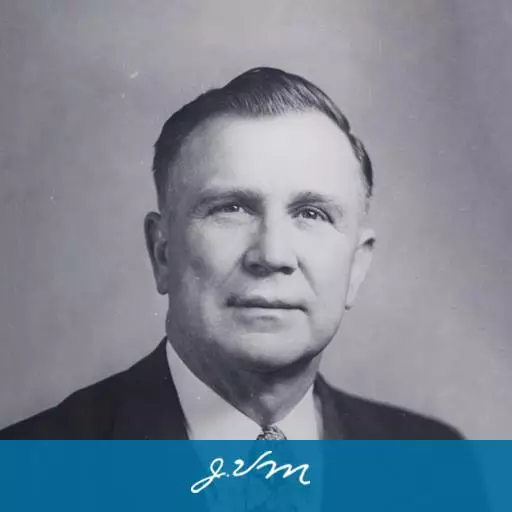
About Dr. J. Vernon McGee
John Vernon McGeewas born in Hillsboro, Texas, in 1904. Dr. McGee remarked, "When I was born and the doctor gave me the customary whack, my mother said that I let out a yell that could be heard on all four borders of Texas!" His Creator well knew that he would need a powerful voice to deliver a powerful message.
After completing his education (including a Th.M. and Th.D. from Dallas Theological Seminary), he and his wife came west, settling in Pasadena, California. Dr. McGee's greatest pastorate was at the historic Church of the Open Door in downtown Los Angeles, where he served from 1949 to 1970.
He began teaching Thru the Bible in 1967. After retiring from the pastorate, he set up radio headquarters in Pasadena, and the radio ministry expanded rapidly. Listeners never seem to tire of Dr. J. Vernon McGee's unique brand of rubber-meets-the-road teaching, or his passion for teaching the whole Word of God.
On the morning of December 1, 1988, Dr. McGee fell asleep in his chair and quietly passed into the presence of his Savior.
Contact Thru the Bible - Sunday Sermon with Dr. J. Vernon McGee
info@ttb.org
https://ttb.org/
Mailing Address
Thru the Bible, Inc.
P.O. Box 7100
Pasadena, CA 91109
In Canada:
Box 25325,
London, Ontario
N6C 6B1
Phone Number
(626) 795-4145 or
(800) 65-BIBLE (24253)