

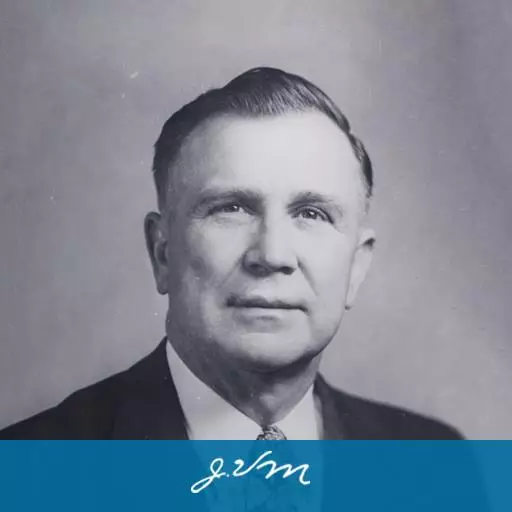
To Tell the Truth


In a world full of confident voices, how do you know what’s real? Dr. J. Vernon McGee borrows the setup of a game show to ask a timeless question: How do you recognize the true person of God? As he walks us through Esau and Jacob in Genesis, Dr. McGee shows the difference between religious appearance and a life changed by the Spirit—and invites each of us to stop striving in our own strength and yield to Christ
Steve Schwetz: One of the hardest truths to face isn't out in the world, but inside our own hearts. Welcome to the Sunday Sermon on Through the Bible. I'm Steve Schwetz, and I've got something that you're going to love. A never-before-aired message from Dr. J. Vernon McGee titled "To Tell the Truth."
Now, most of us know how hard truth can be, especially when more than one voice is competing for our trust. Well, Dr. McGee begins with a familiar picture drawn from a classic game show format: a panel, a moderator, and several people making bold claims. But only one is the real thing.
And in a world filled with religious talk, spiritual labels, and confident opinions, that question still matters. How do you tell the difference between what sounds right and what is right? Well, as we open Genesis, we'll meet Esau, Jacob, and the man God is shaping.
And as Dr. McGee walks us through their story, scripture gently turns the spotlight onto our own hearts. Because this isn't just about someone else, but about what God is doing in us. Let's pray. Father, thank you for your word and for this time to study it. Would you open our eyes and then humble our hearts and lead us by your spirit? Help us to recognize what's real and yield our lives to you. In Jesus' name, Amen.
Dr. J. Vernon McGee: Our subject this morning is "To Tell the Truth." Now, I have this morning three persons to bring before this congregation. Only one is the real man of God. The other two are deceivers. They'll try to fool you, and they have fooled multitudes down through the ages. And I want this morning, therefore, to say just a word about how will we recognize the real man of God? And very briefly, let me put down these guidelines.
The real man of God is one who has been born of the Spirit. He has a new nature. "If any man be in Christ, he's a new creation." And the Lord Jesus said to Nicodemus, a religious man, a Pharisee with a God-given religion, "Ye must be born again." Now, how can you be born again? Well, it's to receive Christ as Savior today. On the other side of the cross, they brought an offering by faith, which pointed to the coming of Christ. This side of the cross, we do not bring an offering, but we look back in faith to the sacrifice he made for us 1900 years ago.
Now, the man of God is one who has trusted Christ. And I want to add something else to that. If he's to be distinguished by the world or by other believers, he must be filled with the Spirit. He must produce in his life the fruit of the Spirit, that is, if others are to be able to distinguish and sense this morning you are the ones to determine it. The man that we're after must be, therefore, one that has some distinguishing marks that he is a believer, that he is a real man of God.
All right. Now, let's meet these three, all claiming, if you please, to be the real man of God. And I pick up the narrative in Genesis at the record of Isaac and Rebecca. Rebecca came from a far country to become the bride of Isaac, and he received her, loved her, and she became his wife. Now, in time, we're told that twins were born to Rebecca. These two boys, Esau and Jacob, they represent actually two nations.
And they also represent two natures of the believer. I do not want to emphasize that too much this morning but call your attention to something that's quite interesting. In Genesis 25:22, "And the children struggled together within her; and she said, if it be so, why am I thus? And she went to inquire of the Lord." And these two struggled within her. The two natures of the believer.
And Paul says that the Spirit warreth against the flesh and the flesh warreth against the Spirit, and these two are contrary, and ye cannot do the things that ye would. A child of God has, therefore, a nature that is contending with the old nature and could never acquiesce with living continually in the old nature. Now, let's look at this man Esau, because he happens to be one of them that's brought before us today. After all, he's brought up in the family of Abraham and the family of Isaac, and certainly he's a candidate to be a child of God in this family.
And so let's look at him for just a moment. The scripture says this concerning him: "The first came out red, all over like a hairy garment; and they called his name Esau." Now, Esau means hairy. You'll see later on he's called Edom. That means red. And the nation that came from him was called Edom, evidently because of the texture of the soil, the mountains where the country of Edom is. The rose-red city of the dead, that's in the mountains of Edom, is entirely red in that entire area. It certainly was a fitting name for him. And this man, an outdoor man, as we shall see, a red man, he was sunburned.
At the very beginning, we are warned concerning him, and we're told certain things concerning him. We're told a little later on, and I should like to drop down and pick this up concerning him: "The boys grew: and Esau was a cunning hunter, a man of the field; and Jacob was a plain man, dwelling in tents." We're told that he was, first of all, a cunning hunter. There are two hunters in the scripture, and neither one of them stand out very well. One's Nimrod; the other's Esau. The hunter comes off badly in scripture.
Let me give you just a couple scriptures this morning. In 1 Samuel, the 24th chapter, verse 11, David had just gone over and taken off the skirt of Saul. Had not killed him. Then he went back over on the other side from of the hill, across the valley, called to him. And he says, "Moreover, my father, see ye, see the skirt of thy robe in my hand: for in that I cut off the skirt of thy robe and killed thee not, know thou and see that there is neither evil nor transgression in mine hand, I have not sinned against thee; yet thou huntest my soul to take it." Now, Saul was a hunter, just like Nimrod was a hunter of the souls of men, and he was after this boy David, of course, to kill him.
Micah 7:2, just one other: "The good man is perished out of the earth: and there is none upright among men: they all lie in wait for blood; they hunt every man his brother with a net." Now, the ancients all said that when hunting was an obsession, that it always developed a cruel and brutal character. Well, I will not maybe go for that, but nevertheless, that was the viewpoint, and the hunter comes off very badly. Isn't it interesting that when our Lord called men, he didn't call them to be hunters?
He says, "I'll make you fishers of men." It's interesting how he changed the entire figure of speech. You say, "Well, they were fishers." Right. And that is all the more to the point. He called fishers, and he did not call hunters, which is quite interesting. So, this man Esau, already we are warned against him. We're told something else concerning him, that he is a man of the field. Actually, this man of the field means man of the open country. He was a nomad. He wandered around. He was one who was undisciplined. He had no definite work.
He is the opposite to what a believer should be today. "Be ye steadfast, unmovable, always abounding in the work of the Lord forasmuch as ye know that your labor is not in vain in the Lord." So that this man Esau, a man of the field, shiftless, restless, dissatisfied, and on the move, and in the home of Abraham and in the home of Isaac, if you please, having everything. We have all the comforts and gadgets of life today, but it is not bringing satisfaction to the human heart, and it's not satisfying men today.
Esau, the man of the field, of the open country, wandering here and there, not finding any place that would satisfy him. Then this man of the field can be, I think, changed and said the man of the world, if you please. You can broaden it out a little, and the man of the world, that's what he was. A typical worldling. He loved the world and the things of the world. Those were the things he was. A man of the flesh. He manifested only the old nature.
So much for the moment for Esau. Let's look at Jacob for just a moment, and believe me, he starts off wrong. He comes out holding onto the heel of his brother, and they name him supplanter, Jacob. But we're told this concerning him here: that he was a plain man. That's quite interesting. And dwelling in tents. Two things concerning him. A plain man means simply this: that he was a man of peaceful habits. Now, you don't get that at first; I'm willing to grant that. He did live a simple life, and he complicated it by evil, because evil always complicates life.
Don't know why it is, but part of our problems today are the result of evil. Evil's always twisted and distorted and crooked. Listen to David in Psalm 27:4: "One thing have I desired of the Lord, that will I seek after; that I may dwell in the house of the Lord all the days of my life to behold the beauty of the Lord and to inquire in his temple." And Paul could sharpen his life down to one point. He could say, "One thing I do." How many of us this morning have reduced our lives to that simple formula today?
It's become complicated. This man made his life complicated because of evil and sin, but he was a simple man and a peaceful man. We'll find that out. And then we're told the second thing: he's dwelling in tents. This man recognized that he was a pilgrim and stranger in this earth. And he is among that number in the Old Testament of whom it was said, "These all died in faith, not having received the promises, but having seen them afar off, and were persuaded of them, and embraced them, and confessed that they were strangers and pilgrims on the earth."
That's Jacob. He's a man of the spirit, actually. He did have a new nature. And I hate to have to make this statement; it's an unfortunate statement; it's a sad statement. But the man with a new nature who also has an old nature. And the tragedy of it is that sometimes the man with the new nature, who also has an old nature, lives in the old nature and does not manifest the new. I say that's the tragedy of the Christian life today.
Now, will you follow me with these two boys? They grew up. At the beginning, the contrast between these two does not place Jacob in a very favorable light. In fact, we have a very bad perspective of this fellow. Esau is the outdoor man. He was the hunter. He was the fellow that had the sunburn. He was the fellow who was virile. He was attractive in many ways. He was an adventurer. Esau had tremendous experiences. And Jacob was mama's boy.
He stayed at home, tied to his mama's apron string, connived with her, if you please, to deceive the father. And he could cook. May I say to you, he doesn't look good in this first recorded incident, nor in the second recorded incident, nor in the third one either. Will you notice that the patterns of their conduct were set early? Verse 29: "And Jacob sod pottage: and Esau came from the field, and he was faint." Now you have a capsule picture of these two boys as they're growing up in that one short verse.
Now will you notice Esau said to Jacob, "Feed me, I pray thee, with that same red." He didn't even know what it was, if you'll notice that in your translations. This is in italics, "pottage," and I think we should supply it, of course, but Esau didn't say it. He says, "Whatever that stuff is that's red, I'd like to have some of it, for I am faint. Therefore was his name called Edom." Now, the impression is sometimes given that Jacob took advantage of his brother because his brother was starving to death and that he wanted to take advantage of him.
And this poor boy Esau had come from the field, and he just couldn't make it very much longer; he would have starved to death. May I say to you, do you think anyone brought up in the home of Isaac would have starved? I don't think so. He's not starving to death. He does say, "I'm faint," and he was faint, but all he's saying is "I'm just hungry. I've been out hunting all day, and I'm hungry, and I'd like to have that." And I'd like to absolve Jacob; he's bad enough as it is, but to say that he took advantage of his brother in that connection just doesn't happen to be so.
And Jacob said, "Sell me this day thy birthright." And immediately we find this man Jacob trading and using trickery to do exactly what God had promised that he would do. Because at the birth of these boys, God said to the mother, "The Lord said unto her, Two nations are in thy womb, two manner of people shall be separated from thy being; the one people shall be stronger than the other, and the elder shall serve the younger." Now they should have believed God, and this man Jacob is not willing to wait for God to work this thing out for him.
And he sees a marvelous opportunity to reach in and make a trade, and I can assure you God wasn't back of this. God had promised to give it to him, and God would have given it to him in an altogether different manner, but this boy could never miss an opportunity to drive a good bargain. And so we find him here. And notice the reaction of Esau, and I'm confident that Jacob knew the attitude of this boy Esau. But listen to him. Esau said, "Behold, I'm at the point to die."
"I'm just starving to death." And you've heard young people say that; way they eat it looks like it, but they're actually not starving to death. "And what profit," listen to him, "what profit shall this birthright be to me?" And notice the contempt that he has for it. "This birthright." "What profit is it to me?" "I don't care for it." He treated it as a contemptible thing. To him it was valueless. He had no appreciation of it whatsoever. Let's look at what he's despising here.
The birthright had a wonderful meaning, and especially in the family of Abraham. To begin with, it belonged to the eldest son, and it belonged, therefore, to this boy. Will you notice that old Jacob later on when he was dying called his 12 sons in? In the 49th of Genesis, he begins with his eldest, Reuben. Listen to him, Genesis 49, verse 3: "Reuben, thou art my firstborn, my might, and the beginning of my strength, the excellency of dignity, and the excellency of power."
Don't you see that the firstborn speaks of dignity and it speaks of power? The firstborn occupied a unique position. Not only that, he got a double portion in the inheritance. We're told over in Deuteronomy, the Mosaic law, chapter 21, verse 17, listen to this: "But he shall acknowledge the son of the hated for the firstborn by giving him a double portion of all that he hath: for he is the beginning of his strength; the right of the firstborn is his." So that the firstborn had a double portion.
Now, added to that, the firstborn was the priest of the family. He was the one to receive divine communications if there were to be those. And in the family of Abraham, it meant not only to receive divine communication, it led in the line to the Messiah. It had great spiritual value attached to it, and Jacob knew that, and Jacob wanted it because down underneath his conniving, he had a spiritual discernment which this boy Esau lacked entirely. Now notice the attitude of this boy Esau. What he's saying is simply this: "I'm going to die anyway.
I can't live on promises." God says he's going to send in this line someone to come, but "I can't wait for that, and I'm not interested in that." Candidly, he had no spiritual sensitivity whatsoever. And I feel that the writer to the Hebrews gives us the final word concerning him. Hebrews 12:16, "Lest there be any fornicator or profane person as Esau, who for one morsel of meat sold his birthright." Esau was a profane person. Now that didn't mean that he cussed. He might have, but that's not what this word means.
The word comes from a Latin word, *profanus*, means *fanus* was the temple, the front of it, and *pro* meant before or against it. Profane was a man who was against God. Esau actually was the first one who started the "God is dead" movement. He says, "As far as I'm concerned, I'm against him. I have no need of him." He was a man of the flesh. And I think that you can say definitely that he's not God's man. You can rule him out.
Now will you notice this other man? Jacob's experience now in the home doesn't improve after this. You wish it had, but didn't. In fact, it got worse. When he found out that his father, who did something actually he should not have done, was going to bless Esau as the eldest, then his mother, I think, connived the plot. The idea was hers. And so she urges him to go in and deceive the father. As you know the story of putting, killing a goat, put the skin on him, and the smell of it on him.
And believe me, they say if you cut a goat's nose off, he'll smell just the same. And so this fellow went in smelling like the field. And old Isaac took a good whiff, and he says, "That sure must be Esau." They did not advertise in those days the deodorants that we have today. And so he said, "This is my boy." And he blessed him. And this boy stole, actually stole the birthright, that which was his according to the promise of God, but God did not lead him in this at all.
Now he is forced to leave home because Esau now won't take any more. He seeks his life, and when Rebecca sees the outcome of it, she tells him, "You leave now, and I want you to go over to where I came from, to my people, and you just stay there till Esau cools off. And when he does, I'll bring you back." My, tell you how sin works out. She never saw him alive again. She died before he got back. And so this boy starts out. And if there ever was a fellow who was cock-sure and conceited, it was this fellow.
He went 500 miles. And God overruled, and God protected him on that journey, and yet he gives God no credit whatsoever. He first came to Bethel, homesick, I think, that night, and God appeared to him to assure him. And then God brought him back to Bethel later on. So this boy went on, and he came to the land of Haran. There's no dependence on God whatsoever. He didn't need to depend on God. He's clever. He has ability. He's been able to get by.
He was able to put it over on Esau; he was able to put it over on his father. And I think that along the way he did pretty well also. But no record of that at all. But finally he arrives in Haran. And I want you to look at him and how humble and dependent upon God he was. But look at this boy. When he came, he met some men with sheep. And Jacob said unto them, "My brethren, whence be ye?" And they said, "Of Haran are we."
And he said unto them, "Know ye Laban the son of Nahor?" And they said, "We know him." When Jacob didn't, but he found out later. The way they said this lets you know that this man Laban also had quite a reputation in that country for doing the same thing Jacob was able to do, that is, put over a very sharp deal. "We know him." And he said unto them, "Is he well?" And they said, "He's well, and behold, Rachel his daughter cometh with the sheep." And then we find that Rachel comes down to the well.
And Jacob meets her. He's a very gallant young man, by the way. He draws the water here. And then we read as we move on down, verses 10 and 11, "It came to pass, when Jacob saw Rachel the daughter of Laban his mother's brother, and the sheep of Laban his mother's brother, that Jacob went near, rolled the stone from the well's mouth, and watered the flock of Laban his mother's brother. And Jacob kissed Rachel, and lifted up his voice, and wept." And for the life of me, I can't explain that.
She was beautiful, she was lovely, she's to become his wife, and yet when he kissed her, he lift up his voice and wept. I think that frankly he's so filled with emotion that now he's come to kinfolks at last. It took a long time to make a 500-mile journey in those days. And now he's entertained in the home of his uncle. I say entertained, not long. We're told that he abode with him the space of a month. That's verse 14.
Now, if you think that Laban is going to let any nephew of his stay with him a month and not pay board, you are wrong. Because Laban is clever also. In fact, Jacob is going to find out he's an amateur, and Laban is an old pro. Will you listen to this? One morning at breakfast, Laban said unto Jacob, "Because thou art my brother, shouldst thou therefore serve me for nought?" And who said anything about going to work? Not Jacob. But Laban has. Laban says, "You're not going to serve me for nought. I'm going to pay you."
And I imagine Jacob wondered at this time, "Tell me, what shall thy wages be?" And he had already discovered in the month's time that Jacob was in love with Rachel. We're told that Leah was tender-eyed, but Rachel was beautiful and well-favored. And so now there begins the battle of the wits. And Jacob finds himself outwitted, outsmarted at every turn. Fact of the matter is he cries *caveat emptor* after 20 years. He find out that he'd been deceived.
And we're coming back to this later on. I'll not deal with it in detail today. But after those years went by and he found that he had been beaten, and yet in it all God had blessed him. He finally sneaked off like a whipped dog under cover of darkness and the absence of Laban. And then we find that he came down to the brook Jabbok. And that's where God now deals with this man because he is his man. But he is a man that's lived in the flesh.
And God can't let his man just go on and on and on in the flesh. So God's going to move in on him. And he comes down now to Jabbok. And you will notice that when he came there, and I'm turning now to chapter 32, verse 24, "And Jacob was left alone; and there wrestled a man with him until the breaking of the day." And that man was the pre-incarnate Christ. I'll not turn this morning to Hosea the 12th chapter, 1 and 5.
You may want to look at that later, but you'll find out that that person was more than just a man. Was the pre-incarnate Christ that appeared to him there at Jabbok. A few months ago we were at Jabbok. We had been to Gerasa or Jerash, the one of the cities of the Decapolis. And when we came back, they stopped. I wondered why they stopped and made inquiry, and they said, "This is the brook Jabbok, and this is where Jacob crossed the brook." And so I took a little walk.
I walked all the way down. They have a bridge over it now. I took a little walk down to the bridge, and there was a shepherd over there with sheep. I thought, "My, that could very easily have been Jacob if you'd move back a few thousand years." And it's a wild place. I tell you, it's a wild place. It's not a place to meet a man that's seeking your life because you'd have very little protection. And so this man is left alone there.
Back of him is a father-in-law that would like to kill him. Ahead of him is a brother, the last time he saw him, he wanted to kill him. And if you think that Jacob wanted to wrestle with somebody, you're wrong. He didn't. He didn't want to take on a third party. He had enough. He had a tag-team match going. Laban on one side and Esau on the other side, and that's enough for one bout, let me tell you. And tell the truth, he's already lost every fall so far.
He's not wanting to wrestle. "Jacob was left alone; and there wrestled a man with him until the breaking of the day." Wasn't Jacob wrestling; was the man. One of the greatest wrestling matches in history. This is the match that is recorded here, and the match is with Jacob and a man wrestled with him, the pre-incarnate Christ. Now very briefly, "And when he saw that he prevailed not against him, he touched the hollow of his thigh; and the hollow of Jacob's thigh was out of joint, as he wrestled with him."
"And he said, Let me go, for the day breaketh. And he said, I will not let thee go, except thou bless me." Now Jacob during that night tried every wrestling hold that he knew, and he knew a few. He was a clever boy. But frankly, he's now reached the end of his rope. And this man wrestling with him, the pre-incarnate Christ, wants him to yield, but he won't. He keeps fighting because all of his life he'd been doing it on his own. And now God moves in on him.
Because God crippled him. God broke his leg to get him, but he got him. And finally, Jacob just reaches out and holds on and says, "I'll not let you go until you bless me." I say we have a change of attitude here because this boy's not asking anybody to help him, but he is now. And he said unto him, "What's thy name?" And he said, "Jacob." He said, "Thy name shall be called no more Jacob. No more a supplanter, no more of a trickster, a clever boy, but Israel: for as a prince hast thou power with God and with men, and hast prevailed."
Prevailed? He won the match. But he didn't win it by wrestling. He won the match by yielding. And now he has something that all of us need today: power with God and power with men. My, how the child of God today needs power with God and power with men. This man alone with God. Man of the flesh. Living in the old nature. Unattractive, unlovely, despicable. But I want to say to you, he happens to be God's man, and he doesn't look like it, and he doesn't act like a man of God.
After this incident that took place yonder at Jabbok, we see the man of God now. Not Jacob, the old nature. Oh, yes, it pops out. He always had it, as you will. But he's now Israel. He's a prince with God. God broke his leg, but God got him. Sometimes he does that today. The story's told of the shepherd in the Alps. A tourist from this country visiting noticed the sheep and the shepherd and got up close and noticed one of the sheep had a broken leg, but it was bound in a splint.
And he said to the shepherd, "How did that happen?" He said, "I broke it." He said, "You don't mean it." Said, "Yes, I broke his leg." Well, he said, "You look to me like a very kind shepherd. Why did you break his leg?" Well, he said, "This sheep is the leader. This sheep is the one that the others follow. And when I would lead them up the Alps in the summertime as the grass dried in the lower meadows and I began to walk up, and there's several very difficult precipices that you go around, this little sheep would go to the dangerous places and he'd lead the other sheep off down a dangerous trail.
And I tried to get him to follow me, and he wouldn't follow me. And finally, I broke his leg. And now he stays right along with me." Sometimes God breaks the leg. He broke Jacob's. He has moved in on others. And I think he'll move in on you and me if we're his child, not manifesting the new nature. This man now has power with God. I see him down in Egypt blessing Pharaoh. Imagine that.
The greatest ruler of the day. And Jacob blessed him. Power with God. And I see him now talking to his grandsons. My, that's when a man boasts, they tell me, is when he becomes a grandfather and starts talking to his grandchildren. That's when he becomes a big man. But I listen to Jacob, who is Israel, and he says concerning the sons of Joseph, "May the angel that kept me from evil, keep the lads. I have nothing to boast of.
I wasn't so clever. Everything I did was wrong. And the angel kept me from evil, and the angel today watches over me." He fought a battle at Jabbok and he won because he yielded. Will you notice that truth? And I'm going to close now. I want to turn to the New Testament where we see that battle raging. And I think it raged in the life of the apostle Paul. But will you listen to him in the fifth chapter of Galatians?
"For the flesh warreth against the spirit, and the spirit warreth against the flesh, and these are contrary the one to the other, so that ye cannot do the things that ye would. If ye be led of the spirit," and if you're led of the spirit, you've yielded, my beloved, because that's the only way you can be led. "You're not under the law. Now the works of the flesh are manifest, and here they are, it's an ugly brood: adultery, fornication, uncleanness, lasciviousness," and so on.
Then he says, "But the fruit of the spirit," and it's not works of the spirit, for we cooperate, but it's what the Holy Spirit produces in the life. Anything that Vernon McGee produces is no good, and God won't have it. In fact, he must throw it out; it's vile to him. Anything the flesh produces. It's only what the Holy Spirit produces in our lives. "The fruit of the spirit is love, joy, peace, longsuffering, gentleness, goodness, faithfulness, meekness, self-control: against such there is no law."
And Paul, I believe, went through this. Will you listen to him in Romans 7:19? He says, "For the good that I would, I do not." For the good that this new nature would do, I do not, but "the evil which I would not," and that new nature won't sin, "that I do." The old nature. Do you know anything about that in your life this morning? Is this your experience? And this man who tried to fight it himself, this is his experience.
I've been a pastor many years, and a lot of the same saints I wish I could get them in the 7th of Romans, because the man who fought the battle in the 7th of Romans found out there was no good in him. No power within him. And he found out that when he yielded and only when he yielded and permitted the Holy Spirit to work in his life could he produce anything. And Paul cried out, "O wretched man that I am!" That's not an unsaved man.
That's a man that's God's man saying that. "O wretched man that I am! Who shall deliver me from the body of this death?" And the picture is of a corpse. When a man murdered in that day, one of the punishments was to take the corpse, chain it to his body, and he carried it the rest of his life. And Paul says, "That's what I'm carrying around." My friend, that's what you're carrying around today. You and I.
But this man did reach the place where he could say, "I can do all things in Christ who strengtheneth me." And the Lord Jesus, we've seen in that upper room, and of course his last word is a word of victory. "These things I've spoken unto you that in me ye might have peace. In the world ye shall have trouble: but be of good cheer; I have overcome the world." You'll never be able to do it, and I'll never be able to do it, but he can.
He has. His victory's our victory. That only comes when you and I yield. May I say to you this morning, are you fighting it out yonder alone like Jacob by your Jabbok? Well, there's no use saying you're losing, aren't you? Why don't you turn it over to him? Why don't you call him in? Why don't you yield to him? If you are here today, though, and have never begun the battle, God would like to begin with you by giving you a new nature.
He wants to make you his child. And he doesn't want you to be an abnormal child. Because today the average Christian accepts defeat as the normal way of living, and God never intended it that way. It's abnormal today to live a defeated Christian life day in and day out and whimper and cry. God wants us, "Be of good cheer; I've overcome the world." "I can do all things in Christ." But he wants you maybe to begin with him. And you begin with him by letting him give you something. "The gift of God is eternal life in Christ Jesus." He'll give it to you if you by faith this morning will accept.
Steve Schwetz: You know, we'd love to have you travel with us daily on Through the Bible as we continue our journey through Genesis and discover God's faithfulness in every chapter. Listen anytime on our app or at ttb.org or call 1-800-65-BIBLE if we can help. Again, that's ttb.org or 1-800-65-BIBLE.
And you can also write to us at Through the Bible, Box 7100, Pasadena, California, 91109. Or in Canada, Box 25325, London, Ontario, N6C 6B1. As we go, I'm Steve Schwetz, praying the God of peace make you complete in every good work to do his will, working in you what is well pleasing in his sight, through Jesus Christ. Amen.
Featured Offer


Featured Offer
About Thru the Bible - Sunday Sermon
These Sunday Sermon messages form a collection of the most effective and fruitful sermons given by Dr. J. Vernon McGee during his 21-year pastorate (1949-1970) at the historic Church of the Open Door when it was located in downtown Los Angeles.
Other Thru the Bible Programs:
Thru the Bible - Minute with McGee
Thru the Bible - Questions & Answers
About Dr. J. Vernon McGee
John Vernon McGeewas born in Hillsboro, Texas, in 1904. Dr. McGee remarked, "When I was born and the doctor gave me the customary whack, my mother said that I let out a yell that could be heard on all four borders of Texas!" His Creator well knew that he would need a powerful voice to deliver a powerful message.
After completing his education (including a Th.M. and Th.D. from Dallas Theological Seminary), he and his wife came west, settling in Pasadena, California. Dr. McGee's greatest pastorate was at the historic Church of the Open Door in downtown Los Angeles, where he served from 1949 to 1970.
He began teaching Thru the Bible in 1967. After retiring from the pastorate, he set up radio headquarters in Pasadena, and the radio ministry expanded rapidly. Listeners never seem to tire of Dr. J. Vernon McGee's unique brand of rubber-meets-the-road teaching, or his passion for teaching the whole Word of God.
On the morning of December 1, 1988, Dr. McGee fell asleep in his chair and quietly passed into the presence of his Savior.
Contact Thru the Bible - Sunday Sermon with Dr. J. Vernon McGee
info@ttb.org
https://ttb.org/
Mailing Address
Thru the Bible, Inc.
P.O. Box 7100
Pasadena, CA 91109
In Canada:
Box 25325,
London, Ontario
N6C 6B1
Phone Number
(626) 795-4145 or
(800) 65-BIBLE (24253)