

The Next Happening in the Program of God


God is following a plan. This truth is revealed in the numerous prophecies recorded in the Scriptures. Most have already been fulfilled, but there are still many waiting for the day of their fulfillment, particularly those dealing with the Second Coming of Christ.
Steve Schwetz: When you read and study the Bible as a whole message from God, just as we do in our daily five-year journey on through the Bible, you start to see God's overall plan and purpose unfold day by day. I'm Steve Schwetz, welcoming you aboard the Bible Bus for another great adventure in God's word. From Genesis through Revelation, God's word pulls back the curtain little by little to reveal many aspects of his plan.
Many prophecies forecasted in the Old Testament were fulfilled in Jesus Christ, down to the small details. And some prophecies are still waiting for the day of their fulfillment, especially those related to end-time events. Well, in this Sunday sermon, our Bible teacher Dr. J. Vernon McGee considers the program of God, that is all the events and circumstances that'll happen next in God's timeline. We'll learn not only what'll happen next, but also how our lives can be motivated by them.
His message is titled "The Next Happening in the Program of God." As we listen, let's pray not only that our curiosity is stirred, but more importantly that our hearts are encouraged to follow the Lord more passionately, more obediently, looking forward to the day when we'll be caught up together with him in the clouds. Let's pray.
Father, thank you for revealing to us a little bit of your program for the church and the world. We can't wait to meet you face to face, either when you call us home or when we meet you in the air. Please help us to follow you wholeheartedly until then. In Jesus' name, our savior and our hope, amen.
Dr. J. Vernon McGee: I want to speak on the subject "The Next Happening in the Program of Prophecy." And here in Southern California, as well as across the country today, we're hearing some strange things in the area of prophecy coming actually from some men I'm rather surprised. They are right on the border of setting a date. Some are saying he's going to come by 1980, others say he'll be here by the end of the century.
Now they worry me because apparently they got a line into the heaven that I don't have, and that worries me a great deal because I'd like to have that line also, and I just simply don't have it. But the word of God, I think, tells us what the next happening is, and the word of God calls it the rapture. And there are three great passages of scripture on the rapture: John 14 is one, 1 Thessalonians the fourth chapter beginning with verse 13 is a second, and then 1 Corinthians 15.
But now I'm turning to 1 Thessalonians the fourth chapter, a very familiar passage for those that are acquainted with this field of prophecy. Let me read these verses in your hearing: "But I would not have you to be ignorant, brethren, concerning them which are asleep, that ye sorrow not, even as others which have no hope. For if we believe that Jesus died and rose again, even so them also which sleep in Jesus will God bring with him."
"For this we say unto you by the word of the Lord, that we which are alive and remain unto the coming of the Lord shall not prevent"—it should be, shall not go before—"them which are asleep. For the Lord himself shall descend from heaven with a shout, with the voice of the archangel and with the trump of God, and the dead in Christ shall rise first."
"Then we which are alive and remain shall be caught up together with them in the clouds to meet the Lord in the air, and so shall we ever be with the Lord. Wherefore, comfort one another with these words." Now this passage that I've read in your hearing has been called one of the most important prophetic passages in scripture, and certainly I would concur in that. Now it teaches the imminent and impending coming of Christ.
And now hear me rather carefully, and that does not mean the immediate or even the soon coming of Christ. Now we have used that expression for years, the soon coming of Christ. We're not using there the language of the word of God. The word is the approaching coming, the next event on the agenda of God is when he takes his church out of the world. When that'll take place, we're given no indication whatsoever.
We're just told that's the next event. It may be tomorrow, could be this year, may not be. Don't go out of here and say I said he's coming this year, I didn't, I don't know. And he may come this century, I don't know. He may not come this century. But let me illustrate that with a very homely illustration. Last winter, Mrs. McGee and I made our annual trip to Florida.
Seems strange anybody in California going to Florida in the wintertime, but that's what we've been doing and we've had a wonderful ministry down there. This time, we got on one of these new DC-10s. Never been on one of them before, and we were very much interested in this new plane. And it took off, went out over the Pacific and circled to the left, and then we were still in sight of the airport, the captain came on and he introduced himself.
He told us the how the weather was. He says the weather here in California is lovely and the report we get from Florida is the weather's lovely down there, but he says, "You know we go over Texas and you can't tell about the weather there." And so we were listening very intently of course to him and he told us the number of feet high we'd be flying, gave us a lot of other information about this new plane.
And then he said, "Our next stop is Miami." Well, we didn't grab up our bag that we carry on the plane and rush for the door because it was five hours before we'd get there. But it was the next event, provided we didn't go by Havana, which we didn't by the way. But that was the thing he said, "The next stop will be Miami." But it was five hours away.
Now it was imminent all the time, but it wasn't soon coming, not for a fellow like I am who doesn't like to fly. Those to me are the longest five hours that I spend. Now the thing that the word of God teaches is the imminent coming of Christ, not necessarily the soon coming. It's the thing we're to look for though all the time, by the way. Now Paul put it just like that.
Paul believed that Jesus could return in his lifetime. He never did say he would return. He did not know, he just said he could return and that means the imminent coming of Christ. And for instance, he says here, "we which are alive and remain unto the coming of the Lord." Paul says there'll be a "we" at sometime and he said I could be with that group, but he wasn't, and there have been many generations since then.
And then he said something else to a young preacher: "Looking for that blessed hope and the glorious appearing of our great God and Savior." Something to look for. And my friend, if somebody's not due for ten hours, you just don't go out and start waiting for it. But if they might come anytime within the ten hours, you can go out and wait for them. And that's exactly was the position of the Apostle Paul.
And that, I think, should be our position today. Now Paul labeled this event when the Lord Jesus would come and take his own out of the world, he labeled that the rapture. Now today, there're a group of the amillennial brethren that like to say that the Bible does not use the word rapture at all. It's not a Bible term, and we ought not to use it.
May I say to you that the Bible does use that term. Will you notice verse 17: "Then we which are alive and remain shall be caught up together with them in the clouds to meet the Lord in the air" and so on. Now, "then we which are alive and remain shall be caught up." Now that word in the Greek is *harpazō*. And it has several meanings. It means caught up, it means to grasp hastily, it means to snatch up, it means to lift, it means to transport, it means to rapture.
That's one of the meanings of it. And therefore it is a Bible word. Now if they don't like the word rapture, then I suggest they call it *harpazō* because that is all it will all mean the same and it'll all come out the same. It's the rapture of the church that he's talking about. Now another rather startling thing here is actually the primary consideration here is not the rapture, really, it's not.
The precise question is this: What about believers who die before the rapture? That is the question that Paul is answering. Now the background is simply this: Paul went to Thessalonica on his second missionary journey. Actually, Paul had covered the ground that he and Barnabas had been over on the first missionary journey, and we would gather from what Dr. Luke says in the book of Acts that all that Paul and his party with Silas and Timothy intended to do was to just widen the circle.
Just widen the circumference of that circle and Dr. Luke says that they attempted to go down into Asia where Ephesus was the chief city and one of the great cities of the Roman Empire. But the spirit of God put up a roadblock, wouldn't let him go south. And so Paul thought, well if I can't go south, certainly I'm to go north.
Along the southern coast of the Black Sea, there was a very large group of Jews there and of Gentiles that had settled in that area. And Paul started out and again the spirit of God put up a roadblock. And therefore he's bottled in now, he's come from the east, he can't go south, he can't go north, he can only go one direction—that's west.
And you can see it was not Horace Greeley of the New York Sun who first said, "Go west, young man, go west." It was the spirit of God speaking to the Apostle Paul. He came to Troas, given the vision of the man of Macedonia. He crossed over to Neapolis, went to Philippi and founded a church there. Then he continued overland and came to the city of Thessalonica.
And he had a great ministry there and we're told that he was there three Sabbath days he reasoned with them in the synagogue. He was there three Sabbath days, which means he was there less than one month. Now in that one month's period, he performed a Herculean task. He did the work of a missionary. He opened up new territory, made converts, many were led to a saving knowledge of Christ, a local church was established, and he taught them the great truths of the Christian faith.
And he taught them among other things that the rapture might occur at any moment. And Paul then left Thessalonica—I say he left, he was run out of town. They remember they wanted to stone him, he had to leave. And he left Timothy there and Silas. He went down to Berea, I don't know how long he was there, but there he formed a church. And then he took ship and went to Athens, and he was there for quite a while.
How long, I do not know. Then he waited and waited for Silas and Timothy to come, they didn't show. So he went on down to Corinth and he waited there and he had a great ministry there. And during that period, Silas and Timothy joined him and they brought word from the Thessalonian church. It was a good word, it was a word of how the word of God was growing.
But the Thessalonians, you see, they'd only had Paul there for a month, and they'd been taught all the great truths, but there were many details that hadn't been told them. And in that interval from the time that Paul left them until Silas and Timothy joined him, quite a few of the believers died. And a question arose in the minds of the church: What about our beloved dead? Did they miss the rapture?
And by the way, that means Paul had taught them it might occur any moment or they wouldn't have had the question in their mind of maybe our loved ones have missed the rapture cause it could take place any moment, you see. And would the dead be included in that? Now at that time, that was a very pertinent question. Of course, we've come a long ways since then.
1,900 years have gone by and literally millions of believers have already gone down through the doorway of death and they have gone, multitudes of them, into the presence of Christ. Their spirits have. Therefore most of the church has already gone ahead and today comparatively speaking, a very small minority remains in the world. Now what about the rapture and the dead?
That is the question and Paul is going to answer that question. Now will you listen to him? He says, "But I would not have you to be ignorant, brethren." And I love the way that Paul says that. Paul was a very astute and a very diplomatic preacher. He would declare the truth of course, he never compromised. But Paul did use the very acme of politeness.
He said, "I would not have you ignorant, brethren." And when Paul said that, you can put it down that the brethren were ignorant. "I would not have you ignorant, brethren." That means they were ignorant. And that's a nice way of saying it, though you see he didn't come out flatfooted and say you're ignorant over there, you don't know. He didn't put it like that.
He said, "I would not have you to be ignorant, brethren." And it's now—here is the question: "concerning them who are sleeping, that ye sorrow not even as the rest which have no hope." And it was pretty hopeless in the Roman world. That is, death was. The religions of paganism have never been able to offer much hope after death.
Actually the modern thinking, philosophy today, psychology, the lifestyle of most people today has left eternity out. They don't like to think about it. A man said to me, he said, "Don't talk to me about that, I don't like to think about it. Keep that buried, I just don't want to hear about it at all."
In Thessalonica, they have found there in their excavations a stone that says: After death no reviving, after the grave no meeting again. And Theocritus, a Greek philosopher and poet, wrote: Hopes are among the living, the dead are without hope. So that the pagan world had no hope at all. And today, there're several pastors here tonight, very frankly I think they will corroborate my statement: I can always tell when I have a funeral whether the loved ones and the one that has passed on is a Christian or not.
You listen to an unsaved person weep at a funeral, my friend, it's the weeping of the hopeless and the helpless. May I say to you, it's an awful, terrible thing to have no hope in this world today. It's a terrible thing when death comes, when you have no hope, my friend, that's it. And the motto of the Roman world was: Eat, drink and be merry, for tomorrow you die.
And that's the way multitudes are living in Los Angeles tonight, by the way. Now we find here, Paul says, "I don't want you to sorrow as those that have no hope." You have a hope concerning them who are sleeping. And that, may I say, is one of the loveliest things that Paul could have said. Now "sleeping" is another word that I'd like to call attention to. In the Greek, it's *koimaomai*.
And it means those that are lying asleep. And I got down my classical lexicon some time ago and it means to go to bed back in classical times. It means to go to bed. And you know, you can't put a spirit to bed, and you couldn't put your soul to bed to save your life. And which end would you stick in the bed if you put your soul to bed, my friend?
It's utterly preposterous to use words like this in reference to death of the soul. The soul never sleeps. The moment that a person dies, if he's a child of God, Paul says, "absent from the body, present with the Lord." But the body—and we'll see that in a few moments and talk about it—that body's put to sleep. And I can't think of a lovelier word to use for that than that.
It never refers to the soul because the very language itself means to lie down and only the body can lie down. Now this is the same word, by the way, that's used for natural sleep. In Luke 22:45, we read there in the Garden of Gethsemane: "And when he rose up from prayer and was come to his disciples, he found them sleeping for sorrow."
Peter, James, and John, they were asleep. And then in Acts 12:6, you have that word again: "And Peter was sleeping between two soldiers." That fellow Simon Peter doesn't seem to have much of a problem sleeping. He sleep at the Garden of Gethsemane, go to sleep between two soldiers. And we can say one thing about him: he did not suffer from insomnia. He was able to sleep at night.
So this is the word though, the same word that's used of the body of believers, by the way, and it's a very wonderful word. Now why would that word be used to speak of the body? I have several suggestions to make. The first one is the similarity of sleep to death. A sleeping body and a dead body are similar.
I'm sure that you've been to a funeral and you've heard someone say, "Oh, he or she looks just like they're asleep." And if you want to know the truth, if they're a child of God, that body's asleep. That's the picture. That's the way the word of God says that we should look at it. And sleep is temporary, death is also. Sleep has its waking, death has its resurrection.
And life is not just existence, and death therefore would not be just nonexistence, by the way. Then there's another reason I'd like to suggest to you why the word is used. The very derivation of the word for sleep. It goes back to a word *keimai*, and *keimai* means to lie down. Always refers to the body. And the very interesting thing is that the word Paul always uses for resurrection is a word *anastasis*.
And that word, it means to stand up. *Histēmi* means to stand, *ana* means to stand up. And my friend, may I say to you, resurrection only refers to the body, never to the soul or spirit. It's gone to be with him. You remember the word of God makes it very clear. God said to man, "In the day that you eat of that tree, you'll die." And then God told him when he ate.
He says, "Dust you are, you were taken out of the dust. As far as your body's concerned, you're going to put it right back there. And the spirit will return to the maker who gave it." So that it is the body that lies down in death. It is the body that's raised up in resurrection. Now many years ago, over in the city of New York, in fact it was way back in the days of modernism and fundamentalism, back in the '20s if you please.
And at that time, why they had an argument on about whether resurrection was spiritual. The modernist you know even today says it's spiritual, he doesn't believe in bodily resurrection at all. And so a very famous Greek scholar, Dr. Goodspeed of the University of Chicago, he read a paper and he took the passage from 1 Corinthians 15: "It is sown a natural body, it's raised a spiritual body."
Well, he read the paper and he put the emphasis on "spiritual" and he concluded by saying, "Now brethren, you can see that resurrection is spiritual because it says it's spiritual." And the liberals all applauded. And somebody made a motion they'd print that manuscript and circulate it. Well, a very fine Greek scholar, Dr. Robertson, who's probably the greatest, he was there.
And he stood up, and when he stood up, all the liberals they were a little uneasy. He could ask very embarrassing questions. He said, "I'd like to ask Dr. Goodspeed a question." And Dr. Goodspeed very reluctantly stood up. And he said to him, he said, "Now doctor, which is stronger, a noun or an adjective?" It's a very simple question, but I'd like for you to answer it.
Dr. Goodspeed could see the direction he's going, didn't want to answer but he had to. "Well," he said, "a noun is stronger, of course." And so Dr. Robertson said, "Now doctor, I'm amazed that you presented the paper you did today. You put the emphasis upon an adjective. And the strong word is the noun. Now," he says, "let's look at that again."
"It is sown a natural body. It is raised a spiritual body." He says, "The only thing that's carried over in resurrection is the body. It's one kind of body when it dies, a natural body. It's raised a body, but a spiritual body. Dominated now by the spirit, but it's still a body." You know, they never did publish that paper. They decided it'd be better not to publish it.
May I say to you, just a simple little exercise in grammar would have answered this great professor's whole manuscript that he presented and his entire argument at that time. Now I want to turn back to a passage of scripture that's related here in 2 Corinthians 5. And let me read it: "For we know that if our earthly house of this tabernacle"—he's writing to believers now who know something, you notice he approaches it different, doesn't say I would not have you ignorant, he says for we know, we know something.
"That if our earthly house of this tabernacle"—the word is tent—"of this tent were dissolved, we have a building of God, a house not made with hands, eternal in the heavens." Now this body that you and I live in, Paul calls it a tent. Just a flimsy little tent. That's all in the world that it is. And they're very flimsy, by the way.
I found out that seven spots on your lungs could put you out of business and take these little old tents we live in. My, they're really fragile, they fall down most any time. And some of them are getting old today, I know mine is beginning to wear out, I think. But I'm thankful that he may give me a few more years and I'm sure happy for that. I want to stay in this tent, in spite of the fact that it's got a lot of aches and pains in it.
Now will you notice, he says that. "For in this we groan, earnestly desiring to be clothed upon with our house which is from heaven." Now let me drop down just to a verse down here, verse 4: "For we that are in this tabernacle, this tent, we do groan." Have you found that to be true? I sleep upstairs and I used to come bounding down those stairs 20 years ago, I could do it.
You ought to see me get down the stairs of a morning. I hold on the side and I take one step at a time and I groan at every step. My wife tells me, she says, "You ought not to groan." And I says, "It's scriptural to groan." And I believe it is. I think that we ought to groan in these bodies we got. We groan within these bodies, Paul says.
"We that are in this tabernacle do groan, being burdened, not for that we would be unclothed, but clothed upon that mortality might be swallowed up in life. Now will you listen to him now. Now he that hath wrought us for the selfsame thing is God, who also hath given unto us the earnest of the spirit. Therefore we are always confident, knowing that whilst we're at home in the body, we're absent from the Lord."
Now we're home down here in the body, we're absent from the Lord. But one of these days something's going to happen. And while we're here, "for we walk by faith, not by sight. We are confident, I say, and willing rather to be absent from the body and to be"—the language is—"and to be at home with the Lord." The minute that you leave this body, you're going home.
That's where you're going. You're going home. And the body now is going to be taken and put to sleep. Now that's the way the early Christians spoke of the those that were their own that died. In fact, they called the place of burial, the graveyard, they called it the *koimētērion*. And that really means a rest house for strangers.
It was the word for the inn where Mary and Joseph couldn't get in. It was the place that you'd find all through the Roman Empire. And we get from it our word cemetery today by transliteration. Cemetery, it's a resting place, a sleeping place. What do we call them today? We call them motels and hotels. That's what we call them today.
You don't weep, do you, when one of your loved ones writes you and says I'm going to spend a week up at the Hilton Hotel in San Francisco? We congratulate them, we think it's wonderful. You see that we miss them if they're close to us, they're going to be away from us, but they're asleep up in the Hilton Hotel. They'll be up there sleeping for seven straight nights.
Well, that's the way that the early church, they took their loved ones and they were asleep and they put them in the—out in the cemetery, in the ground. And let me just add this, and I know that I get in controversial places, but I always did that. And there's a great deal today being said about cremation, whether Christians ought to cremate.
Now very frankly, I don't think it makes actually too much difference as far as the individual is concerned. But I don't believe in it and I don't think a Christian ought to practice that. I'll tell you why. An undertaker right in Pasadena told me, he's an aviator, that he made good money of taking the ashes of unsaved people and taking them out over the Pacific and scattering them.
You know why? The unsaved man says, "God, I dare you to bring me back. I don't want to be back." They want that to be the end of it. And you see the early church says, "This is not the end. We just putting them in the motel for the week, for just a short time." That's all that we are doing. We just putting the body asleep, they've gone to be with the Lord.
Even the book of Ecclesiastes, as pessimistic as it is, it speaks of the fact that the dust shall return to the earth, but the spirit return unto the maker. So that today we reveal our faith when we put our loved ones like that in a grave. We believe they're going to be waked up, that body, someday. And how will it be waked up?
Well, will you listen to this: "For the Lord himself shall descend from heaven." And I love that. When the Lord comes to the earth to establish his kingdom at his second coming, he's going to send his angels to gather his elect. But he'll not send any angels for his church. You know why? Because angel ministry's not connected with the church.
It's connected with Israel, never with the church. And there'll be no angels connected with the rapture. There will be angel ministry when he comes, he'll send his angels to gather his elect. But notice here: "For the Lord himself shall descend from heaven." He's coming himself, I love that. He's coming. Our Lord is coming. Will you notice this: "He shall descend from heaven with a shout."
Now what is that shout? That is a word of command. That is the word that he gave there at Bethany at the grave of Lazarus: "Lazarus, come forth." That was the the shout of the son of God. Then somebody says, "Oh, you slipped up because it says with the voice of the archangel." Well, whose voice is it? Well, it's his voice.
His voice is going to be like the voice of an archangel. It's the voice of majesty. It's the quality of his voice, the authority of his voice. It's the voice of the son of God, no archangel is there. And let me ask you a question, and I do not mean to be irreverent: Do you think that the Lord Jesus will need an archangel to help him raise his church from the dead?
I don't think so. Can you imagine him at the at the tomb of Lazarus saying, "Gabriel, would you come on over here and help me get this fellow out of here?" That is absolutely and it's blasphemy if you ask me. He didn't do that, he didn't need to do that. My Lord was able to raise the dead. There'll be no archangel there.
His voice is like the voice of the archangel. And then somebody says, "But wait a minute, and with the trump of God." Whose voice is that? That's the voice of the son of God, it's still his voice. Well, somebody says it says though that it's the trump of God. Yes, but his voice is like a trumpet.
Somebody says, "Do you know that?" I know that from scripture. If you turn to Revelation 1:10, you'll find that John on the isle of Patmos, he said, "I heard a voice like the sound of a trumpet." And whose was it? He says, "I turned to see," and when he turned to see, who was it? It was the glorified Christ that he saw.
His voice will be like—like a sound of a trumpet. It'll be like an archangel. It'll be a shout, and I think it will roll over this earth. And those that are his own, because Paul makes it clear here, "the dead in Christ shall rise first." And I think beginning way back yonder with Stephen, the first martyr, he'll come, and after him the apostles, after him that great company for 200 years of the martyrs of the church.
And then you'll find century after century until he comes down to the time those that are that are living. And if we're living, we're just going to bring up the rear, that's all, of the parade. That great parade of resurrection when he calls his own out of the earth with a shout, and it's the voice not an archangel's voice, his voice is like an archangel, and the sound of a trumpet is his.
Now that ought to get rid of this silly notion today that Gabriel's going to blow a trumpet. To begin with, I don't think Gabriel owns a trumpet. And even if he owns a trumpet, I don't think he can blow a trumpet. And I'm confident we're not talking about Gabriel here at all. It's the son of God and he alone is coming to claim his bride and call his church out of the world.
And my friend, that's the hope. That's the next happening in the program of prophecy when he calls his own out of this earth. And that ought to be a blessed hope to us in these days in which we live. Several years ago, when I was pastor in Pasadena, we were invited out to celebrate the 50th wedding anniversary of one of the loveliest couples I ever met.
And during the time of the dinner, there were congratulating them and great deal of conversation, why he reached over and patted her on the hand, and he said the loveliest thing that any man can say that's been married to a woman 50 years. He said, "We are still on our honeymoon." Isn't that lovely? On the way home that night, I said to my wife, I said, "What happened to ours?"
We hadn't been married 20 years at that time, and they'd been married 50 years and still on their honeymoon. It wasn't long after that that I conducted his funeral. And after the service, the friends went by, the loved ones came by. He was greatly beloved, many were weeping. Then his widow came out leaning on the arm of a friend. She was sorrowing, but she had a hope.
She came up to the casket, she reached over and patted him on the hand, she reached down and gave him just a quick kiss, and she says, "John, I'll see you in the morning." She just putting him in the motel for the night. And the morning is coming, that bright morning, someday, when the Lord Jesus'll come. That's the hope tonight of a believer, friend, and it's hopeless without him.
Isn't it tragic to live down here and make every arrangement to live here and no arrangement for over there? He says, "I go to prepare a place for you. And if I go and prepare a place for you, I'll come again and receive you unto myself, that where I am, there ye may be also." And when you accept him, you have a place over there, you have a hope.
Steve Schwetz: Are you ready to face the life to come? Does the thought of Jesus coming again thrill you or terrify you? Have you trusted him as your savior? Well, if not, I hope that this is your day, the best day of your life. Find out more about God's plan of salvation for your life and how you can live in the hope that you'll spend all eternity in his presence when you click on "How can I know God?" in our app or at ttb.org.
There you'll find many free downloadable resources to help you discover the wonderful gift of grace that God wants to give you, including Dr. McGee's booklet "God So Loved" that takes you through John 3:16 and then explains God's deep, unsearchable love for each one of us in great detail. A listener wrote us a letter about this, and maybe you can identify with her experience.
She says, "I'm Sheila, and I tuned into your program by accident and suddenly realized I didn't truly know God. I'd grown up in a home where the idea of a loving God who wanted to know me was laughable. But your messages changed everything. I kept listening, day after day, and at some point I saw clearly that I was lost and headed for hell. Yet what gripped me most wasn't fear. It was a longing to know the real God, the one who offers love, forgiveness, and eternal life."
"Since then, it's become a game to see how I can weave the Lord into any and every conversation. All the while I pray that others will discover the same truth and hope I found through his word." Praise God. He meets us right where we are. Will you pray with Sheila that people will understand their need for God and then discover the grace that he holds out to them through faith in Jesus Christ?
And if prophecy and the program of God interest you, then why don't you visit ttb.org where you'll find many resources by Dr. McGee available at your fingertips, including today's message "The Next Happening in the Program of God." This week on the daily program of *Thru the Bible*, we continue our exciting journey through Revelation. Hop aboard the Bible Bus and invite a friend to join us.
To listen online, by app, or to see if your local station carries *Thru the Bible*, visit ttb.org or call 1-800-65-BIBLE. And to partner with us in taking the whole word to the whole world, call us, 1-800-65-BIBLE's the number. Now as we go, I'm Steve Schwetz, thanking God for the hope that we have in Christ and his promise of his return in 1 Thessalonians 4: "For the Lord himself will descend from heaven with a shout, with the voice of an archangel, and with the trump of God, and the dead in Christ will rise first. Then we who are alive and will remain shall be caught up together with him in the clouds to meet the Lord in the air, and thus we shall always be with the Lord."
Featured Offer


Featured Offer
About Thru the Bible - Sunday Sermon
These Sunday Sermon messages form a collection of the most effective and fruitful sermons given by Dr. J. Vernon McGee during his 21-year pastorate (1949-1970) at the historic Church of the Open Door when it was located in downtown Los Angeles.
Other Thru the Bible Programs:
Thru the Bible - Minute with McGee
Thru the Bible - Questions & Answers
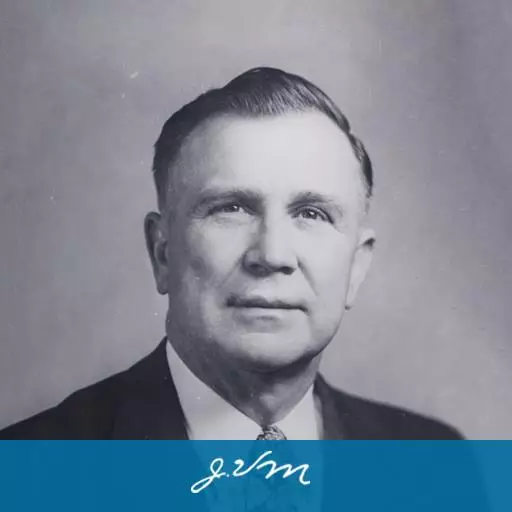
About Dr. J. Vernon McGee
John Vernon McGeewas born in Hillsboro, Texas, in 1904. Dr. McGee remarked, "When I was born and the doctor gave me the customary whack, my mother said that I let out a yell that could be heard on all four borders of Texas!" His Creator well knew that he would need a powerful voice to deliver a powerful message.
After completing his education (including a Th.M. and Th.D. from Dallas Theological Seminary), he and his wife came west, settling in Pasadena, California. Dr. McGee's greatest pastorate was at the historic Church of the Open Door in downtown Los Angeles, where he served from 1949 to 1970.
He began teaching Thru the Bible in 1967. After retiring from the pastorate, he set up radio headquarters in Pasadena, and the radio ministry expanded rapidly. Listeners never seem to tire of Dr. J. Vernon McGee's unique brand of rubber-meets-the-road teaching, or his passion for teaching the whole Word of God.
On the morning of December 1, 1988, Dr. McGee fell asleep in his chair and quietly passed into the presence of his Savior.
Contact Thru the Bible - Sunday Sermon with Dr. J. Vernon McGee
info@ttb.org
https://ttb.org/
Mailing Address
Thru the Bible, Inc.
P.O. Box 7100
Pasadena, CA 91109
In Canada:
Box 25325,
London, Ontario
N6C 6B1
Phone Number
(626) 795-4145 or
(800) 65-BIBLE (24253)