

The New World


Imagine waking up to a world that’s gone silent. That’s the moment Noah faced when he stepped off the ark. Dr. McGee shows how God met that unsettling new beginning with promises, direction, and hope. It’s a reminder that when life shifts suddenly and the future feels unfamiliar, God is already there, steady and faithful, ready to lead us forward.
Dr. J. Vernon McGee: [ 0m0s110ms - 0m17s180ms ]
Host: Imagine waking up tomorrow and realizing the whole world has gone quiet. No cars on the freeway, no voices next door, stores locked, phones unanswered. Not because it's a holiday, but because everyone is simply gone. You and your family are the only ones left. Overnight, you're living in a new world where the old routines don't apply, and normal doesn't exist anymore. Well, that's a glimpse of what Noah faced when he stepped off the arc. The flood didn't just change the landscape, it changed everything. In Genesis chapter 9, God meets Noah on the other side of judgment with a fresh start, new boundaries and a promise that would shape every generation to come. Welcome to the Sunday sermon on Thru the Bible with Dr. J. Vernon McGee. I'm Steve Schwets, and before we begin our message, the new world, I want to announce that May is letter month, and you know, years ago, Dr. McGee started this tradition as really a special invitation for listeners to write and tell us what God's doing in their lives as we study the word together. So, let's celebrate a note from Glenn in Michigan. I've been on the Bible bus for what I believe is 25 years. During this time, many changes have taken place in my life, both good and challenging, but through all these, I have always looked forward to the daily message from Dr. McGee. I am a morning person, so I start each day with a cup of coffee, reading the scriptures for the day, and listening to the teaching of the Holy Spirit through Dr. McGee on the app. I have told many people about the program and will continue to do so. I know that God's Holy Spirit is also working on many people around the globe through this ministry, and I am so humbled to be a small part of this. Between the daily broadcasts and the Q&A and Sunday sermons, along with my local church family, my life is based in Jesus Christ, and I praise him as my savior and Lord. Well, Glenn, thanks so much for your partnership and your faithfulness. I'll keep a seat on the Bible bus reserved just for you. And how about you? You know we'd love to hear your story too. Just send us a note through our app. You can also email biblebus@ttb.org or write to box 7100, Pasadena, California, 91109. In Canada, box 25325, London, Ontario, N6C 6B1 or leave a voicemail at 180065 Bible. Let's pray. Father, thank you for meeting us in your word. And as we listen, would you give us understanding and then help us to trust you in every new season of our lives in Jesus name. Amen. Here's the Sunday sermon on Thru the Bible with Dr. J. Vernon McGee.
Dr. J. Vernon McGee: The subject today is the New World. If you will permit me this morning, I'd like to turn this sanctuary into a psychological laboratory. And I'd like to solicit your further cooperation in making an experiment here today. I would like to ask you to use your imagination for the next few moments. Suppose that you went to bed tonight as usual. It doesn't take much imagination for that, does it? But when you wake up in the morning, you discovered that every person had suddenly disappeared and been removed from your neighborhood. First of all, you found out that only you and your family were the ones that were left. Your immediate family. You first noticed a death-like silence in your neighborhood. You went out and knocked on the door, your next door neighbor, and no one was there. You went down the block, you went around the block. In fact, you went through the community and you found that there was no one there at all. The entire community was abandoned. You went and called your relatives that live in other sections of the city and the country. You received no answer at all. You called the police, there was no answer. You got in your car and you went down the freeway and you found out you were the only one on the freeway. And that's unusual. And it'll take imagination to do that, my friend. But you went up and down the freeways and you found out that Los Angeles was a ghost town. Stores were locked, offices were closed, and there was no smog. Suppose that you could fly a jet. Since we're using our imagination, let's go all the way. You went out to the International Airport, and of course, there's no one there, no planes taking off, no planes landing. You got in a jet and you started around the world. You found out that Europe was vacated. Not a person was in Russia. Africa was absolutely vacant. The millions of India and China were gone. And then you found out that no one was in the islands of the sea. You returned to Los Angeles, and when you got here, an angel announced to you that judgment had come, and all had been removed and you were left. Actually, wouldn't you agree with me that you're in a new world? A world that's altogether different from the one that you live in today. Former regulations and relationships no longer prevail. Traffic laws, they could be, or would be actually obsolete. You could drive down either side of the freeway. The traffic lights if they were working would mean nothing to you, and you could cross the street anywhere you please. You could burn trash in your backyard and you could mix your garbage any way you wanted to, and there would be no income tax to pay. That would be a new world. There'd be no fear of the atom bomb. There'd be no TV either. That would make it pretty lonesome for some folks. And there'd be no need to listen to a liberal news commentator play up a bunch of dirty beatniks marching in Berkeley because they wouldn't be there. And you wouldn't have to listen to LBJ on TV or J. Vernon McGee on radio. You are in a new world. You'd be living in a new dispensation and there'd be no seminary professor there to deny it was a new dispensation. For you, this is only an experiment. For Noah, it was an experience. For you, it's a flight in the imagination. For Noah, it was a fact of reality. What to you is just make believe this morning, for Noah, it was a chapter out of life. Noah found himself in a new world. A new dispensation if you please. It's a good word, Bible word, very meaningful. Now you can change the label on it and call it something else, but the substance in the bottle is still the same. He has moved into a new world. Altogether different world than he was in before. He was in a world where there were millions of people and there was a way of life, and now he's come into a world where he and his family are alone, and there's a new way of life. Now I want us this morning to note several things. When Noah went ashore, he landed in a new world. Actually, he'd only gone probably a few hundred miles. And when this man got off the ark, it was unusual, nothing quite like it. Now I want you this morning to note some of the radical changes from the former status of this man and his family. First of all, we're told in verse 20 of chapter 8, "And Noah builded an altar under the Lord." And took of every clean beast and of every clean fowl and offered burnt offerings on the altar. Now, this is the first mention of the altar. And I think the reason is quite obvious. To begin with, when Adam and Eve left the Garden of Eden, there was an altar. But they didn't build it. God built that one. As they turned and looked back, they saw the cherubims looking down at the blood. The same thing that Moses had built in the Tabernacle later on when he built the top of the ark and it was cherubims looking down at the mercy seat. And there was that altar outside the Garden of Eden. And that's the altar that Cain and Abel went to. Cain did not bring a sacrifice that speaks of the fact that God is merciful to sinners. Abel did. We found that Noah at the very beginning, he went to that altar. He was righteous, and that's the way a man was declared righteous was by faith doing what God had required. Now we find that after the flood, I think the Garden of Eden was pretty well rubbed out. I think that altar was destroyed. I believe that they landed probably two or three hundred miles certainly up the Tigris Euphrates Valley from their original starting place, for the ark apparently drifted and floated inland. And so we find now that he makes an altar. That's the first thing that he does. For the very simple reason, this man was accustomed to come to God by bringing a sacrifice. And we find him coming to God in just that way. We find that he offered these clean animals. And you see now why he took clean animals into the ark a larger number than he did of the others. It says in one place that he was to take on the ark two of every creature. And in chapter 7, verse 2 it says of every clean beast, thou shall take to thee by sevens, the male and the female. So that the question then was raised, did he take two or did he take seven? Why the fact of the matter is, he took seven of clean beasts. He took two of all other beasts, and the reason he took seven is because there was to be a sacrifice when he came off the ark. And if he'd only had two and offered them, then there'd been no clean beast. Therefore he took seven and there was no inaccuracy at all as far as the word of God is concerned. Now he offered a sacrifice, and it was a burnt offering that he brought. If you'll notice it says a sweet savor under God. That's the burnt offering which speaks of the person of Christ. And do you note there was no sin offering? Up to the time of the giving of the law, there was no sin offering. You see, Paul makes it clear that without the law, there is no knowledge of sin, and that sin becomes transgression when you have the law. But when there is no law, then sin is still sin. Men sin from Adam to Moses, but it wasn't transgression. Cain could murder his brother and even God did nothing about it because there's now no law. But now there is a law. And things have been changed. A new dispensation comes in and there must be the sin offering. Therefore, my beloved, whether you know it or not, you're a sinner in God's sight, and Christ is the sacrifice, the burnt offering and was until the giving of the law. And the burnt sacrifice speaks of his person, who he is, and what he did for us upon the cross, while that sin offering, non sweet savor offering speaks of the fact that he was made sin for us who knew no sin, that we might be made the righteousness of God in him. Now, we note that there's some other changes that are being made. We are told in the ninth chapter, verse 1, and God blessed Noah and his sons and said unto them, be fruitful and multiply and replenish the earth. Now, this man, Noah, if you'll look at it for a moment, stood in the same position that Adam did. He becomes actually the head of the race again. And the very interesting thing is that the scripture never enlarges upon that. You'll never find anywhere in the word of God where that's dwelt upon. Why? Because the word of God is going to recognize finally that there are only two heads of the race. One in Adam and the other that's in Jesus Christ. They are the head of the race. There is the first Adam, the last Adam. And even Noah, though he heads up the race again, he is not considered a head of the race as far as the scripture is concerned. Now you'll notice that there's something else. And the fear of you and the dread of you shall be upon every beast of the earth and upon every fowl of the air, and upon all that moveth upon the earth and upon all the fishes of the sea, into your hand are they delivered. Now, apparently, before the flood, all animals were domesticated, that is they were domestic animals. That the fear of man and man's fear of animals did not exist at all. But after the flood, then you have actually the division of the animals. Those that are domesticated and those that are not domesticated animals, and animals that are difficult even to train. So that you have here something taking place in the animal world, and you have a great deal said here about the bringing forth of the animals from the ark. Evidently, Noah had no problem at all with them in the ark, but he did have a problem after the ark. There was the fear of man in the heart of the animal. Then you have another tremendous change that takes place. Every moving thing that liveth shall be meat for you, even as the green herb have I given you all things. Now this is entirely new. We find that here after the flood that man's given meat for food. Actually, before the flood, man was a vegetarian. And I think scripture makes that abundantly clear. I'd be very careful of making anything of that because if you feel like just being a vegetarian is all that's necessary, you need to recognize that it was a bunch of vegetarians that God destroyed in the flood. And if diet had anything in the world to do with it, then something certainly went awry there. May I say to you that it was a radical change that God gave meat to eat after the flood. And as far as the word of God is concerned, it was not before. Then he makes this statement, "But flesh with the life thereof, which is the blood thereof, shall ye not eat." Now, you will find that there's a superstition back of the eating of animals in most countries, in India for instance, as you know it's tied up with the religion. Tied up with Hinduism. And it goes even farther back than that to an animism that believe that when you ate an animal, you got the nature of the animal. Now you hear some of the cultists say that, that you ought not to eat animals because you'll become rather beastly in your conduct, that it'll have that sort of an effect upon you. Well, that's mere superstition of course, and it reveals the fact that those that are saying that are going back to this which is at the very dawn of man in his superstitions as he got away from God. Now, when God gave it here, he's making clear that you're not to eat the blood, the life is in it. For a little later he'll say, "The life of the flesh is in the blood, and I've given it to you upon the altar to make atonement for your sins." That you are to respect the blood because blood is life and life must be surrendered as a penalty for sin. And that blood ultimately speaks of the fact that a savior is coming, and that big fisherman, Simon Peter, said, "It's precious blood." And that is the reason that it is forbidden here, and God later on included it in his law to these people. Now you move on down and find out he did something else. He says, "Whoso shedeth man's blood, by man shall his blood be shed, for in the image of God made he man." Now we come to something that's entirely new. As we said before, when Cain slew his brother Abel, God did nothing about it. He actually put a mark on him. And made it so that no one could touch this man. But now you've moved into something entirely new. God says, "Now, I'm setting for man human government, and I'm giving man this privilege and responsibility that he's to maintain law and order, and he's to maintain it to the extent of taking human life when someone has taken another human life." May I say to you that that rule has never been abrogated. It's never been repealed, it's never been abolished, it's never been changed, it's never been altered, and it is still God's rule for human government today. And as men move away from God, they're naturally moving away from this, and you find today many of our states are repealing capital punishment. And today you're said to be an old fogy or an old timer or you're brutal or cruel if you believe in capital punishment. May I say to you, I'm still going to go along with God. I believe that capital punishment is Christian and is still God's order for this day in which we live. And it's no accident that when we live in a day when men get away from God and lawlessness abounds, the capital punishment. And it'll be abolished, and we have many people today that think that you're being kind if you're repealing. And someone says, "Well, it never deters crime." God never said that about it. God said, "It is to speak of the fact that human life is precious because it's created in my image." That's the reason he gave it. He never said it was a reform measure. He never said it would accomplish something. He said it's a testimony to the fact that man is created in the image of God. And in a day when man thinks he's come from an animal and has no regard for human life, then they want to pass a law that would repeal it and abrogate it. Will you notice that even Paul says this in Romans the 13th chapter verses 3 and 4, "For the rulers are not a terror to the good work but to the evil. Do you wish not to fear the authority? Be doing the good and you will have praise from him, for he's a minister of God to thee for good. But if you are doing evil, be afraid, for not in vain does he wear the sword, for he is the minister of God inflicting punishment under wrath upon the one practicing evil." And you see that God says here he wears the sword not in vain. The sword that which is used for execution, whatever it might be, is not to be just an image. It's not a fraternity pin. It's not a badge of an office, but it speaks of that which he is to use in punishing, if you please. We have men today in this nation and in the world who think that they are bigger and better than God. They want to be, they say, more kind than even the God of the Old Testament. Well, the God of the Old Testament is the God of the New Testament, and he's still God and he did not die in this generation, if you please. Now will you notice, there's another change. "And I will establish my covenant with you. Neither shall all flesh be cut off anymore by the waters of a flood. Neither shall there anymore be a flood to destroy the earth." Now, God makes a covenant with Noah, and it's one of the many covenants that's in the scripture. Some of them are conditional covenants, some of them are unconditional. That means that God never required anything on the part of man when he made the covenant. There is the Edenic covenant. God put man in the Garden of Eden, and he made a covenant with him. He said, "Now you can eat of everything except one tree. And you're not to eat of that tree in the day you eat of it, you'll die." Now, friends, you and I today are not in that dispensation. I trust that you're not living on the basis that you're to avoid eating a tree because you can eat anything. You and I are not under that condition at all. Only Adam was under it. And then when he came out of the Garden of Eden, he's in a different surroundings. He doesn't have to pay attention to trees anymore. He's in a different environment altogether, and there's a different relationship. God says, "Now if you do good." He said to Cain, "If you'll do good. And if you want to live in the day of do gooders, go back to the days of Cain. That was the day of the do gooders." But you see, it was the do gooders that were destroyed in a flood because it's not in man to direct his steps at all. And then you come to this covenant. The covenant God made with Noah that he would not destroy the earth with a flood again. And then you can move on down, and we'll talk about a covenant God made with Abraham. Then you'll find that God made a covenant with Moses. And then when they were ready to enter the land, God made a covenant with them about their occupancy of Palestine. He gave it to them as an everlasting possession, but obedience was the condition on which they occupied that land. Then you'll find that God made a covenant with David. And that's the reason that the angel said, "He's born in the city of David a savior because God's making good a covenant that he had made with David." And then you have God's covenant that he's made with the nation Israel. He's going to return them back to that land. He's going to make them an earthly people. And then God has made a new covenant, and that's the covenant he's made with you and me today that when he gave his son to die, if we had trust him, he'd save us. That's his covenant that he's made with this world today. And this covenant is one that's made in perpetuity as the lawyers say. God said, "This is the token of the covenant which I make between me and you and every living creature that is with you for perpetual generations." Now the token of this covenant was the bow shall be in the cloud. I will look upon it that I may remember the everlasting covenant between God and every living creature of all flesh that is upon the earth. That flag, if you want to call it, that emblem, that fraternity pin, was the rainbow. God gave a token of this covenant in living color and an everlasting color if you please, a permanent one. And it had never need a new paint job. It would always be there as a reminder, not for man to see, but for God to see, if you please. And you will find that God over in the book of Revelation, in the fourth chapter, and I'd like to turn and read that. He mentions when you get to heaven, the first thing you're going to see, and immediately I saw, I was in the spirit, and behold a throne was set in heaven, and one sat on the throne and he that sat was to look upon like a jasper, sardine stone, and there was a rainbow roundabout the throne in sight like unto an emerald. In other words, the rainbow is still there a reminder that God is a covenant making and a covenant keeping God. Now Simon Peter in his second Epistle, he uses the flood and the days of Noah to point believers to the new world that is yet in the future. And I want to turn now to what Simon Peter had to say. Will you listen very carefully. He says, "Knowing this first, that there shall come in the last days scoffers, walking after their own lusts and saying, 'Where is the promise of his coming? For since the fathers fell asleep, all things continue as they were from the beginning of creation.' " And you see, that is the thing that we hear today on every hand. It's the very thesis of evolution is that you and I live in a universe that through billions of years of gradual change has taken place. The word of God has said that there have been certain crisis in the past. And it might be interesting for you to know this that when they say, "We've dug down and found rocks that go back billions of years." Don't you know that in the crisis that God brought upon this earth, that he could press into those rocks billions of years. He'd have no problem in that. Therefore, the word of God teaches that in the past there've been two great crises as far as this earth is concerned. One is before man was ever put here because when you move into the first chapter of Genesis, you find God having to separate the waters from the waters for a flood then had covered the entire world. There'd been some sort of a crisis here and the word of God does not let us in on what it is. Or what it was. Then you come to the flood. And the flood is another great crisis. Now men are going to say at the last days, "Nothing's ever happened, nothing's going to happen. Things continue as they were from the foundation of the world." Now God says something is going to happen. "For this they willingly are ignorant of." Now they'll all tell you that there's a tremendous thing that has taken place on this earth that has caused mountains to end up and seas to depart. For you can go to the top of Mount Wilson and pick up seashells. You can go to the plains of West Texas and you can pick up all kinds of sea urchins, for I've done that. And they tell you today that that entire area was under the sea at one time. My friend, it wasn't a gradual thing. It was a tremendous crisis that came upon this earth. "This they willingly are ignorant of that by the word of God the heavens were of old and the earth standing out of the water and in the water, whereby the world that then was being overflowed with water perished." And this is the world that was. You and I living in a three worlds in one. It perished. That in the past. It went down in the flood and Noah came out into something entirely new and different with a different arrangement God made with him. Now you'll notice, you and I live in the world that is, "Whereby the world that then was being overflowed with water perished, but the heavens and the earth which are now by the same word are kept in store, reserved unto fire against the day of judgment and perdition of ungodly men." And you and I are living in a world today, it'll never be destroyed by water, but it will be destroyed by fire. Now there has been as you know in the past. This has been ridiculed. You couldn't burn up dirt. You couldn't burn up this earth. It'd be impossible to. May I say that's before the little Adam made his appearance on the scene and has become such a big fella. We know today that the very thing that Peter describes here is something that could be applicable to atomic fission. I'm not saying it is because I think there's something in the future that's far and beyond greater than anything we know about this morning. But this gives you an idea that Simon Peter is not out on a limb when he's writing like this, but he's talking of something that is a scientific possibility. And now you have a world that's yet to come. "But the day of the Lord will come as a thief in the night, in which the heavens shall pass away with a great noise, and the elements shall melt with fervent heat. The earth also and the works that are therein shall be burned up." And you and I living in a world today that is to disappear. It's to be burned up. And a new earth, a new heavens and a new earth will appear. So that the world that was, the world that is, and the world that will be. And that world will be a new world. Now you and I are living in a world, therefore, today that's moving to judgment. Just as much as it was in Noah's day. Whether we are as close to it, I'd certainly don't know, and I do not think the wise ones of the earth know today. Our nation today has spent billions of dollars to postpone the crisis that is inevitable and that is coming upon this earth. The day of reckoning is inevitable. You cannot avoid it today. The comfortable pew is reluctant to hear it, but it's time, my beloved, that we recognize we're living in a world that's moving to judgment. The other night, I called attention to something John says in a very interesting way. He says this world that you and I live in is a world that's moving to judgment. But it's not the world that God created. It's another world. It's the world of Los Angeles. It's the world of the United Nations. It's the world of communism and false Christianity as we see it manifested today in this country. May I say to you, that's the world that's going to pass away. Notice how our Lord used language. He said in the 12th chapter of John's gospel, "He that loveth his life shall lose it. He that hateth his life in this world shall keep it unto life eternal." This world. What world? This world. This present order of things. He's not through. In verse 31 of the 12th chapter he says, "Now is the judgment of this world. Now shall the prince of this world be cast out." That's not the world he created. It's not the world of flowers and of birds and of beauty and of color. It's the world that men have made. That's the world that's moving to judgment. He called it this world. And will you notice in the chapter 13 of John, he began this upper room discourse. "Now before the feast of the Passover, when Jesus knew that his hour was come, that he should depart out of this world." What world? This world. This world that crucified him. This world that rejects him today. This world that you and I live in today. This is the world that's moving to judgment. And I think that's why John meant when he said, "Love not the world. Neither the things that are in the world." He's talking about this world that men have made, not the beauties of nature. I take a walk with my daughter's dog up in Eden Canyon. I was up there yesterday. Just to sit down on a rock and look at the beauties of nature. That's his world. But when I got down into Pasadena and went into a store. I found out when I heard the language that was being spoken that I was in this world. It's passing away. We're told not to love it. There is a new world coming. The scripture says, "Righteousness shall cover the earth as waters cover the sea." My friend, righteousness doesn't cover this world today. Righteousness means to act right, to do right, to think right, to be right, to be right with God. Things are not right in this world. Husbands do not treat their wives right, and wives do not treat their husbands right. Parents do not treat their children right, and children are not treating their parents right, and relatives are not treating each other right, and neighbors are not treating each other right, and business is not treating another business right, and one race does not treat another race right, and one government doesn't treat another government right. We don't need a great society. We need a new society, a new world wherein dwelleth righteousness, and peace, and joy, and only Christ can bring that world in. In the meantime, God has a new covenant. A new covenant. We call it the New Testament. The better word is new covenant. God today is not looking upon the rainbow. In the new covenant, he's looking upon the blood of the cross. And the only two colors that he wants to talk to you and me about are the colors of red and white. "Come now, and let us reason together," saith the Lord. "Though your sins be as scarlet, they shall be white as snow. Though they be red like crimson, they shall be as wool." He says in the new covenant, "I don't have a rainbow for you. This is not a polychrome arrangement now. I want you to look at your sins. My eyes, they're black as hell. They're a deep scarlet. But when you look at my son, he shed his blood for you, and if you'll come to him, they'll be white as snow. White as snow." Listen to Paul. "And all things are of God, who hath reconciled us to himself by Jesus Christ, and hath given to us the ministry of reconciliation, to wit, that God was in Christ, reconciling the world unto himself, not imputing their trespasses under them, and he hath committed unto us the word of reconciliation." Because Christ died upon the cross, God looks at this world today, not to destroy it with a flood, but he looks at this world this morning, not with the idea of a big club to hit anybody. He doesn't want to. He's dealing in mercy. He says, "Because my son died for you, I'm reconciled to you. I'm reconciled to you. You don't have to do anything to come to me. And my only word to you today in the world is, will you be reconciled to me?" That's all he asks. That's the new covenant. That's the new arrangement. Christ died. He did it all for us, my beloved. And God today wants to be gracious. I'm wondering if you are here today. You've never been reconciled to God. You've tried hard enough. He doesn't want you to try. He wants you to trust. He doesn't want you to do. He wants you to believe. He's done something for you. He paid it all. All to him I owe. Sin had left a crimson stain. He washed it white as snow. Will you be reconciled to him? Will you trust him? How good he is. How gracious he is. He loves you and he wants to save you. And his question is, "What will you do with my son who died for you?"
Host: For information on how you can be reconciled to God, click How can I know God in our app or visit ttb.org or call 180065 Bible. We'd love to help you take the next step. And as you go, I pray Romans 15:13, asking that God would fill you with hope, joy, and peace as you trust in him. Amen. Join us each weekday for our five-year daily study through the whole word of God. Check for times on this station or look for Thru the Bible in your favorite podcast store and always at ttb.org.
Featured Offer


Featured Offer
About Thru the Bible - Sunday Sermon
These Sunday Sermon messages form a collection of the most effective and fruitful sermons given by Dr. J. Vernon McGee during his 21-year pastorate (1949-1970) at the historic Church of the Open Door when it was located in downtown Los Angeles.
Other Thru the Bible Programs:
Thru the Bible - Minute with McGee
Thru the Bible - Questions & Answers
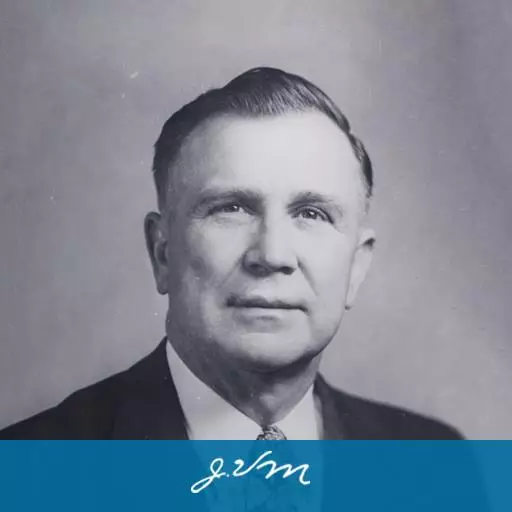
About Dr. J. Vernon McGee
John Vernon McGeewas born in Hillsboro, Texas, in 1904. Dr. McGee remarked, "When I was born and the doctor gave me the customary whack, my mother said that I let out a yell that could be heard on all four borders of Texas!" His Creator well knew that he would need a powerful voice to deliver a powerful message.
After completing his education (including a Th.M. and Th.D. from Dallas Theological Seminary), he and his wife came west, settling in Pasadena, California. Dr. McGee's greatest pastorate was at the historic Church of the Open Door in downtown Los Angeles, where he served from 1949 to 1970.
He began teaching Thru the Bible in 1967. After retiring from the pastorate, he set up radio headquarters in Pasadena, and the radio ministry expanded rapidly. Listeners never seem to tire of Dr. J. Vernon McGee's unique brand of rubber-meets-the-road teaching, or his passion for teaching the whole Word of God.
On the morning of December 1, 1988, Dr. McGee fell asleep in his chair and quietly passed into the presence of his Savior.
Contact Thru the Bible - Sunday Sermon with Dr. J. Vernon McGee
info@ttb.org
https://ttb.org/
Mailing Address
Thru the Bible, Inc.
P.O. Box 7100
Pasadena, CA 91109
In Canada:
Box 25325,
London, Ontario
N6C 6B1
Phone Number
(626) 795-4145 or
(800) 65-BIBLE (24253)