

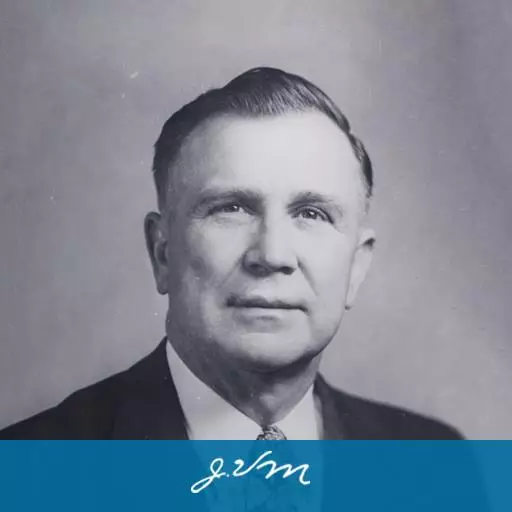
The Man Who Never Died


What does it really mean to walk with God? As we travel through Genesis 5, Dr. McGee introduces us to Enoch—a man who lived by faith in a world marked by death. His story shows us what living by faith can look like in everyday life, and how trusting God day by day still matters in a world that’s always changing.
Steve Schwetz: Walking through Genesis chapter 5 feels like visiting a graveyard. Name after name, life after life, each record ends the same way with the phrase "and he died." It’s a sober reminder of what happened when sin entered the human family.
God created man in his own likeness, but after the fall, Adam passed on a fallen likeness to every generation that followed. Death became the great certainty of life. But right in the middle of this dark chapter, God places a bright beam of hope.
One name breaks the pattern. One life doesn’t end the same way. Verse 24 says, "and Enoch walked with God and he was not, for God took him." I’m Steve Schwetz, welcoming you aboard the Sunday Sermon on Thru the Bible.
In Dr. McGee’s message, "The Man Who Never Died," we’re going to meet Enoch, a man who lived in close fellowship with God and was taken without ever experiencing death. As we examine his life, we’ll discover what it means to live by faith in a dying world.
Let’s pray as we begin. Father, would you open our eyes to your truth and then give us ears to hear your word. Teach us, Lord, how to live in fellowship with you. In Jesus’ name we pray, amen. Here’s the Sunday Sermon on Thru the Bible with Dr. J. Vernon McGee.
Dr. J. Vernon McGee: I'd like to read in your hearing these few verses from the fifth chapter of Genesis, and I begin now at verse 20: "And all the days of Jared were nine hundred sixty and two years, and he died. And Enoch lived sixty and five years and begat Methuselah. And Enoch walked with God after he begat Methuselah three hundred years and begat sons and daughters. And all the days of Enoch were three hundred sixty and five years. And Enoch walked with God, and he was not, for God took him."
Genesis 5, from which this passage is taken, is one of the most disappointing, discouraging, doleful, dark, and dull chapters of the Bible. However, it opens on a bright note, on a very bright and high note: "This is the book of the generations of Adam. In the day that God created man, in the likeness of God made he him. Male and female created he them and blessed them and called their name Adam in the day when they were created."
That's a very high note. But something happened—a great catastrophe took place. That's recorded back in the third chapter of the book of Genesis. And Adam, through disobedience—doubt that led to disobedience—he plunged his entire progeny and his offspring into sin.
So that from that moment on, all have a fallen nature. And you find that Adam lived a hundred and thirty years, and he begat a son in his own likeness. And that's a likeness that is a fallen likeness. No longer a son of God, now alienated from God—a man that ran from God, and God had to come and get him.
God had to clothe him in order that he might stand in his presence. And from that moment on, that is the thing that has happened to the human family. Now, that's clearly evident today. In this day in which you and I are living, we are, for instance, right now seeing the rise of what is known as the new morality.
It is actually an old morality. It's as old as the Garden of Eden. It's a doubting of God, the throwing off of all revelation, and that now we are going to get rid of all Bible ethics, and man now is out on his own doing something entirely different. They call that the new morality.
It's not new at all; it's as old as the human family is. That's what they've been doing. Well, that all is an evidence that the word of God is accurate when it says that when man fell, it was total depravity. And it's coming out again in this day in which we live.
There's a bit of a storm blowing through the world this morning. And that bit of a storm is the result of what Adam did in the Garden of Eden. He has an offspring in this world today, and that offspring are in rebellion against God. That's the picture of the human family.
Now, the very final evidence of it is this: in Adam all die. And now you follow the sons of Adam in chapter 5, and it goes something like this: "And all the days that Adam lived were nine hundred and thirty years, and he died. And all the days of Seth were nine hundred and twelve years, and he died. Verse 11, and all the days of Enos were nine hundred and five years, and he died."
That's the story of man. It's like a walk through a cemetery. And frankly, friends, God's not dead, but man is. He's not dead to the world, he's not dead to himself, he's not dead to sin, but he's dead to God today. That's the picture of man: "And he died."
By man came death. And this chapter gives the lie to the lie of Satan—and he was a liar from the beginning. He said to Eve, "Ye shall not surely die." He's a liar. They've been dying ever since. "Ye shall not surely die."
Now, there's one shaft of light in this morbid mausoleum that we have here: "And Enoch walked with God, and he was not, for God took him." This man didn't die. And a question arises, well, what in the world happened to Enoch? Well, we are told he was not—God took him.
What does it mean? Well, the writer to the Hebrews says, "By faith Enoch was translated, so that he should not see death. He was not, for God translated him." And that word "translate" is *metatithemi*. *Tithemi* means to place, and *meta* means over.
It means to place over. And it actually means to place over death. He went over death, not through it at all. Let me give you the word of another, and it's the finest word I've ever read on this. It's Dr. B.H. Carroll, who was one of the greatest theologians of the Southern Baptist Church years ago.
Listen to this: "God translated him." This is an old Latin word and irregular verb, and it simply means carried over or carried across. God carried him across. Across what? Across death. Death is the river that divides the world from the world to come, and here was a man that never did go through that river at all.
When he got there, God carried him across. God transferred him, translated him. God picked him up and carried him over and put him on the other shore. And walking along here in time and communing with God by faith, in an instance, he was communing with God by sight in another world.
Faith, oh precious faith. Faith had turned to sight and hope had turned to fruition in a single moment. The life of faith was thus crowned by entrance into the life of perfect fellowship above: "And they shall walk with me in white" (Revelation 3:3-4).
What a wonderful explanation that is. He's one of two men—that is Enoch—who did not die. Elijah is the other one. God put down, I think, in Genesis, certain great principles. Someone has said that all truth is germane in Genesis. It's the seed plot of the Bible.
And what you have in the rest of the Scripture is the bud opening up into the flower, and further explanation given. But actually, friends, the book of Genesis contains just about every great truth that you have in the word of God. Now in Enoch, there is here something that's quite wonderful.
He is a picture and a representative of another group of people that are yet not to die. They're in the church. Whether they're living today, I do not know. But one of these days, we are told that the Lord will take out of this world his church.
He'll take those that have died for nineteen hundred years, and that's the larger company. But there will be a group of people alive—believers at that time—who will not go through the river of death. They'll go over the river of death just as Enoch did.
Will you listen to the word of God? Our Lord Jesus introduced it first in the 14th chapter, but notice what Paul says in 1 Corinthians 15:51: "Behold, I show you a mystery; we shall not all sleep"—that is, the body will not die—"we shall not all die, the body, but we shall all be changed, in a moment, in the twinkling of an eye, at the last trump. For the trumpet shall sound, and the dead shall be raised incorruptible, and we shall be changed"—the we, those that are alive at that time, just as Enoch was.
Again, he gives further light on it in 1 Thessalonians 4:15: "For this we say unto you by the word of the Lord"—this is something he got directly—"that we which are alive and remain unto the coming of the Lord shall not go before them that are asleep. For the Lord himself shall descend from heaven with a shout, with the voice of the archangel, the trump of God, and the dead in Christ shall rise first.
Now note: then we which are alive and remain shall be caught up together with them in the clouds to meet the Lord in the air, and so shall we ever be with the Lord." Now, that is the great New Testament truth that we call today the Rapture of the church.
Now, to me, this is no longer academic. I can say to you today there was a time when I believed it, but it was just academic. But it's become in the past few months a very precious truth to me. I had told the Lord and I begged him, I plead with him not to let me die of cancer.
I don't know whether he'll hear my prayer or not. But I do know this: that I sure would like for him to come. It'd be a wonderful thing if he would come. And this is a great truth to me today. I want you to notice something else. Enoch was taken out before the judgment of the flood.
And my friend, the church will be taken out before the judgment of the Great Tribulation period. You can be sure of one thing: when God puts down a pattern, he always trims along that line. He never departs from it. And so we have the picture given to us here.
Now, what I've just said is spectacular. It is sensational. Will you listen to me carefully now, because what I'm going to say is strange coming from me? I'm known as a fundamentalist that leans backwards and emphasizes prophecy. There is another facet of truth.
It's not spectacular, but it's special, and it's more important for us this morning than the Rapture. You say, what could it be? Will you listen? "And Enoch walked with God after he begat Methuselah three hundred years and he begat sons and daughters."
He walked with God, we're told, after he begat Methuselah. And I read here in verse 21: "And Enoch lived sixty and five years and begat Methuselah. And after that, he walked with God." I do not know what the first sixty-five years of this man Enoch was.
I take it that he was pretty far from God. I take it he was not redeemed. I take it that he was like the rest of that generation that was then marching to the flood. But when that little boy was born—Methuselah—and we always think of him being an old man with whiskers that you walked on and a walking cane.
But did you ever stop to think he was one time a little baby in a crib? And that's the first time that Enoch saw him—was not an old man, but a little bitty fellow, a baby in a crib. And when he looked down and saw that baby, that turned him to God.
My friend, sometimes God puts a baby in your family just for that purpose. And if a baby won't bring you to God, nothing else will. The preacher just well stay home. Enoch looked down in the little crib, and there was Methuselah.
And he said, "I've got to bring that little fellow up right. My life is not right. I know this line I'm in is a line where men have known God, and I'm going to worship God." And so from that moment on, it says he walked with God.
Only two men in the Bible, it's said of them they walked with God. On the next page is Noah: "These are the generations of Noah. Noah was a just man and perfect in his generations, and Noah walked with God." Evil day, too. Genesis 6:9, "he walked with God."
And Enoch walked with God. I assume, however, there are others in the scripture, but it's not mention of them. Now, what is involved in this phrase of walking with God? What is the reference? What are the implications? What does it mean to walk with God?
This is important. I'd like to suggest this morning several. First of all, walking with God implies agreement. There must be agreement with God. Amos, in his prophecy in chapter 3, verse 3, asks a question that's an axiom of scripture.
It's an axiom like any that's in geometry. "Can two walk together except they be agreed?" Can they? They cannot. They have to walk in harmony. They have to walk in agreement. Now, he lived in a day of hostility to God, a day that was hastening to the flood, a day when men were in rebellion against God.
And it was a picture of that day, it's a picture of today, it's a picture of the human family. David speaks of it in Psalm 14, verse 2: "The Lord looked down from heaven upon the children of men to see if there were any that did understand and seek God.
They are all gone aside; they are all together become filthy. There is none that doeth good, no, not one." Now God says that—I didn't say it—and God means every word of it. There's not a man on top side of this earth that in his natural condition is seeking God.
He's running from him. Paul confirms it in Romans 3:11: "There is none that understandeth; there is none that seeketh after God." Now, that's the word of God. You take it or leave it, but that's what God says. That's the sad fruit of sin.
Here is a day when men were in rebellion against God, and this man was walking in agreement with God. Now, don't get the notion that God had changed his mind and he decided, well, it looks pretty bad down there, no one wants to walk with me.
I think I'll go down and walk with Enoch and agree with him. You can be sure of one thing: that God hadn't changed, but Enoch had. God hadn't changed from the days of Abel. You remember we saw that Abel, he came to an altar, right? Outside of the Garden of Eden, there was that altar.
And he brought a little lamb because that little lamb recognized two things: it recognized his condition as a sinner and it recognized the character of God—that God was holy and there must be a payment, there must be a penalty for sin.
And he brought a little lamb; he offered that little lamb by faith. And that's the way he came. That, my friend, is the way that Enoch came. He did it by faith. "By faith Enoch..." Enoch walked with God. And that walk originated—it had its beginning—at an altar where he agreed with God that he was a sinner and a sacrifice was needed, that there must be a lamb of God to take away the sin of the world.
It must begin there. God won't begin with any man any other place than the cross of Christ. He said he won't. God said to his own people, "O house of Jacob, come ye, and let us walk in the light of the Lord." And they were far from God.
And God says that he's not going to walk with you in sin. He won't walk with you unless you begin where he begins. He had to walk in newness of life. He had to come to that place that speaks of the one who later on said, "I am the way, the truth, and the life. No man cometh to the Father but by me."
There has to first of all be agreement if you walk with God. You have to begin where he begins. Then the second is nourishment. The word "walk" here in the Hebrew is an interesting word. And I spent some time yesterday looking at it.
One of the facets of the meaning of it—it means to walk up and down. In fact, when it's brought over in the New Testament, it's *peripateo*. *Peripatetic* is our English word. In fact, there was a school of philosophy in Greece—it's Aristotle's school of philosophy—that's known as the peripatetic school.
It wasn't because of his peculiar teaching; it was because of the way in which he taught. Aristotle is said to walk up and down in teaching. And as he walked up and down, his school got the name of peripatetic. That's the same word.
Walking with God means to walk up and down. And will you follow me very carefully now? It actually means to live with God. By faith Enoch was translated, so that he should not see death. He was not found, for God had translated him.
Before his translation, he had this testimony: that he pleased God. For without faith, it's impossible to please him. For he that cometh to God must believe that he is, that he's a rewarder of them that diligently seek him.
Now, this man walked with God by faith, we're told. And faith, we're also told, cometh by hearing and hearing by the word of God. Enoch walked by faith, and he walked by the word of God. What God told him when God said Abel had to bring a sacrifice to that altar to recognize he's a sinner and Enoch, you'll have to begin there.
You have to go back to the exit of the Garden of Eden and that's your entrance to life. And he went back there and began, and from that moment on, he walked with God. He's walking in the light now of the word of God.
John puts it to believers like this, and he puts it very plainly, 1 John 1:6 and 7: "If we say that we have fellowship with him and walk in darkness, we lie and do not the truth. But if we walk in the light as he is in the light, we have fellowship one with another, and the blood of Jesus Christ, God's Son, keeps on cleansing us from all sin."
In other words, when you walk in the light of the word of God, you see yourself as you really are. And then you find that the blood of Christ will cleanse you so you can continue on to walk with him. Now, the light is the word of God.
Psalm 119:105: "Thy word is a lamp unto my feet, a light unto my path." If you're going to walk, you walk in the light of the book. Psalm 119:130: "The entrance of thy words giveth light." Now, hear me very carefully. There's a movement today, another movement—and believe me, this is the day, friends, when we've got every kind of religious gimmick that's imaginable that's appearing on the scene.
There's a movement today that strives to be spiritual and superior without regard for the word of God. The word of God causes divisions, they say. And the talk goes like this when they meet together—I have met with the group one time, one time.
Here is the way the leader began: "Now," he says, "we want to meet together here in fellowship. And we'll not read the word of God. We just want to meet about the person of Christ and think about him and not regard the word of God at all."
What's wrong with that? Sounds, oh, it sounds so plausible and sounds so good that we don't want to have divisions. And here we've all met from different groups, and we have our peculiar viewpoints. Now let's leave the book aside, and we'll not read it; we'll just meet about the person of Christ.
My friend, how do you meet about the person of Christ without his word? The Lord Jesus said this in his day, Mark 7:9: "Full well ye reject the commandment of God that ye may keep your own tradition." And a very fine British writer has said this: "Division and disunity among Christians is not the ultimate sin.
Rather, the ultimate sin is the obscuring of God's truth by the accumulation of man-made traditions and its distortion by human opinions." That's what causes the trouble. Not the word of God, it's the human element. And the human element is always in there, humans meet together.
But what do you do with the words of our Lord: "He that heareth my word and believeth on him that sent me." How can you meet about his person and not meet about his word? "If ye love me, keep my commandments."
How are you going to meet about his person without his word? You can't do it. It reminds me of a little game I played several years ago. When we lost our first child, a family that was in the neighborhood of the church in Pasadena was deserted by the father.
And one of the most precious little families I've ever seen. Three of the most precious children, and we took one of them, the middle child, about three years old or four years old. And one night, I'd built a fire in the fireplace and was sitting there with the little one.
And the door—the front door—just came open for no reason in the world; it just came open. And I could see she was frightened a little. And in order not to frighten her more, I got up and went to the door and I said, "Oh, it's you, Mr. Foo-Foo. Come right on in."
And so I invited Mr. Foo-Foo in. And she just stood up there bug-eyed as she looked around. And I had him sit down, and I talked with him. And then Mr. Foo-Foo said he had to go. And then he left, and I closed the door. You know what she did the next night?
She said to me, "Mr. Foo-Foo's at the door." And I'm telling you, she was ready to play it. And she and I played it to the hilt. I went to the door and I opened and I said, "Come in, Mr. Foo-Foo." And he came in, and he sat down, and she talked to him.
It was a good game. We played that as long as we had that little girl. My friend, Mr. Foo-Foo never existed. There are a lot of Christians, oh will you hear me, that are playing Mr. Foo-Foo with Jesus. He is not a reality to them.
God was a reality to Enoch. He pondered the word of God. He listened to what God had to say, and it meant something to him. And he had fellowship with the living and true God. He was his companion. He lived with God. And it brought joy and peace to him.
Joy and peace. David says, "Yea, though I walk through the valley of the shadow of death, I'll fear no evil, for thou art with me." Is he with you? Enoch knew God personally. There was a growth in grace. Mary and Martha, they're the illustration of it. Mary and Martha.
Actually, both of them knew Jesus in a way. But Martha actually didn't know him, didn't know who he was, didn't know. Will you notice? Then Martha, as soon as she heard that Jesus was coming, went and met him. But Mary sat still in the house.
Then said Martha unto Jesus, "Lord, if thou hadst been here, my brother had not died." And actually, this is not a rebuke but just sorrow for her brother and the emphasis is upon him and not upon the Lord at all. But notice what she says: "But I know that even now, whatsoever thou wilt ask of God, God will give it thee."
Hasn't she found out yet he is God? Well, she hadn't. But Mary had. Mary sat in the house and waited until she was called for. And she went out. And when she went out, our translation gives the impression it's the same thing: "Lord, if thou hadst been here, my brother had not died."
It's a little change, but it's more than that. "Lord, if thou hadst been here, had not died my brother." The emphasis is this: "Oh, Lord, with you present, nothing could happen." The emphasis is upon him. She knew him as the Lord. Martha did not at first.
And that's the reason they had to go through this experience so Martha might learn also. My friend, Mary sat at Jesus' feet. Do you know Jesus today? Oh you say, "I trust him. He's my Savior." I'm convinced you can do that and not know him.
Oh you cannot know what fellowship is, you cannot know what it is to sit at his feet, and you cannot know what it is to have a devotion and a love for him. My friend, is he real to you this morning? Are you playing Mr. Foo-Foo?
In the next few months and certainly the next few years, your faith will be tested, I guarantee you that. There is right now on the horizon these movements that are coming, and you better be dead sure Jesus Christ is real to you. Because they're coming and it's frightening.
Now, I must move on. What does it mean to walk with God? It means development. This word "walk" has another meaning. It means not only to walk up and down, but it means to go on. It means to proceed forward. It means steady progress.
And again, I think that the best that I can do is to quote. And quote from a very quaint commentator of the past who was a Scotchman. He said, "Enoch did not take a turn or two with God and then leave his company, but he walked with God for hundreds of years."
What a splendid walk. A walk of three hundred years. It was not a run, it was not a leap, it was not a spurt, but a steady walk. Walking with God—that's what it meant. "He's a rewarder," the writer to the Hebrews says. "He that cometh to God must believe that he is." Is he real?
"And that he's a rewarder of them that diligently seek him." And another translation, I think, brings out the thing the writer is actually saying: "and that he ever rewards them that are seeking him." And that means a constant attitude of a passion for God.
Are you seeking him? Moses said, "Show me thy glory." You want to see his glory? Philip says, "Show us the Father and it sufficeth us." Do you really want to see him? You won't unless you have a passion. You want to see him.
That's what Paul means when he writes to the Galatians, for instance. Now I want to turn there for just a moment. He says, "This I say then, walk in the Spirit, and ye shall not fulfill the desires of the flesh. Walk by means of the Spirit."
And then he won't let that go. In verse 25 of this fifth chapter, he says, "If we live in the Spirit, let us also walk in the Spirit." And did you notice these verses I read in Ephesians? First part's doctrine, but the last part is very practical: "I therefore, the prisoner of the Lord, beseech you that ye walk worthy of the vocation wherewith ye're called."
In verse 17, "This I say therefore and testify in the Lord that ye henceforth walk not as other Gentiles." You can't walk that way and walk with him. You have to make up your mind who you're going to walk with.
And he keeps on developing that. You're to grieve not the Spirit if you're to walk with him. And today, you're either living with a grieved or ungrieved Spirit if you're a child of God. "And walk in love as Christ has also loved us."
And then again he says, "Walk as children of light. Walk circumspectly and be not drunk with wine but be filled with the Holy Spirit." That's what it means to be filled with the Holy Spirit—is to walk with God. Walk with the Lord Jesus Christ.
And to walk with him means a development. It means you'll grow in grace and the knowledge of him. And there will come a day in your experience that you won't need all of this argument to prove to you the Bible is true. You'll know it's true.
I get rather impatient with some of the saints who've been saints twenty-five years, and they say, "Ooh, look what Mr. So-and-So said. Is the Bible true?" My friend, didn't you settle that years ago? And Mr. So-and-So or Doctor So-and-So, you can be sure of one thing, hasn't found out anything.
The disturbance is up here in your mind of not walking with him. Then finally, and before I leave that, may I say this: There are a lot of folks today let a little rain keep them away. Now, many have legitimate reasons. But there are many today that he's not real to you.
Why, my friend, if there was a football game and your alma mater was playing, you'd be there wouldn't you, rain or shine? Because football's real to you. I've sat in the rain many a time watching a football game. And I've hunted in the rain because I love to hunt.
I played golf in the rain because I'm a nut. And my friend, do you think I'm going to let a little rain keep me from worshipping my Savior? Well, I will if he's not real to me. If he's real to you today, you talk to him this morning about it.
The last is this: to walk with God means a testimony. This is very important, you see. It means agreement, it means nourishment, it means development, but it means testimony. Paul said something to the Corinthians, and it's amazing he'd say it to them, but he did.
He said, "Ye are our epistle, written in our hearts, known and read of all men. Forasmuch as ye are manifestly declared to be the epistle of Christ ministered by us, written not with ink but with the Spirit of the living God, not in tables of stone but in fleshly tables of the heart."
Well, Enoch was a witness. He was a testimony. He was a Bible for that unbelieving world of that day. He was a testimony. "By faith Enoch was translated so that he did not see death and was translated. He was not, for God took him. For he had this testimony... he pleased God."
And without faith, it's impossible to please him. This man walked by faith. But even more than that, there is one of the strangest texts in the scripture that concerns this man Enoch. And it's the only other reference to him in the Bible.
Jude 14 and 15, written concerning apostates—our day: "And Enoch also, the seventh from Adam, prophesied of these, saying, 'Behold, the Lord cometh with ten thousands of his saints, to execute judgment upon all, to convince all that are ungodly among them of all their ungodly deeds which they have ungodly committed, and of all their hard speeches which ungodly sinners have spoken against him.'"
Martin Luther said that this scripture reveal that Enoch was an aggressive testimony to his generation. He bore a witness to the fact that there was a coming judgment, and he didn't mind speaking out concerning it.
Now, don't misunderstand me. Enoch did not give out tracts. That has its place; don't misunderstand me. He didn't sing in the choir. That's important. And he didn't preach from the pulpit. That's important. And he didn't go as a missionary.
That's important. His testimony was he pleased God because he walked by faith. Without faith, it's impossible to please him. He was known as a man of faith in his day. How you known where you work, where you live?
Are you a man of faith? Do you believe God? Do you live like it? I invite you to join a minority today to march. This is a day of marching, especially for minority groups. I'm asking you to join a minority group to march today.
And the marching is not to the capital or Washington, but it's to walk with God right where you are. And you can begin by agreeing with God by meeting him at the cross of Christ and trusting a Savior that died for you.
And you can't begin with him any other place. You'll never march with God till you come there. Peter says there's none other name under heaven given among men whereby we must be saved. It's initiated by faith. That's the only way you can come. That's the only way you can come.
I think that we should close this message like this. It's a familiar story of the little girl who went to Sunday school. When she came home, her mama said, "What did you study about?" She said, "About a man named Enoch."
She said, "Well, what about him?" Well, she said, "It seems that Enoch walked with God every day. God would come by his house and say to Enoch, 'Let's take a walk.' And Enoch would say, 'All right,' because he liked to walk with God.
And every day they took a walk. In fact, it got so that Enoch would wait at the gate for God to come, and then they'd take a walk. And one day, they took a long walk, and they got so interested in each other that finally it got late.
And Enoch says, 'It's late; I must get back home.' And God says, 'Enoch, you're nearer my home than you are your home. Come on home with me.'" I don't know how to say it better. Have you begun that walk with God?
You can meet the Lord Jesus this morning at his cross. That's where you have to begin. It can become a sweet walk and become a blessed walk, a walk of peace and joy. You know anything about it today? Are you tired of your burden of sin, under tension and pressure today wondering about the storm blowing outside?
He's not worried. He's not disturbed. And he says, "If you walk with me, I'll protect you." Just put your hand of faith in his hand. That's all he asks you to do. And then let him become a reality to you. He wants to, but again you'll have to come his way.
Steve Schwetz: This week, get your daily dose of Thru the Bible as we continue our journey through the book of Genesis. You can listen anytime through our app. You can also listen online at TTB.org.
And you can find us on a local radio station that carries Thru the Bible as well. Just call us at 1-800-65-BIBLE. Again, that’s 1-800-65-BIBLE if we can help you listen to Thru the Bible. And if God has placed it on your heart to partner with us as we take the whole word to the whole world, well you know we’d love to hear from you at that same number, 1-800-65-BIBLE.
I’m Steve Schwetz, so grateful for your prayers and your partnership. And as we go, I pray Jude 24 and 25 over you, asking the Lord to keep you from stumbling and to present you blameless before his presence with great joy, now and always. Amen.
Well, ride the Bible Bus for five years and you’ll be amazed at what God teaches you from his word about what it means to believe on the Lord Jesus Christ and you will be saved. It’s a blessing that keeps on going. That’s what we believe at Thru the Bible.
Featured Offer


Featured Offer
About Thru the Bible - Sunday Sermon
These Sunday Sermon messages form a collection of the most effective and fruitful sermons given by Dr. J. Vernon McGee during his 21-year pastorate (1949-1970) at the historic Church of the Open Door when it was located in downtown Los Angeles.
Other Thru the Bible Programs:
Thru the Bible - Minute with McGee
Thru the Bible - Questions & Answers
About Dr. J. Vernon McGee
John Vernon McGeewas born in Hillsboro, Texas, in 1904. Dr. McGee remarked, "When I was born and the doctor gave me the customary whack, my mother said that I let out a yell that could be heard on all four borders of Texas!" His Creator well knew that he would need a powerful voice to deliver a powerful message.
After completing his education (including a Th.M. and Th.D. from Dallas Theological Seminary), he and his wife came west, settling in Pasadena, California. Dr. McGee's greatest pastorate was at the historic Church of the Open Door in downtown Los Angeles, where he served from 1949 to 1970.
He began teaching Thru the Bible in 1967. After retiring from the pastorate, he set up radio headquarters in Pasadena, and the radio ministry expanded rapidly. Listeners never seem to tire of Dr. J. Vernon McGee's unique brand of rubber-meets-the-road teaching, or his passion for teaching the whole Word of God.
On the morning of December 1, 1988, Dr. McGee fell asleep in his chair and quietly passed into the presence of his Savior.
Contact Thru the Bible - Sunday Sermon with Dr. J. Vernon McGee
info@ttb.org
https://ttb.org/
Mailing Address
Thru the Bible, Inc.
P.O. Box 7100
Pasadena, CA 91109
In Canada:
Box 25325,
London, Ontario
N6C 6B1
Phone Number
(626) 795-4145 or
(800) 65-BIBLE (24253)