

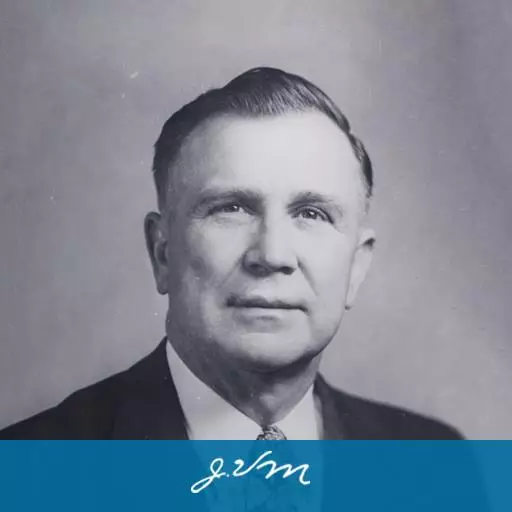
The Greatest Commandment


Among the hundreds of commandments given to Israel, which one matters most? More than a rule to obey, the greatest commandment reveals what God desires from every one of us: a wholehearted love for Him that transforms every part of life. When this command is understood and lived out, all the others begin to fall into place.
Narrator: What if you could teach your children or grandchildren just one rule that could apply to every situation that they'd ever face? Welcome to the Sunday Sermon on Thru the Bible. Our Bible teacher Dr. J. Vernon McGee takes us back to Moses' final sermon to the children of Israel at one of the most important crossroads in their history.
So what is that rule? Well, we're going to discover it in Deuteronomy chapter 6 verse 4. If you got your Bibles, join me there.
Now in Jewish tradition, this passage begins with what's called the Shema. It's the central centerpiece of every morning and evening Jewish prayer service and it's been described as the declaration that sets the Jewish faith apart from all others. It's that important.
We don't often do this, but because of the significance of this passage, let's read God's word together in preparation for the sermon. And I'm reading Deuteronomy chapter 6 verses 4 through 9. "Hear, O Israel, the Lord our God, the Lord is one. You shall love the Lord your God with all your heart, with all your soul, and with all your strength. And these words which I command you today shall be in your heart. You shall teach them diligently to your children, and shall talk of them when you sit in your house, when you walk by the way, when you lie down, and when you rise up. You shall bind them as a sign on your hand, and they shall be as frontlets between your eyes. You shall write them on the doorposts of your house and on your gates."
Dr. McGee's sermon also takes us to the New Testament where Jesus is asked which commandment is the greatest of all. Do you know how he answered? I'll let you discover that for yourself. Before we turn to our sermon today, let's pray.
Father, thank you for your beautiful and life-giving word. Help us listen now with all the seriousness and joy that this passage deserves. Thank you for Jesus, in whose name we pray. Amen.
Now, here's our Sunday sermon with Dr. J. Vernon McGee on Thru the Bible.
Host: Our subject of the morning is the greatest commandment. This morning we shall be using a great deal of scripture, and I would like to begin today by going to the New Testament, the 22nd chapter of the Gospel of Matthew at verse 35. Will you listen to this language very carefully.
"Then one of them, which was a lawyer, asked him a question, tempting him and saying, 'Master, which is the great commandment in the law?'"
"Jesus said unto him, 'Thou shalt love the Lord thy God with all thy heart, with all thy soul, with all thy mind. This is the first and great commandment. And the second is like unto it, thou shalt love thy neighbor as thyself.' On these two commandments hang all the law and the prophet."
The last question that was put to Christ by his enemy was put by the religious rulers when they asked him which was the greatest commandment. We are told that after he answered that question, the answer which we just read, they never came to him again with a question. Now this is the first time that our Lord answered this question just like this, but it's not the first time that he had made this declaration.
This momentous thesis was declared before by our Lord when another lawyer came to him and asked him, tempting him concerning the great commandment, and at that time our Lord gave to him the wonderful parable of the Good Samaritan. I turn now to Luke the 10th chapter, verse 25. "Behold, a certain lawyer stood up and tempted him saying, 'Master, what shall I do to inherit eternal life?'"
"He said unto him, 'What's written in the law? How readest thou?' And he answering said, 'Thou shalt love the Lord thy God with all thy heart, with all thy soul, with all thy strength, with all thy mind, and thy neighbor as thyself.' Apparently, there was a feeling among the religious rulers of that day that this was the greatest commandment. He said unto him, 'Thou hast answered right. This do and thou shalt live.'"
So that our Lord, during his entire ministry, had set before them the fact that this was the greatest commandment. Now there are two considerable facts of great consequence and in the answer that our Lord gave that are self-evident here. The first one is this: Christ did not go to the Ten Commandments to get the greatest commandment.
He went to this passage in Deuteronomy that contains the greatest doctrinal statement in the Old Testament. "Hear, O Israel, the Lord our God is one Lord. Thou shalt love the Lord thy God with all thine heart, with all thy soul, with all thy might."
Now this is the commandment that our Lord took and he said it was the greatest. Why didn't he go to the Ten Commandments? He might have taken the first commandment, "Thou shalt have no other gods before me." But he didn't go there. And there are a great many people today think that he should have taken the Sabbath day and made it the greatest. But he didn't do that.
The interesting thing is that he went to the book of Deuteronomy and he lifted out a commandment that's not even connected with the Ten Commandments at all. And it's quite interesting that our Lord seemed to have quoted from Deuteronomy more than any other book in the scripture. It was the book he quoted from twice in the three answers that he gave to Satan in his temptation.
And the very interesting thing is that this is the first book of the Bible that was ever attacked by the higher critics. And you can see the satanic hatred of this book, the book that our Lord went to and he gave it a great deal of importance. I believe today we should give it a great deal more importance than we have, in spite of the fact it's not very interesting reading.
Our Lord went to this book that was given at the end of the wilderness march. He didn't quote from that which was at the beginning, but that which was at the end. And in the book of Deuteronomy, you find that the law has been tested in the crucible of 40 years' experience in the wilderness.
And here is pulled out of the test tube of this rugged experience, and now our Lord comes up with this and says, "Here is the greatest commandment, 'Thou shalt love the Lord thy God with all thy heart, and with all thy soul, and with all thy mind.'"
There is the second thing that we should notice here that's in a doctrine. On both occasions when Christ took up the greatest commandment, he didn't leave it with just one, he took two. He always put these together. He says, "Thou shalt love the Lord thy God," but he says, "Thou shalt love thy neighbor as thyself." He says, "That's second."
Here are the first two, first and second commandment that our Lord put them in the order of their importance. He made it as you will find in First John that our relationship today are like a triangle. God is at the top angle. On the base, if one is you, on the other is your neighbor. And the relationship is a love relationship to God and a love relationship to those that are round about you.
That are God's children. John makes it clear that he's talking about God's children. Now the love of God and the love of the neighbor are both found in the book of Deuteronomy. Deuteronomy is not a repetition of Exodus and Leviticus. It's not merely stating the law the second time.
In Exodus and Leviticus, you have the emphasis upon the law. In the book of Deuteronomy, the emphasis is upon love. May seem strange, but the emphasis here is upon love, and the strangest thing of all is, it took God a long time to tell anybody that he loved them. You can go through Genesis, you won't find him telling anybody he loves them. You can go through Exodus, he doesn't tell anybody that he loves them. You can go through Leviticus, he doesn't tell anybody that he loves them. You can go through Numbers, and he doesn't tell anybody that he loves them.
But when you come to the book of Deuteronomy, and this is the book that came out after the wilderness experience. And a new generation enters the land, God says to this new generation, "I want you to know something, if you haven't discovered it so far, I love man." He demonstrated it, but he hadn't said it.
And you will find for the first time in Deuteronomy the fourth chapter, verse 37, and this is one of the most wonderful statements, "And because he loved thy fathers, therefore he chose their seed after them. Brought thee out in his sight, with his mighty power out of Egypt." My beloved, that is a glorious, wonderful truth. At the end of the wilderness journey, and they had had a rugged experience. It might be a question in the mind of some now, the new generation, "Does God really love us?" They had heard their parents say again and again, "We just don't believe God wants to bring us in the land. We don't believe he's interested in us."
Now God says to the new generation, "Look back, look back upon your father, and see how I dealt with them. I loved them. I loved them." And that explains the reason I dealt with them, and you will see my mercy extended to them again and again, "It is an evidence of my love for them."
In Exodus and Leviticus, you have law-filled love. But when you come to the book of Deuteronomy, you have love-filled law. Do you notice in Exodus and Leviticus, you will find that it's law, but even in that there is the mercy and love of God. In Exodus 20, verse 6, which is in the Ten Commandments, "And showing mercy unto thousands of them that love me. Keep my commandment."
"And in Leviticus the 19th chapter, verse 18, 'Thou shalt not avenge, nor bear any grudge against the children of thy people, but thou shalt love thy neighbor as thyself. I am the Lord.'" It's in Exodus and Leviticus, but it's a minor note there. It becomes a major note when you get to the book of Deuteronomy.
And we find in Deuteronomy, therefore, law-filled love. "Thou shalt love the Lord thy God, with all thy heart, with all thy soul, with all thy might."
And in the seventh chapter here, listen again. "The Lord did not set his love upon you nor choose you because you were more in number than any people, for ye were the fewest of all people, but because the Lord loved you." And when God started telling them how much he loved them, he couldn't let up. He just kept on telling them that he loved them. May I say that that's wonder of wonders that's something that we take for granted today, but it was a glorious truth in that day.
Therefore, you find in the book of Deuteronomy, the great principle of the gospel is set down here for us. "For God so loved the world." In Deuteronomy, he said, God says, "I have done this for you because I loved you."
And now God says to the world today, "For God so loved the world that he gave his only begotten Son, that whosoever believeth in him might not perish, but have everlasting life."
Now today, all conservative groups start off in harmony. They just don't come out together. That's the trouble. They don't finish in harmony, but they start out. Both those that are called covenant theologians today and those that are dispensational, they agree that there is a bifurcation between law and grace. Both of them go that far. Both of them make a correct division and distinction at this point. The law was given by Moses, but grace and truth came by Jesus Christ.
But I want you to notice something today that I feel that neither group are emphasizing as they should emphasize. And I know I have not emphasized it, but this book gives us that opportunity today. The Lord Jesus Christ came to fulfill the law, not to destroy it. He made that very clear. Over in the fifth chapter of Matthew verse 17, he said, "Think not that I'm come to destroy the law or the prophet. I'm not come to destroy, but to fulfill." Now will you notice how he did that?
In his life, he kept all the commandments. He kept the law. And this morning, up to this morning, he is the only person who's ever lived that has kept the commandment. Unless some of you here today have kept them. And I may be wrong, but I don't think you are here today.
No one has ever kept them. Only Christ has God been able to say, "Thou art my beloved Son, in whom I'm well pleased." Now he hasn't said that about me, and he hasn't said it about you. But he said it about Christ. In his life, he kept all the commandments of God, that which is expresses the will of God.
In his death, he kept the ordinances and the testimonies and the sacrifices. He fulfilled the law in all of its department, in many of its ramifications, in its minutest detail, our Lord kept the law.
Now the great principle of the law is love. I think we're forgetting that today, and we like to think of the Old Testament as being a little harsh, and God in the Old Testament is a little harsh. He is not. He's a God of love, and he's a God of love in the Old Testament. As well as a God of law in the Old Testament. And the great principle of law is always love.
God didn't give law to hurt mankind. His commandments, Paul says, are not grievous. Laws are not made by dumbbells in the legislature. Laws come from God, and they are for the real and welfare of mankind.
Now you have the great principle of the law of love, and we express our love by obedience. It must always be so. Will you notice what he says here in the ninth verse of the seventh chapter of Deuteronomy? "Know therefore that the Lord thy God, he's God, the faithful God, which keepeth covenant and mercy with them that love him and keep his commandment to a thousand generations."
Now the great principle of the gospel is expressed here in Deuteronomy, therefore. It's expressed in love, and again will you notice these expressions? Over in the fourth chapter again of Deuteronomy, verse 37, "Because he loved thy father, therefore he chose their seed after them and brought thee out up in his sight with his mighty power out of Egypt." God did that because of love.
And here in the sixth chapter, verse 5, "Thou shalt love the Lord thy God with all thine heart, with all thy soul, with all thy might." And then if you will notice, 5:14, and in that you will find that he mentioned here this great principle. And when you turn to the Epistle to the Galatians, Paul says, "Therefore all the law is fulfilled in one word, even in this: 'Thou shalt love thy neighbor as thyself.'"
Now having made a statement like we've made, someone asks the question, "Wherein then is the gospel new if we find the principle of it back in the law?" If you have love in the Old Testament, what's new about love in the New Testament?
And therefore, this morning, I want to deal with that particular problem. Will you notice very carefully, and Paul was very careful here today. First of all, the love of God has been translated into history by the incarnation, the death, and resurrection of Christ. So that Paul can write in Romans 5:8, "But God commendeth his love toward us in that while we were yet sinners, Christ died for us."
That's the way God revealed his love today. And it's a vast different. It's one thing to express love by bringing the children of Israel out of Egypt. It's another thing to die for them.
It's one thing to come down to the top of Mount Sinai and give commandment. It's another thing to come on down and take upon himself human flesh and suffer with mankind and bleed and die. That's love, my beloved.
May I say because of the fact that since the giving of the law and the present hour in which we live, God has extended and revealed his love to us as he never did in the Old Testament. So that today, salvation is a love story.
It's a love story. It's not a cold-blooded business proposition, even where he shed his blood and cashed on the barrelhead. He did shed his blood. But why did he do it? He did it because he loved us. Salvation is a love affair, and John, probably the last book written in the New Testament, is First John. In First John, he gathers all of this together and he says, "We loved him because he first loved us."
Now that's salvation. We love him because he first loved us.
Featured Offer


Featured Offer
About Thru the Bible - Sunday Sermon
These Sunday Sermon messages form a collection of the most effective and fruitful sermons given by Dr. J. Vernon McGee during his 21-year pastorate (1949-1970) at the historic Church of the Open Door when it was located in downtown Los Angeles.
Other Thru the Bible Programs:
Thru the Bible - Minute with McGee
Thru the Bible - Questions & Answers
About Dr. J. Vernon McGee
John Vernon McGeewas born in Hillsboro, Texas, in 1904. Dr. McGee remarked, "When I was born and the doctor gave me the customary whack, my mother said that I let out a yell that could be heard on all four borders of Texas!" His Creator well knew that he would need a powerful voice to deliver a powerful message.
After completing his education (including a Th.M. and Th.D. from Dallas Theological Seminary), he and his wife came west, settling in Pasadena, California. Dr. McGee's greatest pastorate was at the historic Church of the Open Door in downtown Los Angeles, where he served from 1949 to 1970.
He began teaching Thru the Bible in 1967. After retiring from the pastorate, he set up radio headquarters in Pasadena, and the radio ministry expanded rapidly. Listeners never seem to tire of Dr. J. Vernon McGee's unique brand of rubber-meets-the-road teaching, or his passion for teaching the whole Word of God.
On the morning of December 1, 1988, Dr. McGee fell asleep in his chair and quietly passed into the presence of his Savior.
Contact Thru the Bible - Sunday Sermon with Dr. J. Vernon McGee
info@ttb.org
https://ttb.org/
Mailing Address
Thru the Bible, Inc.
P.O. Box 7100
Pasadena, CA 91109
In Canada:
Box 25325,
London, Ontario
N6C 6B1
Phone Number
(626) 795-4145 or
(800) 65-BIBLE (24253)