

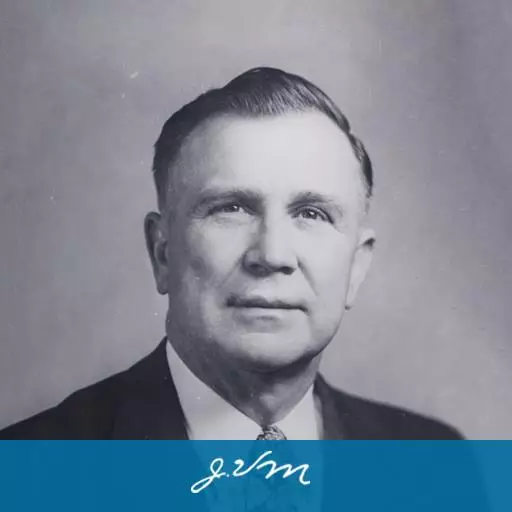
The Gospel in the Genealogy of Christ


Most readers hurry past the opening genealogy of Matthew, but in this message, we slow down and see what’s hidden in plain sight. Inside this long list of names are unlikely people—sinners, outsiders, and lives marked by scandal, faith, and grace. As the family line of Jesus unfolds, we discover that the gospel itself is already written there: God begins with sinners, honors faith, and redeems through love. Even a genealogy becomes a powerful testimony to the fact that God loves us and sent His Son to save us.
Steve Schwetz: What do you usually do when you come to a list of names in the Bible? Well, most people skim it or they just skip it entirely. But what if those names are actually telling a story?
Welcome to the Sunday Sermon on Thru the Bible. I'm Steve Schwetz, and in his message called "The Gospel in the Genealogy of Christ," Dr. J. Vernon McGee shows us that the opening verses of Matthew are far more than a list of ancestors. They're a window into the grace of God.
Matthew begins with a long line of fathers and sons stretching across centuries. At first glance, though, it may look like a page from a history book, but Dr. McGee helps us to see something remarkably woven into that list. In the family line of Jesus are unexpected people, outsiders, sinners, and unlikely stories of grace. And through them, God quietly tells the story of the gospel.
As we open Matthew chapter one, we're going to discover that even a genealogy can reveal the heart of God—a God who saves sinners, honors faith, and writes redemption into the most unlikely lives. Let's pray.
Father, thank you for your word and for the way that every part of it points us to your Son. Open our eyes to see the grace that's written into this passage and open our hearts to receive it. In Jesus' name, Amen. Here's the Sunday Sermon on Thru the Bible with Dr. J. Vernon McGee.
Dr. J. Vernon McGee: I'm turning to the first chapter of the Gospel of Matthew and I want to begin reading where the New Testament begins. "The book of the generation of Jesus Christ, the son of David, the son of Abraham."
Guest (Male): Abraham begat Isaac; and Isaac begat Jacob; and Jacob begat Judas and his brethren. And Judas begat Phares and Zara of Thamar; and Phares begat Esrom; and Esrom begat Aram; and Aram begat Aminadab; and Aminadab begat Naasson; and Naasson begat Salmon; and Salmon begat Booz of Rachab; and Booz begat Obed of Ruth; and Obed begat Jesse. And Jesse begat David the king; and David the king begat Solomon of her that had been the wife of Urias.
Dr. J. Vernon McGee: It was more years ago than I like to remember tonight that I went to a young people's conference, not as a speaker, but as a young person. It was the first conference I had ever been to. In fact, it was the first contact I had really had with anything that was Christian. And I never shall forget the Bible teacher there because he affected my life as much as anyone in such a brief time.
And he asked one morning, he said, "How many of you young people have read the Bible through during the past year?" Not a hand went up. And he asked the question again. He said, "How many of you have read the Bible through during the past year?" And again, not a hand went up. And he said, "I'm almost certain in a group this size," there were about 300 present, he said, "I'm sure that in a group this size that someone here has read the Bible through."
And a young man very gingerly and furtively began to put up his hand. And he said to him, he said, "Did you read the Bible through?" And the young man said, "Well, I didn't exactly read it through. When I got to those 'begats,' I just passed over them. I never read any of them." And the Bible teacher laughed and he said, "Well, that's what I do when I get to them." And right then and there, it impressed me that the Holy Spirit had wasted a great deal of printer's ink if the genealogies in the Bible are meaningless, or if they are just something like two plus two equals four and that ends them.
Now may I say that these genealogies are not interesting to read, and yet the Holy Spirit has seen fit to put them in the Word of God. They are there for a purpose. In one sense, they are the most important part of Scripture for this reason: that the purpose of the genealogies is to establish the line from which Jesus Christ came. And for that very reason, and that reason alone, they are all-important, and the Old Testament can be considered as just the family line of Jesus Christ. That is one of the reasons that the Old Testament has been given to us: to establish the family line of our Lord.
And the New Testament opens with this genealogy. I think properly so. I do believe that we do not use wisdom sometimes in giving a New Testament even to a folk to read. A friend of mine, a chaplain during World War II, told me that he regretted very much the fact that they gave out New Testaments instead of giving out single gospels.
He said, "I've given out literally thousands of New Testaments," and he said, "I've given them out in barracks and I've given them out on shipboard. I've given them out everywhere and I'd watch these fellows. They'd take some of them that had never had a Testament before, and they would open it up. Naturally, you always turn to the beginning of a book, and the fellow would lie down maybe on his bunk and he'd open it up. He'd start reading 'so-and-so begat so-and-so begat so-and-so.' 'What in the world kind of book is this?' And he'd put it down." And he says, "I've seen fellow after fellow put the book down."
He said, "I wish that another gospel had been given." And I imagine you are thinking tonight that the Gospel of John is the one that should have been given. I believe frankly the Gospel of Mark is the one that should have been given first to the fellows in the service, and then the Gospel of John, then the Gospel of Luke, and last of all the Gospel of Matthew. But it stands first in the New Testament because the New Testament stands or falls on that genealogy.
And if you want to know how accurate it is, when you get to the end of the Gospel of Matthew, you will find that the resurrection of Christ was questioned, but not the birth of Christ. This genealogy was not questioned. One of the reasons it was on display in the temple. You will find that they took good care of these genealogies. When they returned after the captivity and came back in the land, they took these genealogies. You will remember that Ezra did that. He kept these family lines and this family line evidently, and I believe that Matthew just copied this right out of the record that was on exhibit, and this is something that cannot be questioned. The Lord Jesus Christ came from this line.
And it's a remarkable one. I want you to notice how it begins. "The book of the generation of Jesus Christ," or the book of the family of Jesus Christ. Now that's a strange expression. If you would go through the rest of the New Testament, you wouldn't find that anywhere. Nowhere would you find the expression "the book of the generation of anybody." It's not mentioned.
If you should turn back in the Old Testament and you start going back—Malachi, go back through the prophets, go back through the poetic books, go back through the historical books and come to the Pentateuch—you won't have found, even in those long genealogies, you won't find that expression "the book of the generation." You come to Deuteronomy, you haven't found it there, and you come to the book of Numbers, it's not there. You keep moving back. It's not in Leviticus, it's not in Exodus, and you come to Genesis chapter 50. It's not there. 49, 48, 47, keep on going back. And oh-oh, all of a sudden, when you come to chapter five, you find "the book of the generation of Adam."
There are two books in the Word of God. One is the book of the generation of Adam. The other's the book of the generation of Jesus Christ. The book of the generation of Adam is the book that all of us are in. The entire human family's in it. I don't see anybody here tonight that I don't think is in that book. I think all of you are in the book of Adam, the human family. But that's an interesting book. It's the book of death. "In Adam all die." "By man came death." And that is the book of death.
There is another book, and it is the Lamb's Book of Life. It's the book of the generation of Jesus Christ. And you and I get in that book just like we get in the book of Adam: by a birth, by the new birth if you please. We are born into the family of God and get into the Book of Life—eternal life, if you please. There are those two books.
Now I said that all of you are in the book of Adam. I do not know whether all of you are in the Lamb's Book of Life. If you are, you got there because you've been born again. You got there because you have trusted Christ as your Savior. Now that story of salvation is woven into this genealogy here in a most remarkable way. The interesting thing is that in these six verses that I read in your hearing, there were four names that are recorded here that stand out as if they were in neon lights. They are remarkable. Actually, they don't belong here. And several of them are a source of embarrassment. Several of them, they just, well, they don't look like they should be here at all.
The interesting thing that makes them stand out, these four names are the names of women. Now, a woman did not get into a genealogy in that day. In other words, the woman did not count in that day at all. My, how times have changed since then. But we have the carryover of that today. We have, for instance, when a couple gets married. Whose name do they take? They take the name of the man. Why don't they take the name of a woman? There's no reason why they shouldn't, but according to our custom today, it's still the name of the man that's carried over in the genealogy.
So that men are listed, but the women are not listed. But I find in these first six verses that there are names of women. Four names of women that are put here. And that's unusual. Now that's not even the strangest thing about these four women. These four women that got in the genealogy of Christ, they are here and they are Gentiles and not Jewish.
And that, my friend, is remarkable indeed because in a genealogy where God was attempting to protect the line, they attempted to keep out Gentiles. And yet these four names, the names of women, they are the names of four Gentiles, and they all four got in the genealogy of Christ. Now tonight, I want us to see how and why they got into the genealogy of Christ because each one of them carries a story. And we have the gospel story given here in the names of these four women—these four Gentiles whose names stand out in neon lights.
Now the first one that is mentioned here is found in verse three. "And Judas begat Phares and Zara of Thamar." Thamar. She's the first one. Thamar got in the genealogy of Christ because of her sin. If she had not been a sinner, she'd never gotten in the genealogy of Christ. Now friends, that's a remarkable sort of thing. May I say to you that that's where God begins with us: as a sinner. God never begins with man on any other basis today.
Those of you that have followed through our study in Romans, we make people angry at first. They don't like the fact. I had a couple. They wrote me. They said, "We're active in the church. We've been listening to your program, and we're tired of you telling us every day we're sinners. We just don't like to be told that every day, and we want you to know that we do this." And then they headed up some department and they did this in the church and they did that. "And we want you to know we're not sinners." And I just came back and said they were sinners. And just kept saying it, you know?
The only reason I said it was because Paul spent three chapters saying that man is a sinner, and that no one is an exception to it, and that the only kind of people God will save are sinners. And until a man sees he's a sinner, he can never be saved. That's where God begins with you. God never has begun with any of us on any other basis than the fact we're sinners.
This business today of thinking that you can breeze into the presence of God and say, "Here I am, and here's what I do, and I want you to take me as I am." God says, "No. I don't take you as you are. And I don't accept what you do. In my sight, you're a lost sinner. You have a heart that's in rebellion against me. You are totally incapable of pleasing me in anything that you do. You're lost." That's where I'll begin with you. I begin with you as a lost sinner. All have sinned and come short of the glory of God.
Now that doesn't mean that some people are not worse sinners than others. It'd be foolish to say that they're not. But all have come short of the glory of God. It's obvious tonight that this evening, none of us—maybe after church you'd like to do this. I live up in Altadena, and up above me is Mount Wilson. I've lived there for 22 years now, and every year I've said I'm going to hike up there. So far, I have not hiked. And each year I know more and more I'm not going to do it. But every year I say I'm this is the year I'll do it. But I haven't done it yet. 22 years have gone by.
And if you want to know the truth, I don't think I will. But really and truly, after church tonight, if you want to play a little game with me, I'll play with you. We'll go out here and run up Hope Street and see who can jump to the top of Mount Wilson. Maybe you'd like to play the game. Now I don't think that even you will be able to jump to the top of Mount Wilson. I think some of you could jump farther than I could. I'm sure some members of the staff here can jump farther than I can jump.
But I want to say this: even these fellows can't jump to the top of Mount Wilson. They all come short. You see, tonight, some are better than other folk. But in God's sight, all come short of the glory of God. There's none that can jump to the top of Mount Wilson. None can measure up to God's standard. And it's rather picayunish to argue about "well, I jumped farther than you jumped." Maybe you did. But you didn't make Mount Wilson. You didn't get to the top with your first jump. You all came short.
It's true that some are better than other folk in this world, but in God's sight, all come short of His glory, and all are sinners. And God begins with man on that basis and that basis alone. I say tonight that you have not been saved unless you've come to God as a sinner. God will not begin with you on any other basis than that. And I don't care who you are. I don't care how good you think you are. You have to come to God as a sinner before God will or can save you.
I say to you tonight, my friend, that it's one thing to say to believe in Jesus. That's fine. But why do you believe in Him? The only reason in the world to come to Him is He's a Savior from sin. He's a Savior for sinners. He said, "I've come to seek and to save that which was lost." He said, "I didn't come to call the righteous to repentance. I've come to save those that are sinners." That's the first one that got into the genealogy of Christ, Tamar. May I say our Lord has her in His genealogy.
But that's not the whole story. The next woman that I find here in the genealogy is Rahab. And Rahab, well, her reputation is not much better. Even the New Testament would not cover up. Even the New Testament would not cover up. The writer to the Hebrews says, "By faith the harlot Rahab perished not with them that believed not when she received the spies with peace."
Now, how did Rahab get in the genealogy of Christ? She got in because she had faith. You remember the city of Jericho was shut up. The children of Israel were camped outside. Joshua had been told that he was to march around that city for seven days. One time until the seventh day and on that day, he was to go around again and again. And when Joshua was commanded to do that, he was told first, "Send spies into the city."
The reason they were to send spies was to bring back encouragement for the people because of the fact the people in Jericho were frightened. And they had heard what God had done with these people, the children of Israel. They had come over miraculously the Jordan River, and they're camped now right outside of the city of Jericho. The spies got inside the city. They came to the home of this woman, Rahab. And her story is a very interesting story. Here is what she said.
She said, "You know, we have been hearing what God has done with you people. We heard how He brought you across the Red Sea." Now I want you to see something for just a moment. There are those that think God was very brutal, and that He's a sort of a brutal deity. That's the way some look at the Old Testament today. They said, "Look. He had the children of Israel go into the Promised Land and just exterminate those people and drive them out of the land, and He never gave those people a chance."
But you look at something tonight. If you make a statement like that, you haven't read the record very carefully. Rahab says, "We've heard how God brought you across the Red Sea." How long ago had it been that God brought them across the Red Sea? It had taken place 40 years before they crossed the Jordan River. For 40 years, word had been percolating into that land. Word had been coming into that land telling these people that God was with them and God was leading them. Listen.
Rahab says, "I believe you." I have a question to ask the critic tonight. Would God have saved anyone else in the city of Jericho had they believed God? I know He would because He saved the worst woman in the town, Rahab the harlot. He would have saved anyone. If the mayor of the town, if the captain of the armies, if the leading citizens in the city of Jericho had said and sent out word to this man Joshua and said, "We believe God is with you," they would have been saved.
May I say to you, friend, God gave them 40 years to decide what they were going to do. And He said very definitely, He said, "One of the reasons I've kept my people out here in the desert for 40 years wandering around is to give the people in the land an opportunity to decide whether they're going to turn to God or not." They had 40 years to make up their mind. And honestly, friends, I do not believe the severest critic of the Word of God would want to ask God to give more than 40 years.
We had a lady, she told me she'd been attending here 20 years and she made up her mind that she ought to join. And I told her we didn't want to hurry her. But you see, after 20 years, you make up your mind. Now God gave these people 40 years to decide whether they wanted to turn to God or not. I do not believe that anyone could ask God to give them any more time than that.
This woman, this woman Rahab, she says, "I believe you. I believe God's with you, and I want you to remember me when you come into this land. And I believe you with all my heart." And these spies said, "You just put out that scarlet thread and you be sure of one thing: you will be saved."
By faith, the harlot Rahab perished not with them that believed not when she received the spies with peace. She believed God. She got in the genealogy because of faith. And God saved her because of faith. And anyone else in the city of Jericho could have believed God had they wanted to, but they didn't want to.
And tonight, my friend, God looks down at the human family. He sees us sinners. He doesn't ask anything of us. He's not asking you to do anything for Him. After all, what could you do for God tonight? Isn't that sort of an egotism in man to think he can do something that'll merit salvation? You and I have nothing. The only thing you and I can do is to come to God as a sinner and we hold up the weak hand of faith. That's all. It's the weak hand of faith.
That's all that Rahab held out. She had no character. She had no reputation. She had nothing to offer God. She just held up the weak hand of faith and said, "I believe you. You want the scarlet thread put out? I'll put it out." God tonight asks you to trust Jesus Christ, who died for you on a cross. That's all. That's all. He's not asking you to do some big something. He's asking you to trust Christ.
Somebody says, "Well, I feel like I ought to do something." Don't do a thing. God says, "Trust him. Trust Christ." Paul told that Philippian jailer, "Believe on the Lord Jesus Christ and thou shalt be saved." Believe. That's all. And that's what they told this poor woman in the city of Jericho. "Believe God." She believed God, and God saved her. And tonight, when you and I hold up the weak hand of faith, God'll take it.
Notice the next one that's mentioned here. And I'm glad that we can mention this other one. She's mentioned in the same verse. "And Boaz begat Obed of Ruth." Now Ruth is like a beautiful rose here among the stinkweeds, if you ask me. When I went to a denominational seminary, I found out that in theology some other classes they were modern and liberal, but in theology, it was sound. But the theology professor was not answering the liberals. And it took me half a year to discover what had happened.
I happened one night to go into the library and they had a very fine library. I pulled down an old volume. And in that, I was amazed to find Robertson, the great English preacher, and to find even the great John Calvin, of which there is no whicher. My, he's great. Yes, he is great. But I went through and I found out that none of them used Boaz or Ruth as an illustration of redemption. And I said, "That's the key. That's what's the matter."
That salvation is actually a love story. And one of the most beautiful love stories in the entire Word of God's in the little book of Ruth. Salvation is a love story. Now this girl Ruth, you can't find anything wrong with her. I challenge you to. You can't find anything that'll mar her character at all. And that's amazing in a book. You see, the Bible never makes man the hero. The hero of this book is Jesus Christ. Man is not the hero.
Someone asked me the other day in this reading, "Why is it that the sin of man is displayed here in this book?" I said, "Because the Word of God is holding up to man a mirror, and this is what man is fundamentally. He's a sinner." But Ruth, you show me what's wrong with her. You can't find anything wrong with her. One of the loveliest characters you ever met. My, she's a lovely person.
But you know, this girl was a foreigner. She was a Moabitess. And the law shut her out. Deuteronomy 23:3, the law said a Moabite or an Ammonite shall not enter into the congregation of the Lord. They can't enter in. Here's a lovely person, and yet the law shut her out. And when she returned back with her mother-in-law back to that land, her mother-in-law talked to her and said, "Listen here, Ruth. I want to tell you if you go back with me, it's not going to be easy for you."
She told both of her daughters-in-law, she said, "If I were you, I'd stay here. Stay here among your own people. Marry here among your own people. If you go back with me, Ruth, you can never marry. No one would ever love you that much. You are shut out. You're a foreigner. You would have no entrance at all to God. And if you go back with me to my little town," and the name of that little town was Bethlehem. The reason Jesus was born in Bethlehem was because Ruth came to Bethlehem. If Ruth hadn't come to Bethlehem, Jesus would never have been born there.
And so Naomi said to her, "Ruth, I wouldn't go." And Ruth said, "Now, the other girl turned and went back." And she says, "You see, your sister-in-law, she's gone back, gone back to her gods, gone back to idolatry, gone back to the old life." Ruth said, "When I married into this family," and she married a fellow and his name is Chilion, an unhealthy fellow. He died the second year they were married. Left her a young widow.
Naomi says, "Stay here." Ruth says, "When I married in this family, I made a decision for God. I won't go back to idolatry. I won't go back to the old life. Now maybe the sacrifice I'm making is a great sacrifice, but I've counted the cost and I'll go back with you. Whither thou goest, I'll go. Whither thou lodgest, I'll lodge. Your people shall be my people. Your God shall be my God. I made a decision."
And she made the decision. And she went back. And the reason that when Ruth and they were poor, oh boy, were they poor. When they got back, she had to go out and immediately glean in the field to get enough to eat. And the reason that she was so surprised when Boaz gave her any attention at all, she said to him, "Why have I found grace in thy sight?" Why Naomi had told her. Why, not any man that would marry you among my people would jeopardize everything that he's got. He'd lose his possessions unless he was willing to bring you in and make you his.
May I say to you that when she went out in the field and this fellow Boaz saw and fell in love with her, love at first sight, and so she said, "Why have I found grace in your sight?" Now I could tell Ruth that. I'd say, "If you just look in the mirror, you'll find out why you found grace in his sight. He never saw a girl like you before. And he's fallen in love with you and he's willing to risk everything for you."
Naomi's gone. Naomi watched him as he walked in every day, moon-eyed like a dying calf in a thunderstorm. And as he came in every day, Naomi said to Ruth, said, "You ought to let that man know that you're willing to claim him." Now you see she's a widow, and under the Mosaic law, you talk about God taking care of the women, God took care of the women under the Mosaic law. The widow was well protected.
As a widow, she could claim any kinsman she wanted of her husband. That's the reason that the brothers were always interested who little brother married. Especially if he's unhealthy. They'd say to him, "Look. If anything happens to you, that widow can claim us." And under Mosaic law, he had to marry her. And so she could have claimed the kinsman. She could claim Boaz.
Poor Boaz sweated it out. Walked in with her every day. He can't open his mouth because there's another kinsman closer than he is. And then one day Naomi says, "Look. I want you to go down to the threshing floor and let this man know you'll claim him as your kinsman redeemer." And she went down to the threshing floor and she claimed him as her kinsman redeemer.
My friend, salvation is a love story. You have to claim Him. He's in love with you. You're a sinner. The law has shut you out, shut Ruth out. But when He came down to this earth, He bore the curse, the curse of the law, and He bore that curse upon the cross, and He paid the full price for your redemption and for my redemption on the cross. And He did it because He was in love with us. We're sinners, but He loved us. He loved us so much that He's willing to give everything that He has.
And He did. Old Boaz when he went up and claimed Ruth, he said to this other kinsman, "You can claim her if you want to. You can redeem this property if you want to, but the minute you do, you're involved with that girl." The other kinsman says, "I can't touch it. I wouldn't jeopardize my estate for anything." Boaz says, "That's all I want to know. I'm willing to." And he stepped in and made Ruth his wife, and that's the way she got in the genealogy of Christ. She got in because somebody loved her and extended grace to her.
And the way that I got saved was that when I was a lost sinner, shut out by the law, shut out from God, He loved me. Paul says He loved me and He gave Himself for me. And now we are told, Peter said this, this great big rugged fisherman, "whom having not seen, ye love." Ye love. We're to love Him today.
Salvation is a love affair. A love affair like the little book of Ruth. It's the story of salvation. Salvation is not a cold, hard business transaction where He shed His blood and paid the price and there's no feeling in it whatsoever. It's not that at all. He did shed His blood, but the reason that He did it was for love. God so loved the world that He gave His only begotten Son, that whosoever believeth in Him might not perish, but have everlasting life.
Look. When you come to God, you come as a sinner. "Just as I am without one plea, but that thy blood was shed for me, O Lamb of God, I come." Just as we are. We hold up the weak hand of faith. He reaches down a nail-pierced hand in grace and lifts us up. And He does it because He loves us. I don't know, but I haven't read or heard of a better plan of salvation than that anywhere. This is God's plan for salvation. And in a human story, just a love story of two ordinary folk, He told it in order that you and I might understand something of His feeling and His love for us tonight. He loved us. He gave Himself for us.
And now Peter says, "whom having not seen, ye love." And John says, "We love Him because He first loved us." I do not believe that we could make the plan of salvation more simple than we have tonight, other than with these slides that we used this afternoon. I do think that the pictures of the tabernacle do make it very clear, very simple. But tonight, these are the steps in the genealogy of Christ.
Four names. Only dealt with three of them tonight. There's another one that's there, Bathsheba. It's not her sin, it's the sin of David that is recorded there. And David is a man after God's own heart. And yet people say, "Isn't it awful that God would choose him?" May I say, friend, if God would take David and not throw him overboard, He may save you, and He may save me. Aren't you glad that God is like that? Aren't you glad that He doesn't want to get rid of us? Aren't you glad that He won't turn us down? Aren't you glad that God in His love and in His mercy and in His grace actually tonight wants to save us?
But we have to come His way. We have to come by faith. Don't try to do business with Him. Don't try to tell Him how wonderful you are. Don't try to tell Him what a fine person you are and all you've done, because He really knows your heart. He knows what no one else knows. He knows you're a sinner, as He knows I am. But thank God He loved us. He loved us and gave Christ to die. And tonight He'll save. Oh, He'll save to the uttermost those that'll come unto God through Him. I'm wondering if you've turned your back maybe on the love of God. There's no sin greater than that, of course.
Somehow or another, you stiff-armed Him. You kept Him away. And maybe tonight you're not sure. You're not sure about your relation to Him. You find yourself cold and indifferent and far from Him. Oh, tonight, friend, the Spirit of God would woo you. The Spirit of God would speak to you. The Spirit of God would turn you to this wonderful Savior.
Steve Schwetz: In the genealogy of Jesus, we see clearly the heart of God. He meets sinners with grace, honors faith whenever it appears, and then weaves redemption into the story of ordinary lives. If you'd like to learn more about God's free gift of salvation through His Son Jesus Christ, we'd love to help. Just click on "How Can I Know God" in our app or at TTB.org. There you'll find several of Dr. McGee's audio and print resources available as free downloads. Or call 1-800-65-BIBLE, and we'll gladly send a few free resources to you by mail.
Keep traveling with us Thru the Bible every weekday as we continue discovering the riches of God's Word together. You can listen anytime with our app at TTB.org or reach out if we can help you find a local Christian radio station that carries the program.
And then be sure to use Dr. McGee's notes and outlines, available for free download in our digital book, "Briefing the Bible." You can also call 1-800-65-BIBLE, and we'll gladly send you an abridged print copy at no cost. Another great resource is our Bible Companion for Matthew. That contains summaries as well as scripture readings and reflection questions to help you go deeper. And just like "Briefing the Bible," which I just mentioned, our Bible Companions are also available for free download in our app or at TTB.org. I'm Steve Schwetz, and thanks for getting on the Bible Bus today. And I hope that you'll join us next Sunday for another never-before-heard message: "John the Baptist and John the Prophet."
And now, as we go, let's focus on this simple but powerful truth from 1 John 4:19: "We love Him because He first loved us."
Steve Schwetz: Join us each weekday for our five-year daily study through the whole Word of God. Check for times on this station or look for Thru the Bible in your favorite podcast store and always at TTB.org.
Featured Offer


Featured Offer
About Thru the Bible - Sunday Sermon
These Sunday Sermon messages form a collection of the most effective and fruitful sermons given by Dr. J. Vernon McGee during his 21-year pastorate (1949-1970) at the historic Church of the Open Door when it was located in downtown Los Angeles.
Other Thru the Bible Programs:
Thru the Bible - Minute with McGee
Thru the Bible - Questions & Answers
About Dr. J. Vernon McGee
John Vernon McGeewas born in Hillsboro, Texas, in 1904. Dr. McGee remarked, "When I was born and the doctor gave me the customary whack, my mother said that I let out a yell that could be heard on all four borders of Texas!" His Creator well knew that he would need a powerful voice to deliver a powerful message.
After completing his education (including a Th.M. and Th.D. from Dallas Theological Seminary), he and his wife came west, settling in Pasadena, California. Dr. McGee's greatest pastorate was at the historic Church of the Open Door in downtown Los Angeles, where he served from 1949 to 1970.
He began teaching Thru the Bible in 1967. After retiring from the pastorate, he set up radio headquarters in Pasadena, and the radio ministry expanded rapidly. Listeners never seem to tire of Dr. J. Vernon McGee's unique brand of rubber-meets-the-road teaching, or his passion for teaching the whole Word of God.
On the morning of December 1, 1988, Dr. McGee fell asleep in his chair and quietly passed into the presence of his Savior.
Contact Thru the Bible - Sunday Sermon with Dr. J. Vernon McGee
info@ttb.org
https://ttb.org/
Mailing Address
Thru the Bible, Inc.
P.O. Box 7100
Pasadena, CA 91109
In Canada:
Box 25325,
London, Ontario
N6C 6B1
Phone Number
(626) 795-4145 or
(800) 65-BIBLE (24253)