

The Church That Goes Through the Great Tribulation


Do you believe the church will be raptured before the Tribulation? Well, so did Dr. McGee, but he said there will be a church that goes through the Tribulation. How is this possible?
Steve Schwetz: Have you heard the phrase, "In the twinkling of an eye"? Do you know the Bible says that's how long it'll take for Jesus to catch us up and transform us to our heavenly bodies when He comes for His church in the rapture?
Welcome to *Thru the Bible*. We've got a great topic on the table as we join Dr. J. Vernon McGee for the Sunday sermon that he calls "The Church That Goes Through the Great Tribulation." But wait a minute. A couple of weeks ago, our sermon was "Why Jesus' Church Will Not Go Through the Tribulation."
So, does Dr. McGee believe the church will be raptured before the tribulation, or doesn't he? Well, if that's the question on your mind, then stay with us and see how he explains that title and then reveals which church he's talking about. Before we begin in God's word, Greg's here and we've got a few letters from our listeners to share with you.
Greg: Hi, Steve. Great to see you. Hi, everyone. Great to be in the studio with the whole listening family. Today we want to do one of our very favorite things, which is read letters and communications—because they're not all letters—from the North American listening family.
Steve Schwetz: Yeah, let me read this first one from Canada. Donna and Keith write this: "Enclosed, please find our donation. We listen to your broadcasts on radio CHSM 1250 when we can, but more often, we go onto your website where we're able to listen at our choosing. Thank you for continuing to teach God's word and staying true to Him.
"With society trying to pacify everyone and not rock the boat, the truth of the Bible has been twisted to suit the desires of this current generation. It is encouraging to hear this teaching and its faithfulness to God, no matter what society demands. May God continue to guide and bless you as you faithfully reach out to others in the precious name of Jesus Christ."
Greg: Wonderful. Now let's move to the south. Roger in North Carolina writes this: "I first started listening to your broadcast in the early 1980s. I listened in my car driving from account to account. I was in industrial sales. When Dr. McGee passed to be in the presence of Jesus, I stopped listening." And just for those of you who don't know, Dr. McGee went to be with the Lord December 1, 1988.
So Roger continues: "It was not until about five years ago that a past roommate of mine from school visited me and my wife, and he mentioned Dr. McGee. That brought back pleasant memories of hearing the Bible teachings of *Thru the Bible*. I downloaded the app and started listening to the daily studies.
"The teachings are a real blessing to me and I now listen every day. I'm on the world prayer team and I start my day by opening your email and praying for the person and region for that day. I've put a little bit of gas in the Bible bus and I've used the bus passes. We just enjoyed an ocean cruise and I gave a bus pass to our servers and room steward. Thank you for the blessings that I receive from your teaching and may God bless you richly."
Steve Schwetz: Roger, thank you so much for all the things that you do for the ministry and your faithfulness, and also in getting out those bus passes. If you're listening and you'd like to get a pack of ten to hand out to your friends, family, and just people you meet along the way, you can do that. Just call us, 1-800-65-BIBLE.
Here's a message from Osvaldo in Mexico: "This is an edifying study with very clear explanations. I have learned a lot, and every time I listen to it, it teaches me how to resolve and respond to everyday situations. Keep teaching so that people will know that God's word is relevant even today."
Greg: And Steve, in just a few months, we are going to complete the eleventh five-year cycle. So God's word is still relevant after more than half a century of broadcasting. Incredible. Now, here's Pat from California, who says: "Steve, when we studied Habakkuk, I enjoyed hearing what you learned from our studies.
"I was encouraged by the last verse of Habakkuk 3 when Dr. McGee said, 'God is the answer to your problems. That we should walk with Him by faith and rejoice in Him, that He has a plan for our life.' No matter what we're going through, we are to trust Him. Praise His holy name. Thank you, *Thru the Bible*, for the encouragement."
Steve Schwetz: And Pat, thank you for that encouragement. Greg, why don't you go ahead and pray for us as we begin our study?
Greg: Father, we marvel that Your word continues to impact lives more than 50 years after Dr. McGee first began to teach it. Lord, we're so grateful that You have been faithful to allow us to keep giving it out, not only here in North America but in hundreds of languages around the world. We thank You and praise You for Your word and pray that You will make us faithful stewards of it, in Jesus' name, Amen.
Steve Schwetz: Here's the Sunday sermon on *Thru the Bible* with Dr. J. Vernon McGee.
Dr. J. Vernon McGee: This evening, we are speaking on the church that goes through the great tribulation. I am sure that there are some here tonight that feel like either there are two churches or else I'm hopelessly confused because I have always taught—in fact, I've insisted upon it, and I'm sure that I've been dogmatic, I intended to be—that the church does not go through the great tribulation period. And yet tonight, we're speaking on the church that goes through the great tribulation period.
Now the confusion arises over the use or the abuse of the word "church," both as it is used on the pages of scripture and as it is used out of scripture today. Actually, there are some that have a very narrow and bigoted view of the church, and they feel that the church is their denomination, or that it is the little group, and many of the cults take that position—that they are the only ones that constitute the church and that all others are on the outside of it.
Now the usage of the word for "church" in scripture, I think, will be helpful to an understanding tonight of what is the true and what is the false as far as the church is concerned. The way the word is used in scripture, I think, will determine the meaning of it. First of all, let's look at the word itself and the way that it is used in its primary and fundamental meaning, its basic meaning. *Ekklesia* is the word that is translated "church." It's translated by the word "assembly"; it's translated in other words.
But actually, it's made up of two Greek words: a little preposition *ek*, meaning "out of," and *kaleo*, the verb "to call." And the *ekklesia* is a called-out group. Now, any group that is called out for a specific purpose is a church. I don't care what it is or for what purpose. If we should organize tomorrow a group to march on City Hall to demand that the city extend the coffee break through the lunch period and furnish popsicles for all, that would be a church.
That group that would march on City Hall would, in the fundamental and basic meaning of the term, be a church. By the way, it's used that way in the scripture. In the 19th chapter of the book of Acts, a mob came together. You will find in the 19th chapter, verse 39, as far as the background is concerned, this was in Ephesus. You remember that the silversmiths there felt like their business was jeopardized by the gospel which Paul preached because the little images of Diana were not going so fast, and they felt like their business would be hurt.
So they marched and formed a mob and met in the arena. This is what is said here when Demetrius spoke: "But if ye inquire anything concerning other matters, it shall be determined in a lawful assembly." And the word "assembly" is *ekklesia*. Now, this was an unlawful assembly, or to put it very candidly, an unlawful church. An unlawful *ekklesia*. Then, will you notice in verse 41: "And when he had thus spoken, he dismissed the assembly." He dismissed the church. This was a mob that had come together to protest against Paul the apostle, and it's used in scripture in this way as a called-out body for any purpose.
There are those that use this scripture—I had a Presbyterian preacher in Nashville that came to me—and he says, "You say there's no church in the Old Testament. There is a church in the Old Testament." In the 7th chapter, book of Acts, verse 38, it says: "This is he that was in the church in the wilderness with the angel which spake to him in Mount Sinai and with our fathers, who received the lively oracles to give unto us." Now, the nation Israel in the wilderness was called an assembly or a church, an *ekklesia*, but not in the New Testament sense at all.
They were called out of the land of Egypt and called to enter the promised land. As a called-out group in that sense, they are an *ekklesia*. They're a church, but not the church of the New Testament, or the church of the firstborn, or the church of the Lord Jesus Christ. Therefore, the word basically means a called-out body for any purpose, and it's used just that way in the New Testament. It's used actually of a mob that was called out to protest against Paul the apostle.
Now, it's used in a second way, and this is the important one as far as we're concerned. The church is used in the New Testament in a very technical sense. The first time that it is mentioned, it is mentioned by the Lord Jesus up in Caesarea Philippi, speaking to Simon Peter and through him to the apostles, and through the apostles to the entire church—that is, the church that He's talking about now. He says, "On this rock, I will build my church." And these five words are the important ones: "I will build my church."
You take up each one of those words and it's filled with meaning. "I will build my church." The church first of all that He's talking about is that which He is building. No one else is building; it's His work. It's not an organization; it is that which He is building. He says, "I will build." It was future when our Lord gave this. The church that He's talking about was future, so there could not be a church in the Old Testament because the one He's talking about is future. "On this rock, I will build."
And "build" is a construction job. Building is a very slow process. The Lord Jesus has been 1900 years. "I will build." And then He says, "my church." It's not the Church of the Open Door; it's not the Baptist church; it's not the Methodist church; it's not the Presbyterian church; it's not the Roman Catholic church. These names may be all right, but the church that's His church is "my church." "On this rock, I will build my church." And that word "church" again: "my called-out body."
Now, He said it was in the future. When did it begin? It began on the day of Pentecost, and we find that on the day of Pentecost, after Peter's sermon, there were added to the church 3000. Then we find our Lord begins His building. Verse 47: "praising God and having favor with all the people. And the Lord added to the church daily such as should be saved." Now, the thing that took place was that on the day of Pentecost, the Lord Jesus Christ began to call out a body of folk who believe in Him. By faith, who trust Him as savior.
Now, when they trust Him as savior, the Spirit of God that He said He was sending in the world to do His work—the Holy Spirit of God regenerates them, indwells them, He baptizes them into the body of believers. That ministry of baptizing means that the Spirit of God takes a sinner that trusts Christ and joins him to the body of believers, and that body of believers is actually called the body of Christ so used in the scripture. Paul says in 1 Corinthians 12, "By one Spirit are ye all baptized into one body."
So that every believer is baptized into the body of the Lord Jesus Christ, irrespective of denominations, irrespective of your church identification. If you're a believer in Christ and have trusted Him, you've been put into the body of believers, and that is the church. That is the church that began in the day of Pentecost, and as we'll see, it'll continue from Pentecost to the parousia. Then it's completed and it's no longer called a church. The minute the church leaves this earth, it's not a church; it becomes something else, which we will see.
May I say to you that in the first chapter of Ephesians, we read here: "he hath put all things under his feet," that is, the Lord Jesus, "gave him to be the head over all things to the church, which is his body, the fullness of him that filleth all in all." The church is the body of Christ, and He's the head of it. The head of the body is in heaven tonight, and He's calling out a group of people to form this body. May I say to you, they're all one.
This silly notion today that you can have an ecumenical movement and just bring a group of people together in one organization, and when you do that, that somehow or another you've made a great world church. The church of the living Christ has always been one church. Oh, I know it's been split up by men, but all believers belong to one body. He prayed that prayer. He said when He prayed to the Father, "that they all may be one." Do you think He has a prayer that hasn't been answered? His prayers are answered, and His church is one tonight.
You Baptists are going to have to live with me in heaven, brethren, and you Presbyterians will have to do the same thing. If you're a believer, you're in the body of Christ tonight. That's very important to see and to understand. It's the mystical body. Now, the unity that it has should be manifested in the world. You can't, my friend, make a unity with an organization, just bringing together a great many people and think the millennium has come when a Jewish rabbi and a Catholic priest and a Methodist preacher sit on a platform together.
May I say to you, that means nothing at all. That just simply means that what you have are three men that have broken down their particular beliefs in order to put brotherhood or whatever you want to call it first, and therefore they've gotten together. It may be that they have no beliefs to begin with, and generally, it's those who want to come together who have no convictions or deep-down convictions at all. But there is a unity.
Now, listen to Paul in the 4th chapter of Ephesians. He says the church is the body, Christ is the head; that's theoretical. Now, he puts it down in shoe leather. Listen to him: "I therefore, the prisoner of the Lord, beseech you that you walk"—and you've got to put it in shoe leather—"walk worthy of the high calling wherewith ye are called with all lowliness and meekness, with longsuffering, forbearing one another in love." And the only bond that holds the church together is love, my beloved. It's the only cement that can hold believers together.
When believers start hating and criticizing each other, you don't have a unity at all. You couldn't, just because they belong to the same church doesn't mean a thing. That proves nothing. They are only held together by love in a practical way. Now he says, "endeavoring to keep the unity of the Spirit in the bond of peace." Now listen to him: "There is one body," that's the church, "and one Spirit," the Holy Spirit, "even as ye are called in one hope of your calling; one Lord," the Lord Jesus Christ; "one faith," and that's the body of truth that relates to Him; "one baptism," and that baptism is the baptism of the Holy Spirit that puts us in the body of believers.
Everything else is subsidiary to that. That's the reason that I can meet with any man who will meet with me around the person of Jesus Christ. But when you move Him out, I can't meet with you because we have no point of unity. The only unity is around the person of Christ, and the only thing that could ever hold us together would be love, my beloved. It's not some little clannish group, not some little super-duper—and we've got so much of that today, the little super-duper spiritual snobs. They get together and they feel like that they're superior to everyone else.
My friend, may I say to you, the only thing in the world that can hold believers together is love. Now, let me turn to one other scripture in Acts 15 that relates to this church, and then we'll pass to another use that we find in scripture. It's over in the 15th chapter of the book of Acts, verse 14. This is that great Council of Jerusalem, the first council of the church, and was called to determine whether the Gentiles would have to be circumcised and come in through the Mosaic system or not. It was decided that they did not. That men were saved by grace. The Jew could come in through the Mosaic law; the Gentile could come in without the Mosaic law. And both could come in by grace.
Actually, I think we make a mistake today and I have joked about it, about those that won't eat certain things as Christians and we say you're a legalist. Well, may I say to you, under grace, they have a right to do that. They have a right not to eat certain things. That's what grace means. The problem with that group is always they criticize those who won't take up their diet, you see. That's the thing that's wrong. You have a perfect right to eat meat or not to eat meat. Paul says meat won't commend you to God. If you want to eat it, eat it. If you don't want to eat it, don't eat it. And don't let that separate believers.
That's the difficulty today: we let these minor things divide us. Now, the church decided men were saved by grace, and James came along. James began: "Simeon hath declared how God at the first did visit the Gentiles, to take out of them a people for his name. And to this agree the words of the prophet, as it is written, After this I will return, build again the tabernacle of David, which is fallen down; I'll build again the ruins thereof, and I'll set it up." I've never yet figured out how these folk who think God is through with the nation Israel can dismiss this scripture here.
James makes it very clear that God's now taking out from among the Gentiles a people for His name. But after that, He's to return and continue His plan and program with the nation Israel. "After this I will return, I'll build again the tabernacle of David, which is fallen down; I'll build again the ruins thereof, and I'll set it up: that the residue of men might seek after the Lord, and all the Gentiles, upon whom my name is called, saith the Lord, who doeth all these things." I think the greatest time of revival in the sense of seeing people brought to a saving knowledge of Christ takes place after the church leaves this earth. God's calling out a people to His name in the world today.
Now, that's the church that is *the* church, if you please. It has no name, and you cannot put it in any organization. It's made up of believers that belong to, I think, all organizations. I think that there are many Roman Catholics that are saved. You may not know it, but in our Thursday night Bible study 15 years ago, every Thursday night for six weeks in the summer, a Roman Catholic priest from Philadelphia sat right over there. No one knew it, but a lawyer who had been a converted Roman Catholic that attended here then said he was my priest when I was a Roman Catholic. He talked with him.
He said every summer I come out here, he did it for several years. Now, that man is not out of the Roman Catholic Church. If you went back there tonight, he's got his collar button in the back and he's going through all of the rigmarole. You say he ought to come out. Well, I say so too, but that's his business. He is a believer in Christ. He told this lawyer friend of mine, he says, "I can do more to win men to Christ in the confessional than I could ever do out of it." I'm not going to judge him. He belongs to the same church I belong to, and he and I are going to the same heaven.
Any believer in Christ—the organization does not amount to that. I wish you Presbyterians and you Baptists would learn that. That your organization means nothing at all. The important thing: are you a member of the church of the living Christ? That's all-important. Oh, how we need to emphasize that in these days. And I want to say this: I'm afraid there are folk that are members of the Church of the Open Door that think they're going to heaven because they're members of this church. Let me assure you, He'll never ask you that question.
I don't think He'll ever make inquiry whether you belong to this church or not. He'll want to know, though, something about your personal relationship to Him. Now, let's look at another way that the word "church" is used in the scripture. It's used of a local organized group. And our Lord made way for that. He said where two or three are met together in my name, I'm there in the midst of it. And you don't have to put a steeple up, you don't have to have chimes, you don't have to have a pulpit. Let two or three come together in His name, my friend, the church is in meeting. That's a meeting of the church anytime two or three will come together in His name. That's a meeting of the church.
And the writer to the Hebrews says, "not forsaking the assembling of yourselves together." I attach a great deal of importance to that scripture. God won't let you go off by yourself and take the Bible and become a super-duper saint without the rest of us. Do you know the only way in the world that you can grow is by sharing? The only way in the world He'll ever let me grow is by sharing. You can't just study it and do nothing about it; you become a Dead Sea Christian. If you want to become a Sea of Galilee, it's not only got to go in. "Not forsaking the assembling of yourselves together." I believe that there's something that comes in meeting together that cannot come in any other way.
Now will you notice, this local church is identified in the word of God. In Acts 8:1, it says, "the church which was at Jerusalem." And Paul, writing to the Thessalonians, says "to the church that's in Thessalonica." I do not believe there were in those days more than one local assembly in any place. I do not think there were that many in Thessalonica to constitute two. And the freeways in Thessalonica made it possible for all of them to come together and meet in one place. May I say to you, there was the local church, and the local church is scriptural. It's to have discipline, it's to have officers. And Paul says let everything be done decently and in order in the church. And the church is to have a certain amount of ritual.
A lot of people that won't join any church—one family, they won't join any church because they haven't found one that's perfect. I've had to bite my lips to tell them what I told a family here one time. They wouldn't join here; they said they'd never found a church that was perfect, and they were looking for one. I told the family here, if you do find it, don't join it because the day you join it, it won't be perfect. May I say to you that the church, the local church, has great many imperfections. I grant you. And the preacher at the church business meeting, he says we're now going to call on the treasurer to make his report that we might know what the status quo of the church is.
And in the back, one of the members got up and he says, "Brother preacher, says some of us members of this church, we just don't know what that status quo is." The preacher got up and he says, "That's the Latin for the mess we're in." May I say to you, regardless of the mess that we're in, the church is a local assembly also and should be recognized as that. One of the most remarkable chapters—and I didn't see this, and the interesting thing is none of the commentators noticed this, and I've been amazed at it. Did you know that the church is used in five different ways in the 16th chapter of Romans? Listen to this.
"I commend unto you Phoebe our sister, who is a servant of the church which is at Cenchrea." Now, that was a local assembly at Cenchrea, the seaport town. A church we know nothing about. There's no epistle even to the church, the epistle to the Cenchreans. But it's a local church and Phoebe was a deaconess in that church. Now, in verse 4, we have it used another way: "who have for my life laid down their own necks: unto whom not only I give thanks, but also all the churches of the Gentiles." Now Paul speaks of a group of local churches being the church.
And sometimes that group is specified, and sometimes it's an unspecified group. I do not know just what he has reference to here, but a group of churches he calls them all the churches of the Gentiles. I do not know, but he calls that the church, you see. Then he says in verse 5: "Likewise greet the church that's in their house." Now the church in that day did not even have a building, and it's called the church that met in the house. And it's the group of believers, by the way, that is the thing that of course is evident.
Now drop down to verse 16: "Greet one another with a holy kiss. The churches of Christ greet you." And again, unspecified. I do not know what churches Paul refers to, but he calls these the church, a group of unspecified churches. Then the last way it's used in verse 23: "Gaius mine host, and of the whole church, greeteth you." Now what does Paul mean by the whole church? All the believers? I don't know. I don't think so. But he says the whole church. Evidently, it's the church in Rome, but I can't even be sure of that.
Now that's the way that it's used in this particular way. And you'll find that therefore, the local church or a group of local churches, and they can be specified or they can be unspecified. Now, these are the ways the word "church" is used in the scripture. And today we have that which is non-biblical use of the term. For instance, a denomination is sometimes called a church. And as I do not want to say this because I was brought up in a denomination and I believe that there are some fine denominations.
And since I've been so unkind to the Baptists, may I say that I think the Conservative Baptists are some of the finest folk that I know. I've had the privilege of ministering in their churches, and just recently to the Baptist men in Oregon with about 1200 of them there. And it was a privilege indeed, and they are those who love the Lord. But denomination is never used in the scripture, and no group of churches were ever formed into any kind of apparently of any organization at all. And I do not think it's unscriptural. I think that at the beginning, there was not necessary. That was a loose organization; travel was difficult in that day. The thing that held the church together was mutual love.
As you know, Paul went around taking up an offering for the poor saints that were yonder in Jerusalem, and all the churches responded to that. Now another way that the word "church" is used today that's entirely unbiblical is a building. The building is here, but this is not the church. To say that it's a building is entirely unscriptural. This is actually a building. We call it the Church of the Open Door, but it's anything but a church. And frankly, I wish we could think of another way of identifying the building. I do not know how that can be done.
Then there's a third way, and this is entirely unbiblical, is the aggregate of all the churches. Now we lump everything together today, and I use the term like this. I've said this recently: the church is in apostasy. I've lumped everything that's in an organization and said the church is in an apostasy. Now technically speaking, that's not true, of course. That needs to be broken down and defined by that. But it's the term that we use today, and I think it is understood.
Now we come to the question: what church goes through the great tribulation? I'm sure that you understand: not the body of believers today. That body of believers, that mystical body of those who have trusted Christ and have been baptized into this one body and belong to Him—that church is not going through the great tribulation period. Well, what church will? Well, the organized church, the members of local assemblies, denominations, or a group that are not members of the mystical body of Christ. They've not trusted Christ, but they have joined an organization.
And we've discovered recently that there are many that are like that today. In fact, there are many ministers today right now. With this tremendous revolution going on in the church, we're finding out. Now, these individuals, I'm confident, can be identified today—who are believers and who are not believers. I believe they can be identified. I'm turning to 2 Thessalonians, the second chapter, and I'd very briefly like to look at this.
Here is a question that the Thessalonians raised with Paul. Some of their group had died; looked like they'd missed the rapture, and they felt like that the day of the Lord had come, that is the time of the great tribulation period, and they had reason to believe they were in it. Persecution had set in. Now, will you listen to Paul as he writes to them in the second chapter: "Now we beseech you, brethren, by the coming of our Lord Jesus Christ, by our gathering together unto him, that ye be not soon shaken in mind or be troubled, neither by spirit or by word nor by letter as from us, that the day of the Lord is at hand."
He says, "Let no man deceive you by any means." Now listen to this: "For that day shall not come, except there come a falling away first, and that man of sin, the son of perdition." Now, this is something that I think we need to note because this passage has been so abused today. Paul says actually two things must take place. And one of the things that must take place before you're in the great tribulation is a total apostasy of the church.
And that means that the real believers must be removed from the earth before you can have a total apostasy in the church. I find that today there are many fine believers that are left in the Presbyterian church, although the Presbyterian church is repudiating today—and I can use that as an example, I was raised in that church, and it's repudiating the most wonderful confession of faith that I think's ever was written, the Westminster Confession of Faith. They've turned from it; they've repudiated it.
Now, there are still a great many wonderful believers that are left in that church. You cannot say that any one of the great denominations today are totally in apostasy. They're not in total apostasy. May I say, it takes the rapture of the church to put the organization in the total apostasy. The rapture has to take place. And Paul says that you're not in the day of the Lord because it can't come until there is this total falling away first. The total apostasy must come.
Therefore, the organization that enters the great tribulation is an organization. It is godless, and it's those that heard the truth but they rejected the truth. I keep reading here in 2 Thessalonians 2, verse 8: "And then shall that wicked one be revealed, whom the Lord shall consume with the spirit of his mouth, shall destroy with the brightness of his coming: even him, whose coming is after the working of Satan with all power and signs and lying wonders, and with all deceivableness of unrighteousness." Now here's what I'm after: "in them that perish, because they received not the love of the truth that they might be saved."
You notice, it isn't that they didn't receive the truth; they didn't receive the love of the truth. And this pertains to those in the great tribulation and those before it that enter the great tribulation. I believe that one of the reasons today that God's permitting the gospel to go out by radio and television and all these other means, by printed page, and that the gospel is getting out, is the fact that men cannot become apostates until they have turned from the truth. They must hear it first. And God now is permitting them to hear it.
And that's the reason that I put my ministry on one basis: teaching the word. I've found out this—and I didn't find out much—but I found out this is a Geiger counter. And all you do is just take the Geiger counter out, and you find out whether there's uranium or not. You find out whether there's any love for the book or not. May I say to you, I've seen them right here, 18 years, come and go. And I can tell you those that were here 18 years ago and some of them in apostasy tonight, and frightful apostasy. And thank God there are many of them on the mission field.
This is a Geiger counter. You just put the word of God down. And that's our business today. And it's those that received not the love of the truth. And when you turn your back upon it, my beloved, then may I say that's the group that enter into the great tribulation period. Those that have turned their back upon it. This is a book different from all other books. Human knowledge, someone has said, must be understood to be loved, but here this is different. This must be loved before it can be understood. You must love the book, you must love the word of God, before it can become real and living to you.
Now I've watched this over a period of years. I do not want to dwell on that. But after the true church is removed, the world church, the ecumenical church enters the great tribulation with great prestige and influence and power. We see today that only those that are oddballs as far as theology is concerned are given any publicity at all. Today we see building up a prestige for an apostate church, so that today the fundamentalists will not be heard nor will he be listened to at all.
And finally, this false church will put Antichrist into office. I'm convinced now that it is the false church that puts Antichrist into office and puts him into control. But you know, Antichrist doesn't love the church. He's a phony as far as the church is concerned; he wants to be worshipped himself, and he intends to destroy the church when he can, and he will. Very briefly now in closing in the 17th chapter of Revelation, here is the false church: "And there came one of the seven angels which had the seven vials and talked with me saying, Come hither; I will show thee the judgment of the great harlot that sitteth upon many waters."
Now this false church is called a harlot. This is the most frightful picture there is in the word of God. I'll not go into detail other than to say this: "with whom the kings of the earth have committed fornication, the inhabitants of the earth have been made drunk with the wine of her fornication." And she's riding the beast. That beast is the Roman Empire. You see, there is a true wedding of church and state with the church on top, riding the beast, controlling the politics.
But Antichrist is not going to have it that way. After he comes to power—and I think it takes him the first three and a half years of the great tribulation to come to power—and when he does, and he's an absolute dictator, he gets rid of the church. Will you notice what it says in verse 16: "And the ten horns which thou sawest upon the beast, these"—they're the ten kings we were told—"these shall hate the harlot, shall make her desolate and naked, and shall eat her flesh, and burn her with fire." And Antichrist, because he intends to be worshipped, he destroys this false church.
This is the church that goes into the great tribulation, and this is the destruction of it. And God says this was His judgment of a false church that turned its back upon the love of the truth. They came and sat in church pews. They listened, but they didn't believe. Or they came into a liberal church and were happier there and by being, you know, flattered and told how wonderful humanity is. Someone has said flattery is like perfume; it's nice to smell, but you don't want to swallow it. And I want to say to you that mankind does not need flattering today; he needs to be told he's a lost sinner.
And did you know you can sit right here and be lost? Let me ask you a question tonight: are you a member of the church? "Oh," you say, "I'm a Baptist," or, "I'm a member of the Church of the Open Door," or, "I'm a Presbyterian." I didn't ask you that. Are you a member of the church? Do you just sit and listen and it rolls off your back like it's a duck's back? Or really, have you ever really accepted Christ as your savior? I don't ask you to do anything publicly at an invitation like this, but wouldn't hurt you before you go to bed tonight to talk to the Lord about it and see whether you're really a born-again child of God, member of the body of Christ, and really belong to Him.
Shall we pray? Heavenly Father, we truly thank Thee tonight for the church of the living God. The church that the gates of hell shall not prevail against it. That death will never overcome it. A church that will be in Thy presence someday, and not one will be lost. But we do pray, Heavenly Father, that we may not have our vision obscured by all of the fallacies around about church membership today and belonging to an organization and being active and nodding our head and yet in our hearts—our hearts are far from Thee. We pray that if there is tonight in our midst one like this young couple that were here so long and so far from Thee, oh God, don't let them go away from here without being born again, a child of Thine. For we pray in Jesus' name, Amen.
Steve Schwetz: Dr. McGee closed with a great idea: if you're concerned about the state of your soul, talk to the Lord about it before you go to sleep tonight. To know more about the salvation that He offers you right now, you can click on "How Can I Know God" in our app or over at TTB.org. There you'll find a bunch of resources from Dr. McGee that explain this amazing gift and how it can be yours today.
To be in touch, our number is 1-800-65-BIBLE. Or if you want to reach us by mail, you can write to Box 7100, Pasadena, California, 91109, or in Canada, Box 25325, London, Ontario, N6C 6B1. Our sermon, "The Church That Goes Through the Great Tribulation," is also available in our app or at TTB.org.
The Bible bus rolls along as we travel deeper into the book of Revelation this week, Monday through Friday, so why don't you join us? I'm Steve Schwetz, and I'll be here saving a seat just for you.
Join us each weekday for our five-year daily study through the whole word of God. Check for times on this station or look for *Thru the Bible* in your favorite podcast store, and always at TTB.org.
Featured Offer


Featured Offer
About Thru the Bible - Sunday Sermon
These Sunday Sermon messages form a collection of the most effective and fruitful sermons given by Dr. J. Vernon McGee during his 21-year pastorate (1949-1970) at the historic Church of the Open Door when it was located in downtown Los Angeles.
Other Thru the Bible Programs:
Thru the Bible - Minute with McGee
Thru the Bible - Questions & Answers
About Dr. J. Vernon McGee
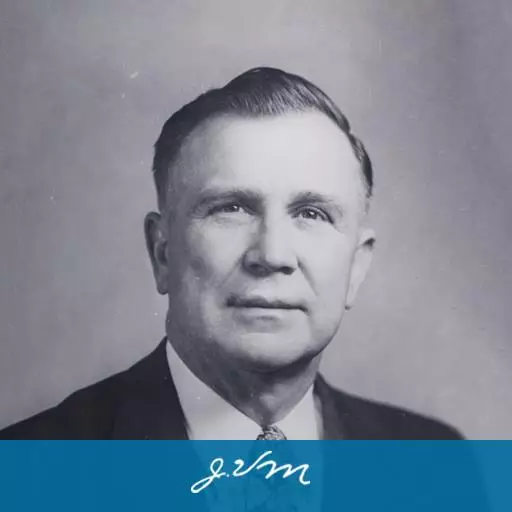
John Vernon McGeewas born in Hillsboro, Texas, in 1904. Dr. McGee remarked, "When I was born and the doctor gave me the customary whack, my mother said that I let out a yell that could be heard on all four borders of Texas!" His Creator well knew that he would need a powerful voice to deliver a powerful message.
After completing his education (including a Th.M. and Th.D. from Dallas Theological Seminary), he and his wife came west, settling in Pasadena, California. Dr. McGee's greatest pastorate was at the historic Church of the Open Door in downtown Los Angeles, where he served from 1949 to 1970.
He began teaching Thru the Bible in 1967. After retiring from the pastorate, he set up radio headquarters in Pasadena, and the radio ministry expanded rapidly. Listeners never seem to tire of Dr. J. Vernon McGee's unique brand of rubber-meets-the-road teaching, or his passion for teaching the whole Word of God.
On the morning of December 1, 1988, Dr. McGee fell asleep in his chair and quietly passed into the presence of his Savior.
Contact Thru the Bible - Sunday Sermon with Dr. J. Vernon McGee
info@ttb.org
https://ttb.org/
Mailing Address
Thru the Bible, Inc.
P.O. Box 7100
Pasadena, CA 91109
In Canada:
Box 25325,
London, Ontario
N6C 6B1
Phone Number
(626) 795-4145 or
(800) 65-BIBLE (24253)