

John the Baptist and John the Prophet


John stands as the final voice of the Old Testament prophets, bridging the gap between the Law and the coming of Christ. With blunt honesty and fearless conviction, he calls people to repent because the King has arrived. John’s remarkable life, message, and humility, remind us that the path of faith is found in a simple confession: “He must increase, but I must decrease.”
Steve Schwetz: How do you handle it when God's word comes straight at you? No smoothing the edges, just truth. Clear, direct, and impossible to ignore. Welcome to the Sunday Sermon on Through the Bible. I'm Steve Schwetz, your host. This time we're sharing Dr. J. Vernon McGee's never-before-heard sermon, "John the Baptist and John the Prophet."
In this study, Dr. McGee introduces us to one of the most unusual men in scripture. John wasn't simply a baptizer standing in the Jordan River. He was a prophet standing at a turning point in history—the final voice of an old order pointing straight to the King who had arrived. John's message was pretty straightforward and urgent: "Repent, turn around, you're headed in the wrong way." And Dr. McGee shows how that call still reaches into our lives, not as religious noise, but as God's mercy pulling us back to himself.
Before we begin, let's hear from our Bible Bus family—reminders that God's word is still changing lives all around the world. First, a young listener in the East African country of Burundi writes this: "My emotions are stirred because I am a young man who often wrestles with uncertainty about what lies ahead. I frequently wonder which decisions are right and which path will lead to a life of value and integrity.
Without clear guidance, I sometimes feel lost or influenced by unhelpful opinions, and I worry that poor choices could shape my future. Now, listening to the Through the Bible lessons and scripture broadcasts, a new confidence is growing in me. I believe these messages are reshaping my thinking and renewing my spirit. I'm learning to depend on the Lord's direction instead of trusting only my own understanding. The anxiety I once felt about the future is being replaced with determination and assurance. I'm confident that as I listen faithfully, the Lord will guide my steps and shape my tomorrow according to his will."
Wow, there's a lot of wisdom in that letter, isn't there? Next we hear from Mr. Sugeng in Indonesia: "I grew up in a Muslim family in a small village where very few people knew anything about Christianity. The first time I heard about Jesus was through my older sibling who studied at a Christian school. Through simple conversations with him, I slowly began to learn about Christ. At first I was only curious, and some of my friends even made fun of me for asking questions.
Later, I moved to East Java for work, and in 1979, I was married. Married life wasn't easy. We experienced many ups and downs—times of joy but also seasons of struggle. Yet, even in those difficult moments, I began to sense that God had never left me. Even when I felt far from him, he remained faithful. Over time, my desire to know God grew stronger. As I began to surrender my life to him, I experienced his help in very real ways.
The Lord provided for our needs, gave me strength when I was weak, and slowly rebuilt my life step by step according to his will. Now I regularly listen to Through the Bible in Madurese. Through these programs, I understand God's word more clearly. The teaching encourages me to stay faithful and trust God in every situation. I also share what I learn with my family and neighbors so they too can be strengthened. I believe that when we truly surrender our lives to God, he will guide us, sustain us, and bless our lives."
And here's a thoughtful note. This one is from Poland: "Thank you for the Through the Bible broadcasts I've been listening to online. I want to be honest about where I am in my thinking. I don't struggle with feelings of guilt as much as I struggle with unanswered questions. I listen because I want to understand whether all of this truly makes sense. One thing that surprised me is how logically the Bible can be explained.
If I'm going to believe, I need to know exactly what I believe in. I find myself asking questions like, how can I be sure that scripture is reliable and how do faith and reason fit together? I don't want to make a decision based only on emotion. At the same time, I feel closer to believing than ever before. I just need to sort these things out in my mind. If what the Bible says is true, then I want to embrace it knowingly and willingly because I understand and believe it."
Different countries, different stories, same God using his word to call people to himself. And that brings us right to John's message in Matthew chapter 3. It's not complicated, it's not comfortable, but it is mercy.
Let's pray and ask God to speak to us through his word. Father, thank you for the way you draw people to yourself, calling listeners to grace, steadying the uncertain, and inviting honest seekers to truth. As we listen and learn, Lord, shape our lives to honor your Son. In Jesus' name, amen.
Dr. J. Vernon McGee: Now tonight, I want to turn to the third chapter, the Gospel of Matthew, and read some verses there. "In those days came John the Baptist, preaching in the wilderness of Judaea, and saying, Repent ye: for the kingdom of heaven is at hand. For this is he that was spoken of by the prophet Esaias, saying, The voice of one crying in the wilderness, Prepare ye the way of the Lord, make his paths straight.
And the same John had his raiment of camel's hair, and a leathern girdle about his loins; and his meat was locusts and wild honey. Then went out to him Jerusalem, and all Judaea, and all the region round about Jordan, and were baptized of him in Jordan, confessing their sins. But when he saw many of the Pharisees and Sadducees come to his baptism, he said unto them, O generation of vipers, who hath warned you to flee from the wrath to come?
Bring forth therefore fruits meet for repentance: And think not to say within yourselves, We have Abraham to our father: for I say unto you, that God is able of these stones to raise up children unto Abraham. And now also the axe is laid unto the root of the trees: therefore every tree which bringeth not forth good fruit is hewn down, and cast into the fire. I indeed baptize you with water unto repentance: but he that cometh after me is mightier than I, whose shoes I am not worthy to bear: he shall baptize you with the Holy Ghost, and with fire."
My, how that's been misunderstood. The baptism of the Holy Spirit took place 1,900 years ago on the day of Pentecost. The baptism of fire has not yet taken place. That's judgment. He came the first time in blessing and salvation, and it was the baptism of the Holy Spirit on the day of Pentecost that began the church, and that's the ministry of the Holy Spirit today in the lives of those who come to Christ.
But that of fire, the baptism of fire, has not yet come upon this earth. It will come at his second coming, and therefore John, you see, is his forerunner for both his first and second comings to this earth. The next one to introduce him will be Elijah in person. John will not come back, but Elijah will come to introduce the Lord Jesus before he comes the second time. John made a twofold announcement, you see.
Now let me read on. "Whose fan is in his hand, he will thoroughly purge his floor, and gather his wheat into the garner; but he will burn up the chaff with unquenchable fire. Then cometh Jesus from Galilee to Jordan unto John, to be baptized of him. But John forbad him, saying, I have need to be baptized of thee, and comest thou to me? And Jesus answering said unto him, Suffer it to be so now: for thus it becometh us to fulfil all righteousness.
Then he suffered him. And Jesus, when he was baptized, went up straightway out of the water: and, lo, the heavens were opened unto him, and he saw the Spirit of God descending like a dove, and lighting upon him: And lo a voice from heaven, saying, This is my beloved Son, in whom I am well pleased."
There are those that say the scripture does not—that is, the New Testament does not present the Trinity. Before you get four chapters, not even three chapters, in the New Testament, the Trinity is presented. There is the Lord Jesus Christ, the Holy Spirit coming, and the voice of the Father from heaven. All three are here.
Now tonight, I'm going to rest—reading some more scripture to you because, honestly, it's far more important what the scripture says than what I shall have to say tonight. So I'm turning to the 11th chapter of the Gospel of Matthew to pick up another fragment in the life of this strange man that's known as John the Baptist.
"And it came to pass, when Jesus had made an end of commanding his twelve disciples, he departed thence to teach and to preach in their cities. Now when John had heard in the prison the works of Christ, he sent two of his disciples, And said unto him, Art thou he that should come, or do we look for another? Jesus answered and said unto them, Go and shew John again those things which ye do hear and see:
The blind receive their sight, and the lame walk, the lepers are cleansed, and the deaf hear, the dead are raised up, and the poor have the gospel preached to them. And blessed is he, whosoever shall not be offended in me." The reason that the Lord Jesus gave this answer was because Isaiah and the other prophets had said that when the King comes, this is what he'll do. The lame will walk. The eyes of the blind will be opened.
And these are things that mark the King, and do not mark the church today at all. It's not a mark of the church, this matter even of physical healing, but it was the mark of the King when he came to this earth. And because of that, he tells the disciples of John, "You go back and tell John what you see, and he'll know that I have the marks of the Messiah. I have the credentials of the Messiah."
Now will you notice as they departed, now you listen to the Lord Jesus. He never complimented anyone unless they deserved it. Our Lord never buttered anybody up. Our Lord never flattered anyone. Now listen to him because he's going to say the finest thing he ever said about any person about John the Baptist. As they departed, Jesus began to say unto the multitudes concerning John, "What went ye out into the wilderness to see? A reed shaken with the wind?
But what went ye out for to see? A man clothed in soft raiment? behold, they that wear soft clothing are in kings' houses. But what went ye out for to see? A prophet? yea, I say unto you, and more than a prophet. For this is he, of whom it is written, Behold, I send my messenger before thy face, which shall prepare thy way before thee. Verily I say unto you, Among them that are born of women there hath not risen a greater than John the Baptist."
Our Lord put John the Baptist on an equal with every man in the Old Testament that you want to call great. You want to say tonight Moses is the greatest man in the Old Testament? Our Lord says that of those born of women, none are greater than John the Baptist. You want to make Moses the greatest? Then we'll put John right by the side of him. You want to make David the greatest? You want to make Samuel the greatest? Our Lord put John right along with him.
Of those born of women, there's none greater than John the Baptist. What a compliment, my beloved. What a glorious compliment. Now let me read in conclude our reading. "And from the days of John the Baptist until now the kingdom of heaven suffereth violence, and the violent take it by force. For all the prophets and the law prophesied until John." And I want to stop with that.
Our subject tonight is John the Baptist and John the Prophet, because we always think of this John as and identify him as being John the Baptist. But personally, I think that he's John the Prophet, way yonder above being John the Baptist. A recent biographer of Lincoln wrote this of him: "He cast a long shadow." I do not know about Lincoln, and yet I believe that was true of him. But John the Baptist does cast a long shadow.
He casts a shadow from the Old Testament to the New Testament. He closes the gap between the Old Testament and the New Testament. He is actually, John is an Old Testament character who walks out on the pages of the New Testament, my beloved. He actually is the last of the Old Testament prophets. He closes the gap. He belongs to the old order. The age of law belongs particularly to John the Baptist, and he finishes it, if you please.
You remember our Lord made that very clear in this passage here in the 11th of Matthew that I read. He said this of those that are born of women, none greater than John the Baptist. But he says now, today, in this new order, the least in the kingdom of heaven is greater than he. In other words, John belongs to an old order, and a new order is coming into being. Now, that may be a little different than you've heard it in the past.
I want to make this very startling statement to you, and some of you may want to think it over before you reject it. Maybe some of you will reject it before you think it over, but I hope you'll think it over before you do, and it's this: John the Baptist was not in the church. He had nothing in the world to do with the church. He never heard of the church. And after he had his head taken off, I have a notion when he got to heaven that he got some more information.
But up to the time he had his head taken off, he knew nothing about the New Testament church whatsoever. Now, somebody says, "But one of the greatest denominations in the world have adopted the name of Baptist from him." That's true, and it's all right. But I hope we can understand one thing. John the Baptist never belonged to the Baptist church. And he never belonged to anybody's church, for that matter.
Now, having said that, I don't want you to think I'm picking on the Baptists. The Methodists were founded by a man who gave up certain methods. Fact of the matter is, they took their name because John Wesley had certain methods, and he did try out certain methods. But my beloved, when John Wesley got converted, he gave up all of his methods and preached this one text: "Ye must be born again."
And yet the church calls itself Methodist. And that's the one thing John Wesley got away from was method. The third—I don't want to leave the Presbyterians out. The Presbyterians, you know, that means elders. And that's just a polite way of saying old folks. Imagine taking that for the name of a church, the old folks. I belong to the old folks—that's what you say when you say I belong to the Presbyterian.
Now that I have alienated the Baptists and the Methodists and the Presbyterians, I want to return to John the Baptist and talk about him tonight. I want to talk about his birth because this man, we want to more or less see his biography this evening, and I want you to notice his birth. For his birth was different than other men. He's an unusual man. He's one of the strangest men that you'll find in scripture out of scripture.
I want to be very frank with you tonight. I do not think that I would want to travel with John the Baptist. I don't think I would have wanted to have been in his company. I do not believe that I would have cared to been a friend of this man. I say that very frankly. I'd love to followed the Lord Jesus, but not John the Baptist. He was very different than all other men. His birth was different.
Fact of the matter is, his birth is not really told in Matthew's Gospel because Matthew's presenting Jesus as the King. And when you're talking about a King, you're not interested in anyone else in the kingdom except the King. But Dr. Luke, who gives the record of the births of men, he tells about two supernatural births. You do not just have one supernatural birth in the Gospel of Luke; you have two supernatural births.
But not a virgin birth in the case of John the Baptist. John the Baptist's father happened to be of the tribe of Levi. He happened to serve in the temple. Fact of the matter is, he was serving yonder at the altar of incense, the golden altar, when the angel Gabriel appeared to him. God broke through after a silence of 400 years. God came through with tremendous power and broke the silence.
He spoke to this man Zacharias and announced to him that there was to be born of his wife Elisabeth a little boy, and his name was to be John. Let me turn to Luke and read the first chapter, the 13th verse. Will you listen to this? "But the angel said unto him, Fear not, Zacharias: for thy prayer is heard; and thy wife Elisabeth shall bear thee a son, and thou shalt call his name John. And thou shalt have joy and gladness; and many shall rejoice at his birth."
Now, Zacharias knew that it was physically impossible for him to have a child. And he very candidly challenged the angel Gabriel. He said, "Whereby shall I know this? I've got sense enough to know that my wife and I who have been childless all of these years—I'm an old man, she's an old lady—how can we have a child? I don't believe." The angel Gabriel said to him, "You're going to be dumb until he's born. You won't be able to speak a word."
May I say to you tonight unbelief is always dumb. It has no message. And this priest of God was made dumb for nine months. And when John the Baptist was born to Elisabeth, they came to this man and says, "What shall we call him?" His mother says, "Call him John. What do you say?" And for the first time he spoke and said, "We'll call him John. That's to be his name." That's the birth of this strange man.
And may I say that he wasn't raised like other men either. Here's the story concerning him. The last verse in the first chapter of Luke reads, verse 80: "And the child grew, and waxed strong in spirit, and was in the deserts till the day of his shewing unto Israel." He grew up differently. He was to be trained in the priesthood. He was a Levite, brought up to follow in his father's footsteps, but he was not.
He's to be different. They took him out in the woods, out in the wilderness. He was a country boy. And that's the way they brought him up. May I say that this man is the last of the Old Testament prophets. He's of the tribe of Levi. His father was a priest. He should have been a priest, and he never served in the temple as a priest. It's interesting the first prophet Samuel was not a priest.
He was an Ephraimite, and he was brought up in the temple, served in the temple, and he's the first of the prophets. The last of the prophets was a Levite but never served in the temple. He repudiated the temple and its God's rejection of it. When John the Baptist walked out and yonder in the wilderness began to minister, may I say to you that he has a very strange beginning. His birth is miraculous. He's raised differently.
The Holy Spirit of God came upon him actually before he was born. He was set aside for a particular and a peculiar ministry. It's never been duplicated, and it never will be repeated again until Elijah comes at the last and announces the second coming of Christ. This man John was the forerunner. Now I want you to notice his ministry. So much for his birth and so much for his young life. Notice his ministry.
When he was about 30 years of age, all of a sudden, out yonder in the wilderness, a voice is lifted. Strange. He never had any publicity committee. He never had any advertisement put in the paper. He never said, "There's plenty of free parking if you come down and hear me preach." He never went out in a community and made it easy for the folks. He went way out yonder in the country where there was nobody, and the crowds came.
The Spirit of God was on him. He's God's man. He's a Nazarite. The Nazarite was a man who voluntarily took an oath to set himself aside to God. He never touched wine. He's to find his joy in the Lord. Never got a haircut. Why? Because Paul says it's shame for a man to have long hair. He's willing to bear shame. John the Baptist was the strangest preacher that's ever appeared. Shaggy mane, whiskers.
You notice what he wore? "And the same John had his raiment of camel's hair, and a leathern girdle about his loins; and his meat was locusts and wild honey." He was a Nazarite. Found his joy in the Lord, and he never had a haircut. Shaggy fellow. Strange dress. Got up, eyes on fire, filled with the Holy Spirit. And the multitudes came out, and Sadducees and Pharisees came out to hear this man.
He saw them, and he said, "My, I'm certainly honored to see you brethren in the audience today. My, you certainly—certainly flattering to have you with me." Is that what he said? You'd lose any preacher in Southern California. He'd lose his congregation if he said what John the Baptist said. You know what he said? He said, "You generation of vipers, who warned you to flee? What are you doing out here?"
Any preacher would lose his congregation that talks like that. John talked like that, and the congregation picked up. That might help in Southern California. It's never been tried. And then his message. Will you listen to his message? He's different in his birth. He's different in his life. He's different in his dress. Brother, he's different. And his message is different. It's not our message today.
Nobody dares give this message. "Repent, for the kingdom of heaven is at hand." That's the message. You can't give that message. I can't give that message and be honest. You see, if you give that message, you've got to know that he's right around the corner. You've got to know that Jesus is pretty close by. You see, John knew that. John says, "There stands one in your midst. I don't know him yet, but he's here, and I'm announcing him."
"He'll come one of these days to me, and I'll know who he is. But in the meantime, I'm a voice in the wilderness." And that's all I am. My message is a message of "Repent, for the kingdom of heaven is at hand." Now briefly, how was the kingdom of heaven at hand? Obviously, the kingdom that he announced—he never defined it—was the kingdom in the Old Testament because he's speaking to Jews.
They were imbued with the Old Testament, and you can't read any more into the kingdom than what's in the Old Testament. You couldn't—don't read 1,900 years of church history in here because it's not there. John the Baptist knew nothing about the church. You must remember he's an Old Testament—he's an Old Testament prophet. He walks out of the Old Testament to give the last message, and he says, "I'm a voice, the last voice before the King gets here. He's in your midst."
And when he said the kingdom of heaven is at hand, you can't have a kingdom without a King. You've got to have a King—or at least a queen. And you can't have a kingdom without a King, my beloved. I tell you tonight that the thing that John the Baptist is saying, the kingdom of heaven is at hand, the King is here. That's what he's saying. May I say that after the church leaves this earth, again that message will go through this world: "The kingdom of heaven is at hand," because at best it won't be but seven years until he comes.
But as long as the church is here, that's not our message. That was John the Baptist's message because the King was there. John says, "He's in your midst. I don't know him yet." He knew him when he came to be baptized. Now my beloved, will you note there are two things that I'd like to emphasize tonight, and that's this message of John the Baptist: Repent. "Repent ye, for the kingdom of heaven is at hand."
This question comes in continually: what does it mean when it says repent, for the kingdom of heaven is at hand? Is repentance the message that we're to give today? Now, I don't want to quibble or split hairs. I believe that repentance is for today. But I believe that the repentance for today is in the word believe. You remember that Philippian jailer came bounding into the prison, and he asked these two men, Paul and Silas, "What must I do to be saved?"
I'm glad Paul and Silas was there and not some modern-day preacher, for they would have had him jump in the rope. "You must repent first. You got to be baptized. You got to join this. You got to do that." All they said was, "Believe on the Lord Jesus Christ, and thou shalt be saved." That's all. Somebody says, "Then repentance is not there?" Yes, repentance is there. When Paul wrote the Thessalonians, he recited their history.
He went there and stayed less than a month, and he preached to the Thessalonians, and many of them turned to Christ. And when he wrote them just a few short weeks after that, he said this to them: "How ye turned to God from idols to serve the living and true God and to wait for his Son from heaven." Now, my beloved, there's the repentance. You see, Paul came to Thessalonica, and he didn't have a lecture one night on what's wrong with idolatry.
And he didn't have a lecture the next night on what's wrong with the Oracle of Delphi. He had no negative messages. Paul says that he determined not to know anything but Jesus Christ and him crucified. Now, he came into the city of Thessalonica. He went into the synagogue, and he didn't even say Judaism was wrong. What he said was, "Christ is the Savior. He died for your sin. If you trust him, you'll be saved."
These people in Thessalonica, many of them Gentiles, were idolaters. They were actually worshipping idols. When Paul preached Christ to them, they turned to Christ. When they turned to Christ in faith, they turned in repentance away from idols. That's repentance. May I say that tonight you could not possibly turn to Christ without turning away from something. You see, if I go this direction, and the word that's used here in the Greek is metanoeo.
Metanoeo means change of mind. It means to be walking this direction, and you sometimes see a man going down the street and all of a sudden he stops, right about face, starts back, and you say, "Well, he changed his mind." He was going that way, but now he's going this way. There was something that caused him to change his mind, and where he turned, that is metanoeo, change of mind, repentance.
Now look, Paul came to Thessalonica. Many of the Thessalonians were going to worship idols. They heard of Christ, and when they did, they turned to Christ. When they did, they turned from idols. You can't turn to Christ without turning from something. I candidly can't be impressed today by people who tell me they've trusted Christ as Savior and they go on the same old way. Their life is not changed.
There's no transformation. They've turned from nothing. I say to you tonight that if you turn to Christ, you will turn from something. And when you turn from something, that's repentance. That's repentance. That's repentance. That's the repentance today that there is in salvation. Believe on the Lord Jesus Christ, and thou shalt be saved. And the Philippian jailer believed on Christ, and when he did, he turned from his idols.
He turned from an old life to a new life, my beloved. And so John just preached that: repentance. That's all. Just repentance. You see, he's not yet preaching faith in Christ. He doesn't know where he is. All he's saying is, "I'm a voice in the wilderness. You're going the wrong way. You're headed the wrong way. Repent! Turn around! Go the other direction, and then you're going to meet him because he's in your midst."
And then the Lord Jesus came out to be baptized of John. And I want you to notice John just a moment—how humble he is. And you must remember the crowds are with him now. And the minute he sees our Lord, he says to him, "No, I shouldn't be baptizing you. You baptize me." And our Lord said unto him, "Suffer it to be so now: for thus it becometh us to fulfil all righteousness." Why was Jesus baptized?
Gracious, I don't want to get in controversy tonight, but why was Jesus baptized? May I say that he was baptized to completely identify himself with the human family. He was numbered with the transgressors. And when he went down into the water to be baptized, he's identifying himself with the human family that he's come to redeem. Remember he's the King here. What a King! To take off his regal robes and identify himself with you and you and with me, for that's what he's doing.
Now briefly I must close. John the Baptist lifted his voice against sin in high places. He lifted his voice against Herod, the king on the throne. I actually believe that Herod would have finally have turned to God, but Herod had a wife that actually was not his wife. But she was scorned, and someone has said that hell hath no fury like that of a woman scorned. It's interesting when you go through the word of God and see how many times that occurs.
Joseph down yonder in Egypt, Potiphar's wife makes advances, and then when she is turned down, she brings a false accusation against Joseph. Ahab and Jezebel. Ahab, a weak king. Jezebel, one of the most wicked, vile persons that's ever been on this earth. And poor Elijah beats it to the country under a juniper tree. It's interesting the number of men, God's men, that have had to face this same thing.
And John the Baptist is arrested. He's put into prison. He actually, don't be afraid to say it, he had his doubts about Jesus. He said, "You know, when I was out yonder preaching, I said he's in your midst and you better repent, the kingdom is coming, it's going to be here. And what's holding it up? Are you the one that we're looking for, or is there another?" Our Lord sent back that gracious word by the disciples, "You go back and tell John, it's all right. I have my credentials. I'm doing what I've come to do."
He's fulfilled his ministry. And John the Baptist yonder in prison because of this woman Herodias, my, how she manipulated and got it around. It's that familiar story of how she made it possible for her daughter to dance before this lascivious king and how he offered her anything her little heart wanted, and of all things, it wasn't her wish, it was her mama's wish that she ask for the head of John the Baptist. It's an awful thing.
John the Baptist was beheaded. May I say to you tonight that was one of the most ignominious ends for any man as was for this man John the Baptist. How does that jibe today with your theory that if you serve God, he'll take care of you? He'll never let anything happen to you. He never told you that, my beloved. He just said he'd be with you to the very end. "I'll never leave you nor forsake you," he said.
And he was with John the Baptist. But this strange man had a strange beginning. He had a strange life. He had a strange ministry. He had a strange message. He had a unique life and a unique ministry. And he ended it in a very strange manner. It's ignominious. It's awful to see this man beheaded. His disciples came in and took up lovingly his body, his decapitated body, and took it out and buried it.
You say, "Well, what good did that serve?" That served this purpose, my beloved. That was the world. That was King Herod. That was the devil telling God, "Here's your man! This is what we do with him!" The world's always treated God's man like that. It's interesting the King withdrew at this time. Why? Because one of these days Herod will have to stand before him.
But I conclude tonight with this man John the Baptist. Listen to what he said. He's so different from us tonight. We might say it, but I don't know whether we mean it or not. John the Baptist, when his disciples came to him and said to him, "John, all of your followers are now following Jesus," John says, "It's all right. He must increase, but I must decrease." May I say that in that statement there is the formula for a happy, successful Christian life.
Somebody said it didn't work for John the Baptist, look where it got him. May get you in trouble too. But the only place of happiness and joy today for a child of God is to come to the place where we can say, "He must increase, but I must decrease." Oh, tonight in the church, the grasping, the polite elbowing, the getting to the front, the secret ambitions, the secret desires. Tonight to be able to say, "He must increase, but I must decrease." My brother, that'll search your heart.
Steve Schwetz: If today's message stirred something in your heart, keep traveling with us on Through the Bible as we explore God's word together on the daily program. You can hop aboard the Bible Bus and invite a friend to join you. You can listen anytime at ttb.org or on our app. Or for help finding a local radio station that carries Through the Bible, call 1-800-65-BIBLE.
You can also write to us at Box 7100, Pasadena, California, 91109. In Canada, Box 25325, London, Ontario, N6C 6B1. And when you're in touch, would you let us know how you listen? Is it by app or online, YouTube, maybe one of your favorite radio stations, or maybe there's some other way? As we've said before, this little bit of information helps us to follow God's lead as we take his whole word to the whole world.
I'm Steve Schwetz, and I sure hope that you'll join us again next Sunday for Dr. McGee's message, "The Sermon on the Mount for Today." And as we go about the week ahead, let the words of John 3:30 that we heard today echo in your heart and mind: "He must increase, but I must decrease."
Featured Offer


Featured Offer
About Thru the Bible - Sunday Sermon
These Sunday Sermon messages form a collection of the most effective and fruitful sermons given by Dr. J. Vernon McGee during his 21-year pastorate (1949-1970) at the historic Church of the Open Door when it was located in downtown Los Angeles.
Other Thru the Bible Programs:
Thru the Bible - Minute with McGee
Thru the Bible - Questions & Answers
About Dr. J. Vernon McGee
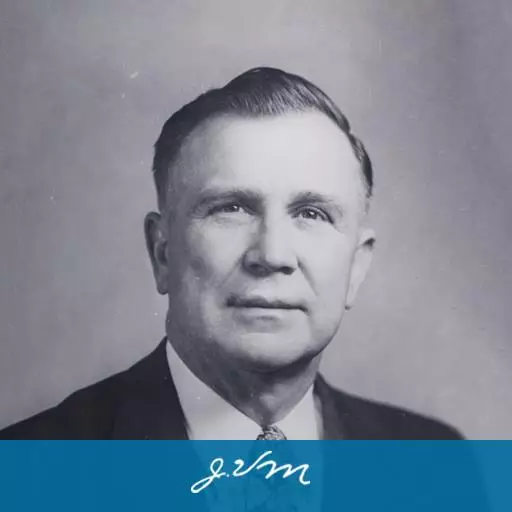
John Vernon McGeewas born in Hillsboro, Texas, in 1904. Dr. McGee remarked, "When I was born and the doctor gave me the customary whack, my mother said that I let out a yell that could be heard on all four borders of Texas!" His Creator well knew that he would need a powerful voice to deliver a powerful message.
After completing his education (including a Th.M. and Th.D. from Dallas Theological Seminary), he and his wife came west, settling in Pasadena, California. Dr. McGee's greatest pastorate was at the historic Church of the Open Door in downtown Los Angeles, where he served from 1949 to 1970.
He began teaching Thru the Bible in 1967. After retiring from the pastorate, he set up radio headquarters in Pasadena, and the radio ministry expanded rapidly. Listeners never seem to tire of Dr. J. Vernon McGee's unique brand of rubber-meets-the-road teaching, or his passion for teaching the whole Word of God.
On the morning of December 1, 1988, Dr. McGee fell asleep in his chair and quietly passed into the presence of his Savior.
Contact Thru the Bible - Sunday Sermon with Dr. J. Vernon McGee
info@ttb.org
https://ttb.org/
Mailing Address
Thru the Bible, Inc.
P.O. Box 7100
Pasadena, CA 91109
In Canada:
Box 25325,
London, Ontario
N6C 6B1
Phone Number
(626) 795-4145 or
(800) 65-BIBLE (24253)