

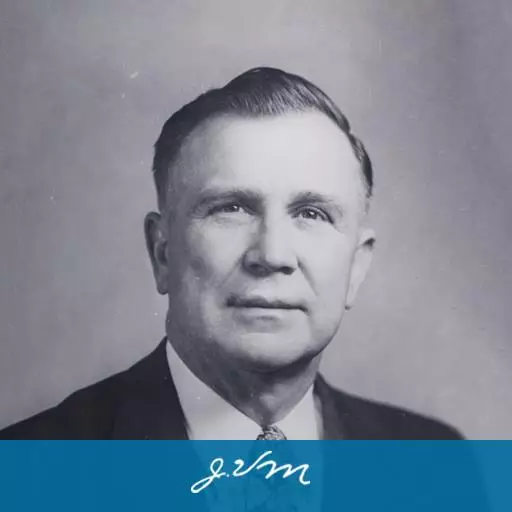
He is Coming Again!


Paul says that we are looking for that blessed hope—that is, the day when Christ will come again. What will that be like, and when will it happen?
Steve Schwetz: Welcome to the Sunday Sermon on Thru the Bible. As we turn the page into a brand new year, our focus is on a promise that has carried believers for more than 20 centuries. Jesus said, "I will come again." History remembers the powerful words of General Douglas MacArthur: "I will return." For millions living under the darkness of war, those words became a lifeline of hope. And true to his promise, he did return.
But as Dr. J. Vernon McGee reminds us, General MacArthur was still only a man. The words of the Lord Jesus Christ carry infinitely more weight. Before he left this earth, he told his disciples, "I will come again." And in Revelation we hear it again: "Behold, I am coming quickly." This promise is our present hope. And it anchors us in uncertain times, steadies our faith when the world feels shaken, and then reminds us that history is moving toward God's perfect conclusion.
In this sermon, Dr. McGee takes us into the book of Revelation to remind us that while Christmas marks his first coming in grace, there's another Christmas yet to come: the day when Christ will return in glory. And that's the central theme of Revelation, and it's the central hope of every believer today. So let's begin 2026 with our eyes fixed on the greatest promise yet to be fulfilled: the return of Jesus Christ. I'm Steve Schwetz, welcoming you aboard the Bible Bus. And as you settle into your seat and get comfortable, Thru the Bible's President Gregg Harris is here. So happy New Year, Gregg.
Gregg Harris: Thank you. Happy New Year to you and happy New Year to everybody in our listening family.
Steve Schwetz: Yeah, and we're going to be talking about some specific areas of the world, focusing in Africa. Why don't you tell us a little more?
Gregg Harris: Well, today we really want to focus on—I would call this one of our foundational pillars of our ministry. It seems like if you go around the world, like Arabic in the Middle East and Latin American Spanish, and what we want to talk about in Africa is Swahili, which of course is a huge language spoken by tens of millions of people. It's a trade language, particularly in East Africa.
And just before we jump into some amazing testimonies, I want to point out that our team is seeing God do amazing things in Africa. I know you've been there a couple times lately.
Steve Schwetz: Yeah, and it really is exciting. I've said this before on the program that really Africa is kind of the new India for us. India is still doing well, doing great, and they've got lots of things. They were the birthing place of our home group movement, but we're really seeing things in Africa that we're frankly not seeing replicated at this point in any other place in the world.
Gregg Harris: And one of the things that's part of that whole sort of renewal movement or revival—whatever we want to call it—is we hear people talk about having listened to this program "Neno." "Neno" simply means "the word" in Swahili. And so that's the name of the Thru the Bible program in Swahili.
And our friend and colleague Ray Alary, who you've traveled with, I've traveled with, and he spent many years in Africa as a missionary, he was recently in Kenya and he said everywhere I went—he was actually partly on vacation after he finished his work, he and his wife were celebrating their anniversary, and he was sending me pictures. These people listen to Neno, these people listen to Neno everywhere he went.
Steve Schwetz: Now, one of the things that I don't know if people realize, how many years have we been in Africa at some point? Like, how old is Swahili for us?
Gregg Harris: I don't know exactly. Something in the 1970s strikes me. Yeah, okay. I got a thumbs up from the other side of the glass. So you're looking at a 50-plus year commitment that Thru the Bible has had to the ministry in Swahili in Africa.
So when we talk about how we're seeing a revival of sorts in Africa with Thru the Bible, the Lord has enabled us to be faithful for decades in that continent, and only now are we seeing all of these significant things in Swahili but in all these other languages that are just incredible.
Steve Schwetz: Yeah. Well, we thank you, those of you that support the ministry, pray for it, those of you that have been with us for many, many cycles of Dr. McGee's teaching. You've made it possible for us to just be there for literally decades.
Gregg Harris: Absolutely. And Steve, we can go on and on about God's faithfulness to us, but I get most excited by listening and hearing of the testimonies. So this first one from a man named Abraham or Ibrahim. Why don't you go ahead and read that testimony?
Steve Schwetz: Yeah, he says: "Just like Peter, who thought he was highly skilled in fishing, there was a time I also considered myself very knowledgeable in my work, so much so that I didn't see the need to involve God much in it. However, it reached a point where as days went by, my work kept declining.
It was only when I gained the understanding that for me to succeed I must listen to God and obey what he says that I began to prosper. The secret of our success as Christians does not lie in our level of education, our positions or the like, but in hearing his voice and obeying it. Peter experienced the greatest success ever when he obeyed and let down the nets into the sea. Thank you so much for the powerful lesson, teacher."
Gregg Harris: Wow, what a great testimony. Here's another one. This one's from a listener whose name's John, and he wrote to us about the same study, interestingly enough, in Luke 5, and he shared this: "I have learned that no matter how weak I may appear in the eyes of people, and even if I am despised, I can become a hero only when I decide to take the step of obeying the word of Christ and let down the nets into the sea. This powerful teaching has challenged my life and helped me keep my focus solely on the Lord."
Steve Schwetz: Well, both of those seem to be referring to the same passage of when Jesus said let your nets down on the other side. Now let's go to Prisca, who found the studies in Proverbs especially beneficial.
She said this: "I pray that God will help me grow in my obedience to his voice. Many times the devil deceives us and we forget what God said in Proverbs 3:5 through 6. Instead, we lean on our own understanding rather than listen to him."
Gregg Harris: I think we've got time for one more. This is from Sarah. She shared this: "After listening to Thru the Bible's teaching on forgiveness, something changed in me. When Dr. McGee taught from Matthew 6 verses 14 and 15, I realized how much bitterness I was holding against my sister. God used those verses to open my heart and I was finally able to forgive her. That step brought reconciliation between us and a deep peace into our family."
One of the things, Steve, that we get asked from time to time is: "How do you know they're getting Dr. McGee?" And these letters are just proof positive that that's happening.
Steve Schwetz: Yeah, absolutely. The testimonies we get, we hear how people's lives are changed. And hopefully you're encouraged by these letters and testimonies. And you know, the number one thing we ask people to do, yeah, financial support's important, but joining our World Prayer Team, signing up for that email Monday through Friday, just go to TTB.org/pray. You'll read testimonies like this and others every day as we travel the world on our knees, praying that God would continue to move in people's hearts. Gregg, as we get to our study, why don't you open us in prayer?
Gregg Harris: Father, we rejoice in the fruit that you have produced through our humble efforts. We try to be faithful. We want to be faithful to your word and to give it out freely. And we are amazed at what you do when we just do that simple act of obedience. Help us now as we grow in your word. In Jesus' name, Amen.
Dr. J. Vernon McGee: Field Marshal Lord Alanbrooke, who was head of England's top brass in World War II, has published his memoirs. It bears the title of *Triumph in the West*. And in this volume, he pays tribute to General Douglas MacArthur as the outstanding general of World War II.
These are his exact words, for I want to give you his quotation: "MacArthur was the greatest general and best strategist that the war produced. He certainly outshone Marshall, Eisenhower, and all other American and British generals, including Montgomery."
When General Douglas MacArthur withdrew from the Philippines after Pearl Harbor and before the surrender of Corregidor, he issued his now famous statement: "I will return." Millions of people in the Orient hung on those three words for several years as the only ray of light in the darkness of tyranny and oppression. They were words of hope. They were words of deliverance for people around the world.
He did return. He returned with a vengeance. He did not stop at Manila. He went on to Tokyo to receive the surrender of the proud nation of Japan on the deck of the battleship Missouri. He was after all a frail human being. But when he said "I will return," he made good.
Before the Lord Jesus Christ left this earth to return to heaven, he said, "I will come again." Those words have been the hope and the comfort of millions of believers for 20 centuries now. He repeated those words again as the glorified Christ to John on the Isle of Patmos. And there he made these words more sharp, more poignant, and he delivered them in a dramatic way.
Will you listen to them? In Revelation 22:12, he said, "And behold, I come quickly, and my reward is with me." He didn't mean he was coming soon. That's not what he said. But he said that his coming and all that it entail would occupy a very brief time. "I come quickly."
And then we close the Bible, the book of Revelation, with his statement, and it's his affirmation again: "Surely I come quickly." He says in the 20th verse, "He which testifieth these things saith, surely I come quickly. Amen." That's the end, as far as he's concerned. He has said, "I come quickly." And again may I say to you, those are the words that have been the comfort of his own for 20 centuries.
Now some think that the book of Revelation is a book filled with that which is frightful and sensational. That these symbols are symbols that are actually out of this world. There are wild beasts, there are monstrous creatures in this book. There are convulsions of nature, there are thunders and lightnings and earthquakes, and there are trumpets of judgment and bowls of wrath.
I say to you this morning, all of that is incidental. It's not that which is essential. That are the freaks that you see in the sideshow. The main event is the return of Jesus Christ to this earth. The return of Christ is that which comes first. It's the central truth. It's that which is all-important. It's the primary meaning of the book. It's the prevailing purpose of Revelation to say just one thing, and he says it: "Behold, I come again."
That's the message. And that's the message for us at this Christmas time. This book of Revelation opens with that statement, the revelation of Jesus Christ. The word revelation is our word apocalypse by transliteration, or better still, it's the unveiling, if you please, of Jesus Christ. Actually, at the first coming of Christ, he was not revealed. Rather, he was concealed.
The word was made flesh and pitched his tent here among us, says John. And the word was made flesh and took upon him a tabernacle, a tent of flesh. And he was put in wraps, if you please, and God was not revealed when he came the first time. Actually, the word tabernacle is the word that's used there.
He took upon himself a tent, a human fleshly tent or tabernacle, and just as God back in the Old Testament had manifested himself through a tabernacle, a tent with all sorts of coverings and doors, and it shut man out from God. Now the Lord Jesus comes in flesh and you can know God, yes, but God is not revealed. It still can be said: "No man hath seen God at any time. The only begotten son which is in the bosom of the Father, he hath declared him."
He's exegeted him. He's led him out in the open where for the first time you can see the heart of God. But you haven't seen God, my beloved. And so we have in the first coming of Christ not the revelation of Jesus Christ. The revelation of Jesus Christ takes place at his second coming. The first and second comings of Christ are actually component parts of a whole.
Christmas means that God came in human flesh, but the biggest Christmas is still in the future. And there's a Christmas day that is yet to come, my beloved. The first time that he came, the great word was grace. He came that men might know something of the grace of God. When he comes the second time, the big word and the high word is glory. Men will see for the first time the glory of God.
When he came before, he was veiled in human flesh. When he comes the second time, the veil is removed and you'll see him coming in the clouds of glory. And for the first time, men will see God. The first and second comings of Christ belong together. And so on this day in which we think of Christmas, I want to put them together.
And this morning, we'd like to talk to you first about a contrast: the first and second comings of Christ. A comparison: the first and second comings of Christ. And then the completion: the second coming of Christ completing the first coming of Christ. Will you look with me this morning at the first, the first and second comings of Christ, just a contrast?
And listen for a moment to the writer to the Hebrews: "So Christ was once offered to bear the sins of many, and unto them that look for him shall he appear the second time without sin unto salvation." When Christ came the first time, it was to settle one question and one question alone, and that was the sin question. He didn't come to settle government questions.
He didn't come the first time to set before the world even a philosophy of government or a philosophy of living. He came the first time to settle the sin question, to die for the sins of the world. When he comes the second time, he'll come to settle the government question, the political question, and these disturbing questions that are in the world. But up to this morning, he only deals with the sin question in your heart and in my heart today.
And so there is a contrast between the first and second coming of Christ. And it's interesting to note that the way the scripture makes that contrast very sharp. He came the first time riding on a little donkey into Bethlehem in the womb of the Virgin Mary. I challenge you this morning to show me how God could have humbled himself more.
He came riding on a little donkey into Bethlehem in the womb of the Virgin Mary. The second time that he comes, he comes riding on a white horse. Listen to John on the Isle of Patmos: "And I saw heaven opened and behold a white horse, and he that sat upon him was called faithful and true, and in righteousness he doth judge and make war."
What a contrast. First time coming in all the lowest form of humility, not even a little baby, but in the womb of the Virgin Mary. You can't become anymore humble than that. But the next time, not that. The next time that he comes, he comes to assert his will. He comes to put down all unrighteousness. He comes in power and in glory, my beloved.
When he came the first time, the door of the inn was shut in his face and it slammed so loud that after 1,900 years you can still hear it. And he's being shut out today. Oh, the cash registers have been ringing loud. They've been ringing so loud this Christmas that you couldn't even hear that door slam, but it was slamming—slamming in his face.
But the next time he comes, I read that a door is opened in heaven and he comes with none to hinder him, none to stop him. The first time that he came, he came in weakness. He came in meekness. He came in obscurity. He came to an out-of-the-way place. Oh, Bethlehem, little among thousands, but he's coming out of you. Not Rome, not London, not Moscow, not Washington, not Paris—coming out of little Bethlehem.
And his coming was wrapped in secrecy. Very few knew he came the first time. Very few knew it. Jerusalem closed shops that Christmas eve and didn't know what was taking place and cared less. Even Bethlehem did not know. If you want to have a contrast this morning, contrast his coming with President Eisenhower's entrance into the Orient.
That's unprecedented. There's been nothing like that so far in the history of the world. Millions of people lining along the way of march in order to welcome him and the whole world knew he went to India. But the whole world didn't know that Jesus came to Bethlehem and they don't know it after 1,900 years. There are more people today that know that Eisenhower went to India than Jesus came to Bethlehem.
But the prophets said he'd come that way the first time. Isaiah put it like this: "There shall come forth a rod out of the stem of Jesse, and a branch shall grow out of his roots." Why didn't Isaiah, who again and again mentioned the fact that he's the branch of David, why didn't he say the branch of David here? Because my beloved, when Jesus came, the difference was obvious.
David was a prince, Jesse was a peasant. When Jesus came, the line of David, the line of David had been reduced to peasants and he comes out of the line of Jesse in humility, in humbleness. He comes as a peasant, if you please. And listen to Isaiah as he keeps talking about him in the 42nd chapter. I think this for Christmas is one of the most wonderful passages of scripture.
Listen to it: "Behold my servant, whom I uphold, mine elect, in whom my soul delighteth. I put my spirit upon him. He shall bring forth judgment to the Gentiles." But before he does that, will you listen: "He shall not cry, nor lift up, nor cause his voice to be heard in the street. A bruised reed shall he not break, and the smoking flax shall he not quench. He shall bring forth judgment unto truth." He's coming forth but in secrecy.
And Isaiah goes on to say this about him in the 53rd chapter: "He is despised and rejected of men." Now the scribes in Christ's day ignored those scriptures. They didn't want to have anything to do with those scriptures. And that's the reason they did not believe the wise men. When they said "We've come to Jerusalem in order that we might worship him who's born King of the Jews. Where is he?"
The scribe says "The prophecy says it's in Bethlehem, but anybody knows he's not down there now. The newspaper reporters are not there. The photographers are not there. The world is not there. He is not there as a conqueror and we know he's not there." But he was there. They had ignored these scriptures.
But don't be too harsh with them because they were dubious. They would not go with the wise men to worship him because they had other scriptures that made them believe he was coming as a king in great power and glory and they just wanted to soft-pedal these scriptures. They didn't seem to know him. And as George MacDonald in his lovely poem has said: "They were looking for a king to slay their foes and lift them high. He came a little baby thing that made a woman cry."
And someone a few days ago sent me a poem by Martin Luther. I'd never seen it before. It's such a lovely poem, I'd like to pass it on to you today for it speaks of this very thing. "Our little Lord, we give thee praise, that thou hast deigned to take our ways. Born of a maid, a man to be and all the angels sing to thee.
The eternal Father's son he lay, cradled in a crib of hay. The everlasting God appears in our frail flesh and blood and tears. What the globe could not enwrap, nestle lies in Mary's lap. Just a baby, very wee, yet the Lord of all the world is he."
What a lovely poem. Oh today, that we had the same reverence and the same relationship to him that Luther and the reformers had in those days. He came a little baby thing and they were not looking for that. They did not care for that. Now they did have scriptures that were very spectacular, but they spoke of his second coming.
Listen to some of them, will you? One of those scriptures over in the 63rd chapter of Isaiah: "Who is this that cometh from Edom with dyed garments from Bozrah? This that is glorious in his apparel, traveling in the greatness of his strength? I that speak in righteousness, mighty to save." He's coming in glory there.
And then it was Daniel who in the seventh chapter saw him coming in glory. Will you listen to this, 13th verse: "I saw in the night visions, and behold one like the son of man came with the clouds of heaven. He came to the Ancient of Days and they brought him near before him. And there was given him dominion and glory and a kingdom, that all people, nations and languages should serve him.
His dominion is an everlasting dominion which shall not pass away, and his kingdom that which shall not be destroyed." That could be multiplied again and again in the Old Testament. And when you come to the New Testament and John looks to his coming again, John says: "Behold, he cometh with clouds and every eye shall see him, and they also which pierced him, and all kindreds of the earth shall wail because of him." That's his second coming. What a contrast between the first and second coming of Christ.
Will you notice with me briefly a comparison between the first and second coming of Christ? At the second coming of Christ, we're told there are two phases of it. There's what we call today or pleased to call the rapture. He himself spoke of it for the first time. You won't find it anywhere in the Bible till you get to the 14th chapter, John's Gospel, and for the first time he told about taking people off of this earth out yonder to a place he's prepared.
He said to them: "I go to prepare a place for you. And if I go and prepare a place for you, I will come again and receive you unto myself, that where I am, there ye may be also." That's one thing. But may I say to you that he also spoke of his coming to this earth to establish his kingdom upon this earth in power and glory.
And when he was brought before the high priest and was being tried, they put him on oath and this is what he said. Will you listen: "But he held his peace and answered nothing. Again the high priest asked him and said unto him..." Now he's on oath. "Art thou the Christ, the son of the blessed?" Now listen to him. "And Jesus said, I am. And ye shall see the son of man sitting on the right hand of power and coming in the clouds of glory."
We believe this morning that he will come one of these days, we don't know when, it may be soon, to take those that are his own out of this earth. He's putting them today on a launching pad and one of these days they're going to take off and meet him. But that doesn't have anything to do with this earth because after that he begins to move in judgment and brings it to a fulfillment by his personal coming to this earth where it actually says his feet shall touch the Mount of Olives and he shall stand upon this earth, he shall sit upon the throne of David and he shall rule upon this earth.
And our critics today, cynically and dubiously they say, "Well you really believe in a second and third coming of Christ?" Oh no. Let's make a comparison. Do you recall that when he came the first time, there was his birth which we remember at this season? It was Micah who says: "But thou, Bethlehem Ephratah, though thou be little among the thousands of Judah, yet out of thee shall he come forth that shall be ruler unto me, whose goings forth have been from of old, even from everlasting."
Out of Bethlehem. That has to do with his birth. And then I read that on the cross, it was prophesied in the 22nd Psalm he would say: "My God, my God, why hast thou forsaken me?" My friend, both of those events, his birth and his death, are connected with his first coming and they are 33 years apart. But it's all called his first coming to this earth. And his coming to take the church out of this earth and then his coming to this earth is all called his second coming when you compare it to what's taken place.
It's easy to see. I wish I could make other comparisons this morning, but I must move on. Will you notice the first and second coming of Christ, the completion? And that means that the second coming of Christ is the completion of his first coming. He must come again to complete the work of his first coming.
Oh, somebody says, "But he said on the cross it's finished." Yes, the work of redemption was finished. He had wrought out for you and me a way of salvation. But as Paul very definitely says, no other foundation can any man lay than that which is laid, which is Jesus Christ. He put down the foundation for your salvation and mine. But my friend, the towers have not yet been put on.
He has not yet completed his work of salvation. He only got a partial victory when he came his first time. It was a truncated triumph. He won the battle but he did not receive the booty. He gained the victory but he did not receive the kingdom. Actually, salvation is in three tenses. I can say this morning that I have been saved. I can also say I am being saved. And I can also say I shall be saved.
All three are true. I have been saved. Listen: "He that heareth my word, believeth on him that sent me, hath everlasting life, shall not come into judgment, but is passed from death to life." Has right here and now eternal life. And my friend, the moment that you trust Christ, receive God's gift eternal life, you are as much saved that moment as you'll be a billion years from today. Complete in him, saved in him.
But there needs to be a work to go on on the inside of us. And Paul could say to the Philippians: "Work out your own salvation with fear and trembling, for it's God that worketh in you both to will and to do of his own good pleasure." And we ought to be patient one with another. There are few people that are very critical of the preacher. May I say to you, be a little more patient with me, God's not through with me. He's not through with me.
Someday I shall be saved. Beloved, it doth not yet appear what we shall be. But we know that when he shall appear, we shall be like him. We shall see him as he is. A work he started 1,900 years ago born, he took upon himself the likeness of sinful flesh but without sin, in order that in time he might present you and me in his own likeness. That's going to be a wonderful day when you will be like Jesus and I'll be like Jesus.
Let's be patient. We're the sons of God now, but it doth not yet appear what we shall be. Will you listen to Paul as he writes to the Romans, having said that God today will work in you today in order to perfect that which he's done, but yet there's a glorious future. Listen to him in Romans 8:18: "For I reckon that the sufferings of this present time are not worthy to be compared with the glory which shall be revealed in us for the earnest expectation of the creature waiteth for the manifestation of the sons of God.
And not only they but ourselves also which have the first fruits of the spirit, even we ourselves groan within ourselves, waiting for the adoption to wit, the redemption of our body." A great day's coming. What are you going to get for Christmas? I'll tell you what I'm going to get for Christmas. Not this Christmas maybe, but when the big Christmas comes, I'm going to get a new body.
A body that'll not have pain and subject to all of the limitations of this life. A body that's not subject to weakness and disease. Somebody said to me, "Healing's in the atonement." So's a new body, but I don't have it yet. And the package that he gave me says "Do not open until Christmas." Trouble about these folk today that go after the healing is that they're trying to open their package before Christmas. Don't do that. Don't open it till Christmas. One of these days we'll receive a new body—the redemption of our body. What a Christmas present that's going to be.
And so I say this morning, do not open your package till Christmas, but you've got one coming. And that's not all we get for Christmas. This earth is going to be tied up as a Christmas gift, if you please. Listen to him again in Romans the eighth chapter: "For the creature was made subject to vanity, not willingly but by reason of him who hath subjected the same in hope. Because the creature itself also shall be delivered from the bondage of corruption into the glorious liberty of the children of God.
For we know that the whole creation groaneth and travaileth in pain together until now." This poor earth on which we live today, this Christmas is trying to be happy, but there are many broken hearts. The hospitals are filled, the cemeteries are being filled today, and even nature itself is groaning.
You go down by the seaside and you can hear the sob of the waves. Go to the mountain top and you can hear the wind going through the top of the pine trees. It's a low note. Creation is groaning, waiting for Christmas. A glorious Christmas when he shall come and the curse of sin lifted from nature and the package will explode with a new heaven and a new earth.
And somebody says, "Well I sure'd like to have have stake in this that's coming. I'd like to be sure about the Christmas that's coming." Well you can. I'm not asking anybody to join a church. I don't think I've ever asked anyone here to join a church to become a Christian. We try to keep it separate. You come there for church membership, you come here to accept Christ.
But the important thing is to be properly related to Jesus Christ. You see Christianity is not a religion, it's a relationship. It's a personal relationship to Jesus Christ and it means to come to grips with him personally. The gift of God is eternal life in Christ Jesus. How do you get a gift? To as many as received him, that is the Lord Jesus, to them gave he the right to become the sons of God, even to those that don't do any more nor less than simply believe in his name.
I have on here a watch that was given to me 20 years ago when I left Texas. It was not given to me to leave, but because I was leaving. I taught a Bible class for several years there and the last morning one of the ladies got up and said, "You've been talking now for several years, we want to talk." And I sat down and listened.
They handed me the little box and they said this is a gift. For 20 years I have never paid one penny on this watch. For 20 years I have never given anything, but it's my watch and it's my watch because I didn't do but one thing: by simple faith I held out my hand and took it. And God this morning is holding out to this lost world a gift: eternal life in Christ Jesus. And you get it by taking it, simple faith in him. Have you received this morning the greatest Christmas gift God has today and that's his son? If you haven't, he wants you to have it. As our heads this morning are bowed in prayer, I'm wondering if you're here today and you'd like just at this Christmas season to receive a real gift—the gift of God's son. Simply by trusting him. That's all. Just receive him by faith, coming to grips with the son of God.
Steve Schwetz: As we step into a new year, may the words of Jesus echo in our hearts: "Behold, I am coming quickly." That promise isn't meant to stir fear, but to give hope. Just as his first coming was certain, so is his return in glory. Until that day, we live in the in-between. We're saved by grace, strengthened by his spirit, and waiting with anticipation for his appearing. My friend, the greatest gift that you can receive at the start of this year is the gift of eternal life through Jesus Christ. Have you received him? If not, well today is the day. To learn more, click on "How Can I Know God" in our app or over at TTB.org. There you'll find several free resources to download. Or if you prefer to have a couple of these mailed to you, just call us: 1-800-65-BIBLE's the number.
And for those wanting to stay connected with us, well you can drop us a note through our app, you can email us at BibleBus@ttb.org, or write to Box 7100, Pasadena, California, 91109. In Canada, Box 25325, London, Ontario, N6C 6B1. And you can also call and leave a message anytime at 1-800-65-BIBLE. And when you're in touch, be sure to sign up to receive our monthly newsletter. Each issue is filled with updates from the ministry as well as teaching from Dr. McGee and helpful prompts to deepen your time in God's word. I love reading it every month.
We'd also love to send you a free pack of our Bible Bus passes. Now these little cards, they feature a QR code that link directly to Dr. McGee's teaching. It's a great way to share an invitation to study God's word with us. And as we break for the weekend, it's a great time also to further your study with our Bible Companion for Revelation. In addition to prompts to listen to Dr. McGee's messages and read the scripture for yourself, you'll also find some great questions to reflect on—better yet, for group study and discussion.
So just visit TTB.org. You can download your free copy or you can purchase any of Dr. McGee's New Testament Bible Companions in softcover by calling 1-800-65-BIBLE. That's TTB.org or 1-800-65-BIBLE. Once more, for the newsletter, Bible Bus passes, and Bible Companions, call 1-800-65-BIBLE or just head over to TTB.org. As a reminder, we really do appreciate it when you tell us how and where you listen to Thru the Bible, whether it's a radio station, our app, Alexa, YouTube, some other way.
As we've said before, that information really is important as we make wise ministry decisions, so please let us know. As we begin this new year, let's live with our eyes fixed on the Lord's promise that he will return. That's our hope, that's our comfort, and that's the joy that we have until the day that he returns. And so we close with these words from the final chapter of Revelation: "He who testifies to these things says, 'Surely I am coming quickly.' Amen. Even so, come Lord Jesus. The grace of our Lord Jesus Christ be with you all. Amen."
Featured Offer


Featured Offer
About Thru the Bible - Sunday Sermon
These Sunday Sermon messages form a collection of the most effective and fruitful sermons given by Dr. J. Vernon McGee during his 21-year pastorate (1949-1970) at the historic Church of the Open Door when it was located in downtown Los Angeles.
Other Thru the Bible Programs:
Thru the Bible - Minute with McGee
Thru the Bible - Questions & Answers
About Dr. J. Vernon McGee
John Vernon McGeewas born in Hillsboro, Texas, in 1904. Dr. McGee remarked, "When I was born and the doctor gave me the customary whack, my mother said that I let out a yell that could be heard on all four borders of Texas!" His Creator well knew that he would need a powerful voice to deliver a powerful message.
After completing his education (including a Th.M. and Th.D. from Dallas Theological Seminary), he and his wife came west, settling in Pasadena, California. Dr. McGee's greatest pastorate was at the historic Church of the Open Door in downtown Los Angeles, where he served from 1949 to 1970.
He began teaching Thru the Bible in 1967. After retiring from the pastorate, he set up radio headquarters in Pasadena, and the radio ministry expanded rapidly. Listeners never seem to tire of Dr. J. Vernon McGee's unique brand of rubber-meets-the-road teaching, or his passion for teaching the whole Word of God.
On the morning of December 1, 1988, Dr. McGee fell asleep in his chair and quietly passed into the presence of his Savior.
Contact Thru the Bible - Sunday Sermon with Dr. J. Vernon McGee
info@ttb.org
https://ttb.org/
Mailing Address
Thru the Bible, Inc.
P.O. Box 7100
Pasadena, CA 91109
In Canada:
Box 25325,
London, Ontario
N6C 6B1
Phone Number
(626) 795-4145 or
(800) 65-BIBLE (24253)