

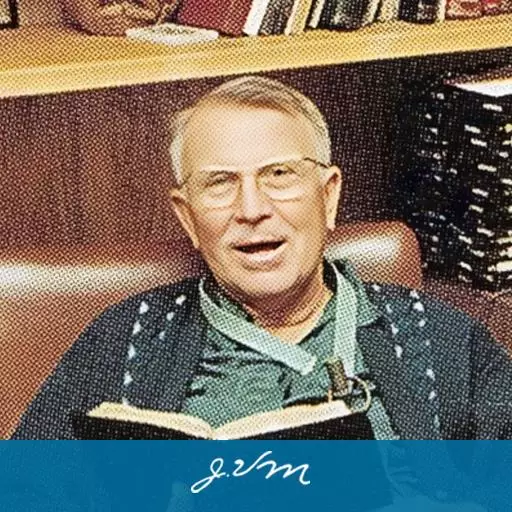
Questions & Answers 3078


1) Could you explain 1 Samuel 15:3 in relationship to God’s command to not murder?
2) Could you explain Paul’s comments on widows in 1 Timothy 5:4, 11 and 16?
3) What are the marks of a mature Christian compared to a babe in Christ?
4) Who is the “rock” in Matthew 16:18?
5) Dr. McGee discusses the baptism for the dead in 1 Corinthians 15:29.
6) When does a believer receive the filling of the Holy Spirit?
Guest (Male): Are you a mature Christian? How do you know? Well, stay with us and find out.
Guest (Male): This is the question and answer program with Dr. J. Vernon McGee, a ministry of the Through the Bible Radio Network. Our first question today comes to us from a listener in Dayton, Oregon, who writes, could you please explain 1 Samuel chapter 15 verse 3?
Dr. J. Vernon McGee: Now, this says 1 Samuel 15 verse 3. And will you listen to this? Now, go and smite Amalek and utterly destroy all that they have and spare them not, but slay man and beast, infant and suckling, ox and sheep, camel and ass. Now, that to this individual seems to be a very severe sort of thing. And they go on actually. It says also meaning no respect. Could you explain the difference between this and murder? For you have said that even a king is subject to his own laws. So God could not and would not command murder.
Now, may I say to you, it's what you call murder. And I would say when God, who's able to give life, has a perfect right to take it. After all, your life was given to you. You didn't earn it. The interesting thing is you can't even earn your first life, and you can't even earn your second life in Christ. It's given to you. And salvation is a gift that's given to you. Now, I'm getting away from the main thing here. And I think that we can explain it. The Amalekites It's difficult for you and me to realize what a horrible people that they were and what a dangerous people they were and how depraved they were.
Well, the interesting thing is old Saul did not obey God. He felt like you did about it. That's going a little too far. That's committing murder. And so therefore why he hesitated to do it. Fact of the matter is he never did kill all the Amalekites. He killed some of them. God wanted them exterminated. And God knew more about the future than Saul did or you and I do. And if you follow the Bible story, you'll find that a man by the name of Haman became one of the greatest enemies Israel ever had. He was the first Hitler.
And he wanted to exterminate the entire nation. And do you know what Haman was? Haman was He just happened to be an Amalekite, a Agagite, same thing. He's one of them that Saul spared. And if Saul had not spared any of them and exterminated them, then Israel wouldn't have been put in the most difficult spot. And actually many of them had been slain. You see God sees down into the future and he knew what wretched people these were. Now, let's turn to what you thought was murder. When God gave the commandment, thou shalt not kill, that is murder, he's speaking to an individual.
And that an individual through hatred or through planning or in any way is not to kill another human being. That's murder. But God has given to the state to protect human beings. He is At the very beginning he said, whosoever sheddeth man's blood, by man shall his blood be shed. That's God speaking. And therefore God gave to man capital punishment to protect society. And believe me if Saul had carried out God's command, it would probably have spared literally thousands of people. Read the book of Esther and you get that story. So maybe they ought to listen to God by the way.
Guest (Male): Here now is a listener who expressed her gratitude for the comfort she received from us after her husband passed away. She writes, could you please explain 1 Timothy chapter 5 verses 4, 11, and 16?
Dr. J. Vernon McGee: I'll turn to those and read the first verse, 1 Timothy 5:4. But if any widow have children or nephews, let them learn first to show piety at home and to requite their parents, for that is good and acceptable before God. It says here if any widow have children. The whole point I think here in this verse is that when the father dies, that widow takes the place as head of the house. And that the children should hold her in that position. I think that is what it means very simply. Then in verse 11 that you've referred to, it says, but the younger widows refuse, for when they have begun to wax wanton against Christ, they will marry.
And I understand this to be in positions of leadership. And you'll note that if one be taken into your number and I understand that to mean in a place of leadership. In other words, they should be tested. Don't make them the chief soloist in the choir the first Sunday they are there. And don't make them president of the missionary society after they've been in the church a month. Test them out by the way. And verse 16 that you've asked says if any man or woman that believeth have widows, let them relieve them and let not the church be charged that it may relieve them that are widows indeed.
The early church took care of their members. That's something the church today does not do and should do it. Most churches have a deacon's fund. Every church I served I think had a deacon fund. And that was used to help people in need. It needs to be used discreetly and wisely. And what he's saying here that if you have widows in your family, you are responsible as a Christian to them before the church. You should take care of them and not put that burden on the church. But it would be the church's responsibility by the way.
Frankly, the neglect of widows like that is wonderful to send money to missions. And I'm for that. And I wake up at night with a cold sweat when I think of the tremendous responsibility that we have. And we do depend on people. And we think it's essential to get the word of God out. But I don't think the church ought to neglect their own.
Guest (Male): This listener here has an excellent question which relates to us all. She writes, could you please explain the marks of a mature Christian as compared to a babe in Christ?
Dr. J. Vernon McGee: Well, I think the Scripture makes that clear for us. Peter says, as newborn babes, desire the sincere milk of the word that you may grow thereby. And then we're told to grow in knowledge and in faith and in grace. We're to grow in these things as Christians. And how do you grow? Well, the only way to grow is in the word of God. That's the only way. We're told to study it. We're told to meditate upon it. We're told to read it. And thereby we grow in grace and in the knowledge of the Lord Jesus Christ.
And therefore the difference between a mature Christian and a babe in Christ, a mature Christian should know the word of God. He should be conversant with the word of God. It doesn't mean that he's to have a so-called spiritual vocabulary. Now, may I speak very frankly? I am sick and tired of listening to people today who have a pious vocabulary. They have a great deal of verbiage, but very little knowledge of the word of God. Now, I delight in listening to a certain one on TV. He's a good teacher. At one time he said that he got what he got.
He's not a graduate of school apparently. He got it from our notes and outlines. But he doesn't follow them. I can assure you that. But it amuses me at times how he covers up a wealth of ignorance by his strong assertions. And when he's making very strong assertions, I know that he doesn't know very much about that subject at all. And it's really highly amusing. It's time we're getting away from all of this pious drivel that we are hearing today. And get right down to the word of God and find out that the only way that you can grow from babyhood spiritually to a full maturation is by a study of the word of God again and again and again that is mentioned in both the Old Testament and the New Testament.
Well, in the Old Testament God said his people, I want you to write it on the door posts. I want you to put it everywhere that it can be seen. And I want you to talk about it when you go to bed at night with your children. Instead of saying, now I lay me down to sleep, I pray the Lord my soul to keep and etc. Instead of that type of thing, the important thing is to have the word of God. We can't get too much of it, friends. And we're getting so precious little of it today in the church and on radio.
Some people think that the radio is larded with it today. It's really not. There's not as much Bible teaching as you really think that there is. You see the Bible is a book. It's made up of 66 books. And you can't just draw out here and there a few little nice, sweet verses that you want to use that comfort you. Well, they're there and they should be used. But there's some other verses there and there's some other books in the Bible. And we're to grow by a knowledge of the entire word of God. And let me now come and say the thing that I keep repeating.
The greatest sin in the church is ignorance of the word of God. Imagine a man being an elder in the church and never having read the book of Malachi. He at least should have read it. It's a knowledge of the word of God. It's not your business ability or your administrative acumen. It is your knowledge of the word of God.
Guest (Male): Our next question comes to us from a listener in Dayton, Oregon, who writes, could you please explain who the rock is that Jesus refers to in Matthew chapter 16 verse 18? I believe it's Jesus. But why then is Peter mentioned in the same sentence? What is the connection between Peter's name and the rock in the original Greek?
Dr. J. Vernon McGee: Well, let me turn to that Scripture that you're referring to, Matthew 16:18. And I'll read it. And it's that incident up at Caesarea Philippi where the disciples are asked, whom do men say that I the Son of man am? And they gave their different answers that were around like John the Baptist, Jeremiah, and Elijah. And then he asked them the specific question, but whom say ye that I am? Now, Simon Peter answered and I take it that he's answering for the whole group. Thou art the Christ, the Son of the living God. And Jesus answered and said unto him, blessed art thou, Simon Bar Jonah, for flesh and blood hath not revealed it unto thee, but my Father which is in heaven.
And this is something only the Spirit of God can make real to you that the Lord Jesus Christ is the Son of God. God manifest in the flesh. God took upon himself our humanity. Walked down here as a man. Now, we are told then, and I say unto you that thou art Peter and upon this rock. And definitely there's a play upon words here. Thou art Petros. Thou art a little rock. And upon this bedrock I will build my church. And the gates of hell shall not prevail against it. And the question has always been, who is the rock here?
And I think that it's very easy to determine who the rock is. And you asked the question, why is Peter mentioned in the same sentence? Well, for the very simple reason that he is making this play upon words, you're just a little rock. But upon this rock What rock is that? Well, upon the Lord Jesus Christ himself, not the church or not Peter, upon this rock I'll build my church. Now, the important thing would be to go and find out how did Simon Peter understand this? And I'd like to turn over to 1 Peter the second chapter and listen to this.
And I think this ought to settle it and ought to clinch it for us. He says here, wherefore laying aside all malice and all guile and hypocrisies and envies and all evil speakings as newborn babes desire the sincere milk of the word that you may grow thereby. If so be you've tasted that the Lord is gracious. To whom coming as unto a living stone, disallowed indeed of man, but chosen of God and precious. Ye also as lively or living stones are built up a spiritual house, a holy priesthood to offer up spiritual sacrifices acceptable to God by Jesus Christ.
Wherefore also it is contained in the Scripture. Behold, I lay in Zion a chief cornerstone, elect, precious. And he that believeth on him shall not be confounded. Unto you therefore which believe he is precious. But under them which is disobedient, the stone which the builders disallowed the same is the head of the corner and a stone of stumbling and a rock of offense even to them which stumble at the word being disobedient whereupon also they were appointed. And later on the Lord Jesus in his ministry, you'll remember he said that he was the rock that if you fall upon this rock, why you will be saved.
If this rock falls on you and he's that stone cut out without hands that's coming someday in judgment, if it falls on you, you'll be destroyed. So this figure of speech of using Christ as the rock is very familiar to the entire word of God. Actually back in the Old Testament God is called a rock. And this is not new here at all. And it's quite a play upon words. But the Lord Jesus could have said that of any of the apostles, you're a little stone, but every one of them is a little Petros. You're a little stone.
But he is the chief cornerstone and the one that we rest on today. And I think that that is made abundantly clear the way that Simon Peter clears that up.
Guest (Male): We turn now to a question from a listener in Durant, Oklahoma, who writes, would you please explain 1 Corinthians chapter 15 verse 29?
Dr. J. Vernon McGee: And I read now verse 29 of 1 Corinthians 15. Else what shall they do which are baptized for the dead? If the dead rise not at all, why are they then baptized for the dead? And why stand we in jeopardy every hour? Now, he's talking here about actually the resurrection of the Lord Jesus Christ in this section. And he concluded it by saying in Adam all those die even. So in Christ, that is all that are in Christ shall be made alive. But every man in his own order Christ the first fruits. Afterward they that are Christ that is coming.
Then cometh the end when he shall have delivered up the kingdom to God even the Father when he shall have put down all rule and all authority and power. For he must reign till he hath put all enemies under his feet. The last enemy that shall be destroyed is death. For he hath put all things under his feet. But when he saith all things are put under his feet, it's manifest that he is accepted which put all things under him. And when all things shall be subdued unto him, then shall the Son also himself be subject unto him that put all things under him that God may be all and all.
In other words, the Lord will return to his rightful place in the Godhead. Now, what he's saying here is this is the great hope of the Christian, the resurrection. And after it the believers are to be raised. And God has a program and he's following that. Now, because of that he is saying here, else what shall they do which are baptized for the dead? That is identified as dead man. Now, you see there is the interpretation of the word baptizo to mean identify. It actually means to submerge a garment or a person in liquid in water.
And that would be true of washing. That is washing clothes. You baptize them when you put them in water. Now, that has come to mean to identify. When you put a garment in a tub of water, it's identified with the water. It's wet. You can be sure of that. And when you get in it, you're identified as wet. And what he's talking about here, we are identified as dead people because of this wonderful hope that we have. When as Paul said to the Galatians, he was not only crucified with Christ, but he says that God forbid that I should glory save in the cross of the Lord Jesus Christ which the world is crucified unto me and unto the world.
In other words, he's dead to the world. Now, he's saying that here he's identified as a dead man as far as the world is concerned. He's alive under God, but dead unto the world. And it simply means that they which are baptized for the dead, he's baptized as a dead man. And he's considered that. Follow that out now. If the dead rise not at all, why are they then baptized for the dead? If there's no resurrection You see we're back now to the main theme. If there's no resurrection, then why should a person be identified as a dead person down here now?
Why shouldn't he just go out and live it up, you see? But he says, and we stand in jeopardy every hour. Paul says we're in danger constantly. But we're willing for that because we've already considered ourselves dead. And it doesn't anything to do with a ceremony at all.
Guest (Male): Our final question today comes to us from a listener in Midland, Michigan. She writes, after a person has accepted Christ as his personal savior, is there a specific time in which the believer must receive a filling of the Holy Spirit in addition to that which is in him?
Dr. J. Vernon McGee: Well, he is indwelt by the Holy Spirit at the moment that he accepts Christ. You see there are five ministries performed for the believer. Four of them at the very moment that he is born again. And one of the ministries of the Holy Spirit He's born of the Spirit. And number two, he's indwelt by the Spirit of God. Number three, sealed by the Spirit. Number four, he's baptized by the Holy Spirit, put in the body of believers. But the filling is something that now he's to do. It says, be not drunk with wine wherein is excess, but be filled with the Holy Spirit.
Well, how are you filled with the Holy Spirit? Well, you do not grieve the Holy Spirit. You're not to quench the Holy Spirit. You grieve the Holy Spirit when there's sin in your life. You have to deal with that. And you quench the Holy Spirit when you don't do the will of God. You should seek the will of God. And then you're to walk in the Spirit. And now when you walk, that means that you are to definitely, deliberately, and purposefully start out every day to try to walk in the Spirit of God. Now, you'll fall on your face, but when you do that, you'll be filled with the Spirit of God and you'll know it because you will produce the fruits of the Holy Spirit in your life.
Today there are people that are seeking a baptism. What they need to seek is the filling of the Holy Spirit. Now, we need the filling of the Holy Spirit in order to exercise the gift that God has given to us. And I believe that if you are filled with the Spirit of God, you'll know what the gift of God is, what he wants you to do. May be to teach a Sunday school class, it may be to do something else. But it's very important. Now, this part it says, I have been shown places in the Bible, the book of Acts, where the apostle laid hands on Christians and they were filled with the Holy Spirit.
I would greatly appreciate any help that you can give me. Well, may I say this, if one of the apostles were around today, either Paul or Peter, I would frankly seek them out and get them to put hands on my head and pray that I would be filled with the Holy Spirit. But they were apostles. They had a gift that I do not see. Anyone has today and there's no apostle around today. Therefore the apostle himself, Paul and Peter both, they talked to us about living the Christian life, a holy life. And that it's only possible through the Holy Spirit.
That is being filled by the Holy Spirit of God. And that you and I can't do it ourselves, that we must do it in the power of the Holy Spirit. So the very important thing I think for you and for me both today is to make sure that there are certain things in our life that is right. And when those things in our life is right, then we can be filled with the Holy Spirit. You can't have sin in your life and then running off doing your own will and then expect to be filled on Sunday morning the teacher of Sunday school class.
Can't do that. These conditions must be met before.
Guest (Male): As we come to the end of another question and answer program, we hope that one of your questions was answered today. If not, we have a number of books, booklets, and CDs by Dr. McGee, which may have the answer to your questions. Ask for a resource catalog when you call, write, or email us. Now, CDs are available of today's program. And you can purchase those if you'd like. If you want to have a copy for yourself or maybe give to a friend or family member. Now, the Bible bus keeps rolling on with Dr. J. Vernon McGee on the Through the Bible Radio program that's heard every Monday through Friday on this station.
If you'd like to have the notes and outlines for these daily studies, you can also ask for our resource catalog or place an order for a CD. Just call us at 1-800-65 Bible. Now, do that Monday through Thursday from 6:00 a.m. to 3:00 p.m. Pacific time or write to questions and answers in the US box 7100 Pasadena, California 91109. In Canada box 25325 London, Ontario N6C 6B1. Our online bookstore, links to our free audio downloads, Facebook, Twitter, and our apps can all be found when you visit our website at ttb.org. Now, until this same time next week, we hope and pray that God will answer all your questions and solve all your problems.
Guest (Male): Jesus paid it all. All to him I owe. Sin had left a crimson stain. He washed it white as snow.
Guest (Male): This program's been brought to you by the faithful friends and supporters of the Worldwide Ministry of Through the Bible Radio Network.
Featured Offer


Featured Offer
About Thru the Bible - Questions & Answers
Questions and Answers offers Dr. J. Vernon McGee's signature wit and wisdom in answering Bible questions sent to him by radio listeners throughout his years of ministry.
Other Thru the Bible Programs:
Thru the Bible - Minute with McGee
Thru the Bible - Sunday Sermon
About Dr. J. Vernon McGee
John Vernon McGeewas born in Hillsboro, Texas, in 1904. Dr. McGee remarked, "When I was born and the doctor gave me the customary whack, my mother said that I let out a yell that could be heard on all four borders of Texas!" His Creator well knew that he would need a powerful voice to deliver a powerful message.
After completing his education (including a Th.M. and Th.D. from Dallas Theological Seminary), he and his wife came west, settling in Pasadena, California. Dr. McGee's greatest pastorate was at the historic Church of the Open Door in downtown Los Angeles, where he served from 1949 to 1970.
He began teaching Thru the Bible in 1967. After retiring from the pastorate, he set up radio headquarters in Pasadena, and the radio ministry expanded rapidly. Listeners never seem to tire of Dr. J. Vernon McGee's unique brand of rubber-meets-the-road teaching, or his passion for teaching the whole Word of God.
On the morning of December 1, 1988, Dr. McGee fell asleep in his chair and quietly passed into the presence of his Savior.
Contact Thru the Bible - Questions & Answers with Dr. J. Vernon McGee
info@ttb.org
https://ttb.org/
Mailing Address
Thru the Bible, Inc.
P.O. Box 7100
Pasadena, CA 91109
In Canada:
Box 25325,
London, Ontario
N6C 6B1
Phone Number
(626) 795-4145 or
(800) 65-BIBLE (24253)