

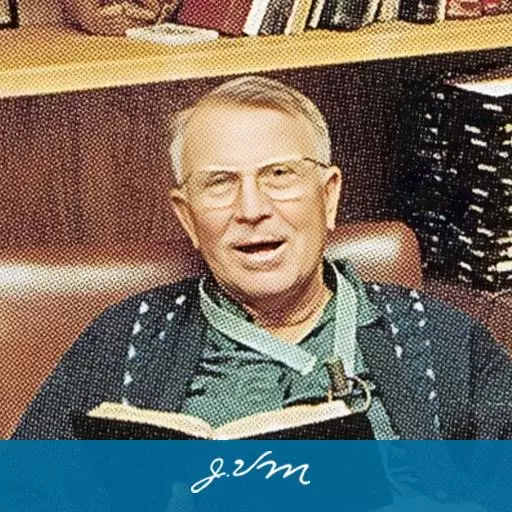
Questions & Answers 3083


1) What is the sin unto death in 1 John 5:16-17?
2) Who are the 24 elders in Revelation 5:13-14?
3) What does the phrase "may the Lord do so and much more" mean in 1 Samuel 20:13?
4) Do the events in 2 Samuel 2:15-16 describe some type of sacrificial rite that had to be performed before the battle could begin?
5) Are white lies justifiable?
6) Why did Jesus need to study the Scriptures since as God He would know all things?
7) Is it possible to be a born-again believer and never be filled with the Holy Spirit?
Announcer: If Jesus was God, then why did he have to read and study the scriptures like any other man? Well, stay with us to find out. How firm a foundation, ye saints of the Lord, is laid for your faith in his excellent word. What more can he say? You're listening to the Question & Answer program with our Bible teacher, Dr. J. Vernon McGee. This is a ministry of the Thru the Bible Radio Network. Our first question today comes to us from a listener in Alexis, North Carolina, who writes, would you please explain 1 John chapter 5, verses 16 and 17?
Dr. J. Vernon McGee: All right, let's read 1 John 5, 16 and 17. If any man see his brother sin a sin which is not unto death, he shall ask and he shall give him life for them that sin not unto death. There is a sin unto death. I do not say that he shall pray for it. All unrighteousness is sin, and there is a sin not unto death. Now, let me say that in this question, the primary thing is to determine what does he mean by death? And I assume that the average person thinks it means eternal death, or that is eternal separation from God. And what he's talking about here is just simply physical death. And he says that there is a sin unto death, and there's a sin that's not unto death.
And if a person has committed a sin unto death, no need to pray for that individual. But how are we to know? Well, we don't know. Therefore, we ought to pray for a person, a Christian who has sinned. Now, that's what he's talking about here, a Christian who has sinned. And if that Christian commits sin and continues in it, then surely that individual is going to be actually punished for it. And there is a sin that a Christian can commit. It means that God's going to bring him home. He's not going to leave him down there. Now, Ananias and Sapphira committed a sin unto death, and they were struck dead, and Simon Peter walked over their bodies and went down to Joppa, and there was a woman down there by the name of Dorcas that had died, and he raised her from the dead.
She was a seamstress, very good at it too, by the way. And Ananias and Sapphira, he didn't attempt to raise them from the dead. They'd committed a sin unto death. Now you and I don't know when a Christian sins, whether it's a sin unto death or not. We should pray for them, regardless whether we know it or not. If they've committed a sin, pray for them. And if it's a sin unto death, we've just wasted our breath, to tell the truth, but we don't know that. Pray that they would be spared or that God would not exact a punishment that would be as extreme as death. You see, God believes in capital punishment, by the way, even for his own, and there have been many that have been taken home.
I am of the opinion that if you and I today knew the number of people that have died, that have died because it's the Father calling them home. They've committed a sin unto death, that is, physical death. Now that's what he's talking about, and I think I should illustrate this for you because this is so misunderstood today. A mother has a little son by the name of Willie, and we always call these little boys Willie, and there's sure a lot of Willies around. But this mother has a little boy, and he's a obstreperous little brat, or son, I should say, and she tells him now, she says, Willie, you can go out and play in the backyard, but I don't want you fighting with the little brat next door.
I want you to not fight with him. And he says, yes, mama, I won't fight with him. And so she says, if you fight with him, you're going to have to come in the house, and I'll not let you out. So he goes out, and it isn't long until she hears the little brat next door yelling at the top of his voice. She goes out on the porch and looks out, and there's her precious little Willie just beating the stuffing out of the little brat next door. And she says, Willie, didn't I tell you not to do that? He says, yes, mama. And she says, now I'm not going to tell you again. You are not to fight with a little boy next door, and if you do, you're going to have to come in.
He says, yes, mama, I won't fight anymore. And so she goes back in and working around the kitchen, and it isn't too long till she hears that same sound coming from the brat next door. And she goes to the door, and the same scene greets her. There's her precious little Willie on top of the boy next door, and she says, Willie, didn't I tell you that you're going to have to come home? And he says, yes, mama. But he says, I don't want to come home. And she says, come on in. And she has to go out and get him. She gets a hold of his ear. And I have a notion that she could be prosecuted today if she'd take hold of her ear today.
That would be cruelty to children. By the way, there is a lot of cruelty to children, but holding them by the ear isn't that. And she gets this little boy by the ear, and he's just crying now at the top of his voice. He says, I don't want to come in. But she says, I told you you were coming in. Now, God has a lot of children that are out here in this world, and they're sinning today. And every now and then, one of them will commit a sin unto death, and the Lord says, come on home. And he takes them home, and they have a funeral at the church, and the preacher maybe doesn't know it. In fact, none of us know it, but it's the Father calling one of his own home.
And so I think that's the meaning of this verse of scripture.
Guest (Male): Our next question comes to us from a listener in Benson, Arizona. He writes, would you please explain who the 24 elders are in Revelation chapter 5, verses 13 and 14?
Dr. J. Vernon McGee: And I didn't have any notion of reading that, but maybe I should read that. And I'll turn to Revelation then, and we'll try to read those verses. I didn't intend to do it, you know, but I think I ought to do that. Revelation now, 5, verses 13 and 14. And it says, and every creature which is in heaven and on the earth and under the earth, and such as are in the sea, and all that are in them, heard I saying, blessing and honor and glory and power be unto him that sitteth upon the throne and unto the Lamb forever and ever. And the four beasts, or living creatures, said, amen, and the four and twenty elders fell down and worshiped him that liveth forever and ever.
And who are the 24 elders that are mentioned there? I believe the 24 elders are the raptured church. Now, I recognize that there are those that, and I accepted the interpretation for many years, that 12 of those elders represented the Old Testament saints, and that the other 12 elders represented the church. That sounds logical. The only thing is, why didn't John make that division, if that is the division that should be made? I assume that the 24 elders, whatever they represent, they all represent the same thing because there are 24 elders there. Now, I recognize that the Old Testament had elders, but finally they had a kingdom, and the king became the important one.
And the church, though, is supposed to be ruled by elders. That's not always true, but that is certainly the suggested formula and pattern for church government. So I assume that the 24 elders represent the raptured church that is taken up into the presence of God at the time of the rapture.
Guest (Male): We turn now to a question from a listener in Coupeville, Washington. She writes, the phrase, may the Lord do so and much more, is used several times in the Old Testament, but doesn't seem to fit the remainder of the verse it's tied to. First Samuel chapter 20, verse 13 is an example. Could you please explain its meaning?
Dr. J. Vernon McGee: And if you turn to that, we find here that this is a statement of Jonathan, and you need to read the verse before and probably the verse after to see that there is a connection and that it's not out of place. It says, and Jonathan said unto David, O Lord God of Israel, when I have sounded my father about tomorrow any time or the third day, and behold, if there be good toward David, and I then send not unto thee and show thee, the Lord do so and much more to Jonathan. Well, that's very much in keeping. He's talking to David, and he says, now I'm going to test out my dad and see how he feels towards you, and if everything is all right for you to return, why, I'll bring the word to you.
And then he takes an oath. He says, why, if I don't do that, why, may God do even worse to me than my father would do to you. So that it's very much in keeping here. In fact, Jonathan said it to give an assurance to David. So actually, the expression is not out of place at all.
Guest (Male): The same listener has a second question. Do the events in 2 Samuel chapter 2 verses 15 and 16 describe some type of sacrificial rite that had to be performed before the battle could begin?
Dr. J. Vernon McGee: And let me read these 2 verses that he's mentioned here. That's 2 Samuel, and it is the second chapter, 15 and 16 verses. Then there arose and went over by number 12 of Benjamin, which pertained to Ish-bothi, the son of Saul, and 12 of the servants of David. And they caught every one his fellow by the head and thrust his sword in his fellow's side. So they fell down together, wherefore that place was called, and I'll not attempt to pronounce it, it means field of the swords, which is in Gibeon. And there was a very sore battle that day, and Abner was beaten, and the men of Israel before the servants of God.
May I say there's no thought or suggestion of a sacrifice of human beings in this statement or any place in the scripture. When it's mentioned in the scripture, it is mentioned to condemn it, and this is merely a historical record that 12 men of each group of Saul's side and David's side met in battle, and that it was a very bloody sort of thing. It's just a historical record of how bad man really is.
Guest (Male): We turn now to a question from a listener in Round Rock, Texas, who writes, I believe that the ninth commandment is broken more than any other. For example, in the impish fib, when a friend asks, how do you like my new hat? In this instance, the truth can often start a small war. And then there are the white lies, lies told to protect people from trouble that would surely ensue if the truth became known. So then my question is, are white lies justifiable?
Unidentified Speaker: And the answer has to be no, they're not justifiable, but there are exceptions or times when they are used to protect human life. Now, if it's used to protect human life, that's one thing, but if it's used, for instance, by an individual to get out of doing a certain thing or that he failed to fulfill a certain chore that he was to do and say, yes, I did it, and then slip around and do it in order that his lie might become the truth. Those times, I think they're never justified, but when it's used to protect human life, and I do think that there are times like that. For instance, during the war, where the Nazis were looking for Jews to actually put them in these concentration camps, why an individual would take one in and protect them by putting them in the cellar up in the attic.
And then when the Nazis knocked at the door and said, do you have anyone here that is not a member of your family? Why the answer'd be, well, no, we don't have one, when in reality you did. But if you said yes and turned that individual over, you'd be absolutely betraying them into the hands of those who would destroy them. And under cases like that, I think it absolutely would be permissible to say what was said to protect the individual. But that, may I say to you, is what's called a white lie, but there's no such thing as a white lie. Well, that's a lie, but it's told for a purpose of protecting an individual, actually saving human life.
And I think there would be other cases of that also. I think those are extreme cases, and that it's understood that in times like that, that would be permissible. But in our ordinary dealings with each other, a white lie is not a white lie. It's as black as hell itself, because a lie is a lie. You are a little cynical, I believe, about the human family, and I think you're entirely accurate. The scripture has a great deal to say about the lie and the liar. Actually, the originator of the lie was the devil. It said that he was a liar from the beginning and that he's the author of it, and you certainly are doing the devil's work and you're the devil's messenger when you lie, and yet it comes so natural to us to not tell the exact truth.
Guest (Male): Our next question comes to us from a listener in Woodland Hills, California, and he writes, why was it necessary for Jesus to study the scriptures? Since he was with God when the world was made, he must have known all these things.
Unidentified Speaker: That is absolutely true, what you're saying, but to fail to recognize who the Lord Jesus Christ was. He's not only the most wonderful person that's ever lived on this earth, but he actually is a unique person because he was both God and man. And when he was God, he was not any more human because he is God. And he's not any less God because he's human. He is the theanthropic person, the God-man. The oldest creed says he's very man of very man, and he's very God of very God. The first heresies that came, of course, was relative to the person of the Lord Jesus Christ, who he was, and there were many ways of interpreting him.
You see, at the very beginning, they could not deny his deity for the very simple reason there were men all around that had seen him, heard him, and saw his mighty works, and they knew that he was more than a man. They never questioned his deity. They did question his humanity, and you'll find that the first heresies of the church dealt with that angle. Gnosticism recognized the deity of Christ. They had some peculiar ideas about his humanity. They said, for instance, that he was just an ordinary man, and that deity came on him at his baptism and left him at the cross. Things like that, that had actually no scriptural basis whatsoever.
He was the God-man, and he's both God and he's both man, and he never operated in a mixture. That's what is known in theology as the hypostatical union. There's no blending or mixing of the two. And you find, for instance, that he's out on the Sea of Galilee, and he is in a storm, and he's in a storm because he's actually asleep. He's gone to sleep. Now, that's perfectly human to go to sleep. He was a perfect man. And they wake him, and they said, Master, carest thou not that we perish? And he got up, and he stilled the storm. That's not human. That's God. Only God could do that. Only God could still the storm, and he did that.
And then, may I say to you, he one day walking through Samaria, he sat down at a well. Why? He was tired, weary. And there came a woman down to the well, and he said to her, I can give you the water of life. May I say to you, only God can do that. He's both God and man. And he stood yonder at the tomb of Lazarus, and he wept. It says Jesus wept, and there's nothing quite as human as tears, and he shed tears. May I say to you, he also said, Lazarus, come forth, and only God can do that. May I say to you, he is the God man. And since he was the God man, he was perfectly human, perfectly God. And as we've indicated that he came and took upon himself our humanity, made in all points like as we are, sin apart, of course, and he had to go through the same process that we do.
He came into the world through a birth. He could have burst forth out of heaven in a blaze of glory, but that was not his method. He came down and took upon himself our humanity, and he was born of a virgin. He grew up in Nazareth, a miserable little town. You talk about whether your environment can affect you or not, well, believe me, Nazareth was a mean little town, and it had that reputation in that day, and he was brought up there, and he learned the carpenter's trade. His stepfather taught him that. Joseph taught him to be a carpenter because Joseph was a carpenter, and he had to learn a trade, and he practiced that trade.
But there came a day when he began to not build houses or build things down here, but he began to deal with the human soul, and he said, sinful man, ye must be born again. He's now God speaking to mankind. May I say to you, he is the God man, and you and I will never understand that down here. We can only bow in reverence and in worship. And so he had to learn the scriptures, just as you and I do, because he's a man. And he was able, though, to confound the wisest of that day because he was actually more than a man. Therefore, we need to understand that when he came to this earth, he took upon himself our humanity, and in so doing, he began with birth and childhood, young manhood, and he never knew what old age was, but I think that there on the cross they made an old man of him when they crucified him, and when he took upon himself the sins of the world.
He was then the ancient of days, bearing the sins of the world in his humanity on the cross because he was one of us. Or we could enlarge on that. May I say to you that all through the scripture you have the teaching that reveals him as a man and reveals him as God. I think those five offerings that are given in Leviticus, that's the reason Leviticus is such an important book. Those five offerings speak of him in his humanity and in his deity. For instance, the bread offering, the meal offering, that speaks of his humanity in a very wonderful way, and that explains why he had to go to school.
He had to learn as others learn. I'd love to stay there all day on that, but we can't do that, of course. We must move along.
Guest (Male): And moving along, we come now to our final question today, and it comes from a listener in Mattoon, Illinois. The listener writes, is it possible to be a born-again believer and never be filled with the Holy Spirit?
Dr. J. Vernon McGee: I think that it's possible, quite possible. I'm of the opinion that there are people that are saved and are never filled with the Holy Spirit, but stumble along in the Christian life for years and finally end up in the grave and never know what it was to be filled by the Holy Spirit. You see, when you accept Christ as your Savior, you are regenerated. You are baptized by the Holy Spirit. That's the work of the Holy Spirit that puts you in the body of believers, the church, the real church. And then you are indwelt by the Holy Spirit, and he indwells you in order that you might exercise a gift, that you might do the thing God wants you to do, and then you're sealed by the Holy Spirit.
Now, there is the one ministry of the Holy Spirit that you're asked to do something about, and you are commanded, be filled with the Spirit. Now, that is something that comes later. We need the filling of the Spirit to live the Christian life. We need the filling of the Holy Spirit to serve the Lord, to perform any Christian work. It must be done in the power of the Holy Spirit. If it's not, it's not Christian work at all. So that the filling of the Holy Spirit is something that you and I are commanded to do. Now, you and I are, I think, filled with the Holy Spirit when we are walking in the will of God, when we do not have unconfessed sin in our life, and when we attempt to walk by the Spirit of God.
Now, when I say attempt to walk, I mean exactly that, that that is the thought of Paul in Galatians. Learn to walk in the Spirit, and that means to start out depending upon the Holy Spirit and a walk is a very peculiar thing. It's putting one foot out in front of you and leaning forward and start out and then put the other foot in front of you. And if you don't, you'll stumble and fall on flat of your face. Now, the problem is some of us will start out walking, and just like Simon Peter did walking on the water. He did it. He walked on the water, proved he could do it, but he got his eye off of the Lord Jesus, and when he did, he saw the waves.
And today, in this mad world in which you and I live, it's so easy to get our eyes off of the Lord Jesus, and when we do, we start stumbling, start sinking in the mire and muck of this world today.
Announcer: Well, we need to close out today's program, and as we do that, let me tell you that we have a number of books and CDs that are available by Dr. McGee that may be helpful in answering some of your questions. To receive our resource catalog, simply call us. You can do it anytime and leave a voicemail request. Just make sure it includes your name, address, and the call letters of this station. Now, for those of you who are interested in purchasing a copy of today's program on a single CD, contact our offices by phone or mail, or shop our online bookstore at TTB. Now, be sure to join us this week on the Thru the Bible radio program that's heard on this station.
You can be added to our mailing list that also includes our notes and outlines that go along with that study by calling us at 1-800-65-BIBLE. Just make sure and do it Monday through Thursday from 6 a.m. to 3 p.m. Pacific time, or use our internet order form or download them at ttb.org for free.
Guest (Male): And remember, you can always write to Questions & Answers. In the US, box 7100, Pasadena, California, 91109. In Canada, box 25325, London, Ontario, N6C 6B1. Now, until the same time next week, we pray that our God will answer all your questions and solve all your problems.
Announcer: Jesus made it home. This program's been brought to you by the faithful friends and supporters of the worldwide ministry of Thru the Bible Radio Network.
Featured Offer


Featured Offer
About Thru the Bible - Questions & Answers
Questions and Answers offers Dr. J. Vernon McGee's signature wit and wisdom in answering Bible questions sent to him by radio listeners throughout his years of ministry.
Other Thru the Bible Programs:
Thru the Bible - Minute with McGee
Thru the Bible - Sunday Sermon
About Dr. J. Vernon McGee
John Vernon McGeewas born in Hillsboro, Texas, in 1904. Dr. McGee remarked, "When I was born and the doctor gave me the customary whack, my mother said that I let out a yell that could be heard on all four borders of Texas!" His Creator well knew that he would need a powerful voice to deliver a powerful message.
After completing his education (including a Th.M. and Th.D. from Dallas Theological Seminary), he and his wife came west, settling in Pasadena, California. Dr. McGee's greatest pastorate was at the historic Church of the Open Door in downtown Los Angeles, where he served from 1949 to 1970.
He began teaching Thru the Bible in 1967. After retiring from the pastorate, he set up radio headquarters in Pasadena, and the radio ministry expanded rapidly. Listeners never seem to tire of Dr. J. Vernon McGee's unique brand of rubber-meets-the-road teaching, or his passion for teaching the whole Word of God.
On the morning of December 1, 1988, Dr. McGee fell asleep in his chair and quietly passed into the presence of his Savior.
Contact Thru the Bible - Questions & Answers with Dr. J. Vernon McGee
info@ttb.org
https://ttb.org/
Mailing Address
Thru the Bible, Inc.
P.O. Box 7100
Pasadena, CA 91109
In Canada:
Box 25325,
London, Ontario
N6C 6B1
Phone Number
(626) 795-4145 or
(800) 65-BIBLE (24253)