

Questions & Answers 3054


1) Can you deal with the idea of temptation in Luke 11:4 and James 1:13?
2) "Why Four Gospels?" part 1
3) The Gospel for the religious man
4) The Gospel for the strong man
5) The Gospel for the perfect man
6) The Gospel for the wretched man
Guest (Male): Matthew, Mark, Luke, and John each wrote about the life of Christ. We call them the Gospels, but why are there only four? Well, stay with us as we find out the answer.
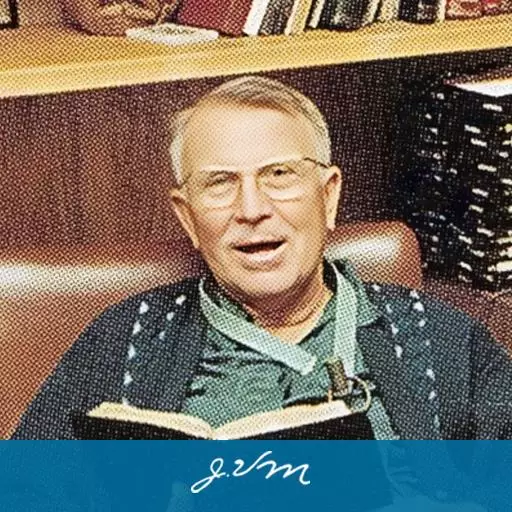
You’re listening to the Question and Answer program with Dr. J. Vernon McGee, a ministry of the Thru the Bible radio network. During the next four programs, Dr. McGee is going to deal with the issue, why four Gospels? as this question has come to him on numerous occasions.
But before we get to that topic, let’s have one question from a listener in Los Angeles who writes: In light of James chapter 1 verse 13, could you please explain Luke chapter 11 verse 4?
Dr. J. Vernon McGee: The emphasis is on lead me not into temptation. James 1:13 reads like this: Let no man say when he is tempted, I’m tempted of God, for God cannot be tempted with evil, neither tempteth he any man.
Here is a place where there’s a distinction without a difference. This, of course, is something that is a great axiom of the Word of God, that God never tempts anyone with evil. That is not God’s testing.
We sometimes think that the Lord may test us with presenting evil to us. He does not. The whole thing that we have back in Luke now, and I’ll turn there, it’s Luke 11:4, and it reads, "And forgive us our sins, for we also forgive everyone that’s indebted to us, and lead us not into temptation, but deliver us from evil."
The whole point here is lead us not into testing. I do not know about you, but I do not want God to test me. I believe that he permitted me to have cancer to test me. I’m sure of that.
I want to say this to you, I pray now, lead me not into that kind of testing again. Deliver me from cancer. I prayed that prayer this morning, that God would keep me well and not let there be a recurrence of cancer. I have multitudes of friends out there that pray that prayer. I think that’s in keeping with what the Lord Jesus said: Lead me not into testing, and then if I fall into evil, deliver me from it.
Over in James, he’s saying something altogether different. God doesn’t test you with evil. That is something altogether different. You might want to raise the question about whether cancer’s evil or not. It’s evil, but not in a moral sense.
God does not test you with that type of thing. Most of us are tested when we ourselves are drawn away by our own lust and enticed. That’s it.
It’s like the little boy. One night his mother heard him back in the kitchen. She said, "Willie, where are you?" And he said, "I’m in the pantry." She said, "What are you doing?" He says, "I’m fighting temptation." Well, now, that’s the wrong place for a little boy to fight temptation. It might be hard to keep his hand out of the cookie jar. That is true of us. Many of us fall because we get in the place where you fall.
Guest (Male): Now let’s begin the first of our four-part series on why four Gospels.
Dr. J. Vernon McGee: We read in the epistle to the Galatians, the fourth chapter, the fourth verse, "But when the fullness of the time was come, God sent forth his Son, made of a woman," that should be born of a woman, "born under the law."
The question has been asked from the very beginning: Why four Gospels? Why not five? And why not three? A wag has given an answer to that. He says, "Three is not adequate. Five is superfluous. So we have four."
There must be a better reason than that. Some scholars have attempted to resolve the problem by making a harmony of the Gospels. It’s amazing how outstanding men will trim the corners in an attempt to reconcile any disparity that they think they find in the Gospel records.
To read many of these harmonies is like trying to fit a number four shoe on a lady with a size seven foot. It’s just difficult to do. You’ve probably heard the story about the lady who went into the shoe store, and the clerk in a very gracious way asked her, "What size do you wear?"
"Well," she said, "I can get a four on my foot, but five is really my size, and since six feels so good, I always buy a number seven." Let me tell you, that’s the way they harmonize the Gospels also. We do not need really a harmony at all. We need a disharmony.
The Gospels are supposed to be different. We’re going to see why. There’s a very good reason why we have four Gospels and there’s a very good reason why they do not harmonize in detail. They were not supposed to.
There’s a vast difference and wide divergence among the Gospel records. Each one was written for a particular purpose, to meet the need of a separate segment of the world population. We need to recognize this and to let the Gospels conform to this very natural pattern.
If the Holy Spirit had wanted one Gospel, he would have given us one Gospel. He gave us four Gospels in order that they might meet the needs of mankind. Somebody says, "Why do you say that?" Well, will you listen?
When Christ came, there were four major divisions in the human family. These divisions were not strictly racial or national, although they basically follow that pattern. Rather they are cultural divisions.
It’s a matter of the thought patterns of the people. There are four separate ways of looking at life. There are four levels of civilization. I believe that to this day, you can put all of mankind, as you could in Christ’s day, under one of these four major divisions.
There’s a Gospel to meet the need of each segment of the world’s population. Each presents certain specific human needs, and each has certain expectations. I hope we shall see that each performed a tremendous mission and that God used these divisions of the human family to get over to man his message—his message that is for all mankind.
We call these differences today the different lifestyles. Mankind is divided today not necessarily on the basis of race, but on the basis that is cultural and a lifestyle.
The Gospel of Matthew is written to the religious man. That’s obvious. It was written very definitely and directly to the nation Israel. The first division, and I’m sure it’s the one that would come to your mind first, would be the nation Israel, representing the religious man.
God took these people, as we’re going to see, segregated and separated them from the rest of mankind in order to do a work in the nation, and then he scattered them throughout the world. He did that for a very definite purpose. They represented religion, a God-given religion, if you please.
Actually, God has never given but one religion. That was Judaism, the Mosaic system. Somebody asks, "But what about Christianity?" Well, Christianity in my book is not a religion. It’s a person.
That person is the Lord Jesus Christ, and it’s your relationship to him. Not even a church, not even a ceremony, not even a ritual. It’s your relationship to the Lord Jesus Christ. That’s different.
You either have Christ or you don’t have Christ. You either trust him or you don’t trust him. It’s not a religion. It’s a person. But God did give a religion, the Mosaic system, and he gave it to the nation Israel. He didn’t give it to you. He gave it to the nation Israel.
In Christ’s day, a God-given religion had gone to seed. It was as dead as a dodo bird. It was reduced to a ritual and a law. It was a legalistic system, one that was concerned with a ritualistic, a liturgical religion. And that was all, by the way.
I’m afraid there are those today even in conservative circles who try to make Christianity just that. They follow a little rule and a little regulation, then they learn a little vocabulary, and they take a few little seminars on some subject.
They get a bunch of rules that are candidly not in the Bible at all. All of this makes them a Christian, so they say. May I say to you that Christianity’s a person. That person is Christ. It’s not a religion at all. It does not even conform to the meaning of the word religion. Look it up.
In Christ’s day, religion had become so dead that though in the beginning of his earthly ministry, he said, "Make not my father’s house a den of thieves," he concluded his ministry by saying, "Your house is left unto you desolate." The Father’s house was no longer the Father’s house; it’s your house. He walked out on them. He turned his back on religion.
Religion had not satisfied the heart of man. A Pharisee one dark night came to Jesus with a question. The religious man always thinks he has the answers until a few questions are asked and he comes into contact with Jesus Christ. That night, Nicodemus asked, "How can a man be born again?" Yet Nicodemus represented religion at its best.
On another occasion, a scribe came to him. This scribe who came to Christ, he knew the Old Testament, or he wouldn’t have been a scribe. Yet he came with his question: "What must I do to inherit eternal life?" He knew he did not have it.
Nicodemus knew he was not born again. Even Zacchaeus the publican, who was an Israelite outcast, climbed up in a sycamore tree because he wanted to see Jesus. He wanted something that religion could never give him.
After our Lord had visited with him in his house, he came out and said, "This day is salvation come to this house." Religion has always been against Jesus Christ. The greatest enemy I think of the Lord Jesus Christ in this country right now is actually liberalism, that which attempts to destroy him in one way or another.
He turned to individuals. He said to them, he says to you and to me today, "Come unto me, all ye that labor and are heavy laden, and I’ll rest you. Take my yoke upon you, learn of me, for I’m meek and lowly in heart, and you’ll find rest in your souls."
He denounced religion. We always hear about the gentle Jesus, how gracious he was, and it’s true that he was gentle, and he is today. But when a sinner came to him, he was always gracious. But my friend, he hated religion when it was phony.
The harshest words in the Bible came from his lips, and he uttered them not against Rome, not against harlots, not against bootleggers, but against religion. Let me lift out just one verse as an example, Matthew 23:13: "But woe unto you, scribes and Pharisees, hypocrites! For ye shut up the kingdom of heaven against man, for ye neither go in yourselves, neither permit them that are entering to go in." Religion will shut man out from God. So our Lord came to meet the need of the religious man.
I’d like to mention the second Gospel, the Gospel of Mark. The Gospel of Mark is written to the second division, the Roman Empire, representing the strong man. Personally, I have always admired the Romans. I can’t help but admire them. For one millennium, they ruled the world.
They brought law and justice to the world. Our laws are partially based on theirs. I have a quotation I’d like to share with you from Dr. Gregory concerning the Romans. Listen to this: "The Romans, on the contrary, gave the world law in its dynamic governmental and temporal aspects. With him, it was not a precept waiting for man to fall in with it, but the expression of a present force, the organized and martial might of Rome, demanding submission and remorselessly crushing man and nation into its own mold. And that mold was an iron one. It said to man, ‘Rome is all-powerful and does not choose to wait. Therefore, yield on the instant or die.’"
That is a good estimation of Rome. The world got tired of that. Mark wrote to meet the need of the strong man. Mark is the Gospel of miracles. It’s the Gospel of action. The word that occurs more than any other word is the little conjunction "and."
He wrote what the Romans wanted to hear. Jesus did this, and he did that, and he did the other thing. The Roman wanted to know that. He believed that law as was represented by him got action throughout the world, and it did. It was death for anybody that resisted.
No one could flee away because Rome had a secret service that reached out everywhere, over three continents and the islands of the sea round about. They called this Mediterranean Sea *Mare Nostrum*. That means "it’s our sea," and it was theirs.
The Gospel of Mark was written to meet the need of that man. It was the Gospel of miracles, and it’s the Gospel that our Lord said the Son of Man came not to be ministered unto but to minister, to do something, and to give his life a ransom for many.
One day, a little Jew, crippled, ill, and heartsick, stumbled down the Appian Way into Rome. He’d already written, "I am not ashamed of the Gospel of Christ, for it is the power," that is delegated power, "of God unto salvation."
Do you want to know if it was dynamite or not? Well, read Gibbon in *The Decline and Fall of the Roman Empire*. He says that the Gospel which Paul brought in was one of the factors that shook Rome to its foundation. It couldn’t stand up against the Gospel. The immorality of Rome had gone so far down that it just couldn’t stand up again it. It's the Gospel written for the man of action that is Mark.
Then there is the third Gospel, the Gospel of Luke. It was written for the Greek, the thinking man, the intellectual man. The Greek was the thinking man. For 100 years, termed the Golden Periclean Age, four centuries before Christ came, Greece erected upon the horizon of history a culture that has dazzled the world from that day to this.
One of the tenets of Greek culture was their search for the perfect man. Look at their art. Look at their statuary. They were seeking the perfect man physically. Read their literature. They were looking for the perfect man mentally.
As you look at their gods, you realize that they were nothing more than projections of humanity. They did not find what they sought. They never found the perfect man even in their gods because they were constantly quarreling among themselves and showed real petty jealousies.
Dr. Luke, a medical doctor and himself a Greek apparently, the one Gentile who wrote in the scriptures, a brilliant man, wrote for the Greek. He wrote with the thinking man in mind, and he presented the perfect man.
Greek philosophy had not produced him, but Dr. Luke says in effect, "I poured the Lord Jesus Christ into the test tube in my clinic, and I put the acids of Greek philosophy down upon him. I placed the stethoscope of humanity upon his heart, and he’s perfect."
That is what Dr. Luke tells us. Our Lord came to save the thinking man. After our Lord’s resurrection, when he met with his disciples, Luke says, "Then opened he their understanding, that they might understand the scripture." That’s in Luke 24:45.
Aristotle was a great teacher. Socrates was a great teacher. Plato was a great teacher, but not like Jesus. Our Lord could open man’s understanding to do something quite wonderful, my friend, to comprehend spiritual truth.
He still does that today. You and I give out the word of God, but understanding comes from him. The Holy Spirit has to be there to take the things of Christ and show them unto us, and he is still the great teacher today, by the way.
Now we come to the last one, the Gospel of John, and why it was written. It was written to the wretched man. Now that may seem strange to you. Now will you listen?
The last major division of the human family was the Oriental races. Out yonder is the mysterious East. An Englishman who went out there spent years as a soldier, and he wrote a great deal of poetry, said, "East is East, and West is West, and never the twain shall meet."
Kipling was right. Although it’s strange to us, there is one thing we know about it. It’s a place of squalor, misery, and poverty, and is at the present hour just that. While you and I try one reducing diet after another, thousands of people, even millions of people in the Orient, die from starvation.
The strange thing is that right beside that poverty is untold wealth. There is a man out there who several years ago, the way that he collected the taxes was, he got on one side of the scale and they put diamonds and gold on the other side that would balance his weight—and he was pretty much of a heavyweight—and that was his income for the year. That’s a nice way to get it.
There’s wealth untold and poverty unspeakable. Yet the rich man is wretched and the poor man is wretched. Out of that mysterious East, for some strange reason, there came wise men saying, "Where is he that is born King of the Jews? For we have come to worship him." They had a need. They were looking for someone to meet that need.
John wrote a Gospel for this particular lifestyle, this particular mind. John wrote, "Many other signs truly did Jesus, which are not written in this book, but these are written, that ye might believe that Jesus is the Christ, the Son of God, and that believing ye might have life through his name." That’s John 20:30 and 31.
Note, they don’t need poverty out there and they don’t need wealth. Somehow, neither has solved any problems. What they need is life. Jesus said, "I am come that they might have life, and that they might have it more abundantly." That’s John 10:10.
Guest (Male): Well, that brings us to the close of today’s program, but just the beginning of this four-part series. The subject of why four Gospels is dealt with in greater detail in Dr. McGee’s booklet by the same title. Or look for the material in the hardback book, *The Best of J. Vernon McGee*, Volume 2.
Be sure to join us every weekday on the *Thru the Bible* radio program heard on this station. To be added to our mailing list for notes and outlines, or to order either of the resources that we’ve mentioned, give us a call at 1-800-65-BIBLE. Our offices are open Monday through Thursday from 6:00 a.m. to 3:00 p.m. Pacific Time.
Or write to Questions & Answers. In the US, Box 7100, Pasadena, California 91109. In Canada, Box 25325, London, Ontario N6C 6B1. We can also be found online at TTB.org. Knowing that God is full of wisdom and knowledge, we pray that he will answer all your questions and solve all your problems.
This program’s been brought to you by the faithful friends and supporters of the worldwide ministry of Thru the Bible Radio Network.
Featured Offer


Featured Offer
About Thru the Bible - Questions & Answers
Questions and Answers offers Dr. J. Vernon McGee's signature wit and wisdom in answering Bible questions sent to him by radio listeners throughout his years of ministry.
Other Thru the Bible Programs:
Thru the Bible - Minute with McGee
Thru the Bible - Sunday Sermon
About Dr. J. Vernon McGee
John Vernon McGeewas born in Hillsboro, Texas, in 1904. Dr. McGee remarked, "When I was born and the doctor gave me the customary whack, my mother said that I let out a yell that could be heard on all four borders of Texas!" His Creator well knew that he would need a powerful voice to deliver a powerful message.
After completing his education (including a Th.M. and Th.D. from Dallas Theological Seminary), he and his wife came west, settling in Pasadena, California. Dr. McGee's greatest pastorate was at the historic Church of the Open Door in downtown Los Angeles, where he served from 1949 to 1970.
He began teaching Thru the Bible in 1967. After retiring from the pastorate, he set up radio headquarters in Pasadena, and the radio ministry expanded rapidly. Listeners never seem to tire of Dr. J. Vernon McGee's unique brand of rubber-meets-the-road teaching, or his passion for teaching the whole Word of God.
On the morning of December 1, 1988, Dr. McGee fell asleep in his chair and quietly passed into the presence of his Savior.
Contact Thru the Bible - Questions & Answers with Dr. J. Vernon McGee
info@ttb.org
https://ttb.org/
Mailing Address
Thru the Bible, Inc.
P.O. Box 7100
Pasadena, CA 91109
In Canada:
Box 25325,
London, Ontario
N6C 6B1
Phone Number
(626) 795-4145 or
(800) 65-BIBLE (24253)