

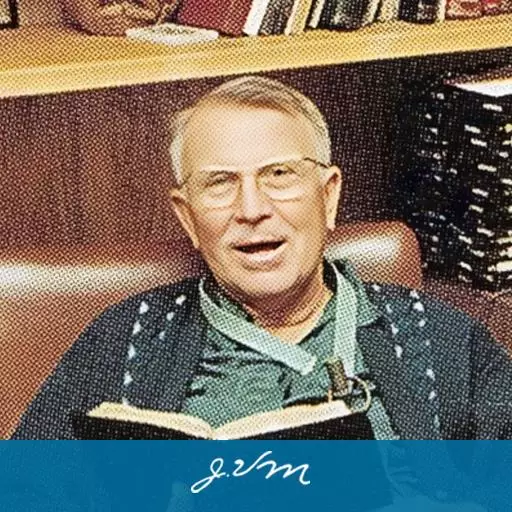
Questions & Answers 3046


1) Will the Antichrist be revealed before the Rapture of the church?
2) Who is Melchizedek in Hebrews 7?
3) Why did Jesus say on the cross to the Father "Why have You forsaken Me"?
4) What is the meaning of "this generation" in Matthew 24:34?
5) How did the Israelites dispose of the blood from the sacrifices they made every day?
Guest (Male): The Bible is full of mysteries, which are not fully explainable because God has given us very little information. Take Melchizedek for instance. Who is he? Where does he come from? And what role does he play in scripture? We'll find out by staying with us.
You're listening to the question and answer program with our Bible teacher, Dr. J. Vernon McGee, who for over 30 years answered the many questions of his listeners. This program is a ministry of the Through the Bible Radio Network. Our first question today comes to us from a listener in North Huntington, Pennsylvania. He says, "Will the Antichrist be revealed before the rapture of the church?"
Dr. J. Vernon McGee: I want to turn to the passage that is generally used and it's a good one. It's 2 Thessalonians the second chapter. And there's an extended passage here and I probably should begin reading it verse three of chapter two. Paul writing to the Thessalonians, he says, "Let no man deceive you by any means: for that day shall not come, except there come a falling away first, and that man of sin be revealed, the son of perdition."
Now he's talking about the day of the Lord. It's the big subject in the Old Testament. The day of the Lord according to the Old Testament is not light, it's darkness. That is, it begins as the Hebrew day began with sunset. It began at nightfall and the day of the Lord will begin with the great tribulation period. And then it goes into the millennium. That's when the son of God comes to the earth to establish his kingdom.
Now he goes on to say that the man of sin is to be revealed before the day of the Lord can begin. And I take it that the man of sin will be working and maybe in a place of prominence at the time of the rapture, but he'll not be revealed what he really is until after the church is removed. It says, "who opposeth and exalteth himself above all that is called God, or that is worshipped; so that he as God sitteth in the temple of God, showing himself that he is God." Yet he is an Antichrist and an anti-God, if you please.
"Remember ye not, that, when I was yet with you, I told you these things? And now ye know what withholdeth that he might be revealed in his time. For the mystery of iniquity doth already work: only he who now letteth will let." And that word "let" of course is the word hinder. He will now hinder and he will hinder until he be taken out of the way. And then shall that wicked one be revealed, whom the Lord shall consume with the spirit of his mouth, and shall destroy with the brightness of his coming.
Now I take it as long as the Holy Spirit is in the world hindering evil, this final manifestation of evil cannot appear as long as the Holy Spirit is here restraining evil. Now when the Holy Spirit is removed, now he's only removed from restraining evil. He'll still be in the world, but no longer restraining evil. Man will now be turned loose to do his thing and it's going to be terrible what he does. And we can see that any place today where man is free to express himself in any way he wants to.
And that is actually the deceit that is being practiced today about our country, that we are free to do as you please. You're not free to do as you please in this country. And our founding fathers founded a place where they could worship God and not have to go to a state church and pay taxes to it. They were looking for a place to worship God, but they started immediately to put down certain laws and barriers that a man must follow in a democracy. And you and I can't live and do as we please. We'll destroy the country if we do that sort of thing.
Now this restrainer, the Holy Spirit, is in the world today. But when the church is removed, he takes the church out, but he does not leave the earth. Remember the Lord meets the church in the air. The Holy Spirit will be right here in the world, but not restraining evil. Then the Antichrist will be manifested.
How much about Antichrist will the church know before it leaves the earth? This is in the area of speculation. I personally do not think we're going to know very much about him at all. I'm sure from what this passage says, he'll not be manifested as the Antichrist. It's not until the restraint is taken off of him, then he's free to go forward and do his thing and the world will be free to do it also. I tell you, that'll be an awesome and tragic day and a ghastly day for this earth when it comes to pass.
Guest (Male): We turn now to a question from a listener in Augusta, Georgia. She writes, "Hebrews chapter seven speaks of a priest named Melchizedek. Who is he and what connection does he have to Christ?"
Dr. J. Vernon McGee: And he is a type of the Lord Jesus Christ. That is his connection to Christ. And he was king of Salem. And I go back to the only reference that we have of him and that is actually in the 14th chapter of the book of Genesis at verse 18. This was when Abraham went out and rescued his nephew Lot, and in so doing, he rescued the king of Sodom and Gomorrah and prevented the kings of the East from taking them away in captivity.
And when he had returned from the battle or the war, why we're told here in verse 18 of chapter 14 of Genesis: "And Melchizedek king of Salem brought forth bread and wine: and he was the priest of the most high God." Now that's absolutely all that's told to us about this man historically. He walks out on the pages of scripture out of nowhere. He is given as king of Salem, which is Jerusalem. And he walks off the page of scripture into the silence of the centuries and I still don't know anything about the man.
And as far as I'm concerned, I'm willing to forget him. But the word of God does not forget him. In the epistle to the Hebrews, this is the epistle that reveals the Lord Jesus Christ as our great high priest. Great emphasis in Hebrews is upon that. And we're told several things about this man Melchizedek in the seventh chapter of Hebrews. And I'd like to turn there and read two verses.
I think maybe I should drop back to actually verse 20, the last verse of chapter six. It says, "Whither the forerunner is for us entered, even Jesus, made an high priest for ever after the order of Melchizedek." Now we're told here that the Lord Jesus is a high priest after the order of Melchizedek. And here we had forgotten all about Melchizedek. He's just mentioned there in one verse in Genesis and he comes out of nowhere and goes into everywhere. We don't know a thing about the man at all.
But we're told that the Lord Jesus is a priest after Melchizedek. How is he a priest after the order of Melchizedek? Well, we're told here. Melchizedek had no beginning nor ending and that the reason we were never given his history was because he's to be a type of the Lord Jesus. He had no beginning, he had no end as far as scripture is concerned. Just walks out on the page of scripture and he performs a service and he brings forth bread and wine to Abraham. And that's the same thing we use in the Lord's Supper.
Where did this man get all this information? I don't know. But he was a priest of the most high God. That's another office that he had. But the head of the family was always the priest in the family. So I take it that the king was the priest when there was a king over a people and he was king in Jerusalem. And so here we have this man Melchizedek given to us and the Lord Jesus is a priest after him.
But after all, Aaron and the tribe of Levi were the priests and Aaron was the high priest to God. Why isn't the Lord Jesus a priest after that order? In verse two he says: "to whom also Abraham gave a tenth part of all; first being by interpretation King of righteousness, and after that also King of Salem, which is, King of peace." This is a man that had a United Nations at work that really brought peace.
And we're told he's without father, without mother, without descent, having neither beginning of days, nor end of life; but made like unto the Son of God abideth a priest continually. Now that causes some men to believe that Melchizedek was the pre-incarnate Christ that has come to earth and did at the beginning. Now the men that take that position are men that I never argue against because I look up to them and have been greatly indebted to both of them. One is Dr. Lewis Sperry Chafer and the other is Dr. G. Campbell Morgan.
I don't see him as that at all. I just think that we're given that record, that historical record of him and not told where he began. And he's in Genesis where we have all the families. Because everybody that's mentioned there's a son of somebody else except Adam and he started the whole business of the human race. And everybody's a son of somebody, but this man is not a son of anybody as far as the record is concerned.
And that has led these men to think that he's the pre-incarnate Christ. I don't agree with that, but that's beside the point. The type is the important thing that is here. Now we're told that, and I don't want to read too much here, but I'm going to drop down to verse 11: "If therefore perfection were by the Levitical priesthood, (for under it the people received the law,) what further need was there that another priest should rise after the order of Melchizedek, and not be called after the order of Aaron?"
We get, I hope, the full picture. Melchizedek is put in Genesis there, one verse, that's about all we have. And he's put there that he might be a type of the Lord Jesus Christ. And when he came, he didn't come in the order of Aaron or the Levitical priesthood. Why? Because they ministered in a earthly tabernacle that was filled with imperfection. I think those skins they put over the tabernacle got dirty in that wilderness march and there wasn't any dry cleaner in the next crossroads of that desert. So they didn't get dry cleaned.
There's a lot of imperfection in the tabernacle, but it's an earthly thing. And Aaron, he had a lot of faults. Melchizedek, we are told nothing about him. We don't know, but he represents the Lord Jesus. He's a type of the Lord Jesus Christ and he ministered to Abraham and the Lord Jesus now is priest after the order of Melchizedek.
Yet the ironic priesthood, ministering not only in an imperfect tabernacle with an imperfect ritual and with an imperfect law—now that's not that there's anything wrong with the law or the ritual or the tabernacle. The problem is with the people that were concerned with it. The problem was with them. We got to have a better high priest than that. The Lord Jesus therefore is not after the order of Aaron, we're told, but after the order of Melchizedek. And that's the reason for that and I've elaborated on that that you might see the answer to your question here. What is his connection with the Lord Jesus Christ?
Everything, if you please. Everything. He wouldn't have ever been mentioned in Genesis. He's not needed for the story at all, but he's put there that he might be a type of the Lord Jesus Christ. And we might somehow or another enter... you see, God gave us a picture book in the Old Testament because we're little babes and we got to learn our ABCs. And that's the reason the Old Testament is so important. "All these things," Paul says, "happened unto them for examples." Examples for whom? For you and me. And that's the reason it's important to know the Old Testament and there's not too much preaching out of the Old Testament today as you well know.
Guest (Male): Here's a listener who has a question about a statement Christ made when he was hanging on the cross. He says, "Why did Jesus say to the Father, 'Why have you forsaken me?'"
Dr. J. Vernon McGee: The reason that the Lord Jesus Christ said, "Why hast thou forsaken me?" and it was one of the last questions that he asked. There were about seven sayings of Christ when he was on the cross and each one of them has a tremendous message. And this one reveals that there was that time when he's hanging on the cross and I personally think it was the last three hours on the cross.
He was there six hours. In the first three hours there was physical light, but spiritual darkness. In the last three hours there was spiritual light and physical darkness. Then there was in the first three hours man did his worst and in the last three hours God did his best.
In the last three hours, He took your sins and mine. We're told that in scripture. He was made sin for us who knew no sin that we might be made the righteousness of God. He actually took our sin upon him, not in some academic way, not in some hypothetical way, but he actually was made sin for us. And when he was made sin for us, then it pleased the Lord to bruise him, He hath put him to grief and that cross then became the altar on which the Son of God was offered. The Lamb of God that taketh away the sin of the world and it was his death there, dying for you and me. It was during that period when he was made sin for us that God forsook him. There was a rift in the Godhead at that particular moment. You see, God cannot compromise with sin.
Guest (Male): From Federal Heights, Colorado comes this question. "Could you please explain the meaning of Matthew chapter 24, verse 34?"
Dr. J. Vernon McGee: Matthew 24:34 and I'm reading now: "Verily I say unto you, This generation shall not pass, till all these things be fulfilled." Now the popular way of interpreting that today, and there are two methods of interpreting, the first and popular one is "this generation" refers to the people living at a particular time and all of these things will be fulfilled during the period of one generation.
I believe that that is true of Matthew 24 and 25, that all of those things mentioned will be fulfilled in a brief period of time, even less than one generation. It will be fulfilled in seven years. And that's the reason that the Lord Jesus said, "Behold, I come quickly." He didn't say behold I come soon. Nowhere did he say that. The Bible doesn't even teach the soon coming of Christ. What he's saying is this, that the events mentioned in Revelation are going to be done quickly. They'll all take place when they start happening just like our trip hammer, one right after another coming down and all of that will bring the Lord Jesus to this earth, quickly if you please, to establish his kingdom. Now that's one way of interpreting that "this generation shall not pass away." Many are using that today.
Now the other is "this generation" and actually the word that is used there in the Greek has to do more with a race of people, a particular line. And he has been talking about Israel here. He gives the parable of the fig tree and he likens Israel to a fig tree and says that "this generation," and what he's saying is that the nation Israel will not disappear.
You see, this verse had a lot of meaning at the time of Hitler when he tried to destroy all the Jews. You can't do that, friends. God says you can't. And I think that's the meaning here: "This generation shall not pass away till all of these things be fulfilled." And the Jew therefore is God's timepiece in the world. God's timepiece is not G-R-U-E-N. It's not B-U-L-O-V-A. And it's not what's on my watch today, S-E-I-K-O. It's not Seiko.
God's timepiece is I-S-R-A-E-L. And today that clock's not running and therefore you can't tell what time it is today. No one has a right that anything's going to happen or what is happening is an indication Christ will be here soon. Somebody says "don't you think he's coming soon?" Well, I want to know what you mean by soon. I think that we are living in days that seem to indicate that it may not be long until he comes. Certainly we can say that our redemption is nearer than when we first believed. I believe his coming is nearer than the first time that a little boy down in Oklahoma went and knelt at a kneeling bench underneath a brush arbor. I think that event's lots closer than it was then. But nevertheless, we are not given any times or dates and we're not even told he's coming soon. We're told that he's coming.
Guest (Male): Our next question comes from a listener in Athens, Pennsylvania. She writes, "How did the Israelites dispose of the blood from the sacrifices they made every day? One tour guide told me that the blood flowed from the temple 24 hours a day, seven days a week. So what did they do with the blood?"
Dr. J. Vernon McGee: May I say to you that I'm sure that the guide that told you that is certainly partially true. However, there were certain times for sacrifice and at other times, shall I say, the temple is closed. So you wouldn't find the blood running down 24 hours a day, but you sure would find it running down. Now this question came to me several years ago and actually it's a thing that I never would have thought of as being a problem or even a question. But I can see that it is a real question and I did some investigating at that time in order to answer that individual.
Very frankly, there is no mention of the blood what became of it, other than in the desert, I can see that it has a very easily solution. They camp for the night and they make the evening sacrifice and then the next morning the morning sacrifice and then they're on their way. The blood has run out on the ground there, the sands of the desert and they move on to the next place. Certain places they stayed one place actually two years. I could see that probably they might have had a little problem there with the getting rid of the blood.
And frankly, I've come to the conclusion that the Spirit of God left it that way purposely. Why? Because Christ shed his blood and it's the shed blood, the blood poured out, poured out upon the ground. That was the way that you find all the way through the Old Testament. It's shed blood, it's poured out blood. It's not the blood that flows in the veins of Jesus that saves us. It's the blood that he shed for us at Calvary.
There is power, wondrous working power in the blood of the Lamb. I disagree with these people that say the blood is only symbolic. It's not. It says the life of the flesh is in the blood, not just symbolically in the blood. I'm telling you, the blood that flows through your veins and mine is the thing that's giving us life. And it meant that Christ gave up his life for you and me and shed his blood.
Now I've taken the position on my book on the tabernacle, and that's the only criticism I've ever read of it. And several Christian magazines in Ohio and through that area, Pennsylvania, many years ago, the reviewer criticized it. He recommended the book, but said "be very careful that this man takes everything literal. That he actually believes that the blood of Christ is going to be on display in heaven." And that's rather crude.
Well, my answer to that was that the blood of Christ is not crude. Peter called it the precious blood. And I think it's going to be there throughout eternity to tell you and me, lest we forget, that Christ shed his blood to redeem us and that it cost something to redeem us. And therefore, it's the blood poured out. And how they disposed of it would be absolutely immaterial. The point is it is shed blood. It's been drained out of the body and that means death, because the life of the flesh is in the blood. Now that's the best way that I think I can interpret that for you.
Guest (Male): Well, that brings us to the end of another wonderful question and answer program. If you've been inspired to learn more about these topics, we suggest that you get our resource catalog. It'll inform you of all the available material that we offer by Dr. McGee. You know, the best way to know the word of God is to study it yourself. And the best way that we know how to study it is with Dr. McGee on the Through the Bible Radio program heard each weekday on this station.
So be sure to be added to our mailing list so that you can receive the notes and outlines yourself. You can do so when you write, call, or use our internet order form at ttb.org. Now don't forget to spend some time praying for this ministry as well. Your prayers help us get the whole word to the whole world in over 100 languages and dialects, reaching people in over 200 countries and territories.
To get your catalog, notes, or to be added to the mailing list, call 1-800-65-BIBLE and leave your voicemail request with your name, address, and the call letters of this station. Or you can write to Questions and Answers. For those in the U.S., Box 7100, Pasadena, California, 91109. In Canada, Box 25325, London, Ontario, N6C 6B1. Now until this same time next week, we pray that our God will answer all your questions and solve all your problems.
Featured Offer


Featured Offer
About Thru the Bible - Questions & Answers
Questions and Answers offers Dr. J. Vernon McGee's signature wit and wisdom in answering Bible questions sent to him by radio listeners throughout his years of ministry.
Other Thru the Bible Programs:
Thru the Bible - Minute with McGee
Thru the Bible - Sunday Sermon
About Dr. J. Vernon McGee
John Vernon McGeewas born in Hillsboro, Texas, in 1904. Dr. McGee remarked, "When I was born and the doctor gave me the customary whack, my mother said that I let out a yell that could be heard on all four borders of Texas!" His Creator well knew that he would need a powerful voice to deliver a powerful message.
After completing his education (including a Th.M. and Th.D. from Dallas Theological Seminary), he and his wife came west, settling in Pasadena, California. Dr. McGee's greatest pastorate was at the historic Church of the Open Door in downtown Los Angeles, where he served from 1949 to 1970.
He began teaching Thru the Bible in 1967. After retiring from the pastorate, he set up radio headquarters in Pasadena, and the radio ministry expanded rapidly. Listeners never seem to tire of Dr. J. Vernon McGee's unique brand of rubber-meets-the-road teaching, or his passion for teaching the whole Word of God.
On the morning of December 1, 1988, Dr. McGee fell asleep in his chair and quietly passed into the presence of his Savior.
Contact Thru the Bible - Questions & Answers with Dr. J. Vernon McGee
info@ttb.org
https://ttb.org/
Mailing Address
Thru the Bible, Inc.
P.O. Box 7100
Pasadena, CA 91109
In Canada:
Box 25325,
London, Ontario
N6C 6B1
Phone Number
(626) 795-4145 or
(800) 65-BIBLE (24253)