

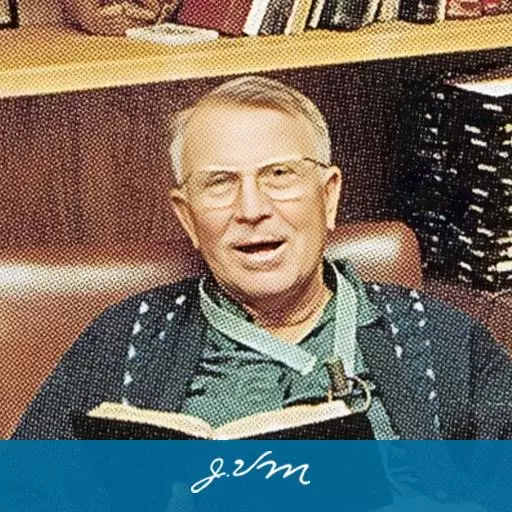
Questions & Answers 3033


1) What is your position on biblical inerrancy?
2) Do Hebrews 6:4-6 and 10:26 teach that one can lose their salvation?
3) What is a presumptuous sin?
4) Can you explain Paul’s teaching on widows in 1 Timothy 5:3-16?
5) Can you speak to the subject of the "better manuscripts" you often mention?
6) Can you explain the tithing principle in Deuteronomy 14:26?
7) Does God the Father, who is spirit, have physical attributes?
Guest (Male): This is the question and answer program with Dr. J. Vernon McGee, a ministry of the Thru the Bible Radio Network. Stay with us as Dr. McGee deals with the issues of biblical inerrancy, the meaning of better manuscripts, God's physical nature, and many others.
Steve Schwetz: You're listening to the question and answer program with our Bible teacher Dr. J. Vernon McGee. This is Steve Schwetz inviting you to join us for the next 30 minutes as we listen to the wit and wisdom Dr. McGee provided in answering the questions of his listeners.
Biblical inerrancy, that's to say the Bible is without error or is infallible, still continues to be debated as an issue. So it's not surprising to get this question from a listener in Los Angeles who says, "What is your position on biblical inerrancy?"
Dr. J. Vernon McGee: Well, my position on biblical inerrancy is that the autographs are absolutely, they are inerrant. And that the translations that we have today, and especially I accept that American Standard as being a very fine translation. I like the King James much better, but the other fine. And I accept it as the word of God. And I stand on the question of the inerrancy of the word of God.
And I do not believe that until you've settled that in your mind and your heart, that you can teach the word of God, and certainly teach it to preachers today, without having your tongue in your cheek or at least have a sneer on your lip. Because, my friend, you have to believe in the inerrancy of the word of God. That's where you're going to begin. And my feeling is that that's the crux of the whole matter today.
Steve Schwetz: We come now to a question from a listener in Douglas, Kansas and he writes: "Would you please explain Hebrews 6 verses 4 through 6, and Hebrews 10 verse 26?"
Dr. J. Vernon McGee: It says: "For it is impossible for those who were once enlightened and have tasted of the heavenly gift and were made partakers of the Holy Spirit and have tasted the good word of God and the powers of the world to come, if they shall fall away, to renew them again unto repentance, seeing they crucify to themselves the son of God afresh and put him to an open shame."
Now this entire section here, if you read that which comes before and that which goes after, you will find out that what Paul is talking about is not salvation, but the fruits of salvation. He discusses that right after this. He uses the figure of speech for the earth which drinketh in the rain cometh oft upon it and bringeth forth herbs meet for them by whom it is dressed receiveth blessing from God. And he's talking about the results or the fruit of salvation.
And I have a book as I've said on this particular passage of scripture. If you'd like to have the book, really know the answer, and it take a little while to go into all the details, I'll be delighted to send the book to you. Write in and ask the book on Hebrews 6:4 and 6. And you're quite right that Hebrews 10:26 is of the same way. 26: "For if we sin willfully after that we have received the knowledge of the truth, there remaineth no more sacrifice for sins."
Now, if you, and it's written to the Hebrews, if they continue to go and offer sacrifices in the temple after they have received Christ as savior, what they're saying is that either Christ has not come and died for our sins or else that it was meaningless and it had no value for them, so they are continuing to offer sacrifice.
And he makes it very clear, if you read on, they trod under foot the blood of Christ. You make it of no effect whatsoever. Therefore today, when actually I think if you attempt to add anything to what Christ has done. People don't bring sacrifices today, not even the nation Israel. They'd love to have the temple so they could restore sacrifices in the temple in Jerusalem. They actually would like that very, very much.
And if you today, not an Israelite, but a Protestant, that think that you have to do something, that what Christ did for you was not enough and you can do something, you're making the death of Christ meaningless and you trod under foot the blood of Christ, you see. And that's what he's talking about in this passage here.
I think this one is far more serious than Hebrews 6:4 to 6. But we would like for you to have the little book, but understand he's not talking about salvation in Hebrews 6. He's talking about the fruits of salvation. That it is possible for a Christian to sin to the extent where he could never get a reward at all. He could never hear the Lord say, "Well done thou good and faithful servant," because of the fact of the life that he lives and he's counting the death of Christ as absolutely valueless for Christian living because we're to produce fruit as Christians. But you need the book to have the entire picture before you. That's a very important passage of scripture.
Steve Schwetz: The booklet Dr. McGee referred to is titled, *Is It Possible For a Saved Person Ever to be Lost?* It's available for purchase online at www.ttb.org or by calling one of our service operators at 1-800-65BIBLE Monday through Thursday from 6:00 a.m. to 4:00 p.m. Pacific time. We turn our attention back to our questions now with this one from Dorchester, Massachusetts. The listener writes, "What is a presumptuous sin?"
Dr. J. Vernon McGee: I'd like to turn to several scriptures to answer your question and then from these scriptures I think we can formulate what is a presumptuous sin. And I'm going to turn first to the 21st chapter of the book of Exodus 14: "But if a man come presumptuously upon his neighbor to slay him with guile, thou shalt take him from mine altar that he may die."
Now if he come presumptuously, what does that mean? This is a presumptuous sin. This means premeditated. This man has planned this. This man in his heart has wanted to kill his brother. It wasn't a flare-up that happened in a moment's time and he got angry and before he knew what he was doing why he shot his brother. Only back in those days, didn't shoot them, but they had other ways of killing them though. The human family since the days of Cain and Abel has been able to decimate the human family when they got angry or something came up or they felt like that they were being injured.
Now I want to turn to another verse of scripture because I think here's where we're going to get our answers to your questions over in the 15th chapter of the book of Numbers at verse 30. It says: "But the soul that doeth aught presumptuously, whether he be born in the land or a stranger, the same reproacheth the Lord and that soul shall be cut off from among his people." Now again, the same type of a sin, one that he does presumptuously. And that just simply means he planned it. This is something that was in his heart. It's not something that he did all at once.
Today, I think that the courts make that distinction. It's a distinction like this: murder or manslaughter. Now manslaughter as I understand it is one that was done maybe accidentally. My mother was killed by a drunken driver. And I had the privilege of talking to that man and he made a decision for Christ. I don't know whether it was genuine or not, but his cellmate in the penitentiary did come to the Lord because he couldn't believe that anybody would forgive him for what he had done.
Well, I didn't exactly forgive him, but I didn't hate him for it. He was drunk and he didn't run down my mother presumptuously. He didn't plan it. He didn't leave home and say, "I'm going to run down Dr. McGee's mother." He didn't say that was not it. He was drunk. He didn't know what he was doing. And I think he should have been punished. And they asked me when I was called in a witness, did I think that the man ought to be let go? And I said, "Oh, no. No." I said, "I have forgiven the man, but I said I think the court should take its course and he should be given the full penalty." Of course. I don't think that he should be let go like that. And it was not though a presumptuous sin. It was what the court called manslaughter.
And of course that reduced his sentence a great deal. And I didn't object to that at all because I'll tell you the man that I wish they'd put in jail is the man that sold him that bottle of liquor and the one that made that bottle of liquor. I wish they could be put back of bars by the way. Because that poor fellow was an alcoholic. But do you know that cured him and I've heard that in the place where he lives that he's turned out to be a pretty decent citizen and he goes to church. Whether he's converted, I don't know. I tried to lead him to the Lord.
Now let me turn to one more scripture, 2 Peter 2:10: "But chiefly them that walk after the flesh in the lust of uncleanness and despise government. Presumptuous are they, self-willed. They are not afraid to speak evil of dignities." Now this adds another dimension to presumptuous sins. And that is they despise government.
I think that those that are seeking to overthrow our government, and there are those that are, in fact there are those that apparently in the Senate of the United States that in order to have their way, they were liberals, they were willing to actually looks to me like they're willing to destroy the country in order that they might have their way. Now I call that a presumptuous sin. That's what Peter calls it here. Their self-willed, they want to have their way. That is presumptuous sin. And they're not afraid to speak evil of dignities, that is of God, things that are sacred and holy. And therefore they are guilty of that. I think that's probably as close as I can get to a presumptuous sin.
Steve Schwetz: Here's a letter from a listener who says she is a widow and also has a daughter who is a widow. She writes: "Could you please explain 1 Timothy 5 verses 3 through 16?"
Dr. J. Vernon McGee: Now Paul is speaking actually to widows and he divides them into two groups. Actually the young widows and the older widows. And the young widows he says are trying to get married and that's generally true, by the way. And I think some of them do things rather foolish. It's been my experience that that's been true.
And Paul is putting down rules for them here and that a lifestyle for a young widow and a lifestyle for an older widow. And I think that I can't go through all of this scripture, but again you give me a marvelous opportunity to do a bit of promoting and that is I have a book on 1 Timothy. And in that book I deal with chapter 5 and I go into these things in detail that here now if you're really interested as two widows and older widow and a young widow, you will find our explanation of this particular passage of scripture here.
And this is the thing that is all important: the reputation of both of them. And that is something that at the present moment that I'm afraid the church is not very careful about. And the reason that I think I know this is because I have had letters from young widows. One young widow that wrote me some time ago, she said very candidly that she was having an affair with a man that's not her husband, her husband died.
And she says, "I love my husband. I've never met a man that I thought was his equal or that I wanted to marry. And the man I'm with now, I don't want to marry him. But I'm having an affair with him." And she said to me, "So what?" So I just say back to her, "So what? You're wrong. You're entirely wrong. You're not going to get by with it. That is if you're a child of God."
Because apparently your reputation where she worked and she's a brilliant woman, she holds an executive position. And she very frankly admits that the office knows pretty much about her lifestyle and I wonder what they think about her testimony as a Christian. I'm sure that they couldn't think very much of her testimony as a Christian. Now that's what Paul's talking about here. Something very practical, something very real. A young widow, Paul says she'd get married. Nothing wrong of them getting married, husband dead. Sure, this woman should get married.
But her excuse is, "I can't find a man that's equal to my former husband." Well, she sure found a man that's equal to her and I think they probably would get along all right. But they should get married if they're going to live together. And that is the same thing. And the older widows should have a testimony for Christ.
I think that the woman, in spite of what is being said today and all of this women's rights, women have always had a position and a right that a man never has. Number one, a woman knows who's the father of her child. Man doesn't always know that. The second thing is, a woman has an influence over a child that no man could possibly have. Now I have watched that in my own family. I've watched it in other families. The woman, the wife has not only an opportunity and an influence, but I think a great responsibility.
Now that's what Paul is talking about in this particular passage of scripture here: the responsibility of widows. And I think the way that you've asked the question that you haven't really taken it too seriously. You've had all this trouble and now you are wondering at this late date if maybe your lifestyle had something to do with it. Of course it did. No way of avoiding that.
And in the second thing, now by your testimony as an older widow and your daughter's a younger widow, you have a tremendous opportunity and a responsibility and a privilege and an influence. And talk about women's rights, you got not only rights but you got responsibility. And no one should have a right that doesn't have a responsibility, by the way. If you are given a certain privilege or a certain position, you should measure up to that. Of course. And that is I think very important in these days in which we're living.
Steve Schwetz: This North Palm Springs, California listener has an interesting question about a comment often made by Dr. McGee. She says: "I hear you often mention better manuscripts. Where are these manuscripts, and have you had the opportunity to see them?"
Dr. J. Vernon McGee: Well, I have been to the British Museum and have looked through a glass case at a couple of them they have there. These manuscripts are scattered around. There's one in Washington, by the way. I've never seen that one. I guess it's in the Smithsonian Institute but I'm not even sure about that. And then there are several others. The British Museum I guess has the better manuscripts.
Now when I say better, I mean because of their age. They go back farther and because there is more authority that surrounds them. That is, they are connected with a certain period and certain individuals. And then you have in the Vatican at Rome the Vaticanus manuscript. They have one in Latin and they have several manuscripts there. And all of them are used in compiling the Greek text of the New Testament. And that's the way that they've come about it.
May I say that there's probably no more scholarly work that's been done in this world today. They boast of what science has done and all of that. And I'm for giving them full credit. But I think the greatest scholarship has been expended today in bringing together the manuscripts of the word of God. And I think God has actually supervised it. I believe that he has had his hand in it all along.
Steve Schwetz: A listener in Syracuse, Indiana wrote asking: "Would you please explain the meaning of Deuteronomy 14:26?"
Dr. J. Vernon McGee: Well, Deuteronomy 14:26 reads: "And thou shalt bestow that money for whatsoever thy soul lusteth after or desires. It doesn't have really an evil connotation. For oxen or for sheep or for wine or for strong drink or for whatsoever thy soul desireth. And thou shalt eat there before the Lord thy God and thou shalt rejoice, thou and thine household."
Well very frankly you need to take in consideration this entire section and it has to do with bringing an offering to the Lord and especially of bringing a tenth to the Lord. And this particular verse has to do with the fact that God says that when they get into the land, and you remember when he gave this law they were not in the land of Israel, they were still wandering in the desert. And he says when you get into the land that I'll choose out a place where you're to come and worship me. Well, we know now that that place was Jerusalem. That offerings were to be brought there.
Now if you lived way up in the tribe of Dan in that day, it would be a very long trek down to Jerusalem to worship. And if you had certain offerings to bring to the Lord like the fruit of the vine, grapes for instance, grapes don't keep too well and certainly in that land wouldn't. By the time you get down to Jerusalem, they might have won a blue ribbon when you started out, but they sure wouldn't have won one when you got to Jerusalem.
Featured Offer


Featured Offer
About Thru the Bible - Questions & Answers
Questions and Answers offers Dr. J. Vernon McGee's signature wit and wisdom in answering Bible questions sent to him by radio listeners throughout his years of ministry.
Other Thru the Bible Programs:
Thru the Bible - Minute with McGee
Thru the Bible - Sunday Sermon
About Dr. J. Vernon McGee
John Vernon McGeewas born in Hillsboro, Texas, in 1904. Dr. McGee remarked, "When I was born and the doctor gave me the customary whack, my mother said that I let out a yell that could be heard on all four borders of Texas!" His Creator well knew that he would need a powerful voice to deliver a powerful message.
After completing his education (including a Th.M. and Th.D. from Dallas Theological Seminary), he and his wife came west, settling in Pasadena, California. Dr. McGee's greatest pastorate was at the historic Church of the Open Door in downtown Los Angeles, where he served from 1949 to 1970.
He began teaching Thru the Bible in 1967. After retiring from the pastorate, he set up radio headquarters in Pasadena, and the radio ministry expanded rapidly. Listeners never seem to tire of Dr. J. Vernon McGee's unique brand of rubber-meets-the-road teaching, or his passion for teaching the whole Word of God.
On the morning of December 1, 1988, Dr. McGee fell asleep in his chair and quietly passed into the presence of his Savior.
Contact Thru the Bible - Questions & Answers with Dr. J. Vernon McGee
info@ttb.org
https://ttb.org/
Mailing Address
Thru the Bible, Inc.
P.O. Box 7100
Pasadena, CA 91109
In Canada:
Box 25325,
London, Ontario
N6C 6B1
Phone Number
(626) 795-4145 or
(800) 65-BIBLE (24253)