

Nehemiah 9:1-37, Part 1 of 3


Israel’s Prayer of Confession, Part 1
Guest (Female): Shalom. Holy Scriptures and Israel is a ministry designed to share with the Jewish people the good news of the Lord Jesus, Yeshua the Messiah, and to instruct Christians on the Jewish roots of their faith. And now, teaching God's word from a Hebrew Messianic perspective, here is Gideon Levytam.
Gideon Levytam: Shabbat Shalom. I would like you all to take your Bibles and please open it to the book of Nehemiah, Nehamayah, chapter nine. Nehemiah, the servant of the Lord, this Hebrew Israeli Jewish man whom the Lord had raised to lead a group of returned Jewish people back to the promised land, to rebuild the walls of the city of Jerusalem and ultimately to lead the nation into a restoration period in the history of the people of Israel.
We finally have arrived at chapter nine. It is rather a very long chapter. It has 38 verses in the English text. In the Hebrew, actually verse 38 belongs to chapter ten. In the Hebrew Masoretic text, we only have 37 verses. But let me read some of these verses and seek with the Lord's help to comment on that chapter. So please follow with me. I begin with verse one.
"Now in the twenty and fourth day of this month, the children of Israel were assembled with fasting and with sackcloth and earth upon them. And the seed of Israel separated themselves from all strangers and stood and confessed their sins and the iniquity of their fathers. And they stood up in their place and read in the book of the law of the Lord their God one-fourth part of the day. And another fourth part they confessed and worshipped the Lord their God.
Then stood up upon the stairs of the Levites: Jeshua and Bani, Kadmiel, Shebaniah, Bunni, Sherebiah, Bani, and Chenani, and cried with a loud voice unto the Lord their God. Then the Levites: Jeshua and Kadmiel, Bani, Hashabneiah, Sherebiah, Hodijah, Shebaniah, and Pethahiah, said, 'Stand up and bless the Lord your God for ever and ever. And blessed be Thy glorious name, which is exalted above all blessing and praise.'"
Now from verse six all the way to verse 31, Israel is really rehearsing before the Lord and before themselves all their history. I'm continuing now from verse 32. And I'm reading: "Now therefore, our God, the great, the mighty, and the terrible God, who keepest covenant and mercy, let not all the trouble seem little before Thee, that has come upon us, on our kings, on our princes, and on our priests, and on our prophets, and on our fathers, and on all Thy people, since the time of the kings of Assyria unto this day.
Howbeit Thou art just in all that is brought upon us. For Thou hast done right, but we have done wickedly. Neither have our kings, our princes, our priests, nor our fathers, kept Thy law, nor hearkened unto Thy commandments and Thy testimonies, wherewith Thou didst testify against them. For they have not served Thee in their kingdom, and in Thy great goodness that Thou gavest them, and in the large and fat land which Thou gavest before them. Neither turned they from their wicked works.
Behold, we are servants this day, and for the land that Thou gavest unto our fathers to eat the fruit thereof and the good thereof, behold, we are servants in it. And it yieldeth much increase unto the kings whom Thou hast set over us because of our sins. Also they have dominion over our bodies and over our cattle at their pleasure, and we are in great distress." And I'm going to stop here at verse 37 for the reading at this point of time.
I have neglected purposely to read from verse six to verse 31 in which Israel, our people of old, rehearse the ways of God with our nation Israel. And they also rehearse and confess their own failure to submit to the authority of the word of God. So let me just put us all a little bit in the thought that we have here in the book of Nehemiah.
Again, his name simply means "Nachum-Yah", the comfort of Jehovah, the comfort of the Lord. He was a man that was raised by God to lead the remnant of Israel that were in Persia back to the promised land of Israel. His exercise of heart was to build again the walls of Jerusalem, which was broken down, and to set up once again the gates thereof and to restore the city of Jerusalem back to a way in which it was in some small measure.
Nehemiah was that wonderful servant of the Lord. He took a group of people, he arrived back to the land of Israel. And if you remember, he have done what he have done. And now, the people of Israel are in a period of time that you might say a good and healthy period of time. They have celebrated the feast of Sukkot. If you notice, it says at the end of verse 18 of chapter eight, "And day by day, from the first day unto the last day, he read in the book of the law of God. And they kept the feast," this is the feast of Tabernacle, the feast of Booth, "for seven days. And on the eighth day, it was a solemn assembly according unto the manner."
Brothers and sisters, here we see the people of Israel return back to the land. A measure of them were now in the land, though the vast majority of them are still scattered around the nations of the world. And now, they have celebrated, as we have noticed from last Shabbat meeting, the feast of Sukkot. They realized that for many, many years, they did not celebrate it. And not only that, they didn't celebrate it in the same manner in which they were celebrating it now, when they were back in the land at about 445 BC.
In chapter nine, we find such a long chapter that is devoted to a time of prayer. Now, while in the end of chapter eight, Israel were celebrating, specifically verse 10, at the end of the verse, it says, "Don't be sorry, because the joy of the Lord is your strength." In other words, they were celebrating the feast of Sukkot.
Something happened here between chapter eight and chapter nine that brought the people of Israel to such a time of repentance and confession. And that long chapter nine of the book of Nehemiah is a very, very important lesson for you and I to learn. Again, to remind you that according to Romans chapter 15 and verse four, Paul-Sha'ul said, "For whatsoever things were written aforetime were written for our learning, that we through patience and the comfort of the scripture might have hope."
Whatever happened to our people Israel historically become an example for you and I who believe in Yeshua the Messiah in this present-day dispensation. So the question immediately rise in our mind, why is it now that in chapter nine, we find out that the children of Israel now begin to confess their sins and repent before the Lord and acknowledge before Him their sins? Notice throughout this chapter.
For example, it says in verse two, "And they stood and confessed their sins and the iniquities of theirs and their fathers." Notice it says in verse 16, "But they and our fathers dealt proudly and hardened their necks and did not obey your commandments." Notice a little bit later on in verse 26, "Nevertheless, they were disobedient and rebelled against thee and cast thy law behind their backs." Notice in verse 28, "But after they had rest, they did evil again before thee."
You see, the whole chapter nine of the book of Nehemiah is the rehearsal that these Jewish men and women and their leaders and the Levites and the priests and so on are rehearsing the story of our forefathers and the manner in which the people of Israel behaved over the generation in their relationship with their God. And when we read such a chapter, it really behooves us to really look back into our own lives and to ask ourselves the question: how did we behave? How did we live our lives as believers in Yeshua the Messiah?
How did we conduct ourselves in relationship to God? And on the other hand, to look at Him and to say: what way in which God have dealt with us? What He have done for us and what He had done on our behalf in the way in which He conducted Himself towards each and every one of us as believers in Yeshua the Messiah? We learn from this, and I want to go over it a little bit to see the reasons that they have come to a time such as this, and the whole chapter is devoted to the prayer of the children of Israel.
Now let me remind you, if you turn back to the book of Deuteronomy, in Hebrew, Devarim, chapter 28 and verse one, God said to our forefathers: "And it shall come to pass, if thou shalt hearken diligently unto the voice of the Lord thy God, to observe and to do all His commandments which I have commanded thee this day, that the Lord thy God will set thee on high above all nations of the earth." Now, continue on a little bit further and jump down to verse 13: "The Lord shall make thee to be the head and not the tail. And you shall be above only, and you shall not be beneath."
God said to our forefathers, the people of Israel, "Listen, if you will submit to Me and if you will obey My word, I promise you, Israel, you're not going to be the tail. You are going to be the head of all the nations of the world. You're going to be above all the nations of the world. You are the chosen nation, the nation that I have chosen for Myself." But the problem is He gave them this condition of submissiveness to His word.
The moment Israel didn't obey the word of the Lord, the moment Israel violated the word of the Lord, all the promises that God had promised them would be now set aside for a season. He will have to discipline them. He will have to punish them. He will have to allow other nations to take them over and He will end up to judge even the very own people whom He loved so dearly. And as we learn this and apply this for us today, it's the very same thing.
A believer that is not walking with the Lord, a saved child of God that is not submitting to the word of God, what do you think the Lord is going to do with us? The book of Hebrews tells us in chapter 12, "Whom the Lord loveth, He chasteneth and He scourgeth every son or daughter whom He had received." And the lesson is very important. And here you can see, beloved brothers and sisters, that the people of Israel, even though they are back in the land, they realize that something is not right.
We are back in the land, a minority of Jewish people. We are surrounded by many people around us, many nations around us. We still don't have what God have promised unto our forefathers. So back to chapter nine, and at the end of the chapter, I'm going to go now to the end for a moment for two more verses and I will go back to the beginning of the chapter. Notice what they say at the end of this prayer time. In verse 36, they say, "Behold, we are servants this day." In Hebrew is "hayom anachnu avadim". We are slaves now, today.
Servants in it, in the very land that You had promised to our forefathers. Verse 37, "The land, it yieldeth much increase unto the kings whom You have set over us because our sins. They have dominion over our bodies. They have dominion over our cattle at their pleasure," and so on. And then notice at the end it says, "And we are in great distress." In the Hebrew, it says "ve-anachnu be-tzarah gedolah". We are in a great distress.
Now, you see, it is so interesting, beloved brothers and sisters. Immediately rise to your mind and to mine: how come Israel is now back in the land, a minority, a remnant is back in the promised land, the city of Jerusalem and the walls have already been set up, the gates are placed there, the walls is all around the city of Jerusalem, and yet these Jewish men, women, and children, the Levites, the priests, the leadership of Israel recognized that even though we are back in the land and even though we got the walls surrounding the city of Jerusalem, we are really not where we should have been and where God had intended to give to all the people of Israel, all the 12 tribes of the nation of Israel.
I can say it this way a little bit to make it up to a New Testament setting. You see, you and I are part of the church, the body of Messiah. Look at the condition of the body of Messiah today. The divided condition, the scattered condition. There are believers everywhere in every form and shape and every view that you want to have, the body of Messiah is scattered. And maybe a few believers gathered together and they come into a right relationship with the Lord.
We really want to walk with the Lord, we want to learn the word of God, we want to teach the word of God, we want to exalt Yeshua the Messiah. But we look around and we see maybe some small group was in some small measure successful in returning to principle, but where is the rest of the body of Messiah? Where is the rest of all the believers who are really in such a sad condition that they are still today in so many places around the world?
There is an amazing lesson. And so it grabbed them in their hearts, and they were so moved because of this. And they realized that still they were in such a state that they could still say: we are in a great distress. We have trouble, Lord. And so look what they're doing. They cry to God in prayer and in confession and in worship. This really behooves us, dear brothers and sisters, to learn from this and to apply this to our own life.
And not to say, "Well, you know what? I'm a believer, things are well with me and things are okay with maybe my family and my friends, a little group that I'm with. Never mind about all other believers, never mind about believers that are struggling, never mind about other brothers and sisters that are going through suffering and persecution and rejection." As long the things are fine with me, I do not need to think about someone else. But I want you to notice that these Jewish men, women, children, they were really searching their hearts. And they rehearsed before themselves and before the Lord the whole history of our nation of Israel.
The reason why sometime God had to discipline the people of Israel. The reason why sometime they were not in a right spiritual condition. So let's look over a little bit those passages together, and I want you to notice how it begins. It began in verses one, two, and three where Israel gather themselves together for a special time of confession and repentance and worship. It was a special time. Notice it says in verse one, the time is just after they finished to celebrate the feast of Tabernacle, the feast of Sukkot.
It says now in the 20th and fourth day of this month, the children of Israel were assembled together, notice, number one: with fasting; number two: with sackcloth; number three: with earth upon them. The date was the 24th of the month. This is the month of Tishrei. This is the seventh month. This is where the celebration of Rosh Hashanah or the feast of Trumpet on the first day of the month of Tishrei. On the 10th day is the day of atonement, Yom Kippur. And on the 15th day is the feast of Sukkot, Tabernacles, for seven days plus one.
The feast of Sukkot, if it's starting of the 15th day of the month, it will end on the 22nd after eight days altogether. So when they finished all the celebration and they went back, you might say, to their own homes, they realized, "Wait a minute, even though I celebrated the feast of Sukkot, things were not bad, I'm back in the land." But they were thinking about all the nation of Israel. And immediately, notice, two days after. It didn't take any more.
Two days after the hype of the celebration of the feast of Tabernacle, they went down back to earth. And now, notice that it says they assembled themselves together and they fasted. Now remember, in the previous chapter, Ezra, Nehemiah, and others said to them, "No, no, it's not a day of mourning, it's a day of celebration." He says, "For the joy of the Lord is your strength. Celebrate, give gifts and celebrate with one another." But now, beloved brothers and sisters, things change.
They finished the celebration and they went back down to earth and they realized, "Yes, we are back in the land, we are back in the city of Jerusalem, the temple is built, we can continue on with the sacrificial system, but where is the rest of our brethren of our people?" The rest of the Jewish people, remember in the time of Esther, many of them were left in Persia, you remember? And the northern kingdom were scattered by the Assyrians and they were dispersed among the nations of the world.
Look at this, brothers and sisters, they come number one with fasting, deny themselves from necessary food. Number two, they put sackcloth, in Hebrew we call it "sakim", you know, bags that you carry perhaps potatoes or something. They were not wearing nice clothes with suit and tie, but they put upon themselves sackcloth. They were mourning.
Thirdly, they put upon themselves earth. The Hebrew word is "adamah". They took earth from the ground, adamah, and they put it upon them. They were in a condition of mourning and weeping because they really wanted to be repentant before the Lord. They want to be right with God. And they began really to rehearse before the Lord the history of the nation of Israel. Look at the second thing that they have done.
In verse two, it says, "And the seed of Israel." In verse one, it says, "The children of Israel," but in verse two, it says, "The seed of Israel," in Hebrew, "Zera Yisrael". In other words, they separated themselves from the strangers. You see what happened. God said to the people of Israel to separate themselves from the nations of the world. And why? Not because Israel were a better nation or better people, but Israel were the chosen people and they were to believe in the only true and living God.
The moment they will mingle themselves with other people of the nations of the world who did not believe in the true and living God, they will be drawn away from the things of the Lord and they will be taken away and ultimately they will not follow the God of Israel. But they made a decision here and they separated from the strangers. The word for separated means "vayibadelu", you know, they really separated themselves from the nations that were around.
Thirdly, God gave Israel this warning, that if they are going to follow Him, they are not to marry with other nations. But apparently, you'll see we're going to get to it later on, they already began intermarried with the people of the nations of the world. It is not because they couldn't marry someone who would believe in the God of Israel. But God was concerned that they will end up to become idol worshippers. You see, God have allowed Rehab to come among the people of Israel.
God have allowed Ruth the Moabitish woman to become part of the nation of Israel because they have adopted the God of Israel. But when the Jewish people would get married with people from other nations, they will end up to become worshippers of idol from other nation. And this is exactly what happened in the history of our own nation Israel. And it is exactly what happened with a believer in Yeshua the Messiah.
Featured Offer
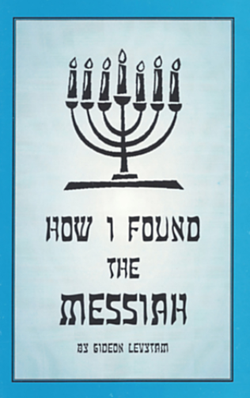
Follow Gideon Levytam's journey and discover how he was led by God, through a series of exciting circumstances, to find the One his people are still waiting for.
Past Episodes

Featured Offer
Follow Gideon Levytam's journey and discover how he was led by God, through a series of exciting circumstances, to find the One his people are still waiting for.
About Holy Scriptures and Israel
As time passed by, the Lord Yeshua took dear brother John Van Stormbroek to himself. The ministry of Holy Scriptures and Israel continued with additional development. In the early 1990’s, a weekly morning Bible class began which brother Gideon Levytam led regularly in the City of Toronto. This weekly open Bible class was held in the Willowdale assembly meeting hall. Eventually, a second mid-week evening Bible class was added. In April 2002, the need for an additional outreach Bible teaching meeting arose. We begun a Saturday (Shabbat) ministry meeting in which a systematic teaching of God’s word is presented to all who attend. Together we learn God’s Word, pray for each need and the salvation of Israel, and sing songs of worship unto our God, praising Him and our Lord Yeshua the Messiah.
In Mid 2004 we started to air on Joy 1250 Radio station a 15 minute Bible teaching program called "The Holy Scriptures and Israel" with Gideon Levytam. The broadcast teaches God’s word from a Hebrew Messianic perspective and has proved to be a blessing to many. It's now aired seven days a week. Our prayer is that many more of our Israeli people will have a clear understanding of who Yeshua is, why we all need him, and come to know him as their Lord and Messiah.
About Gideon Levytam
Contact Holy Scriptures and Israel with Gideon Levytam
426 Simcoe Street
Niagara-on-The-Lake
Ontario L0S 1J0
Canada
(905) 325-1234