

Nehemiah 5:1-19, Part 3 of 3


The Internal Problems Among God’s People, Part 3
Gideon Levytam: The study of Nehemiah, chapter five. Nehemiah, after he challenged and rebuked the nobles and the rulers, said unto them, "You exact usury, every one of his own brother." He's challenging them. The Hebrew word for usury is the word "Massa." Massa is a load. We use the word "usury" or "interest," but it's much more than interest. It became such a load on the people of Judah. If you're going to make more trouble for someone, it becomes so heavy that he will cave. How much can a person take?
So, Nehemiah says that word for Hebrew is not so much you exacting interest, but the thought is it became you exacting a Massa, a load that they cannot carry. Notice it says Nehemiah set up the congregational meeting. It says in verse seven, "And I set a great assembly against them." So what did he do? He did the proper order. He thought about it, prayed about it, challenged the leaders who were involved in that, and then he gathered the assembly together and he set up an assembly to deal with the situation.
It reminds me of Matthew, chapter 18. It has been said that Matthew, chapter 18, is not practiced hardly at all among the people of God because of the fact that most of the time, we don't want to deal with an issue. And we don't need to speak to anybody else; we know it's in our own heart. In Matthew, chapter 18, we read in verse 15, "Moreover, if thy brother shall trespass against thee, go and tell him his fault between thee and him alone."
Secondly, "If he shall hear thee, thou hast gained thy brother. But if he will not hear thee, take with thee one or two more, that in the mouth of two or three witnesses, every word may be established. And then if he will neglect to hear those two and three, then tell it to the assembly, to the congregation. If he neglects to hear the congregation, the assembly, the church, the ecclesia, then let him be unto thee as a heathen man and as a publican."
Notice the order. The problem with us is simply this: we don't practice this. If somebody did something to me, if we do one to another, instead of dealing with it and saying, "Listen, brother, you have wronged me," or "Listen, brother, I have wronged you," and then everything is over, we can continue on. We don't need to spread it. But we love to spread it. We use the phone calls, the internet, we use everything, all the means that we can so everybody will know she did that, he did that, they did that.
That's the way we are, instead of saying, "I've got to go to my brother and I'm going to tell my brother, 'Brother, please let us correct this and let it be done away with.'" And then if it doesn't work, then call another brother, another sister, two or three witnesses, and then try to work it out. You know how many people, how many friendships we lost because we haven't simply gone through this procedure? How divided the people of God become because we haven't followed this procedure?
But here Nehemiah did that. It seems to me that it's working here because if you go back to Nehemiah in chapter five, you notice that after he did that, in verses eight and nine, he's now explaining the wrongdoings to the rest of the congregation and to those that have done wrong. He explained what's happened here. He says, notice verses eight and nine, "And I said unto them, 'We after our ability have redeemed our brethren the Jews, which were sold unto the heathen; and will ye even sell your brethren? Or shall they be sold unto us?'"
He was explaining the problem. He says, "Look, we helped our brethren who had a need. We redeemed them. We gave something in order to deliver them from the condition that they've been in. And now, do we go and sell our brothers and sisters? Should we do it? Is that the right thing?" So look what it says here. Thank God the way the response was, because it says in verse 8b, "Then they held their peace, their shalom, and they found no answer, nothing to answer." They knew they were wrong.
It says in verse nine, "And I also said, 'It is not good that ye do: ought ye not to walk in the fear of our God because of the reproach of the heathen our enemies?'" Brothers and sisters, when God's people don't behave right to each other, what do you think the unbelievers say outside? "And you want me to follow your Yeshua, your Jesus, right? You want me to follow your God when you yourself don't even follow your own God whom you claim to follow after? Don't give me this."
How many times people say to us, because of the way we behave, "And you call yourself a believer in Yeshua the Messiah? Just keep him for yourself, I don't need him." Sometimes our behavior brings a reproach by the heathen who are the enemies of God, and it is to our own shame. It's not only Israel our people historically, but also the body of Messiah present day also. To our own shame, our own behavior brings about a "cherpa," a reproach by those who oppose the things of God.
Turn with me to 2 Peter, chapter two. It says in verses one and two, "But there were false prophets also among the people, even as there shall be false teachers among you, who privily shall bring in damnable heresies, even denying the Lord that bought them, and bring upon themselves swift destruction." And notice what it says in verse two, "And many shall follow their pernicious ways; by reason of whom the way of truth shall be evil spoken of."
The unbelieving world does not understand what the believers know from the Word of God. They see it by the behavior of the believers. Because false teaching, false practices, false things come among the people of God, people are following in this direction. Many follow, and then there are many reasons that things are going from bad to worse and the way of the truth shall be spoken against. That's what happened historically among our nation Israel, and it's the very same thing happening among the professing church, the assembly, those who claim at least to belong to the Lord Yeshua the Messiah.
When sin comes into our life, we end up hurting the Lord and hurting the people of the Lord. We often fail. You can read in 2 Samuel, chapter 12, when David committed this sin, the prophet said to him, "The reproach, the nations are looking at that." Then when we read in Romans, chapter two, about the privilege that the Jewish people have had, but when the Jewish people, the people of God, do not submit to the Word of God, it brings a reproach upon the name of the Lord. When the body of Messiah, when you and I today do not follow the Lord and fight among the people of God, it brings a reproach by the unbelieving world and they say, "Who needs it? You keep it for yourself. I don't want your Yeshua, your Jesus, if that's the way it is that you behave."
In verse 10 of Nehemiah, chapter five, Nehemiah points to the fact that he could charge interest to others, but he did not—to the poor, that is. We read in verse 10, he says, "I likewise, and my brethren, and my servants, might exact of them money and corn: I pray you, let us leave off this usury." He said, "I could have done it myself, but I didn't. I didn't abuse the poor." Again, we have to distinguish between the poor and those who wanted to extend; they were well-off. But the poor were the ones that he was concerned about, those who at least became poor here now.
In verse 11, Nehemiah called for the wrongdoers to restore that which was taken from those individuals, of their brethren who became poor. Notice it says in verse 11, "Restore, I pray you, to them, even this day, their lands, their vineyards, their oliveyards, and their houses, also the hundredth part of the money, and of the corn, the wine, and the oil, that ye exact of them." He says, "Return this back to them." And notice he used the word "even this day." Today. No delay. Deal with it now. Restore to them that which belonged to them which you took wrongfully. You are harming the work of the Lord.
Notice the list: lands, vineyards, oliveyards, houses, money, corn, wine, oil. They have taken from these poor of their own brethren so much to the extent that they exasperated them so they cry to God. By the way, you notice it says, and I just go back to verse nine, where it said, "Ought ye not to walk in the fear of our God?" They should have had the fear of God. Sometimes, brothers and sisters, because of the sin nature that we have and the carelessness that we have, we don't have the fear of God. It's not so much they've been afraid of God, but the reverence towards God. We don't revere God. And when we don't revere God, our consciences are hardened and we become so callous. We simply don't care.
That is not pleasing to the Lord. The Lord wants us to have a tender conscience and to be sensitive to our brothers and sisters and helpful. We need to learn that. We are not pointing fingers because we know our very own heart, how at times we are wrong and we don't walk in the fear of the Lord. Remember what the Apostle Paul said in Galatians 5? "Walk in the Spirit, and ye shall not fulfill the lust of the flesh." If we are walking guided by Ruach ha-Kodesh, the Holy Spirit of God, he assists us to be less and less walking in the flesh but walking in some small measure like our beloved Messiah, the Messiah, Yeshua himself.
Back to our chapter in Nehemiah, chapter five. Notice in verse 12a, look at the wrongdoers' response. They respond in a right way. That's the way we should always respond when we are wrong. It says, "Then said they, 'We will restore them, and will require nothing of them; so will we do as thou sayest.'" Nehemiah, we understand. We realize. You have spoken to us. The Lord has spoken to us. We are going to act in a right way. We're going to take a decision here. We're not going to try to find excuses. "I didn't do it, he did this, she did this." No. Nehemiah challenged them. He told them here are the facts. They responded in a right way and they said, "We will respond. We will do the right thing. We will restore this to them and we will require nothing of them."
Therefore, those people were relieved. They don't have now to worry about all the usury, all the interest that they owed to these other well-to-do persons. They had to continue to build the wall. In verses 12b and 13, Nehemiah called now the priests, the spiritual leaders, to make a promise, to make a commitment. In Hebrew, the word "oath" is "shvua," to make an oath. We read in verse 12b, "Then I called the priests, the Kohanim, and took an oath of them, that they should do according to this promise."
Notice verse 13, "Also I shook my lap, and said, 'So God shake out every man from his house, and from his labour, that performeth not this promise, even thus be he shaken out, and emptied.' And all the congregation said, 'Amen,' and praised the Lord. And the people did according to this promise." That word for shaking is an interesting word. In the Hebrew, it is "Xatsani Na'arti." It's like shaking the garment. Everything is going to be emptied. By doing this act of shaking the garment, he is symbolically saying, "If you will not follow through the promise, the oath that you have made, may the Lord shake you from all your belongings as I'm shaking now this garment upon my body." Symbolically saying God will empty those who will not follow through with the oath that they have made.
So you can see how interesting Nehemiah responds to the wrongdoers, but you can also see that they have responded in a right way and they began to be restored again. It's so beautiful when the believers are seeking to encourage each other, to treat each other in a right way, to build each other up, to use their gifts and whatever they have for the assistance of the building of the body of Messiah. There is a blessing. But if not, there will be the cry and the lack of joy and the divisions among the people of God. In this case, by God's grace, Nehemiah was successful to influence his brethren.
In conclusion, from verse 14 to verse 19, Nehemiah himself became an example of selflessness. He shows us by example what an example we have in this man. We see first of all that Nehemiah himself did not eat the bread that was belonged to him, the bread of the governor that belonged to him, for 12 years. He became the governor of Judea. In Hebrew, it's called "Pecham." It's a kind of a difficult word we don't usually use in Hebrew, Pecham. But if you read the text in Hebrew, the word is Pecham. He became the governor of Judea for 12 years, but he did not use the privileges that were his. Apparently, he was a well-to-do man. He had means, but he didn't abuse things. He could have had more and more and more. He was such an example.
Look at this. Verse 14: "Moreover from the time that I was appointed to be their governor in the land of Judah, from the twentieth year even unto the two and thirtieth year of Artaxerxes the king, that is, twelve years, I and my brethren have not eaten the bread of the governor." He was a governor. He was supposed to get a salary. He was working hard; that was his job. He said, "I did not use, neither me nor my servants, the bread, the food that belonged to the governor. I did not abuse it. I did not take it."
Then in verse 15, he says, "But the former governors that had been before me were chargeable unto the people, and had taken of them bread and wine, beside forty shekels of silver; yea, even their servants bare rule over the people: but so did not I, because of the fear of God, yirat Elohim." He was different. He deserved to get so much because that was his job, that was his work. It's not from the people so much, it's from the governor, but the people pay the taxes. The taxes go to the government. The government will pay the governor a certain salary. But Nehemiah says, "I didn't take it for 12 years." Imagine 12 years passed by from the time that they migrated from Babylon and from Persia back to the land of Israel. 12 years they are there and he didn't take anything that was belonged to him by right.
He was well-to-do, so obviously he didn't have that need. But you could see that he was not selfish to the extent that it doesn't matter what, "I'm going to get my thing, what belonged to me." Verse 16 and verse 17: Nehemiah continued in building the wall while he was there. He himself participated in the building of the wall. Verse 16: "Yea, also I continued in the work of this wall, neither bought we any land: and all my servants were gathered thither unto the work. Moreover there were at my table an hundred and fifty of the Jews and rulers, beside those that came unto us from among the heathen that are about us."
What he's really saying is not only that I continued to build the wall, but I was actually feeding every day 150 Jewish people plus many of the Gentiles that came from around. He must have been a well-to-do man. Can you imagine to feed 150 people breakfast, lunch, and dinner? He could be even more well-to-do if he would only take that which belonged to him as a governor, but he didn't. He didn't take usury from the others. And not only that, he took 150—to feed 150 Jewish individuals for breakfast, then to feed them for lunch, and then to feed them for supper?
And then on top of it, as it says in verse 17, "beside those that came unto us from among the heathen that are about us." It could be other Jewish people who lived among the heathen, or it could be also some of the non-Jewish, the Gentiles, whom he fed at his home, at his own place. Look at the selflessness of Nehemiah. He was a great example. He used his wealth for the blessing of the Jewish people and others around him.
Finally, verses 18 and 19. Nehemiah's daily provision for himself and for the Jewish people was this, verse 18: "Now that which was prepared for me daily was one ox and six choice sheep; also fowls were prepared for me, and once in ten days store of all sorts of wine: yet for all this required not I the bread of the governor, because the bondage was heavy upon this people." Every day, he needed to have one ox killed, six choices of sheep killed, fowls, birds killed, whatever was allowed for him to eat. And also every 10 days, all sorts of wine was prepared for the 150 Jewish people who came, plus the Gentiles that came, and him and his servants every day.
And yet he says, "All this need I didn't require the bread that belonged to the governor. I didn't demand it. I didn't press upon having this myself." Why didn't he demand it? Because the bondage was heavy upon this people. He had grace and mercy. He learned from the ways of the Lord that he was such a blessing to the nation of Israel. What a commendation we have here and what an example that he is now giving to the nation of Israel.
And in conclusion, in verse 19, he's praying. You and I might say, "This is a very selfish prayer." But it was not a selfish prayer. He wanted to please God and he wanted the blessing of God. He said in verse 19, "Think upon me, my God, for good, according to all that I have done for this people." Why did he pray such a prayer? "God, you know, look what I've done for this people and therefore I want you to bless me." God promised that there will be a blessing to those who bless the people of God, that he will reward those who follow him and obey his commandment. There is a reward that is promised to the people of God and he simply wanted that God's pleasure will be set upon him. "God, think upon me." In Hebrew, the word is "Zichra-li. Zechor," remember, God, the way I behaved towards the people of God.
And you see, God will never forget every act that we have done that was for Yeshua the Messiah. Everything that is done for the Lord Yeshua the Messiah, God will remember and he will reward us whenever we do any good deed that is pleasing the Lord and is a blessing to the people of God. With this, I want to close with one verse in the book of Hebrews, chapter six, verse 10: "For God is not unrighteous to forget your work and labour of love, which ye have shewed toward his name, in that ye have ministered to the saints, and do minister."
God is not unrighteous to forget your work and your labor of love. Even when we are sometimes being treated wrongly, we are still to do good, we are still to seek to be a blessing, we are still to build, we are still to edify even though we don't get the right response at times. We are called for that. God is not unrighteous. He's faithful and he's going to remember everything that we have done. Because one day is coming and we're going to stand before the Lord at the judgment seat of the Messiah where all believers are going to be there. Whatever we have done that was for the glory of the Messiah, for the blessing of God's people, we are going to be rewarded. And the Lord is going to use that reward for the Messianic kingdom when we're going to reign and rule with our blessed Lord Yeshua who one day will come back to take his rightful place, restoring Israel and blessing this world as he is intending to do so in a future day. May the Lord help us and encourage us to be like this man by the name of Nehemiah. Amen.
Featured Offer
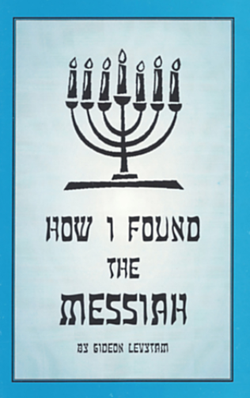
Follow Gideon Levytam's journey and discover how he was led by God, through a series of exciting circumstances, to find the One his people are still waiting for.
Past Episodes

Featured Offer
Follow Gideon Levytam's journey and discover how he was led by God, through a series of exciting circumstances, to find the One his people are still waiting for.
About Holy Scriptures and Israel
As time passed by, the Lord Yeshua took dear brother John Van Stormbroek to himself. The ministry of Holy Scriptures and Israel continued with additional development. In the early 1990’s, a weekly morning Bible class began which brother Gideon Levytam led regularly in the City of Toronto. This weekly open Bible class was held in the Willowdale assembly meeting hall. Eventually, a second mid-week evening Bible class was added. In April 2002, the need for an additional outreach Bible teaching meeting arose. We begun a Saturday (Shabbat) ministry meeting in which a systematic teaching of God’s word is presented to all who attend. Together we learn God’s Word, pray for each need and the salvation of Israel, and sing songs of worship unto our God, praising Him and our Lord Yeshua the Messiah.
In Mid 2004 we started to air on Joy 1250 Radio station a 15 minute Bible teaching program called "The Holy Scriptures and Israel" with Gideon Levytam. The broadcast teaches God’s word from a Hebrew Messianic perspective and has proved to be a blessing to many. It's now aired seven days a week. Our prayer is that many more of our Israeli people will have a clear understanding of who Yeshua is, why we all need him, and come to know him as their Lord and Messiah.
About Gideon Levytam
Contact Holy Scriptures and Israel with Gideon Levytam
426 Simcoe Street
Niagara-on-The-Lake
Ontario L0S 1J0
Canada
(905) 325-1234