
Nehemiah 4:10-23, Part 3 of 3


Remember the Lord, part 3
Guest (Female): Shalom. Holy Scriptures and Israel is a ministry designed to share with the Jewish people the good news of the Lord Jesus Yeshua the Messiah and to instruct Christians on the Jewish roots of their faith. And now, teaching God's word from a Hebrew Messianic perspective, here is Gideon Levytam.
Gideon Levytam: This study of Nehemiah Chapter 4 continues. And then above all, the shield of faith: faith, believing in God and God's word that he's able to sustain us and so on. He continued on; he's talking about the helmet of salvation and the sword of the spirit, which is the word of God.
Now, you can see when they were holding these spears and they were ready to protect themselves against their enemy. For you and I as believers in Yeshua the Messiah, it's not that we're going to take a sword in our hand and harm somebody; we are to take the word of God and apply it in a proper way as we minister to others, as we've been attacked by those who oppose us.
Therefore, in those things that we have before us—those three things: the swords, the spears, and the bows—all those things really speak to us about the word of God. We need to handle the word of God, to know how to answer through the word of God, and to know how to live in subjection to the word of God. That's the only way that we will be able to be protected as we continue on to follow Yeshua the Messiah. In a time when we don't submit to the word of God, we know very well how we end up falling on our faces and dishonoring the Lord.
But go back to our chapter, Nehemiah Chapter 4. The second thing that he tells them is also very interesting. Notice verse 14 now. There he says, "And I looked, and I rose up, and I said unto the nobles, unto the rulers, and unto the rest of the people: Be not ye afraid of them. Remember the Lord." In Hebrew it says, "Zichru et Adonai." Remember the Lord, which is great and terrible, and fight for your brethren, for your sons, for your daughters, for your wives, and for your houses.
Okay, you are taking the sword, the spears, and the bows, but you don't just take this in order to just attack and trust yourself. You have to remember the Lord, the God of Israel, to remember what he has done for you in the past and what he is able to do for you in the present. Remember the one who loved you, the one who called you to be a nation, God is saying through Nehemiah to the Jewish people who were building the walls in the city of Jerusalem.
Don't forget God. You cannot go without God and fight on your own. You need the Lord in your life, Nehemiah is saying to the Jewish people. How important it is to remember who God is, to remember what he has done for us, to remember how he saved us from slavery, to remember that he brought us into a relationship with him, and to remember the price that our Lord Yeshua the Messiah has paid when he died for us on the tree. That's the only way that we're going to be able to gain a victory against those who are opposing us and fight on behalf of your brethren, your sons, your daughters, your wives, and your houses.
In fact, what he is really telling them is exactly what the Apostle Shaul Paul said to the brethren when he gave them the sixth chapter of Ephesians. He said, "Be strong in the Lord," Ephesians 6:10, "and in the power of his might." Not your own might, but in the power of his might. We need to remember our blessed Lord and what he has done for us. In fact, I would like you for a second to turn to 2 Timothy Chapter 2, and here is an encouragement that Shaul Paul gave to another younger brother by the name of Timothy.
He said to him in 2 Timothy Chapter 2 in verse 8, "Remember Yeshua HaMashiach, Yeshua the Messiah, of the seed of David, who was raised from the dead according to my gospel." Timothy, remember Yeshua the Messiah because it was he who came of the seed of David, and it was he that died in accordance with the word of God, and it was he that was raised from among the dead according to my gospel.
You see, Timothy needed this encouragement as well because he was experiencing opposition. Timothy needed to remember what the Lord had done for him. Don't you feel this, when we have problems and issues arise in our lives? What encourages us the most is when we look unto Yeshua and when we see what he has done for us. We see that his love for us has been so great and his care for us is so supreme.
Remember what he has done for us when he died for us on the tree. He paid for every sin that we have committed. He paid the penalty which we could have never paid. You remember when he cried on the tree and he says, "Eloi, Eloi, lama azavtani? My God, my God, why hast thou forsaken me?" He was forsaken on our behalf. He was judged so that you and I will never need to be judged.
And so when we experience opposition and time when we have discouragement, we can also remember what the Lord has done for us. You know in Israel, when somebody passed away and he or she dies, there is a memorial service and it's oftentimes called "The Yizkor," the remembrance. Israel is called to remember God, to remember what the God of our fathers has done for the nation of Israel, never to forget what the Lord has done for Israel the nation, and never to forget what the Lord has done for all those who have trusted in Yeshua the Messiah.
Never forget. His love for us is so supreme. The work that he has done for us will benefit you and I for time and eternity, and even when we go through trials, we can stay close to him and we can lean hard on him. He promised to never leave you nor forsake you. You and I might forsake each other, you and I might disappoint each other, but the Lord says, "I will never leave you nor forsake you."
I want to read another verse in the book of Romans in Chapter 8, if you will turn with me for a moment. Romans Chapter 8, verse 31. Paul encouraged the believers that he led to the Lord, and he is an encouragement to us. Romans Chapter 8 and verse 31: "What shall we say to these things? If God be for us, who can be against us? He that spared not his own Son, but delivered him up for us all, how shall he not with him also freely give us all things? Who shall lay anything to the charge of God's elect? It is God that justifieth. Who is he that condemneth? It is the Messiah that died, yea rather, that is risen again, who is even at the right hand of God, who maketh intercession for us."
Do you know, brothers and sisters, that right now, as we sit here at the meeting, Yeshua the Messiah is at the right hand of the Father interceding for every one of us with any trial that you and I experience in our life today, right this moment? You know, when we fail the Lord, he lifts up his holy hand and he says, "Father, this is my child. I paid for the price of his failure and sins."
The Lord is interceding on behalf of his own people. He doesn't condone our sin, but he intercedes for our weakness, and as a lawyer representing us before God and he says, "I paid for the price of their failure and sins. For these sins, I was judged." Notice what it says here in verse 35 of Romans Chapter 8: "Who shall separate us from the love of the Messiah? Shall tribulation, or distress, or persecution, or famine, or nakedness, or peril, or sword? As it is written, For thy sake we are killed all the day long."
Notice what it says in verse 37: "Nay, in all these things we are more than conquerors through him that loved us." Verse 38 and 39 concludes with this encouraging word. He says, "For I am persuaded, that neither death, nor life, nor angels, nor principalities, nor powers, nor things present, nor things to come, nor height, nor depth, nor any other creature, shall be able to separate us from the love of God, which is in the Mashiach Yeshua, in Christ Jesus the Messiah Yeshua our Lord."
So, who can be against us? Who shall lay anything to the charge of God's elect? Who is he that condemn us? Who shall separate us from the love of the Messiah? Nothing, because you and I belong to the Lord Yeshua the Messiah, not because of our good deeds and our good works, but because of the shed blood that Yeshua the Messiah shed for us.
And so Nehemiah encouraged the brethren in the land of Judah. Shaul Paul encourages you and I and the believers to whom he wrote to simply trust the Lord and not to forget. Zichru et Adonai. Remember the Lord. May the Lord help us to remember when things are difficult for us. Let's not forget what Yeshua has done for us.
And so notice now verse 15. Israel's enemies' plan became known to Nehemiah and the people of Judah. It says there in verse 15, "And it came to pass, when our enemies heard that it was known unto us, and God had brought their counsel to nought, that we returned all of us to the wall, every one unto his work." Now you notice Nehemiah did not say that somebody told me about the plan of the enemies. No, you notice he gives the credit to God.
He says God had brought their counsel to nought. You see, God is the one who is sovereign. He's the one who is in charge of what's going on. He's the one who revealed to Nehemiah and the people of Israel the plan that these Samaritans—Sanballat, Tobiah, the Arabians, the Ammonites, and the Ashdodites—planned to do against the Jewish people who were building the walls of the city of Yerushalayim.
Now, let's move along here towards the end of the chapter and notice verses 16, 17, and 18. Now Israel continued defense and building the wall. Now that they've heard about the plan of the enemies, now that they've got encouragement from Nehemiah, they continue to work. And I'm encouraging us all, brothers and sisters, we too: don't let the enemy discourage you from following Yeshua. Don't let the enemy discourage you from serving the Lord.
Don't say, "What's the use? Everything is falling apart. What am I going to do?" I'm speaking for all of us: let us not allow the enemy to discourage us to such an extent that we stop serving the Lord. Let us continue forward, and you see that's what these Jewish people set up an example for us in the next verses, verses 16 to 18. And so we read in verse 16, "And it came to pass from that time forth, that half of my servants wrought in the work, and the other half of them held both the spears, the shields, and the bows, and the armor; and the rulers were behind all the house of Judah."
You notice, by the way, that Nehemiah used his servants to continue as an example. He says half of them wrought in the work, and the other half held the spears, the shield, and the bows. One half did the work, the other half was holding the ammunition ready to protect them if the enemies will come. You know, it's interesting because you have here the trowel, the hoe in one hand working the ground, and in the other hand you have the sword.
About 40 years before Israel became a nation, there was hardly any kibbutzim in the land of Israel. The Jewish people always had the Arabic nation constantly attack them. So when they began to build the kibbutz—those of you who know the kibbutzim in Israel, the little communities—they had to protect themselves because the enemies constantly came, the nations around Israel, to attack them, to destroy them.
So in order to do so, they lived in communes, that's what we call today kibbutz. The families brought all their children together; in fact, the children were sleeping not even at home at night. They were sleeping in a special children's home, and they were protected there and cared for by some of the nurses and so on. And the men and the women who were free to do the work, they were working outside and working the ground.
But where they were working, it is interesting, they were having a gun on their shoulder and they were hoeing the ground. They had a tool in their hand and were always ready because the enemy might come, so they just protect themselves from the enemy. That's how the kibbutz and the nation of Israel was established because there were a minority of Jewish people who were in the land before 1948, the late 1800s, the early 1900s. That's how they protected themselves.
My grandfather that immigrated from Yemen in the early 1900s was there in the land of Israel in those days; the state of Israel was not even in existence. My father who was born in the 1920s, my father and my mother, they were in Israel when there was no state of Israel, and many of the people of Israel were constantly attacked by the enemies, by the way, just like today.
The problem that's existing: somebody goes over the fence and kills one of the Jewish people, a little girl, a little boy, and so on, shooting them from the side of the road as they drive to their home. Constant friction. They are working the ground, but they have to have a gun on their shoulder. Well, here you see, half of the people took the ammunition, the other half worked the ground. This is an ongoing, continual issue in the land of Israel since the enemies constantly attacking the Jewish people.
The only time when our people are going to have rest is when the Mashiach will come and Israel will say, "Blessed is he that cometh in the name of the Lord," and the Mashiach will establish the Messianic Kingdom and he will rule and reign over the Jewish people in a future day. But until then, there will be constant friction. Notice it says in verse 17, "Everyone who built, carried a burden." It says here, "And they which builded on the wall, and they that bare burdens, with those that laded, every one with one of his hands wrought in the work, and with the other hand he held a weapon."
We don't realize what a privilege to live in a country like the country we live in, that we don't have to have a fear to hold a weapon from somebody who is going to come to attack us. But in the days of Israel, in the whole history of our nation, it always was so: in one hand you were holding a hoe, in another hand you are holding a sword or, in the case of the modern days, a gun, just to protect yourself from the enemy.
And there is a constant situation that exists there in the land of Israel. In the year 1910, there was only one kibbutz in Israel, and by the year 2000 and so, there were over 260 kibbutzim in the land of Israel. But there were communities of people who worked together and protected themselves. But long before that, in the days of Nehemiah, that's how they builded the walls of the city of Yerushalayim.
Notice verse 18 now. We also see that the shofar was introduced, the blowing of the trumpet. It says here in verse 18, "For the builders, every one had his sword girded by his side, and so builded. And he that sounded the trumpet was beside me." You find out three things: number one, the sword; the shovel; and the trumpet. You find these things going together, because every one of these represents before us something that has to do with the word of God.
The sword represents before us the spirit, which we read earlier. And it is also, you remember we read in Hebrews Chapter 4 and verse 12, that the word of God is sharper than a two-edged sword; it represents to us the word of God, and the word of God that is able to cut asunder and to divide asunder, to give us sound teaching, sound truth. That's what we need in our hand.
We also need the shovel in order to build; that speaks to us of the word of God as a source of encouragement and edification. When we teach the word of God, we edify, we encourage the believers. And then the trumpet, in Hebrew it is the shofar, that was next to Nehemiah, the man who blew with the shofar. That speaks to us about sound alert to give us awakening, to awaken the people of God in case some enemy will come around.
So all these three things that we have—the sword, the shovel, and the trumpet—will represent to us the value of the word of God. The word of God is good for encouragement, for refreshment. The word of God is good to teach us truth. The word of God speaks to our hearts to awaken us, to alert us from danger. And how many times we need to be alerted from danger.
And so we read now in verses 19 to 21. Nehemiah gave instruction now to the Jewish people. He said, listen to verse 19. He saw the great work and the separation between one another; they were too far apart. It says in verse 19, "I said unto the nobles, and to the rulers, and to the rest of the people: The work is great and large, and we are separated upon the wall, one far from another."
Nehemiah was observing. He says the work continue, but look: one family is here, another family is there, another family's there. There was too much separation. They always are in danger to be attacked in one area at a time by the enemy. So in verse 20, Nehemiah gave a word of encouragement. He said, "In what place therefore ye hear the sound of the trumpet," the sound of the shofar, he says, "resort ye thither."
The moment that you hear the sound of the shofar, come to the place for which you heard the sound of the shofar because danger is coming. And then at the end of this verse, he says, "Our God will fight for us. Eloheinu yilachem lanu. Our God, he's going to fight for his own people. He's going to defend his own people." When Israel came out of Egypt in Exodus Chapter 14, and they were standing right before the Red Sea, in the back they are looking and they see the Egyptians following them, ready now to come and to destroy them.
On the right hand, you have the mountain. On the left hand, you have the mountain. In front of them, you have the Red Sea. The people of Israel began to cry to the Lord for help, and Moses said, "Stand still and see the salvation of the Lord. Our God will fight for us." And you know what God did? He opened the Red Sea, and he allowed the people of Israel to cross the Red Sea dry-shod. And when the enemies of Israel who pursued them say, "We will pursue, we will go after them," when they enter into the Red Sea, then the water of the Red Sea closed upon them.
It was a miracle of miracles, and God is able to defend you and I when we submit to his will and when we trust him and allow him to work in our life. Now, brothers and sisters, let's conclude here. It says here in verse 21, Israel continued to labor. They continue on. He says, "So we labored in the work: and half of them held the spears from the rising of the morning till the stars at night." Some held the spears, some were working; they were exchanging. Some took back again the spears, the other ones were working. They were working together, they were building together in spite of opposition.
And finally, listen to this, dear brothers and sisters, in verses 22 and 23, Nehemiah gives additional instruction for protection. He says in verse 22, "Likewise at the same time said I unto the people: Let every one with his servant lodge within Jerusalem." Don't sleep at night outside; stay inside the city of Jerusalem. "That in the night they may be a guard to us, and labor on the day."
So work in the daytime, half with your spears, half with the hoes, you might say, and then at nighttime come inside the walls and stay inside the walls to be protected. And he closed here in verse 23 by those words, "So neither I, nor my brethren, nor my servants, nor the men of the guard which followed me, none of us put off our clothes, saving that every one put them off for washing."
In other words, they slept at night with their clothes on. They were laboring because they were determined to finish the building of the walls of the city of Yerushalayim. And when they needed to take their clothes off, it's only for washing, when they took a bath or washed themselves and washed the clothes. They took them off only for that time, then wore it back and remained as they were building, alert and ready in case the enemy will come to seek to destroy them.
So I'm going to close with these two words that we have here to highlight them. First of all, verse 14: "Remember the Lord. Zichru et Adonai." And then secondly, verse 20: "Our God shall fight for us. Eloheinu yilachem lanu." Those two things you and I need to remember as we follow our Lord Yeshua the Messiah. We are never to forget what the Lord had done for us, and as he promised, "I will never leave you nor forsake you," Yeshua will fight for us. May the Lord bless us.
Guest (Female): You have been listening to Holy Scriptures and Israel with Gideon Levytam. Gideon teaches God's word from a Hebrew Messianic perspective. For more information about this ministry, write to Holy Scriptures and Israel, Box 1411, Niagara-on-the-Lake, Ontario, L0S 1J0, or visit our website at holyscripturesandisrael.com. You are also invited to Gideon's weekly Bible teaching on Fridays at 11:00 AM and 7:00 PM and Saturdays at 1:00 PM at Willowdale Christian Assembly Hall, 28 Martin Ross Avenue in Toronto. Holy Scriptures and Israel is made possible by your prayers and financial support. If you would like to support the program, visit holyscripturesandisrael.com. God bless you. Shalom, shalom.
Featured Offer
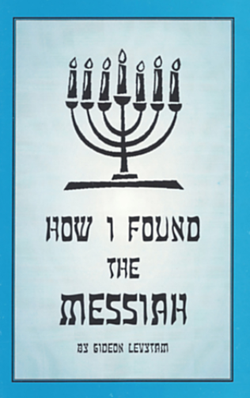
Follow Gideon Levytam's journey and discover how he was led by God, through a series of exciting circumstances, to find the One his people are still waiting for.
Past Episodes

Featured Offer
Follow Gideon Levytam's journey and discover how he was led by God, through a series of exciting circumstances, to find the One his people are still waiting for.
About Holy Scriptures and Israel
As time passed by, the Lord Yeshua took dear brother John Van Stormbroek to himself. The ministry of Holy Scriptures and Israel continued with additional development. In the early 1990’s, a weekly morning Bible class began which brother Gideon Levytam led regularly in the City of Toronto. This weekly open Bible class was held in the Willowdale assembly meeting hall. Eventually, a second mid-week evening Bible class was added. In April 2002, the need for an additional outreach Bible teaching meeting arose. We begun a Saturday (Shabbat) ministry meeting in which a systematic teaching of God’s word is presented to all who attend. Together we learn God’s Word, pray for each need and the salvation of Israel, and sing songs of worship unto our God, praising Him and our Lord Yeshua the Messiah.
In Mid 2004 we started to air on Joy 1250 Radio station a 15 minute Bible teaching program called "The Holy Scriptures and Israel" with Gideon Levytam. The broadcast teaches God’s word from a Hebrew Messianic perspective and has proved to be a blessing to many. It's now aired seven days a week. Our prayer is that many more of our Israeli people will have a clear understanding of who Yeshua is, why we all need him, and come to know him as their Lord and Messiah.
About Gideon Levytam
Contact Holy Scriptures and Israel with Gideon Levytam
426 Simcoe Street
Niagara-on-The-Lake
Ontario L0S 1J0
Canada
(905) 325-1234