

Nehemiah 4:1-9, Part 3 of 3


The Enemies Mock and Discourage Israel, Part 3
Guest (Male): Shalom. Holy Scriptures and Israel is a ministry designed to share with the Jewish people the good news of the Lord Jesus, Yeshua the Messiah, and to instruct Christians on the Jewish roots of their faith. And now, teaching God's word from a Hebrew Messianic perspective, here is Gideon Levytam.
Gideon Levytam: This study of Nehemiah chapter 4. And by hating the Jewish people and opposing the Jewish people and mocking the Jewish people and hindering the Jewish people and persecuting the Jewish people, it's actually going against God. And that's why, beloved brothers and sisters, he prayed such a prayer. There are many Psalms in the Hebrew Scripture that are called Imprecatory Psalms. It is a Psalm that is actually the writer, mostly of them were David, is a Psalm of prayer of judgment upon the enemies of God.
Let me read Psalm 137. This is the famous Psalms that one of the Levi'im, the Levites, wrote at the time when the Jewish people were in Bavel. Sometime God had to discipline his own people. And here is a Psalm of restoration. And you remember this Psalm 137 where we read there, "By the rivers of Babylon," verse 1, "there we sat down, yea, we wept, when we remembered Zion. We hanged our harps upon the willows in the midst thereof. And there they that carried us away captive, they required of us a song; and they that wasted us required of us mirth, saying, Sing unto us one of the songs of Zion."
And the Jewish people who are there in Bavel, they said, "How shall we sing the Lord's song in a strange land?" They couldn't sing because they were away from the Lord. Now they are in the land. Now they can sing in the land, and yet now they have an enemies in the land around them. And so they said when they were in Bavel, in verse 5, "If I forget thee, O Jerusalem, let my right hand forget her cunning." In Hebrew, "im eshkachech Yerushalayim tishkach yemini." Beautiful statement. We have it on many, many places in Israel today. "If I forget thee, O Jerusalem, let my right hand forget her cunning."
"If I do not remember thee," verse 6, "let my tongue cleave to the roof of my mouth; if I prefer not Jerusalem above my chief joy." But now look at the rest of the Psalm is imprecatory prayer. It seems to be very strong prayer. Look what they are saying. It says in verse 7, "Remember, O Lord, the children of Edom in the day of Jerusalem; who said, Raze it, raze it, even to the foundation thereof." And look at that prayer, beloved brothers and sisters. A prayer of vengeance against God's enemy.
He said, "O daughter of Babylon, who art to be destroyed; happy shall he be, that rewardeth thee as thou hast served us. Happy shall he be, that taketh and dasheth thy little ones against the stones." You and I might say, "What kind of a prayer it is?" It is a prayer of revenge or prayer of curse upon the enemies of God. See, those Jewish people who were in Babylon understood that God has a plan to restore Israel back to himself. And the people of Edom and the nations of Babylon, they are the ones that reject God.
You see Babylon from Genesis 11, Bavel, to Revelation 17 and 18, Babylon the Great, you might say, throughout the history of humanity, Bavel always represent the world who rejected God. And so they are praying in light of their understanding of the mind and the plan of God. And they are praying this imprecatory prayer, which is a prayer of curse upon the enemies of God and the enemies of God's people. And here we find again Nehemiah. He is praying in a very similar way.
But we also know that in the present day, for you and I as believers, we are to pray somewhat differently. Now, turn to Matthew chapter 5. Yeshua have taught the disciples how to pray and to distinguish between the two. The one is a prayer that the people of Israel were praying prior to the coming of the Messiah under the age in which they lived in. The Messiah haven't come as yet. The Messiah was going now to die, and everything pointed to his death and resurrection. And so in Matthew chapter 5, when Yeshua came, he taught the disciples in verse 43, 44, and 45 to pray in this manner.
"Ye have heard that it hath been said, Thou shalt love thy neighbor, and hate thine enemy. But I say unto you, Love your enemies, bless them that curse you, do good to them that hate you, and pray for them which despitefully use you, and persecute you; that ye may be the children of your Father which is in heaven: for he maketh his sun to rise on the evil and the good, and sendeth rain on the just and the unjust." You notice what it says in verse 43, "It hath been said," the law.
"But I say unto you," I'm coming right now to teach you something that you have to learn for this present day, dispensation, or era of the days in which the Messiah have finished the work on the cross and is building a body of believers. "I say unto you," and you notice what he says, "to pray for them that despitefully use you and persecute you" in Matthew chapter 5 and verse 44. Now, mind you, brothers and sisters, to be honest, if somebody persecute you, you probably want to pray the prayer that Nehemiah prayed.
You're going to wish him well for the one who persecutes you and despises you? "Oh, God bless you." You probably want to go to Nehemiah chapter 4. That's what you and I might want to say in our own heart, and maybe sometime when we are not in a right condition with the Lord, we probably would say so. But the Lord taught us this. And you see, that's why we need to understand. I know it's not always easy. And we need the spirit of God, Ruach HaKodesh, to help us to distinguish what was in the time before the Messiah came and what applies for us in the time after the Messiah came.
We need to understand that. We cannot make salad and not rightly divide the word of truth. Now, I want you to see, it's not only what Yeshua said, because he said it before he died. Well, look a little bit further in Romans chapter 12 and verse 17. Now you cannot say, "Well, Yeshua didn't die as yet, the cross haven't been behind him." Here the Apostle Paul now speaking to believers after the Mashiach died, after he was buried, after he rose from among the dead, after he was ascended unto heaven, after the Holy Spirit of God came to indwell the believers.
Look what he teaches in Romans chapter 12 and verse 17. He said, "Recompense to no man evil for evil. Provide things honest in the sight of all men. If it be possible, as much as lieth within you, live peaceably with all men. Dearly beloved, avenge not yourselves, but rather give place unto wrath: for it is written, Vengeance is mine; I will repay, saith the Lord. Therefore if thine enemy hunger, feed him; if he thirst, give him drink: for in so doing thou shalt heap coals of fire on his head. Be not overcome of evil, but overcome evil with good."
You see, this is what the Lord is teaching us for this present day, dispensation, this era in which we live in, dealing with believers from among all the nations of the world. And so Nehemiah prayed in light of what he understood in his present days, yet you and I have to be very careful not to pray in such a way as Nehemiah prayed. On the opposite, we are to learn from what Yeshua the Messiah have taught us. Nehemiah was 100 percent right. The Levite who wrote Psalm 137 was 100 percent right.
And you and I, in order to pray today to be like Yeshua taught us, this way we will be right as well if we will pray like Yeshua have taught us to pray. Now, he says in verse 6, "So built we the wall," verse 6, "and all the wall was joined together unto the half thereof: for the people had a mind to work." So imagine now, in spite of the opposition, in spite of the mockery, according to verse 6, Nehemiah and his brethren, the Jewish people, they continue to work.
And I want to encourage you. Listen, if we are going to be so discouraged because we are going to have a lot of enemies as believers, and then we are not going to do anything for the Lord, really we lose out. How do we lose out? By turning away from the Lord, going to the world, stop to serve the Lord, stop to live for the Lord. We are going to lose out. God's going to use somebody else. He can use whomsoever he will. But he wants to use you. He wants to use me. He wants to use his people.
And we should ask the Lord to help us, to encourage us. Can you imagine when you have somebody like Nehemiah when everyone is mocking and laughing at them and so on? Nehemiah is the one that stirred the brethren. And perhaps others among the people also stirring each other and saying, "Let's continue on." And I want to tell you that these people that we find here in this area, that we find here through these Samaritans and all the situation that existed, this is an old story which continues today.
It continues today in the land of Israel. You don't have to know much, just turn your television and you find out that a couple of days ago there was a shooting attack against a family who lived by Judea and this area and passed by with their car. They were shot to death. And other time you find that a boy going to a house, climbing over a fence, going to a Jewish home, and killing a young girl, 13 years of age. This same story is repeating itself now since the time of Nehemiah, but it's not even since the time of Nehemiah.
It's since Abraham, Isaac, and Jacob. Abraham has these two sons, Isaac and Ishmael. And a constant friction between Ishmael descendants and Isaac descendants. It's the same old story. And the enemies are today in existence in the land of Israel even though Israel today is still in a state of unbelief. But spiritually speaking, it's also in your life and mine. We will get it all the time. My wife was telling me just reading a book about some history of believers, Jewish believers, who wanted to serve the Lord and how much opposition they had because of their desire to minister the gospel.
It encourages me. He said, "You think you have problem? Just look at this or look at that." And you and I can say to each other, "You think you have problem? Look at the problems that many believers are experiencing in their life." And so we should just encourage ourselves like David in the Lord and continue on. And so now the Jewish people, it says in verse 6, that "the people had a mind to work." They wanted to work, always abounding in the work of the Lord. They continue to build the wall.
And it says that "the wall was joined together, all the wall," but not all the way high. It was "half thereof." They already surrounded all Yerushalayim with all the wall, but it was not quite high enough. It was half the size. But the people were bent on working. They were encouraged. They continued. So look at this. When plan A doesn't work with God's people's enemy, then they go to plan B. And so notice in verse 7 and 8, you find again Sanballat and Tobiah, the Arabian, which is Geshem, and another group is being added, a group called the Ashdodites.
These are the Philistines. They also began to participate in their opposition against the people of Israel. And so we read in verse 7, "And it came to pass, that when Sanballat, and Tobiah, and the Arabians, and the Ammonites, and the Ashdodites, heard that the wall of Jerusalem were made up, and that the breaches began to be stopped, then they were very wroth." Now, you see, brothers and sisters, I want you again to notice, we have here Sanballat, he was from Moab.
You have here Tobiah, he was from Ammon. You have here the Arabians, this is Geshem, he is the Arabic nation around. And then the Ashdodite. Ashdod is the town today that is really north of the Gaza Strip. And that town was one of the five cities that belonged to the Philistines. One of them was Gaza, one of them was Ashdod, then Ashkelon and Ekron. There were five cities that belonged to the Philistines. So you can see the same old story is repeating itself today like it was many, many years ago.
Moab, Ammon, the Arabic nations around, including the people of Gaza, the Philistines, the Palestinians of today who oppose the people of Israel. "We will not let them build that land. We will not let them live in that land. We have to remove them out of the land and perhaps place them in the Mediterranean." That's what really the enemies of Israel want to do. Want to put all the Jewish people in the Mediterranean and there they're going to let them drown. But that's not the plan of God.
The plan of God is to give his own people Israel the promised land. That's the land that belongs to the Jewish people. So you notice now, you actually have them all surrounding the nation of Israel. And so you find out in verse 8, when they could not succeed to discourage the Jewish people by laughing at them, the next thing to do is by physically harming them. And that's why it does say in verse 8, "And they conspired all of them together to come and to fight against Jerusalem and to completely hinder."
So I want you and I also to understand, that's the way the enemy works. The enemy first of all tries to trick us, to laugh at us and discourage us. But if it doesn't work, he is coming against us by force. In fact, there are the two expressions that we find out in the Brit Chadasha, in the New Testament. Satan appears to us as an angel of light, 2 Corinthians chapter 11. And when he doesn't succeed to trick us as an angel of light, then he continues as a roaring lion.
In 1 Peter chapter 5, he's coming as a roaring lion seeking whom he may devour. And that's exactly the pattern that we see here in Nehemiah chapter 4. He first came against them by laughing at them and mocking them. And when the people had a mind to work and to build and when they saw that the walls of Yerushalayim is starting to climb up higher, they say, "That is not what we wanted. Let's do something about it. Let's gather forces together and now go and attack and fight against the city of Yerushalayim. Let us consume those people."
This is the pattern that happened actually also in church history. You know, we read that when the men rejected the Messiah, they hung him on a tree. And it's not only that the Jewish people refused him, but the Roman soldiers putting him on a tree, it proved to us that all of us are guilty in the death of the Messiah. But what about the early believers? They killed John the Baptist, Yochanan HaMatbil, they cut off his head.
And what about Stephen in Acts chapter 7? They stoned him to death because he told them that Yeshua was the Messiah. And we can continue on. What about James, Ya'akov? He himself was killed. You can read it in Acts chapter 12. The enemies of God's people, if they are not succeeding to say, "Oh, they're not going to continue with the things of God," they are continuing by force to oppose the people of God. What about Shimon Petros?
They put him in jail in Acts 4, in Acts 5, in Acts 12. They thought, "Oh, he will not speak for the Lord anymore. Let's put him, lock him in jail." And what about Sha'ul, Paul himself, in Acts chapter 16 and on? They put him in prison. And much of his ministry and many of the letters that we have in the Brit Chadasha were written from a man who was sitting in prison. And you and I listen to what he has to say 2,000 years ago by divine inspiration. It is amazing.
What we learn from that, that even though there will be physical persecution among the people of God, the persecution of the saints becomes the seed of the gospel. The more you persecute them, the more they grow. The more you kill them, others the Lord is raising. You remember when our Hebrew people were in Egypt and Pharaoh wanted to destroy our Jewish people? Whatever he tried to do didn't work. The more he sought to destroy our Jewish people, the Hebrews, the more they became a greater and a greater and a greater nation.
That's very similar in this age of the church age. The more you persecute the believers, the more the Lord is using this occasion to raise others. It is amazing, brothers and sisters. You and I live in this country, we are so privileged. We don't have any idea what persecution means. We are so blessed to live here in this country to be able to sit for an hour and listen to the word of God. While there are believers like you and I in prison in many countries, in the former Soviet Union, in China, in a Muslim country, where they cannot open their Bible like you and I do it today. And they would love to do so without fear, but they can't.
But that's the way Satan is working. He's opposing God's people. He tried to do it by mockery and trickery and whatever, but when it does not work, he continues and he trying to go and to oppose them even up to the end. Go to Psalm 83. The Psalmist of Israel wrote so much about the opposition that Israel have experienced. And Psalm 83, it's one of the most famous Psalms that teaches us about the enemies of the people of God, the people of Israel.
And it's actually a Psalm that shows us that what's going on in the Middle East today is really nothing new. It is that which were predicted by divine inspiration. In Psalm 83 and verse 1 says, "Keep not thou silence, O God: hold not thy peace, and be not still, O God. For, lo, thine enemies make a tumult: and they that hate thee have lifted up the head. They have taken crafty counsel against thy people, and consulted against thy hidden ones. They have said, Come, and let us cut them off from being a nation; that the name of Israel may be no more in remembrance."
That's what they say, "We don't want that the name of Israel will be in remembrance." Now, look at the list. Who are they that say so? In verse 5, "For they have consulted together with one consent: they are confederate against thee." And then it gives you the list: "the tabernacle of Edom, and the Ishmaelites; of Moab, and the Hagarenes; Gebal, and Ammon, and Amalek; the Philistines with the inhabitants of Tyre; Assur also is joined with them: they have holpen the children of Lot. Selah."
Look at the list. This is the exact group of people that today opposing the people of Israel as well. And it's not new because when the Psalmist wrote this Psalm, it was long time ago, before the Messiah came into this world, when Israel as a nation was living there and experienced this opposition in Israel's history. And who are they? All the same nations that we have in Nehemiah chapter 4. Sanballat the Moabite, Tobiyah the Ammonite, the Arabian, Geshem, and the Ashdodite, the Philistine. All the same nation.
And you know, you and I as believers also have the same old enemy. His name is Satan, who sending others to oppose the people of God and causes them not to grow and not to serve him and to live for him. And many times, unfortunately, we allow him to defeat us because we are not leaning on Yeshua the Messiah. Well, let's conclude with verse 9 for this ministry meeting today. So what is the answer? Well, here is the answer.
"Nevertheless we made our prayer unto our God, and set a watch against them day and night, because of them." Notice two things we mentioned here. The first thing is prayer and the second thing is watchfulness. Doesn't it remind you what Yeshua said in the Garden of Gethsemane before he died on the tree? He said to the disciples, he says, "Watch and pray." In Matthew chapter 26, verse 40 and 41, "Watch and pray." And this is very challenging for us, dear brothers and sisters.
Do we take the time to pray, to talk to the Lord, to tell him our problems, to pray for our brothers and sisters, to ask for the Lord for mercy and grace in relationship to our need, our home need, our family need, our personal need, our collective needs, the country in which we live in? Do we pray? And secondly, are we watchful? Are we discerning things that are happening around and are watching as we are exhorted in Scripture? You know, in Romans chapter 12, it says "continuing in prayer."
In Ephesians chapter 6, it says "praying always." In Philippians chapter 4, it says, "and in everything by prayer." In Colossians 4, it says "continue in prayer." In 1 Thessalonians chapter 5 and verse 17, it says "pray without ceasing." In 1 Timothy chapter 2 and verse 8, "men should pray everywhere." And in James chapter 5 and verse 16, "pray one for another." Ya'akov, James, said to the brothers and sisters. And you and I also need the Lord's help in continuing in prayer in our day-by-day life and also to watch.
Because the enemy seeks every day to cause us to fall, to stumble, to stay away from the Lord. And it is only as we watch and pray that we are able to continue on like the people of Israel in a day of Nehemiah. "We prayed and we were watchful." We were looking around and we were discerning, we were careful. Therefore, we were able to continue on in building the wall of the city of Yerushalayim. Well, brothers and sisters, may the Lord help us to continue on for the Lord.
Guest (Male): You have been listening to the Holy Scriptures and Israel with Gideon Levytam. Gideon teaches God's word from a Hebrew Messianic perspective. For more information about this ministry, write to Holy Scriptures and Israel, Box 1411, Niagara-on-the-Lake, Ontario, L0S 1J0, or visit our website at holyscripturesandisrael.com.
You are also invited to Gideon's weekly Bible teaching on Fridays at 11:00 AM and 7:00 PM and Saturdays at 1:00 PM at Willowdale Christian Assembly Hall, 28 Martin Ross Avenue in Toronto. Holy Scriptures and Israel is made possible by your prayers and financial support. If you would like to support the program, visit holyscripturesandisrael.com. God bless you. Shalom shalom.
Featured Offer
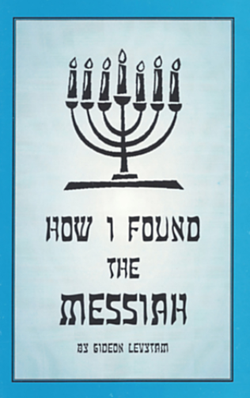
Follow Gideon Levytam's journey and discover how he was led by God, through a series of exciting circumstances, to find the One his people are still waiting for.
Past Episodes

Featured Offer
Follow Gideon Levytam's journey and discover how he was led by God, through a series of exciting circumstances, to find the One his people are still waiting for.
About Holy Scriptures and Israel
As time passed by, the Lord Yeshua took dear brother John Van Stormbroek to himself. The ministry of Holy Scriptures and Israel continued with additional development. In the early 1990’s, a weekly morning Bible class began which brother Gideon Levytam led regularly in the City of Toronto. This weekly open Bible class was held in the Willowdale assembly meeting hall. Eventually, a second mid-week evening Bible class was added. In April 2002, the need for an additional outreach Bible teaching meeting arose. We begun a Saturday (Shabbat) ministry meeting in which a systematic teaching of God’s word is presented to all who attend. Together we learn God’s Word, pray for each need and the salvation of Israel, and sing songs of worship unto our God, praising Him and our Lord Yeshua the Messiah.
In Mid 2004 we started to air on Joy 1250 Radio station a 15 minute Bible teaching program called "The Holy Scriptures and Israel" with Gideon Levytam. The broadcast teaches God’s word from a Hebrew Messianic perspective and has proved to be a blessing to many. It's now aired seven days a week. Our prayer is that many more of our Israeli people will have a clear understanding of who Yeshua is, why we all need him, and come to know him as their Lord and Messiah.
About Gideon Levytam
Contact Holy Scriptures and Israel with Gideon Levytam
426 Simcoe Street
Niagara-on-The-Lake
Ontario L0S 1J0
Canada
(905) 325-1234