
Nehemiah 2:11-20, Part 3 of 3


Nehemiah’s Invitation-Come, Let Us Build Up the Walls of Jerusalem, Part 3
Gideon Levytam: The study of Nehemiah Chapter 2. So, he's telling them and I'm back in Nehemiah Chapter 2 and verse 17. Now Nehemiah points the Jewish people to the condition of the city of Jerusalem. Look at what he says to them in verse 17, "Then said I unto them, Ye see the distress that we are in, how Jerusalem lieth waste, and the gates thereof are burned with fire: come, and let us build up the wall of Jerusalem, that we be no more a reproach."
Now you know one thing I love about him again and again, there are many things I love about Nehemiah, but you notice he identified himself with the people. He doesn't come and say, "Oh, you bad Jewish people, you do not get up to build the city of Jerusalem. I am the good one who is going to come to fix all your problems." No, he says to them, "Ye see the distress that we are in." And then he says, "that we be no more a reproach." He affiliated himself with the brothers and sisters of his own people, the Jewish people.
He says, "Look, brothers and sisters. Look what's going on. Don't you see the distress that we are in and how Jerusalem is lying in waste and the gates thereof are burned with fire? Don't you see this?" You know, again, I think it is kind of sad when we don't respond to the call of the Lord. Don't we see what's going on among the body of believers? I'm not saying that we are going to fix every problem, but why don't we be used to be a blessing to God's people? Maybe we need to make a visit. Maybe we need to give a phone call. Maybe we can go and help somebody who has a need somewhere. I don't know what it is.
"Don't you see?" Nehemiah is saying to them. Look at the condition that is existing. Jerusalem is lying waste. The gates are burned with fire. What you going to do about it? Okay, here, brothers and sisters, come, let us begin to build the walls of Jerusalem. It reminds me of certain other verses that we have in the New Testament. You know, we all have gifts. We are part of one body, not only us here, but all believers. Everyone, God gave us a gift. We are members of one body: the hands, the fingers, the head, the feet, the toes. We are members of one body.
Now, you know very well when let's say you have a certain pain in your hand and you can't use your left hand, you have to do everything with the right hand. You can't do the same thing with one hand that you can do with two hands. You cannot do it with one foot, you have two feet. You've got to use both of your feet in order to be able to walk around and to do things for the Lord. You and I are members of a body of Messiah. Everyone of us is responsible to function, to do our part. So, it's so beautiful to see Nehemiah, how he is encouraging. He says, "Look at the condition. Try to do something about it. Come," he says, "let us build up the walls of Jerusalem, that we will be no more a reproach."
The Hebrew word reproach is *cherpah*, *busha vecherpah*. What a shame when the world looks at the condition of the body of the Messiah, and they look at us and they say, "You are the people of God? Yeah, your Jesus, yes. Don't tell me about your Yeshua. Look at the condition that is existing in your midst. You can't even handle each other. You don't even have patience with each other. Don't you tell me about the love of God. You first of all practice it in yourself. Don't tell me what I need to do," they would tell us.
You remember our people of Israel who were in Babylon. By the rivers of Babylon, there we sat down and we wept when we remembered Zion. Then they that took us captive said unto us, "Sing unto us one of Zion's songs." They were mocking the Jewish people who were supposed to be in Jerusalem but they found themselves in Babel by the rivers of Babylon. So, here we see this can apply to us today. But there was a man that came to seek to help them. "Come, let us," not "I" alone. He's saying about himself, "Let us build it." It's not a one-man show, Nehemiah and everybody else. No, it's, "Let us," he says. All us Jewish people who are in Jerusalem and the surrounding, let us together build the walls.
In verse 18, Nehemiah shares of God's hand and the king's words with the Jewish people. He says, "Listen, what I'm telling you, it's not something that came only from my head." He says, "Listen, the hand of my God was good upon me. I told them of the hand of my God." You see, he was so much dependent upon the help of the Lord, the God of heavens, the God of Israel. He says really, it's not me alone, it is the hand of my God. And even further, he says to them in verse 18b, "as also the king's words that he had spoken unto me." In other words, it's not only God in heaven that his hand was upon me, but the King Artaxerxes, he agreed with it. He approved it. He sent me to come to Jerusalem to do this work.
Then he continued, and look at the response. It's so nice to see when he motivated the Jewish community of those days to begin the rebuilding of the walls of Jerusalem because it says in verse 18, "And they said, Let us rise up and build. So they strengthened their hands for this good work." So, they responded, you see? They were not just leaving that for him alone. They responded.
Sometimes we hear of the expression "the movers and the shakers." You know, we need those brethren that are moving us, shaking us, awakening us, not causing us trouble, but building us, encouraging us to be builders. That's what we need. Trouble we have plenty. We don't need that. You'll see it in the next two verses. Problem will come. We need the movers and the shakers, the godly men and women, brothers and sisters, who are saying, "I'm going to serve the Lord." You see, one day we are going to stand before the Lord. The Lord is going to ask you and I, "What have you done for Yeshua the Messiah?" And we have to tell Him, "Lord, you know what? I was busy, you see."
You know, there is a time when we preach the gospel. We often say, "There is time for pleasure, there is time for business, there is time for family, there is time for myself, but there's very little time for God." And here we see that. We see how Nehemiah was speaking to these people of Israel when they were sleeping. He woke them up and now they said, "Let us come and build up the wall." Now again, I want to mention that by applying it to our own hearts, because we cannot look at each other and say he or she, I have to search my own heart about this. And the Lord has to awaken each and every one of us to do the work of the Lord.
Well listen, when you're going to begin to do the work of the Lord, it's not going to be smooth sailing. It'd be nice if it would be smooth sailing because right there and then, the enemy is going to try to discourage us, just like he did here. You notice the last two verses of Chapter 2, the enemies of the Jewish people opposing the work of the Lord. It says, "But," notice the change here, "But when Sanballat the Horonite, and Tobiah the servant, the Ammonite, and Geshem the Arabian, heard it, they laughed us to scorn, and despised us, and said, What is this thing that ye do? will ye rebel against the king?"
"Then answered I them, and said unto them, The God of heaven, he will prosper us; therefore we his servants will arise and build: but ye have no portion, nor right, nor memorial, in Jerusalem." *Lachem ein chelek utzdakah vezikaron b'Yerushalayim.* You don't have any portion, you don't have any memorial, you don't have any right in the city of Jerusalem, he said to those three individuals that became the enemies of the Jewish people. Now who are those people?
A few things I would like to suggest here about these individuals. First of all, you notice that in verse 10, we only have mention of two of them. This is Sanballat the Horonite and Tobiah the Ammonite. Then later on, at the end of verse 19, we have added another one by the name of Geshem. He was an Arabian. Now in all these three individuals, we can learn some spiritual lesson. Who are those representing for us today?
In biblical time, obviously, you notice Sanballat the Horonite, he's really coming from the land of Moab. Moab had one of the towns called Horon and he came from this area. Then the other one was Tobiah, he was from Ammon. You remember, beloved brothers and sisters, these two names, Moab and Ammon, are the children that came out of Lot who had a relationship with his two daughters when he was drunk. And they were, in a sense, a relative to Abraham. In a sense, what you've really been represented by those two is the flesh that is existing within us, our old nature, the flesh.
The Lord Yeshua had to teach Nicodemus, or Nakdimon, in John Chapter 3. Yeshua said to Nicodemus, "You must be born again. That which is born of the flesh is flesh, and that which is born of the spirit is spirit. That's why I said unto you, you must be born again." What does it tell us? That people that may have the appearance as if they are part of the people of God, but in reality, they were actually not born again. You see these individuals, they claim that they have rights over the city of Jerusalem, but actually they did not.
This is a great lesson to learn in life today. You notice how oftentimes people haven't come to know Yeshua as their Lord and Savior. They are not born from above. Oh yeah, they are religious. Oh yeah, they would go to church meetings or congregation meetings, but they have never applied the blood of Yeshua HaMashiach for themselves and they are not born again, born from above, *lehivaled me'hashamayim*. They haven't been born from heaven from above. They are not really part of the family of God. That's why you may apply this to these kind of individuals that have been entering into among the people of God but they were never born again.
No wonder that they oppose the work of the Lord. No wonder they introduce things that are not sound and not right. No wonder they do not submit to what the Lord says in His Word. I'm not saying that you've got to be a scholar, but there are clear-cut things that are taught in the Word of God. By the way, just to remind you, the Lord said to Israel in Deuteronomy 23 and verse 3, he said, "An Ammonite or Moabite shall not enter into the congregation of the LORD; even to their tenth generation shall they not enter into the congregation of the LORD for ever." Why? God gave Israel an answer because, in verse 4, "Because they met you not with bread and with water in the way, when ye came forth out of Egypt; and because they hired against thee Balaam the son of Beor of Pethor of Mesopotamia, to curse thee."
"Nevertheless the LORD thy God would not hearken unto Balaam; but the LORD thy God turned the curse into a blessing unto thee, because the LORD thy God loved thee. Thou shalt not seek their peace," their shalom, "nor their prosperity all thy days for ever." Now of course you and I immediately are going to say, well Ruth the Moabitess woman had entered into the congregation of the Lord. Well, you see what we learn, that under law, she could have never entered in. But the representation of the Messiahship in His sacrifice has allowed her to come in on the basis of grace and grace alone. What we really learn is historically, these two men who oppose the people of Israel, those two men, Sanballat and Tobiah, they were descendants of these two nations that opposed Israel throughout history.
They are representation, actually they were family, but they were not born again. It reminds me again of the two brothers of Adam and Eve, Cain and Abel. One of them was born from above by virtue of the fact that he offered a sacrifice. The other one was not, by virtue of the fact that he refused to come to God on the basis of the blood shed of an animal. Therefore Cain went out of the presence of the Lord, and it was never, ever written in scripture that he ever came back.
So, there are lessons to learn. But there's a second thing that we can learn from verse 19 of these three individuals. All of a sudden we find them in Nehemiah Chapter 2 and verse 19. By the way, we'll find them again later on. They were constantly opposing the Jewish people historically. You might really say also, beloved brothers and sisters, that even though we are believers today, we have three enemies that constantly cause us to stumble and to fall and not to be builders among the people of God. We know those enemies very well. We have them in the expression of the flesh, the world, and Satan. Those are the three enemies that every believer has in her or his life. We are struggling every day. You have it and I have it. These three enemies constantly seek to hinder us from walking with the Lord.
The world: 1st John 2 tells us, "Love not the world, neither the things that are in the world. For all that is in the world, the lust of the flesh, the lust of the eyes, and the pride of life." That world means the world system that rejects God and rejects Yeshua the Messiah. That's what he meant. He doesn't mean don't love people, don't love trees, don't love things that God had provided us in this world to enjoy. But he told us, "Love not the system that denies God and denies the things of Yeshua the Messiah."
What about the flesh? "Walk in the Spirit," Galatians 5, "and ye shall not fulfil the lust of the flesh." You see, brothers and sisters, you and I still have this old nature. The flesh lusts against the Spirit and the Spirit against the flesh, and they are contrary to each other. That's why we are struggling every day with pride, with arrogance, with lusts, with covetousness, with all that which hinders us from spiritual growth. We have the old nature in us. Your old nature and my old nature is not better than the old nature of the unbeliever. We all have the same abba and ima, the same father and mother, namely Adam and Eve.
But what about the third enemy? You see in the book of Ephesians Chapter 6, Satan himself is attacking the people. In Ephesians Chapter 6 and verse 14, look what Paul said to the Ephesians. He says, "Stand therefore, having your loins girt about with truth," and he gives you all this list. But you see what he said in verse 12 of Ephesians Chapter 6, "For we wrestle not against flesh and blood, but against principalities, against powers, against the rulers of the darkness of this world, against spiritual wickedness in high places. Wherefore take unto you the whole armour of God, that ye may be able to withstand in the evil day, and having done all, to stand." Stand and he gave us that list.
You see, we have this lesson to learn here, that we really also have this problem with Satan who attacks us. So perhaps with these three individuals, Sanballat, Tobiah, and Geshem, we can really see the enemies of the believer as we walk here with the Lord and we seek to build among the people of God. You notice what these three did in verse 19b, they were laughing and they were mocking Nehemiah and the Jewish community. It says there, "They laughed us to scorn, and despised us, and said, What is this thing that ye do? will ye rebel against the king?"
You know, of course, when you look at these Jewish people, who were they? They were nobody, in a sense. They were in such a poor condition at that time. Everything is broken. What they could do? So they laughed at them. I listen to some messages about the passage in Nehemiah, and some of those Bible teachers said, "You know, I remember years ago when I went, I left my job, and I had a heart to gather believers and to share the gospel. I went from door to door. I did some visitation. I went to do all kind of things. We had meetings together. We were studying the Word of God, and people were telling me, 'Are you out of your mind? Are you going to be successful to gather people together and to form a local assembly?'"
You see, of course, on our own we have no strength. We are no match for the enemy, but the Lord is able to do so. The Lord is able to bless the people of God even though people will laugh us to scorn and people despise the people of God. The Hebrew word "they laughed us to scorn" is *vayali'gu lanu*. It's a terrible word. They are laughing and mocking them, "Who do you think you are?" Well, Nehemiah said earlier, "It is the hand of my God upon me." It's not me, I'm but a vessel.
It is God who is the builder. He is the master builder. We're building under foundation that Yeshua the Messiah is a chief cornerstone. He is the one we build upon, not upon ourselves. Remember when Yeshua said to Shimon Petros, "You are Peter, and upon this rock I will build my assembly, my ekklesia." He didn't mean it upon Peter, but he meant upon Peter's confession that Yeshua was the Son of God, the Messiah of Israel. You are the Messiah, the Son of the living God. Upon Yeshua we can build. Upon ourselves, we cannot build anything.
That's why we can have confidence when we preach the Word of God, when we share God's Word in the power of Ruach HaKodesh, the Holy Spirit of God. We can have confidence that God will use it. Even if it seems to be very shallow and maybe it doesn't seem to be much influence, it doesn't seem to have a big things going on, but the power of the Spirit of God have an effect upon those who will listen. The Lord is able to do His work, and we trust in Him like Nehemiah did.
So, the final verse, brothers and sisters, in verse 20 of Nehemiah Chapter 2, "Then answered I them, and said unto them, The God of heaven, he will prosper us; therefore we his servants will arise and build." You see, we don't trust ourselves, but we trust *Elohei ha'shamayim*, the God of heavens. He's going to give prosperity, not ourself. He's going to prosper the building of the walls of the city of Jerusalem. Therefore, because we have an assurance that He will bless it, we His servants are going to get up and going to build.
Then he said to them in closing, "But you, you have no portion, *lo chelek*. You have no right, *lo tzdakah*, and you have no memorial, *lo zikaron*, in Jerusalem." Again to remind you that these were the Samaritans, the Shomronim. There was a mixture of them. They were really not those who devoted themselves to the God of Abraham, Isaac, and Jacob. They worshipped Jehovah, but they also worshipped other gods. Those were the Shomronim of which we read in Chapter 4 and verse 1 and 2.
I'm going to close with these words. "But it came to pass," Nehemiah 4:1 and 2, "that when Sanballat heard that we builded the wall, he was wroth, and took great indignation, and mocked the Jews. And he spake before his brethren and the army of Samaria, and said, What do these feeble Jews? will they fortify themselves? will they sacrifice? will they make an end in a day? will they revive the stones out of the heaps of the rubbish which are burned?"
You see, he spoke it, he told this to the Samaritans, to the rest of them who were there around him. So, beloved brothers and sisters, these Jewish brethren with the encouragement of Nehemiah rose up to build the walls of Jerusalem. You and I have to ask ourselves the same question. Are we going to be those that will build among the people of God or not? Are we going to be the ones who say, "Listen, I want to take part. Maybe not a big part, but a little part in the work of the Lord. I'm going to do something for my Messiah, for Yeshua, and for the people of God"? And I can tell you, that will give you joy in your heart because it is a blessing to be builders among the people of God.
Featured Offer
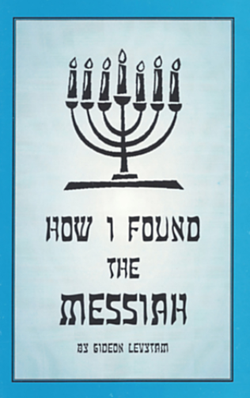
Follow Gideon Levytam's journey and discover how he was led by God, through a series of exciting circumstances, to find the One his people are still waiting for.
Past Episodes

Featured Offer
Follow Gideon Levytam's journey and discover how he was led by God, through a series of exciting circumstances, to find the One his people are still waiting for.
About Holy Scriptures and Israel
As time passed by, the Lord Yeshua took dear brother John Van Stormbroek to himself. The ministry of Holy Scriptures and Israel continued with additional development. In the early 1990’s, a weekly morning Bible class began which brother Gideon Levytam led regularly in the City of Toronto. This weekly open Bible class was held in the Willowdale assembly meeting hall. Eventually, a second mid-week evening Bible class was added. In April 2002, the need for an additional outreach Bible teaching meeting arose. We begun a Saturday (Shabbat) ministry meeting in which a systematic teaching of God’s word is presented to all who attend. Together we learn God’s Word, pray for each need and the salvation of Israel, and sing songs of worship unto our God, praising Him and our Lord Yeshua the Messiah.
In Mid 2004 we started to air on Joy 1250 Radio station a 15 minute Bible teaching program called "The Holy Scriptures and Israel" with Gideon Levytam. The broadcast teaches God’s word from a Hebrew Messianic perspective and has proved to be a blessing to many. It's now aired seven days a week. Our prayer is that many more of our Israeli people will have a clear understanding of who Yeshua is, why we all need him, and come to know him as their Lord and Messiah.
About Gideon Levytam
Contact Holy Scriptures and Israel with Gideon Levytam
426 Simcoe Street
Niagara-on-The-Lake
Ontario L0S 1J0
Canada
(905) 325-1234