

Nehemiah 2:11-20, Part 1 of 3


Nehemiah’s Invitation-Come, Let Us Build Up the Walls of Jerusalem, Part 1
Guest (Female): Shalom! Holy Scriptures and Israel is a ministry designed to share with the Jewish people the good news of the Lord Jesus Yeshua the Messiah and to instruct Christians on the Jewish roots of their faith.
Guest (Male): And now teaching God's word from a Hebrew Messianic perspective, here is Gideon Levytam.
Gideon Levytam: Shabbat Shalom everyone. Please open your Bibles now. We are going to turn to the Book of Nehemiah today. We are going to seek with the Lord's help to finalize the second chapter. Nehemiah chapter 2 is the passage that we're going to look into this ministry meeting.
We are studying the Book of Nehemiah. This man was a cupbearer, a Jewish man that was living outside of the country in Babel, and he was ready to return to the city of Jerusalem to rebuild the walls of Jerusalem that were broken down and the gates that were burnt with fire. Today, I would like to read from verse 11, Nehemiah chapter 2 verses 11 to 20. Those are the last portion of the second chapter. Please follow me. It is a beautiful passage.
We read in verse 11, "So I came to Jerusalem and I was there for three days. And I arose in the night, I and some few men with me. Neither told I any man what my God had put in my heart to do at Jerusalem. Neither was there any beast with me, save the beast that I rode upon. And I went out by night by the gate of the valley, even before the dragon well and to the dung port, and viewed the walls of Jerusalem, which were broken down, and the gates thereof were consumed with fire.
Then I went on to the gate of the fountain and to the king's pool, but there was no place for the beast that was under me to pass. Then went I up in the night by the brook and viewed the wall and turned back and entered by the gate of the valley and so returned. And the rulers knew not whither I went or what I did. Neither had I as yet told it to the Jews, nor to the priests, nor to the nobles, nor to the rulers, nor to the rest that did the work.
Then said I unto them, 'Ye see the distress that we are in, how Jerusalem lieth waste and the gates thereof are burnt with fire. Come and let us build up the wall of Jerusalem, that we be no more a reproach.' Then I told them of the hand of my God which was good upon me, as also the king's words that he had spoken unto me. And they said, 'Let us rise up and build.' So they strengthened their hands for this good work.
But when Sanballat the Horonite and Tobiah the servant the Ammonite and Geshem the Arabian heard it, they laughed us to scorn and despised us and said, 'What is this thing that ye do? Will ye rebel against the king?' Then answered I them and said unto them, 'The God of heaven, He will prosper us. Therefore we, His servants, will arise and build. But ye have no portion, nor right, nor memorial in Jerusalem.'"
I am stopping here. This is the last verse of Nehemiah chapter 2. As we study the Book of Nehemiah, we really fall in love with this man. Nehemiah, his name means "comfort of Jehovah." He was a man that really sought a blessing for the people of God. We really need these kind of men and these kind of women today in this present day of the last days of the church age, of the Laodicean days.
We need men and women that will rise up to be servants among the people of God, to be those that want to build rather than destroy, those that want to see the people of God growing spiritually, want to see the assemblies and the congregation growing both spiritually and also numerically, so that the people of God who are in so much need can get encouragement from those kind of servants like Nehemiah.
Our own Jewish people historically needed such a man as Nehemiah, and God raised it for them in a time of decline. Remember that in the first 10 verses of Nehemiah chapter 2, Nehemiah, who was a cupbearer, came to the king. The king saw him very sad and asked why he was so sad. He said, "Why shouldn't I be sad? Look at the condition when the city and the place of my father's sepulchre lieth waste and the gates thereof are consumed with fire."
Beloved brothers and sisters, let me ask you a question. When you look around today, do you see the believers, the people of God who are scattered and dispersed and divided? Not only were the Jewish people historically divided; the church is divided. The assemblies are divided and broken to pieces. How do you feel about it? Does it grieve you at your heart? Do you feel, "Lord, help me to be a blessing to the people of God?"
This is the kind of individual that the believers need today. The scattered and the broken down people of God need you and I. We need these kind of men and women to rise up and to be a blessing to the people of God. The king sent him. He gave him letters and he gave him lumber. He sent him all the way across the river to the land of Judah, to the land of Israel, and to the city of Jerusalem.
We find ourselves today in the time when Nehemiah has arrived to the city of Jerusalem. Let me add one more thing here and then we're going to move on. If you just turn with me to Daniel chapter 9 for one moment and verse 25, I want you to notice the prophecy that God gave to Daniel when Daniel was in Babel. God gave to Daniel this prophecy concerning the future restoration of the temple in Jerusalem and the city of Jerusalem.
This is the angel speaking to Daniel, telling him the word of the Lord. In verse 25 he says, "Therefore I want you to understand from the going forth of the commandment to restore and to build Jerusalem unto the Messiah the Prince shall be seven weeks." This is 49 years and threescore—this is an additional 434 years—two weeks. Notice the street shall be built and the wall, even in troublous time.
After threescore and two weeks, Messiah shall be cut off, but not for himself. The people of the prince that shall come shall destroy again the city and the sanctuary, and the end thereof shall be with a flood, and unto the end of the war, desolations are determined. We find ourselves now in Nehemiah chapter 2. It is the beginning of the fulfillment of the rebuilding of the walls of Jerusalem and the streets of Jerusalem.
It is about 444 BC or 445 BC. Now Nehemiah finally has arrived to the city of Jerusalem to fulfill the word of the Lord in Daniel chapter 9, verses 25 and 26, that the Messiah ultimately will come after certain years. The beginning of the counting will be from the building of the walls of the city of Jerusalem. So here is Nehemiah, finally having arrived to the city of Jerusalem. When he arrived, enemies already began to work against him. In verse 10, we already read that Sanballat the Horonite and Tobiah the Ammonite were grieved.
They were not happy that someone came to seek for the welfare of the children of Israel. It is sad that when you come to Jerusalem to start to build the city, its broken walls and burned-down gates, you have people who do not like you to do that. They were right there in the very same place. You and I will notice this in our lives as believers, that when you want to serve the Lord and you want to minister to the saints, it is not without opposition.
We see it historically among our people Israel, we see it historically in the ecclesia age or the church age, and we see it today even in the life in which we live. There are those that simply do not want the building of the body of Messiah. Paul warned us against this in Philippians chapter 1 and Philippians chapter 3. He says some really became like an enemy of the Lord because they did not seek to see the building of the body of Messiah.
Satan is causing us many trials and we have to be very careful in our own hearts. It is better to ask the Lord to pray for the people of God rather than to oppose the work of the people of God, because otherwise we find ourselves turning against the Lord and against His will. Now you find out when Nehemiah arrived that there are four things that we find here in verses 11 to 20.
Number one, he arrived to Jerusalem and he is rising up at night. He began with planning how to build the wall of Jerusalem. It says in verse 11, "So I came unto Jerusalem and I was there for three days and I arose in the night, I and some few men with me. Neither told I any man what my God had put in my heart to do at Jerusalem. Neither was there any beast with me save the beast that I rode upon."
Nehemiah is not only a heavenly minded man. He was really a practical man. He says, "Listen, I'm going to build the walls of Jerusalem, well, I have to see what is going on, right?" It is so true when a servant of the Lord is really observing what is going on. He is not a fool. He is listening to the voice of the Lord. Notice that he says here in verse 12, "My God had put in my heart to do in Jerusalem."
The Lord laid it upon his heart to build. Nehemiah was not foolish; he was just observing the situation. What does he do? First of all, he rested for three days. Verse 11 says he had a long journey from over the river. When he arrived to Jerusalem, he rested, like Ezra did. Ezra also rested for three days. He waited until the time came. Look what Nehemiah does. He arose in the middle of the night.
Everybody was sleeping. Everybody was unaware of the fact that he was doing something at nighttime to prepare for building. Usually, who comes at night? The thieves. What do they do at night? They come to break down, to tear, and to steal. Nehemiah was doing exactly the opposite. He rose up at night, and instead of seeking to destroy, he is rising up at night to prepare. He did not even tell everyone anything of the plan that he had.
He wanted to know for himself what he was going to do. He got up at night and took some of the men that were with him. He said, "I didn't tell anybody else as yet what my God had put in my heart to do in Jerusalem." If he would tell everyone immediately, you know how things spread around. Information would come to the enemies of Nehemiah and the Jewish people, and they would cause them to stumble.
They would seek to stop them from building the walls of the city of Jerusalem. Notice the only ones that he took with him were a few men, and then he only took with him one single beast, the beast that he rode upon. Maybe it was a donkey or a horse; I do not know what he rode upon, but he only took with him that one single animal. It is so beautiful that he said the word, "My God had put in my heart to do something in Jerusalem."
God lays things in our hearts. Maybe the Lord laid something upon your heart to do for the Lord's people. God speaks to us through His word in the power of Ruach HaKodesh, the Holy Spirit of God. He speaks to us and He lays things upon our hearts. Every service that we do for the Lord is a blessing for God's people. God's people are being blessed, but God has to put it in our own hearts.
God is the one who has to place it upon our hearts. Later on, he says it again in chapter 7. Notice, "My God had put it in my heart." This was his God, and it was God that placed it in his own heart to do something in the city of Jerusalem to build the walls of Jerusalem. In verses 11 and 12, Nehemiah is in Jerusalem. He rises up at night and he is preparing a plan for building the walls of Jerusalem.
Sometimes you and I also need to have a plan if we are going to do something for the Lord. We need to think, "Lord, what should I do? What will be the right thing to do? How can I be more useful in the things of the Lord? How can I be more edifying?" There is no magic in that. Men can plan, but God is the one that has to give us the blessing. He has to bless His work among the people of God.
In verses 13, 14, and 15, this is the second thing that we learn from this chapter. Nehemiah went out by night to see the conditions of the walls. He wanted to make a plan, so he rose up. He leaves his place and began to take a journey around the city walls. It is so amazing. It says here in verse 13, "I went out by night." He began to tell us the way in which he has gone. He went by the gate of the valley, that is called in Hebrew Sha'ar HaGai.
Then he continued even before the dragon well, which was Ein HaTanin. It is a name given to these areas. Then he went into the dung port, which is called the Sha'ar HaAshpot. In fact, just a few months ago when I was with our group in Jerusalem, we entered into the old city of Jerusalem through Sha'ar HaAshpot, through the dung gate that was existing already then. He says, "I went and I viewed the walls of Jerusalem which were broken down and the gates thereof were consumed with fire."
Nehemiah heard about that in chapter 1, but now in chapter 2 he sees it with his own eyes. We can hear about a condition that exists somewhere, but it is altogether another story to actually arrive to the place and to see it for ourselves and to recognize it. It was not only stories that were told to me when I was in Babel; I now see it with mine own eyes. It must have grieved him.
It must have hurt him. He is walking around the wall of the city, entering into one gate, coming out from another gate, going through the dung port and so on, and he sees broken walls and burned gates. It was real, what he was told about in Babel. Now he sees it for himself. Sometimes we hear about a congregation or an assembly that is broken down. The people are divided. They are fighting among themselves.
You hear it from afar off. "I heard about this church, this assembly. They used to be on fire for the Lord. Look at them where they are today. Things are broken to pieces." Hearing it is one thing, but visiting and actually speaking to the people and seeing what is going on, you find out what was told is a real thing. God's people are broken and divided and scattered. It becomes very real.
If one is really convicted before the Lord, you pray and you ask, "Lord, how can healing begin? How can a restoration begin?" The lesson here is not only a lesson of Israel's history and a lesson of the body of Messiah today, but we can apply it to broken lives, broken marriages, broken families, and broken friendships. The enemy constantly sows seeds of discord and causes problems for the people of God.
Nehemiah cared and he wanted to be a builder, a uniter, a person that is bringing the people of God together. Notice what it says in verse 14 here, "Then I went to the gate of the fountain." This is called Sha'ar HaEin. This is another one of the gates in Jerusalem. Notice what happened, "And to the king's pool. But there was no place there for the beast that was under me to pass."
The rubble was so terrible, with broken walls and stones one upon the other, that there was no room for the animal to the other side. He went by the gate of the fountain and by the king's pool. That king's pool is what we would know today as the pool of Shiloach. That pool was very near to the king's palace there in Jerusalem. Turn to chapter 3 and verse 15 and notice what it says there, "But the gates of the fountain repaired."
He gives you the names of the people. Then it says, "And the wall of the pool of Shiloach." The pool of Shiloach is the pool where the blind man of John 9 received his healing when Yeshua sent him. You remember he told him, "Go and wash your eyes and you will see." The word Shiloach comes from the Hebrew word lishloach, to send. Indeed we may say it is applied to the Messiah, the King of the Jewish people, who was sent by God to this world to heal the brokenhearted.
He was sent to give sight to the blind and to provide salvation to all of us who needed redemption and salvation. Turn with me to Isaiah chapter 8. Just another remark on the king's pool. In Isaiah chapter 8, we read that the reason the people of Israel were taken captivity to Babel is because Israel was not appreciating and they refused what God had for them. God had to discipline His very own people.
Isaiah chapter 8 in verse 5 says, "And the Lord spake unto me again forasmuch as this people—this is our Jewish people—where they refuse the waters of Shiloach that go softly and rejoice in Rezin and Remaliah's son. Now therefore behold the Lord bring up upon them the waters of the river strong and many, even the king of Assyria and all his glory. He shall come up over all his channels and go over all his banks.
He shall pass through Judah. He shall overflow and go over. He shall reach even unto the neck. And the stretching out of the wings shall fill the breadth of thy land, O Immanuel." What we read in Isaiah 8 happened long before what we read in Nehemiah chapter 2. Because our nation, the people of Israel, refused the waters of Shiloach, they ended up to be in captivity by the Babylonians and the northern kingdom by the Assyrians.
Now Nehemiah comes back and what does he see when he is looking at the walls and looking at the gates? He sees everything is broken down. He is going from one place to another, and by the pool or the king's pool, there was no place for even his beast to pass through because the rubbish, the rubble was so great there. Nehemiah was not pleased with that. Nehemiah eventually goes back to the same place where he started.
In verse 15 we read, "Then I went up by the night by the brook and I viewed the wall and turned back and entered to the gate of the valley." This is Sha'ar HaGai, the valley gate. "And so I returned." In a sense, you can see that he may have gone around the ancient city of Jerusalem observing all the walls and making a plan for how he is going to rebuild the walls of the city of Jerusalem.
That tells us also something very important because if we are going to be builders, we have to know all the things that are going on among the people of God so we can be helpful. We often take one side with one person and another side with another person. We often are very unfair in our judgment and our deliberation. We are not always having the grace of God in our dealing with God's people.
Nehemiah knew everything that was going on. We are talking about the physical wall in Nehemiah's time, but we apply this to the spiritual life of the people of God. Nehemiah definitely was an example in the way that he planned, he observed, and he was a very gracious man. He understood what was going on and he ultimately now is ready to build the walls of the city of Jerusalem.
Verses 16, 17, and 18 are the third point that we learn from this passage today. Nehemiah now encourages the Jewish people to rise up and to build. His name is Nehemiah. He is a man that represents comfort, the comfort that comes from the Lord. He is now an encourager to build and to raise up again the walls that were broken down. To remind you, walls are raised for two reasons: number one to separate, and number two to protect.
God's people also need walls in our lives, biblical walls. We do not need human walls, not walls of pride or walls of sectarianism. We need biblically sound walls of protection and separation. We need protection from the enemies and separation from that which is contrary to the word of God. So you find out in verses 16, 17, and 18 that he is encouraging our Jewish people of old to rise up and build.
Guest (Female): You have been listening to the Holy Scriptures and Israel with Gideon Levytam. Gideon teaches God's word from a Hebrew Messianic perspective. For more information about this ministry, write to Holy Scriptures and Israel, Box 1411, Niagara-on-the-Lake, Ontario, L0S 1J0, or visit our website at holyscripturesandisrael.com.
You are also invited to Gideon's weekly Bible teaching on Fridays at 11:00 AM and 7:00 PM and Saturdays at 1:00 PM at Willowdale Christian Assembly Hall, 28 Martin Ross Avenue in Toronto. Holy Scriptures and Israel is made possible by your prayers and financial support. If you would like to support the program, visit holyscripturesandisrael.com. God bless you. Shalom! Shalom!
Featured Offer
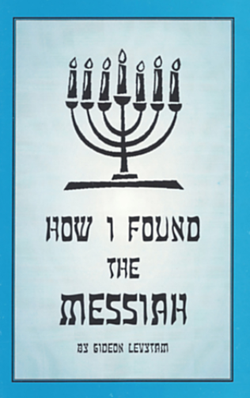
Follow Gideon Levytam's journey and discover how he was led by God, through a series of exciting circumstances, to find the One his people are still waiting for.
Past Episodes

Featured Offer
Follow Gideon Levytam's journey and discover how he was led by God, through a series of exciting circumstances, to find the One his people are still waiting for.
About Holy Scriptures and Israel
As time passed by, the Lord Yeshua took dear brother John Van Stormbroek to himself. The ministry of Holy Scriptures and Israel continued with additional development. In the early 1990’s, a weekly morning Bible class began which brother Gideon Levytam led regularly in the City of Toronto. This weekly open Bible class was held in the Willowdale assembly meeting hall. Eventually, a second mid-week evening Bible class was added. In April 2002, the need for an additional outreach Bible teaching meeting arose. We begun a Saturday (Shabbat) ministry meeting in which a systematic teaching of God’s word is presented to all who attend. Together we learn God’s Word, pray for each need and the salvation of Israel, and sing songs of worship unto our God, praising Him and our Lord Yeshua the Messiah.
In Mid 2004 we started to air on Joy 1250 Radio station a 15 minute Bible teaching program called "The Holy Scriptures and Israel" with Gideon Levytam. The broadcast teaches God’s word from a Hebrew Messianic perspective and has proved to be a blessing to many. It's now aired seven days a week. Our prayer is that many more of our Israeli people will have a clear understanding of who Yeshua is, why we all need him, and come to know him as their Lord and Messiah.
About Gideon Levytam
Contact Holy Scriptures and Israel with Gideon Levytam
426 Simcoe Street
Niagara-on-The-Lake
Ontario L0S 1J0
Canada
(905) 325-1234