
Nehemiah 2:1-10, Part 2 of 3


Nehemiah’s Request to Go to Build the Walls of Jerusalem, Part 2
Guest (Male): Shalom. Holy Scriptures and Israel is a ministry designed to share with the Jewish people the good news of the Lord Jesus, Yeshua the Messiah, and to instruct Christians on the Jewish roots of their faith. And now, teaching God's word from a Hebrew Messianic perspective, here is Gideon Levytam.
Gideon Levytam: The study of Nehemiah Chapter 2. And so we begin in Verse 3. He said unto the king, "Let the king live forever. Why should not my countenance be sad?" Notice his concern for Jerusalem: "When the city, the place of my fathers' sepulchers, lieth waste, and the gates thereof are consumed with fire." He shared with the king his problem. And he told him, listen, the reality, King Artaxerxes, I'm really troubled in my own soul because the condition of my people, the condition of the city of Jerusalem, the condition of my fathers' sepulcher is laying waste. The gates thereof are consumed with fire. Why should not I be sad?
He was sharing with the king his heart. And you can understand that Nehemiah would share this right now. He had a great open door, a great opportunity where the king seems to ask him this question, and that is a great opportunity to share the desires of one's heart. We learn a great deal from those first three verses. These show us the care that Nehemiah had in his heart for the people of God and for the place where God set his name upon in the city of Jerusalem.
The Apostle Paul teaches us the very same lesson. He also had concern for the believers. He also shows us how important it is to have a yearning desire for the welfare of God's people. He also showed us with many tears and many times in mourning he had a concern for the welfare of the people of God. And he taught the Ephesians this. He was telling them, listen, I'm very much concerned for your welfare, and I wept for you, I prayed for you, I'm longing to see you carry on in your walk with the Lord.
In fact, turn with me to Acts Chapter 20. Paul in Verse 25 says these words: "And now, behold, I know that ye all, among whom I have gone preaching the kingdom of God, shall see my face no more. Whereupon I take you to record this day, that I am pure from the blood of all men. For I have not shunned to declare unto you all the counsel of God. Take heed therefore unto yourselves, and to all the flock, over which the Holy Spirit have made you overseers, to feed the assembly of God, which he has purchased with his own blood. For I know that after my departing shall grievous wolves enter in among you, not sparing the flock."
He continued to share. He says, listen, beloved brothers and sisters of the Ephesians, I want to tell you, I'm leaving now and I'm not going to see you for a while, but I want you to know my concern is for you. Ephesians, he says, I know that after my departure, there will be wolves coming and not sparing the flock, and the people of God will be dispersed and scattered. He had the heart of Nehemiah, the same kind of a heart of care and concern for the people of God.
Well Nehemiah said to the king, "Why shouldn't I be sad? Look at the city. Look at the gates. I heard that the gates were burned, the walls were broken down, the people of God are in great distress. Why shouldn't I be sad, King Artaxerxes?" He should have been afraid because he was in danger. Yet God by divine design have assisted him and opened the door for him to share his concern for the work of the Lord.
Don't you feel sometimes when you and I perhaps want to serve the Lord in one area or another, and we feel that there is so much opposition and we don't know how to handle the situation? But our hearts are yearning to do that one thing for the Lord, or a certain thing for the Lord, and there are so many things that are opposing the exercise of your heart. And yet the Lord all of a sudden opens a door of opportunity. And all of a sudden there is a great privilege, a great door was open and you share something that the Lord lay upon your heart.
And somehow maybe it will be your boss or maybe your superior, maybe people who oppose you, all of a sudden they allow you. The door has been open and you are able to go to serve the Lord in the things which he had given unto you. Look at another verse in 1 Corinthians Chapter 16 and Verse 9. Paul said that, "a great door and effectual is opened unto me, and there are many adversaries." Yes, the door is open. I can go out and serve the Lord, but there is a lot of opposition that I'm experiencing as I desire to serve the Lord among his people.
Well, that's exactly how Nehemiah had felt. And yet the Lord is opening for him such a great door right now through the king. The very king that he may have thought first that he will not allow him to go out to the city of Jerusalem to rebuild the city, the very king was now moved by the Lord and his heart now is opening towards Nehemiah to allow him to go to serve the people of Israel, his Jewish brethren.
And so from Verse 4 to Verse 8, Artaxerxes asked Nehemiah what does he want? And Nehemiah is giving him an answer. Imagine now, the King of Persia, the one who is a supreme ruler over the then-known world, now is giving Nehemiah the opportunity to do his bidding, to do his service. And so look at this, Verse 4, the king questioning Nehemiah: "Then the king said unto me, 'For what dost thou make a request?'"
Now notice that, brothers and sisters, it says immediately, "so I prayed unto the God of heaven." Now notice the beautiful thing that we learn here. Nehemiah did not have much time here to say, King Artaxerxes, could you wait a moment? I want to go to another place to go on my knees to pray for 15 minutes, I'm going to come back, just hold on for a moment. No. Nehemiah, it says here, the king said to him, "What do you want, Nehemiah?" "So I prayed unto the God of heaven, and I spoke unto the king."
It's like a moment or a second of prayer. God have mercy on me, let me give you the list of the things that I need. It reminds me of Matthew Chapter 14 when Peter was walking on the water in the Sea of Galilee. And all of a sudden Peter began to sink because he looked at the waves and everything, the storm around him, and he began to sink and he said, "Lord, help me." He didn't have time for 15 minutes to have some kind of a long prayer, God and Father and so on. A moment, just help me, Lord, I need your help. And he immediately went and he shared with the king the problem that he had and the needs that he had.
You see, sometimes we might not have a lot of time to spend in prayer, though we should spend a lot of time in prayer, but there are times coming that we just have to ask the Lord in that one second, Lord, please help me, and to carry on and do the things that we have to do. This is exactly what happened here. The king saying to him, "What do you need, Nehemiah? What do you need? What do you make a request for?" "So I prayed unto the God of heaven, and I said unto the king."
Now again I would like to mention, brothers and sisters, that he used the word "the God of heaven." In Hebrew, Elohei Hashamayim. Remember that in our previous study of Nehemiah Chapter 1, the first time that he used the expression, "I prayed unto the God of heaven," Verse 4 of Chapter 1, Verse 5 of Chapter 1, Elohei Hashamayim. Why? To remind you that the times of the Gentiles began at 605 BC. The Jewish people were taken captive. Nebuchadnezzar took our Jewish people to Babylon. And therefore God have handed over the kingship, the rulership over this world to the Gentile world.
It began with Babylon, it followed up by Persia, it continued on by Greece, and ended up to be by the Romans Empire by the time Yeshua the Messiah came. And it will culminate at the second coming of the Messiah when the Roman Empire will be revived and ultimately the Messiah will judge the kings of this world and he himself will establish the Messianic Kingdom. We see this in the image that we saw from Daniel 2, the image that Nebuchadnezzar saw in a vision that Daniel gave him the interpretation.
So Nehemiah, and by the way you and I today are still, even though we are part of the Church age, in the times of the Gentiles. And the Gentiles rule this world still today, awaiting the day when Israel is restored, when the Messiah will establish the Messianic Kingdom and he will rule as King of Kings and Lord of Lords at his second coming. So Nehemiah says, I prayed not now to the God of Israel, but I prayed unto the God of heaven, Elohei Hashamayim. Israel at that time still had not been the one through the Messiah ruling and reigning over all the nations of the world. They have lost the kingdom, awaiting the restoration of the future day.
And so he prayed to the God of heaven and he spoke unto the king. This teaches us a great lesson, that you and I sometimes in a bind, we don't have much time to make a list of prayers to the Lord, but we can definitely say, God be merciful to me, help me. A sinner who is unsaved can say in a sincere way before the Lord, "God be merciful to me a sinner." A saint can say, "God assist me in my trial today," and he can continue on and do the things that he or she have to do. And that's what Nehemiah prayed to the God of heaven, a short prayer, a very concise prayer, and then now he began to give the king a list of the things that he wanted.
And everything began with the servant of the Lord. You notice that, brothers and sisters? He requested three things from the king, but it began with himself. And you notice what it says here in Verse 5? He said unto the king, the first request was "send me." In Hebrew, Tishlacheni. Notice that it says here in Verse 5, "And I said unto the king, if it please the king, and if thy servant have found favor in thy sight, that thou wouldst send me unto Judea, unto the city of my fathers' sepulchers, that I may build it."
Sometimes we expect everybody else to be sent and to do the ministry of the Lord's work, but we do not participate in the Lord's work. Nehemiah said, listen, I'm going to apply it first of all to me. God, send me, that I will be the one that do the building. You remember Isaiah, where the Lord said, "Whom shall we send?" and then Isaiah said, "Here am I, send me." Hineni, shlacheni, shlach oti, send me. It began with a personal exercise of the servant himself. If we are going to do something for the Lord, don't expect somebody else to do that. We individually have to say, Lord, what will you have me to do? I want to serve you myself. I want to take part in the labor and work that you called me to do.
Send me. That was the first request of Nehemiah from the king. He said to him in Verse 5, "If it please the king, and if thy servant have found favor in thy sight, that thou wouldst send me," notice, number one, "to Judea, unto the city of my fathers' sepulchers." Remember, brothers and sisters, the city is always Jerusalem. Where Jerusalem was situated in the area that belonged to the tribe of Judah. And in the whole area there our fathers are buried.
If you go today to the land of Israel, you'll be on Mount Olives, you'll see the large gravesites where many Jewish people want to be buried right in the Mount of Olives in the city of Jerusalem. And elsewhere, many are buried in the area. Why? Because Jerusalem is the place of our forefathers. When my mother died two years ago, she died here in Canada, and for some reason in my heart of hearts, I felt really that she belongs to where she lived all her life, where she grew up, to the city of Jerusalem. We end up flying here and getting a gravesite next to my father in the city of Jerusalem.
Even though it would not be wrong to bury her here, it's not the issue. The point is there is something in a heart of the Jewish people even till today that says, listen, this is the area of our fathers' sepulchers, there I want to go. Joseph wanted to be buried, Jacob wanted to be buried in the land. The people of Israel want to be buried in the land that God had given the people of Israel. So here he is not only mentioning that I want to go to that place, but he is mentioning this is the burial sites of my fathers. So he says, "Send me, that I may build it."
Now you and I have the same kind of an exercise in our own hearts if we're going to serve the Lord. We might not build the walls around the city of Jerusalem, but we can definitely assist in the work of the Lord. There are so many needs among the people of God, among the body of Messiah. Believers are discouraged. There are people who are running to and fro, never finding a place where they can get some rest and encouragement, like sheep going astray, not feeding on the person of the Lord. How you and I are responsible to build each other and to encourage each other and to support each other, so we can be builders of the body of Messiah.
It might not fix all the problems that are existing today in the church, but we can definitely seek to be builders. There was a man that wrote in 1800 a pamphlet called, "You're either a help or a hindrance." And the question, of course, rises, are we going to be like Nehemiah? If those things apply to us, and if Nehemiah's life is a good example for us, you and I have to ask ourselves, do we want to build? Can we say, "Lord, send me. I want to serve you. I want to minister to the people of God."
And I tell you, brothers and sisters, we live in the last days of the Laodicean days of the church age. The Lord is coming soon. And if the Lord is coming soon, how much more men like Nehemiah are needed among us? May the Lord work this in our own lives. So that was the first request. But now notice that in Verse 6, the King's responding to him, and here you can see that he agrees with him. And it seems to be that the Spirit of God worked in the heart of the King Artaxerxes. And notice the clause here, it said, "And the king said unto me," and then you have this little pause here, it said, "the queen also sitting by him."
Now the question is why is it that the Spirit of God put this little thing called "the queen also sitting by him?" Who is that queen? This word for queen is not the normal word that we use in scripture. The word that we use in scripture for queen is Malkah. Melech for king, Malkah for queen. The first time the word Malkah is mentioned in the Bible is in 1 Kings Chapter 10 and Verse 1 about the Queen of Sheba, Malkat Shva. She came to visit King Solomon. But the word here is not Malkah. The word here in Hebrew is Shegal.
This word Shegal is only mentioned twice in the Tanakh. One time here, and another time in Psalm 45 you find the word is Shegal. And when it says the queen also sitting by him, the word Shegal can also mean more than just a queen. It could be a companion. It could have been a person that is related to the king. It's not necessarily the word Malkah, queen. The word is Shegal. Now some Bible teachers believe that this queen or this Shegal that was sitting by him may be Esther, the queen that was married to Ahasuerus, Xerxes, the one who was the father of this man. And she, if he was her son, may very well have a great influence upon this man by the name of Artaxerxes.
Queen Esther, remember Esther is the name that she has in the diaspora, but her Hebrew name is Hadassah. And she became the queen, married to King Xerxes who had embraced her to be his wife. And you remember Vashti had to be taken out of the way. Queen Esther was chosen from all the beautiful women in Persia at that time. And it may very well be that this was the Queen Esther who is the Shegal here in this verse that had an impact upon him and influenced him to give Nehemiah the room to go to care not only of Nehemiah's people, but it was Esther's people.
And you remember how Esther saved all our Jewish people in the time when Haman wanted to kill all the Jewish people years before? So the Spirit of God by divine design putting this clause, "the queen also sitting by him," and here's the king says a statement. He says, "For how long shall thy journey be? And when wilt thou return?" So it pleased the king to send me, and I set him a time. See the king didn't want to lose Nehemiah. Really he was such a faithful servant. He had to let him go because he sensed the urgency that he have in his heart and he said to him, "You know, Nehemiah, how long you will go and when you will return?" He wanted him to come back.
So it says here at the end of Verse 6, "So it pleased the king to send me, and I set him a time." Now how long time Nehemiah would give him, we do not know the length of time, but if you will turn to Chapter 5 and Verse 14, you will notice that Nehemiah have gone for 12 years. Look at this, it says in Verse 14 of Nehemiah Chapter 5: "Moreover from the time that I was appointed to be the governor in the land of Judah, from the twentieth year even unto the two and thirtieth year of Artaxerxes the king, that is, twelve years, and I and my brethren have not eaten the bread of the governor."
In other words, what Nehemiah is saying in Chapter 5 we learn that for 12 years he had gone to Judea, to Jerusalem. A little bit later on if you read in Chapter 13 that after 12 years he had gone back to the king and then he returned back to the city of Jerusalem. So for 12 years Nehemiah left Shushan the palace, the city of Shushan, he went to Jerusalem, he built and he worked around the city of Jerusalem in the land of Israel, and he only returned after 12 years. Now I don't know what happened, maybe he sent information to the king, he says, "Listen I need more time, and I need to stay to finish the job that I have here," and the king allowed him. But the king asking this twofold question, "How long is your journey going to be and when will you return?" Nehemiah, how long it's going to take, when you're going to return? So I set him a time.
The word for time, zman, simply mean that he set up a certain time, a certain dates, but apparently 12 years it took him to be there in the land of Judea and the city of Jerusalem to help there with the situation there. So number one, he first of all requested that he will be sent by himself. Number two now, beloved brothers and sisters, in Verse 7, he requested letters. See Nehemiah was a very practical man. He was not merely a person who was heavenly minded but not earthly good. Practically he knew what he was doing and so in Verse 7: "Moreover I said unto the king, 'If it please the king, let letters be given to the governors beyond the river, that they may convey me over until I come into Judea.'"
He knew very well what was going to happen. He was going to cross the Euphrates River and as he arrived to the area in the land of Israel, the governors might say to him, "Who sent you? How can you come to this area? Who gave you the permission?" So Nehemiah said, "I want those letters from the king." Notice letters here are plural because everywhere he had gone there were governors there. Can you imagine if he passed through area and a new governor and a new governor, and everyone needed to get a letter from the King Artaxerxes that he gave the permission for Nehemiah to come into the city of Judea.
So he was very wise. You see, brothers and sisters, it's not only enough to pray to the Lord and yes, we have to trust the Lord, but we also have to take the responsibility in what we are doing, to be practical. You know, a believer is not only heavenly minded but is not responsible in a practical way here in his or her life. So Nehemiah was very practical. Yes, he prayed, he trusted the Lord, but he was not waiting there and doing nothing. He was taking the responsibility. Oh yeah, I'm going to pass the river. I'm going to have those rulers there. What I'm going to tell them? They will ask me some questions. Well, here's a letter from King Artaxerxes. Artaxerxes, he told me, he gave me the permission to come to the land of Israel and to the city of Jerusalem.
Now the third request is found in Verse 8. We find out that he is asking for an additional singular letter. You notice that in Verse 7 it's plurality of letters for the governors, but in Verse 8 it was a singular letter for the man by the name of Asaph: "And a letter unto Asaph the keeper of the king's forest, that he may give me timber to make beams for the gates of the palace which appertain to the house, and for the wall of the city, and for the house that I shall enter into. And the king granted me, according to the good hand of my God upon me."
You know the third thing that he does, he trusted the Lord and shared with the king, but wait a minute, when I'm going to go to the land of Israel and I'm going to have to build the wall, well what I'm going to build them with? I need some material. What I'm going to use? You need timber, you need wood, you need to be able to build the walls of the city of Jerusalem and the gate. So he asked him for timber and so he asked him, "Give me letter for Asaph, he is the keeper of the king's forest, and ask from Asaph to give me lumber."
Guest (Male): You have been listening to the Holy Scriptures and Israel with Gideon Levytam. Gideon teaches God's word from a Hebrew Messianic perspective. For more information about this ministry, write to Holy Scriptures and Israel, Box 1411, Niagara on the Lake, Ontario, L0S 1J0, or visit our website at holyscripturesandisrael.com. You are also invited to Gideon's weekly Bible teaching on Fridays at 11:00 AM and 7:00 PM and Saturdays at 1:00 PM at Willowdale Christian Assembly Hall, 28 Martin Ross Avenue in Toronto. Holy Scriptures and Israel is made possible by your prayers and financial support. If you would like to support the program, visit holyscripturesandisrael.com. God bless you. Shalom, shalom.
Featured Offer
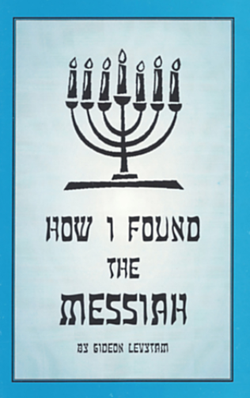
Follow Gideon Levytam's journey and discover how he was led by God, through a series of exciting circumstances, to find the One his people are still waiting for.
Past Episodes

Featured Offer
Follow Gideon Levytam's journey and discover how he was led by God, through a series of exciting circumstances, to find the One his people are still waiting for.
About Holy Scriptures and Israel
As time passed by, the Lord Yeshua took dear brother John Van Stormbroek to himself. The ministry of Holy Scriptures and Israel continued with additional development. In the early 1990’s, a weekly morning Bible class began which brother Gideon Levytam led regularly in the City of Toronto. This weekly open Bible class was held in the Willowdale assembly meeting hall. Eventually, a second mid-week evening Bible class was added. In April 2002, the need for an additional outreach Bible teaching meeting arose. We begun a Saturday (Shabbat) ministry meeting in which a systematic teaching of God’s word is presented to all who attend. Together we learn God’s Word, pray for each need and the salvation of Israel, and sing songs of worship unto our God, praising Him and our Lord Yeshua the Messiah.
In Mid 2004 we started to air on Joy 1250 Radio station a 15 minute Bible teaching program called "The Holy Scriptures and Israel" with Gideon Levytam. The broadcast teaches God’s word from a Hebrew Messianic perspective and has proved to be a blessing to many. It's now aired seven days a week. Our prayer is that many more of our Israeli people will have a clear understanding of who Yeshua is, why we all need him, and come to know him as their Lord and Messiah.
About Gideon Levytam
Contact Holy Scriptures and Israel with Gideon Levytam
426 Simcoe Street
Niagara-on-The-Lake
Ontario L0S 1J0
Canada
(905) 325-1234