

Nehemiah 13:1-14, Part 1 of 3


Israel’s Lack of Separation from Evil, Part 1
Guest (Male): Shalom. Holy Scriptures and Israel is a ministry designed to share with the Jewish people the good news of the Lord Jesus, Yeshua the Messiah, and to instruct Christians on the Jewish roots of their faith. And now, teaching God's word from a Hebrew Messianic perspective, here is Gideon Levytam.
Gideon Levytam: Shabbat Shalom, everyone. I would like you all please to open your Bibles and turn with me today to the 13th chapter of the book of Nehemiah, Nehemiah in English. Now, let me remind you that Nehemiah, his name Nehemiah simply means "the comfort of Jehovah." "Nachum Ya," "Nachum" or "Nechem" means "the comfort" and "Ya" stands for the Hebrew word "Jehovah" or "Yehovah" or "the Lord."
We know that this man by the name of Nehemiah really wanted to be a blessing to our own nation, Israel, to the people of Israel who returned from captivity in Babylon and needed comfort and needed blessing from the Lord. A man such as Nehemiah was raised by God to minister to our own nation, Israel. By application, I would like to suggest that we need men and women such as Nehemiah today, in these last days of the church age, who will be willing to be a blessing to the people of God. We are so thankful when the Lord raise in our midst those that are really a blessing to us, and we really appreciate our brothers and our sisters who do so.
Please follow me, Nehemiah chapter 13. I'm reading the first 14 verses of this chapter. "On that day they read in the book of Moshe, of Moses, in the audience of the people; and therein was found written that the Ammonite and the Moabite should not come into the congregation of God forever; because they met not the children of Israel with bread and with water, but hired Balaam against them, that he should curse them: howbeit our God turned the curse into a blessing."
"Now it came to pass, when they had heard the law, that they separated from Israel all the mixed multitude. And before this, Eliashib the priest, having the oversight of the chamber of the house of our God, was allied unto Tobiah: and he had prepared for him a great chamber, where aforetime they laid the meat offerings, the frankincense, and the vessels, and the tithes of the corn, the new wine, and the oil, which was commanded to be given to the Levites, and the singers, and the porters; and the offerings of the priests."
"But in all this time was not I at Jerusalem: for in the two and thirtieth year of Artaxerxes king of Babylon came I unto the king, and after certain days obtained I leave of the king: and I came to Jerusalem, and understood of the evil that Eliashib did for Tobiah, in preparing him a chamber in the courts of the house of God. And it grieved me sore: therefore I cast forth all the household stuff of Tobiah out of the chamber. Then I commanded, and they cleansed the chambers: and thither brought I again the vessels of the house of God, with the meat offering and the frankincense."
"And I perceived that the portions of the Levites had not been given them: for the Levites and the singers, that did the work, were fled every one to his field. Then contended I with the rulers, and said, 'Why is the house of God forsaken?' And I gathered them together, and set them in their place. Then brought all Judah the tithe of the corn and the new wine and the oil unto the treasuries."
"And I made treasurers over the treasuries, Shelemiah the priest, and Zadok the scribe, and of the Levites, Pedaiah: and next to them was Hanan the son of Zaccur, the son of Mattaniah: for they were counted faithful, and their office was to distribute unto their brethren. Remember me, O my God, concerning this, and wipe not out my good deeds that I have done for the house of my God, and for the offices thereof."
This is where I'm going to stop with the passage for this ministry meeting today. We are studying the man, the book called Nehemiah. Nehemiah was a cupbearer in Persia. He was serving the king of Persia with wine, lest someone will seek to poison this king of Persia. This king of Persia, Artaxerxes, one day saw that Nehemiah was really sad because his face showed that he was not so happy as the past days. He asked him, "Nehemiah, why are you so sad?"
Nehemiah told him, "How could I not be sad? Look at the condition that exist in my people's land. Look what is going on among my people. The walls are broken down. The gates of Jerusalem are burnt with fire. Look at the condition that existed. Things are in a terrible situation among my people, Israel." The king Artaxerxes loved Nehemiah, and he trusted him. He said, "Nehemiah, okay. You want to go home? You want to go back to the land of Israel? Go ahead. What do you need? When are you going to go? When are you going to come back? Set me a time. Go ahead."
Lo and behold, beloved brothers and sisters, Artaxerxes the king of Persia sent Nehemiah, the comfort of Jehovah. Nehemiah arrived to the land of Israel. The whole book, which we have already covered, show us the development of the days that Nehemiah was in the land of Israel, in the city of Jerusalem, and how he build the walls around the city of Jerusalem many, many years ago. It was such an amazing work in spite of the enemies attacking the Jewish people, seeking to sway them from building the walls around the city of Jerusalem.
With the help of the Lord, they successfully build the wall of Jerusalem, which speaks of protection, which speaks of separation, which speaks of being devoted to the God of Israel. Well, that is where we ended in the 12th chapter of the book of Nehemiah. There was a celebration of the building of the wall. You could see there was a dedication. If you just go back to chapter 12 and read with me verse 27, it says, "And at the dedication of the wall of Jerusalem they sought the Levites out of all their places, to bring them to Jerusalem, to keep the dedication with gladness, both with thanksgivings, and with singing, with cymbals, psalteries, and with harps."
There was a celebration, beloved brothers and sisters, in the city of Jerusalem at somewhere about 445, 444 BC when Nehemiah came with the many who came, and they rebuilt that wall. It took some time. Then there was a great celebration, and the people of Israel celebrated what have happened in the building of the wall, in the setting up of the gates, and things came to be in order. But you see, if you and I would have read the book of Nehemiah, it would be so nice to end in Nehemiah chapter 12. It looks like the story ended with a wonderful story.
Unfortunately, beloved brothers and sisters, that was really not the end of the story. The book of Nehemiah take us to another chapter to show us that even though things were well for a period of time, then when we allow the enemy of God to attack us, when we don't judge the flesh, when we don't submit ourselves to the authority of the Lord, it wouldn't take too long, and the enemy seems to catch us and to grab us and pull us down and away from the things of the Lord.
We find out in this chapter 13 that the story is not ended in the way that we would have liked to hear the story. I would like to make by application into our own personal life. I trust all of us here are believers in the Lord Jesus the Messiah because without forgiveness of the person of the Lord for you and I, we will never be right with God. The Bible teaches us that all have sinned and come short of the glory of God. The Bible teaches us that the wages of sin is death, but the gift of God is eternal life through our Lord Yeshua the Messiah.
I trust all of us can say in our own hearts today, here in this room, "I belong to the Lord Jesus the Messiah, to Yeshua Hamashiach." Listen, beloved brothers and sisters, even as believers who have accepted the Lord Jesus, who have accepted Yeshua the Messiah, who died for our own sin, many times in our life, we have a time when we depart from the way of the Lord. Yet the Bible tells us whom the Lord loveth he chasteneth, and he scourgeth every son that he receiveth. Sometimes the Lord disciplines us and he give us a little spanking because he loves us. He want us to be restored to a fellowship with him, to enjoy his love for us as we have just sung, for God so loved the world that he gave his only begotten son.
Therefore, sometime the Lord allow us to experience some trial. Look what happened here. In chapter 13, we see the sad consequences of a lack of separation from that which is not honoring to the Lord. We can see that there is consequences when we allow, when Israel allowed, and when you and I as believers allow sin to enter into our life. When we turn away from the Lord and we do our own thing, it somehow catching us. It somehow eventually cause us to suffer loss in our spiritual growth.
Notice that in chapter 13 verses 1 to 14, we see Israel's lack of separation. We begin actually in verses one, two, and three that the Bible was read. The law was read, just like it's read every Shabbat. If you go to a synagogue, you will find that the law is read every Shabbat. The Torah is being read: Bereshit, Shemot, Vayikra, Bamidbar, Devarim; Genesis, Exodus, Leviticus, Numbers, Deuteronomy. You will notice that there is a cycle that the law is being read in the synagogue, just like it was read in the time of Nehemiah, just like you and I read this today in our meeting.
Notice verse one begins. We find out of the reading of the book of Moshe, the book of Moses. "On that day they read in the book of Moses in the audience of the people." Notice that there was a public reading of the word of the Lord. It is so important. That's why when we come every Shabbat, every time we meet together, there is a public reading of the word of God. The public reading that happened to be here, was happened to be reading the book of Deuteronomy.
Remember that Moshe gave Israel the law, the Torah, and he wrote the law. The Lord used Moses to give Israel the five books of Moses. Lo and behold, there is a public reading now. Everybody was listening to the word of God. What does the word of God say? They found out in verse one, they read therein and there was found written that an Ammonite and a Moabite should not come into the congregation of God forever. I would like you to turn with me to Deuteronomy chapter 23.
It says there in verse three and verse four, "An Ammonite or Moabite shall not enter into the congregation of the Lord; even to their tenth generation shall they not enter into the congregation of the Lord forever." The reason he gives immediately in verse four is because they met you not with bread and with water in the way when you came forth out of Egypt, and because they hired against thee Balaam the son of Beor of Pethor of Mesopotamia to curse thee.
When Israel came out of Egypt many years ago, 3500 years ago, our own Jewish people were slaves in Egypt. When the Lord have redeemed the people of Israel and he brought them out of the land of Egypt, on the way as they were journeying towards the promised land, just before they have entered into the land, guess what happened? This group of people, in this case in chapter 13 here, the Ammonite and the Moabite did not assist the people of Israel along the way. In fact, they gave them a hard time.
They didn't provide for them bread and food on the way when Israel was hungry, when Israel had many needs in those days. Instead, they inflicted upon them all sort of things that were contrary to the will of God. Not only so, beloved brothers and sisters, it says in verse two of Nehemiah chapter 13 that they called a man by the name of Balaam. They said, "Balaam, you come here. There are some people here that are just coming from Egypt. They are on the way to Canaan. We would like you to curse this people, this nation of Israel."
Think about this. God knows exactly what someone done to his own people. He says, "Hey, wait a minute. These people that was supposed to assist the Jewish people when they came out of bondage, instead of assisting them, they inflicted upon them to go a long way, not to be able to enter easier into the promised land, not met their need with natural need such as bread and water. But even more than just that, they have hired a man by the name of Balaam and they wanted him to curse the people of Israel."
God remembers that. God knows this very well. That's why God gave a command to Moses and the people of Israel in Deuteronomy chapter 23. He says to them, "Listen, Israel, no Ammonite and no Moabite will ever enter to be among the people of Israel for the tenth generation." He added there, "and forever." Of course, you and I immediately ask the question, "Well, wait a minute. Wasn't Ruth a Moabitish woman?" Of course she was a Moabitish woman.
But you see what happened with Ruth? Ruth rejected the false gods. Ruth said to Naomi, "Your God shall be my God, your people shall be my people." Ruth really truly became a woman of God who loved the God of Israel, and therefore she could have come into the congregation of Israel. Let me make an application for a moment. I would like you to turn with me to Genesis chapter 19. You remember what happened in the story of Sodom and Gomorrah? Lot went to Sodom and he lived there, and he raised his family in Sodom.
It didn't take too long that he became one of the leaders of Sodom, sitting at the gate. Then God sent these angels of his to go to Sodom to give warning to Lot to come out of Sodom. Sodom is a picture of the world and its system who reject God. Lot's family in a sense laughed at him. His sons-in-law did not accept what he had to say. Really what happened, if you remember, when those two angels came, they appeared as men and they went into Lot's house. The whole men of Sodom wanted actually to take these men and to have sexual relationship with them.
Those angels blinded all the people of Sodom and took Lot out. They immediately told them, "Listen, take your family and run out of the way. Run out because we are going to judge the city of Sodom and Gomorrah." Finally, he went out. His two daughters went out with him, but there was his wife. You remember she looked back? Instead of running and fleeing out, she looked back and she kind of felt like, "I don't want to leave. I'm leaving all what I have there in Sodom." She turned into a pillar and she end up to be fixed in one location because she simply rejected the invitation to leave and she looked backwards.
You remember what happened in chapter 19 at the end of the chapter, that Lot's daughters had caused their father to be drunk and both of them had a relationship with him. Guess who are the two nations that were born as children of Lot? The two nations: Moab and Ammon. These are the very two nations that God gave a warning to our people, Israel. A Moabite and an Ammonite shall not enter into the congregation of the Lord. There is an amazing lesson, beloved brothers and sisters. The Moabite and an Ammonite are picture of our own sinful nature.
You remember what the Lord Jesus said to Nicodemus in John chapter three? "Except a man be born again, he shall not enter into the kingdom of God." The Moabite and the Ammonite is a picture and a type of the human nature that you and I have. It's like you might say the closest enemy to ourself is our very own old nature. Even though we became born from above, born again, we belong to the Lord, we really experience in our life how often this old sinful nature constantly seeking to pull us down and to turn us away from the things of the Lord.
No wonder the Apostle Paul says, "I know that in my flesh dwelleth no good thing." This is a picture of our very own nature. How often time we are struggling with it. Notice what happened exactly here in the history of our people, Israel. Often time they have struggled when they allow themselves to carry on in their own path, in their own direction, just like you and I many times it happened to us in our very own life. That's why God gave to Israel these warnings. "Israel, listen to me. I'm telling you, a Moabite and an Ammonite shall not enter into the congregation of Israel." Here is the reason. Number one, they harmed you. Number two, they seek to curse you.
When they raised that man by the name of Balaam, he was a false prophet. I want you to turn with me to the book of Numbers for a moment, chapter 22. I want you to see what happened in Numbers chapter 22 with that man by the name of Balaam that Moab and Ammon raised him to come against the people of Israel. Numbers 22 verse one says, "And the children of Israel set forward, and pitched in the plains of Moab on this side Jordan by Jericho." Balak the son of Zippor saw all that Israel had done to the Amorites.
Moab was so afraid of the people because they were many and Moab was distressed because of the children of Israel. Moab said unto the elders of Midian, "Now shall this company lick up all that are round about us, as the ox licketh up the grass of the field." Balak the son of Zippor was the king of the Moabites at that time. Look what he does, verse five and on. He sent messengers therefore unto Balaam the son of Beor to Pethor, which is by the river of the land of the children of his people to call him, saying, "Behold, there is a people come out from Egypt: behold, they cover the face of the earth, and they abide over against me: Come now therefore, I pray thee, curse me this people."
Balaam sought to curse the people of Israel four times. You notice what it says if you just turn the page to chapter 23. It says, "And Balaam said unto Balak, 'Build me here seven altars, and prepare me here seven oxen and seven rams.'" Balak did as Balaam had spoken. Balak and Balaam offered on every altar a bullock and a ram. Balaam said unto Balak, "Stand by thy burnt offering, and I will go: peradventure the Lord will come to meet me: and whatsoever he showeth me I will tell thee." He went to an high place. God met Balaam.
He said unto him, "I have prepared seven altars, and I have offered upon every altar a bullock and a ram." The Lord put a word in Balaam's mouth and said, "Return unto Balak, and thus thou shalt speak." Balaam returned unto him, and lo, he stood by his burnt sacrifice, he, and all the princes of Moab. He took up his parable, and said, "Balak the king of Moab hath brought me from Aram, out of the mountains of the east, saying, 'Come, curse me Jacob, and come, defy Israel.'" Look how beautiful, how the Lord worked in Balaam.
He says, "How shall I curse, whom God hath not cursed? or how shall I defy, whom the Lord hath not defied?" "How can I do that? God did not curse these people. I'm not going to be able to curse these people." God put words in his mouth. Notice it says in the end of verse nine, "lo, the people shall dwell alone, and shall not be reckoned among the nations." Israel is a unique nation that God had set them to dwell alone, not because they are better, not because they are superior than other nations of the world. It is because that they are an elect nation and God in his wisdom sought to have them as separated nation that will be a blessing to the nations of the world.
But did Israel fulfill what God had intended for them? The answer is no, because Israel had failed to submit to the authority of the Lord. Therefore, we find out what happened over the generations to our very own nation, the nation of Israel. A Moabite and an Ammonite shall not enter into the congregation of Israel. It is a picture, beloved brothers and sisters, of our own sinful nature which we need to judge on an ongoing basis.
That's why, brothers and sisters, at times we have problems in church congregations and assemblies and fellowship because we don't judge the flesh. We allow the flesh to rise up and the flesh, we go with it to school and we go to work and we go home, we come to the meeting, and wherever we go, this old sinful nature is always with us. That's why, as we read Colossians chapter three in the reading, it says to mortify, to put it to death. As long as we allow it to have its own course, we are always going to lose out.
Featured Offer
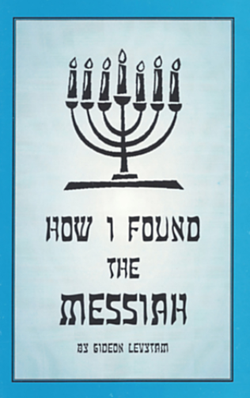
Follow Gideon Levytam's journey and discover how he was led by God, through a series of exciting circumstances, to find the One his people are still waiting for.
Past Episodes

Featured Offer
Follow Gideon Levytam's journey and discover how he was led by God, through a series of exciting circumstances, to find the One his people are still waiting for.
About Holy Scriptures and Israel
As time passed by, the Lord Yeshua took dear brother John Van Stormbroek to himself. The ministry of Holy Scriptures and Israel continued with additional development. In the early 1990’s, a weekly morning Bible class began which brother Gideon Levytam led regularly in the City of Toronto. This weekly open Bible class was held in the Willowdale assembly meeting hall. Eventually, a second mid-week evening Bible class was added. In April 2002, the need for an additional outreach Bible teaching meeting arose. We begun a Saturday (Shabbat) ministry meeting in which a systematic teaching of God’s word is presented to all who attend. Together we learn God’s Word, pray for each need and the salvation of Israel, and sing songs of worship unto our God, praising Him and our Lord Yeshua the Messiah.
In Mid 2004 we started to air on Joy 1250 Radio station a 15 minute Bible teaching program called "The Holy Scriptures and Israel" with Gideon Levytam. The broadcast teaches God’s word from a Hebrew Messianic perspective and has proved to be a blessing to many. It's now aired seven days a week. Our prayer is that many more of our Israeli people will have a clear understanding of who Yeshua is, why we all need him, and come to know him as their Lord and Messiah.
About Gideon Levytam
Contact Holy Scriptures and Israel with Gideon Levytam
426 Simcoe Street
Niagara-on-The-Lake
Ontario L0S 1J0
Canada
(905) 325-1234