

Malachi 3:7-15 Part 1 of 3


Will a man rob God yet ye have robbed me, part 1
Guest (Male): Shalom. Holy Scriptures and Israel is a ministry designed to share with the Jewish people the good news of the Lord Jesus, Yeshua the Messiah, and to instruct Christians on the Jewish roots of their faith. And now, teaching God's word from a Hebrew Messianic perspective, here is Gideon Levytam.
Gideon Levytam: Shabbat Shalom everyone. Please open your Bibles to the book of Malachi, or Malachi please. Today we are studying Malachi chapter 3 and we are going to start from verse 7 and read into verse 15. Malachi chapter 3, verses 7 to 15. And so I am reading. Malachi is continuing to speak to our people Israel, the people of Judah. And now in chapter 3 and verse 7, he continues and he says by the word of the Lord, "Even from the days of your fathers ye are gone away from mine ordinances and have not kept them. Return unto me and I will return unto you, saith the Lord of hosts. But ye said, Wherein shall we return?"
Verse 8. "Will a man rob God? Yet ye have robbed me. But ye say, Wherein have we robbed thee? In tithes and offerings. Ye are cursed with a curse: for ye have robbed me, even this whole nation. Bring ye all the tithes into the storehouse, that there may be meat in mine house, and prove me now herewith, saith the Lord of hosts, if I will not open you the windows of heaven, and pour you out a blessing, that there shall not be room enough to receive it. And I will rebuke the devourer for your sakes, and he shall not destroy the fruits of your ground; neither shall your vine cast her fruit before the time in the field, saith the Lord of hosts."
"And all nations shall call you blessed: for ye shall be a delightsome land, saith the Lord of hosts. Your words have been stout against me, saith the Lord. Yet ye say, What have we spoken so much against thee? Ye have said, It is vain to serve God: and what profit is it that we have kept his ordinance, and that we have walked mournfully before the Lord of hosts? And now we call the proud happy; yea, they that work wickedness are set up; yea, they that tempt God are even delivered." And I'm going to stop here with the reading of this passage of Malachi chapter 3, verses 7 to 15.
It is amazing how as we study the book of Malachi, we are once and again reminded that God was not speaking to the unregenerated world. He was not even speaking to those now that were in captivity in Bavel or those that were taken by the Assyrian. No, he is actually speaking to those that have already restored from among our own people Israel and are now already in the promised land. The temple is established and built. The sacrificial system continues on. The celebration of the feast are carrying on. The Shabbats are continue on to be kept. And the Jewish people were now in the place of blessings because they were now back in the land.
But we learn from the prophet Malachi and from previous prophets such as Haggai and Zechariah that there was so quickly a departure from the Lord by the very own people whom he had brought back into the land. And here we can see, towards the end of his prophecy, Malachi is now by the word of Jehovah of the Lord speaking to the conscience of this returned remnant who have already now in the very same promised land very quickly departed from the will of the Lord. And to remind you, beloved brothers and sisters, Malachi is the last messenger. He is the last voice of God before there will be a long period of silence.
No prophet is going to come after Malachi. No messenger is going to come after Malachi. A long period of time in Jewish history will remain before Yohanan Hamatbil, John the Baptizer, will burst with a message. "Behold the Lamb of God which taketh away the sin of the world." And he will look at the person of the Lord Jesus, the Messiah, and he will proclaim him as the Lamb of God. But Malachi was speaking over 400 years before John the Baptizer was going to present the Messiah. And Malachi now, in this almost the end of his message to Israel, is now challenging Israel with respect to their heart's condition in relationship to the Lord.
Like us today, we are very similar. The church age has gone now nearly 2,000 years. You and I are living now in the last days of the church age. The dark ages are past before us. The various ages in church history are gone. We live now in the Laodicean age, Revelation chapter 3, the church of Laodicea who is lukewarm, neither hot nor cold, where the Lord Jesus, the Messiah, said to John, Yohanan, "I will spew you out of my mouth." That's where we live in today. So whatever had been spoken to these Jewish people who came back from Bavel is spoken really to you and I in the present day in which we live.
In this message here, he is speaking to their hearts and to their conscience. You remember that I said and we read that there are four times the name Malach or messenger or my messenger is mentioned in the book of Malachi. The first one in chapter 1 and verse 1 is the man himself, Malachi, the prophet himself, where in chapter 1 and verse 1, it says, "the burden of the word of the Lord to Israel by Malachi." He is the first one whose name is messenger, Malachi, my messenger. The second time we read about the word messenger was in chapter 2 and in verse 7. And there the Lord said, "the priest's lips should keep knowledge and they should seek the law at his mouth for he is the messenger of the Lord of hosts."
This is the second messenger, which was the priests of Israel who should have led Israel in a way that was honoring unto the Lord. His lips speaking the word of God, and he is called to be the messenger of the Lord. Then in our previous ministry meeting, we read in chapter 3 and verse 1 of an additional two messengers, two Malachim, as we say in Hebrew. Malach, the third one, will be the messenger that will prepare the way before me, Malachi chapter 3 verse 1a. Who is that messenger? God is prophetically looking to the future. And that messenger will be Yohanan Hamatbil, John the Baptizer, who will introduce Yeshua, Jesus, the Messiah, at his first coming.
He is that third messenger in Malachi. And he is the one predicted by God that he will come to introduce the Messiah himself. And the fourth messenger we have spoken about in chapter 3 and verse 1b. And in that messenger, Malach Habrit, it is the Messiah himself, the messenger of the covenant, whom ye delight in. "Behold, he shall come," saith the Lord of hosts. And we have already looked at that and said that this applies to the Messiah's first coming as the messenger of the covenant. Yeshua came. He fulfilled the promise that God said that he will make a new covenant, Brit Hadasha, where he will die for the sin of this world.
We read from the Gospels, and when Yeshua celebrated Passover and then he introduced the Lord's Supper, he says, "take this, this is the blood of the Brit Hadasha of the new covenant which is shed for you." And so what we really learn is that those four messengers, Malachi himself, the Levites secondly, John the Baptizer thirdly, and Yeshua the Messiah, are the messengers in the book of Malachi. Now if you remember, Israel has spoken to the Lord and Israel said in chapter 2 and verse 17, "Everyone that doeth evil is good in the sight of the Lord and the Lord delighteth in them." And then secondly they said, "Where is the God of judgment?"
So God said, "I will bring the judgment one day. Don't you take it for granted. I will bring the judgment, but before I'm going to bring the judgment, I'm going to send the messenger of the covenant. He will prepare this new covenant, but in the second coming of the Messiah, he will surely judge in righteousness all this world that rejected him." And you remember what we just read in the previous verses in chapter 3 of the book of Malachi. It says in verse 2, "But who may abide the day of his coming? And who shall stand when he appeareth? For he is like a refiner's fire and like fuller's soap. And he shall sit as a refiner and purifier of silver, and he shall purify the sons of Levi and purge them as gold and silver that they may offer unto the Lord an offering in righteousness."
In other words, God is saying, "Listen, I am going to send the Messiah one day and he is going to come to judge the world in righteousness. He will refine Levi. He will be like a purifier. And he will be the one that will judge this world in righteousness." So now beloved brothers and sisters, after God made that assuring promise that he will send one day the Messiah in his first coming to accomplish the new covenant and in his second coming to judge, now in the next verses from verse 7 actually of this third chapter, all the way to the end of the book, you have a response of two groups. Group number one are those that really did not repent and turn back to the Lord.
And group number two are those who did repent and became the remnant that one day will enjoy the blessing of the restoration of our people, the people of Israel. Today in this ministry in Malachi chapter 3 verses 7 to 15, we find out about that first group who did not repent. Who really shows that the heart was not right with the Lord. And the Lord is saying to them in these verses three things. The first thing that he says in verses 7, 8 and 9, the Lord points to his people's wrongdoing. This is the one who did not take to heart what he is going to do at the judgment day.
And so notice that in verses 7, 8 and 9, the first thing the Lord is charging. He says here in verse 7a, "Even from the days of your fathers ye are gone away from mine ordinances and have not kept them." Now you notice what he does? He takes Israel back all the way to its origin. And he's reminding them of the days of their fathers. Abraham, Yitzhak, Ya'akov. Abraham, Isaac and Jacob. And then Jacob had 12 sons. From Re'uven the firstborn until Yosef and Binyamin the last. And we have the 12 tribes of our own forefathers, the people of Israel. And he is kind of reminding the people here in the time of Malachi of our forefathers and their forefathers and the history.
And you notice very sad commentary. Very sad commentary. He said, "From the days of your fathers ye are gone away from mine ordinances and have not kept them." In other words, he's taking them back. Look at your history, Israel. In all the history of your forefathers, there was always that rebellion, disobedience, and not keeping the word of the Lord. And how sad. How it must have grieved the heart of God. Just look at your history. From the days of your fathers. And we can just think about the judges, the time of the judges where every man did that which was right in his own eyes. When we can think of the time of the Samuels and the kings where the kings rebelled.
There was no one godly king in the northern kingdom of Israel. In the southern kingdom, there were some good and godly kings, but there were also some ungodly kings that made it necessary for God to send them to the land of Bavel for those 70 years of dispersion. In a sense, God is appealing to them and he says, "Look at this. From the days of your fathers." Mi'mei avoteichem. He's going back. He is saying to them, "From the days of your fathers ye are gone away from mine ordinances and have not kept them." Sad commentary. And yet you notice, beloved brothers and sisters, in the first chapter God said, "I have loved you."
Jacob have I loved. I have chosen you. I have elected you to be my people. And in this third chapter, if you remember in verse 6 where we ended the ministry last time, "I am Jehovah, I change not; therefore ye sons of Jacob are not consumed." I am not changing. You have changed. I have been faithful to you, Israel. You have not been faithful to me. And look at us today who are part of the church age, the assembly. We are looking at the history of the 2,000 years of the church age. It is just the same. A repetition that has gone exactly the same as our own forefathers, the people of Israel.
And God is coming, appealing to them and he says, "Listen Israel. Listen. From the days of your fathers you have gone away from my ordinances and have not kept them." Disobedience. Rebellion. Doesn't that speak of our own hearts? How often time we rebel against the Lord. How often time we think that our ways are better than God's way and that we know better than the Lord and we don't obey the Lord. You know, when we have children that we brought into this world, we never need to teach them to disobey. They were born in sin. And they disobey again and again.
You remember how this book of Malachi also began? "A son honoreth his father, and a servant his master: if then I be a father, where is mine honor? And if I be a master, where is my fear? Saith the Lord of hosts unto you, O priests, that despise my name." And God in a sense, brothers and sisters, is opening his heart to his people that he loves so much. And he looks at the history. Sometimes it buckles my mind when I think why does God bother with us? Why does he even want to have anything to do with the rebels? Why is it? And yet God said, "Jacob have I loved."
And when we think of New Testament teaching, for God so loved the world that he gave his only begotten son that whosoever believeth on him shall not perish but have everlasting life. You think about Ephesians 5. The Messiah loved the church, the assembly, and gave himself for it. And yet the assembly, the church, just the same like Israel of old, have rebelled against the Lord and dishonored him. So he is looking at history. And he says from the days of your fathers you have not obeyed me, as he said here in verse 7. But notice that, he's appealing and in verse 7b, he is asking Israel to repent. Will they repent? Will they change their manner?
Notice he is saying to them so beautiful in this verse 7. He says, "Return unto me and I will return unto you, saith the Lord of hosts." The word return in the Hebrew is shuvu. It comes from the word teshuvah. To repent and turn around and come back towards the Lord. "Where are you going?" he is saying to them. "Come back. Come back. Turn around. Don't carry on in your own way because you will be punished. I will judge you. You eventually gonna bring upon yourself damnation. Turn around. Turn around." Who of us as a father will not say to our own children, "Turn around. There is a danger there. Don't go in that direction. You are gonna fall. You are gonna stumble. Please turn around."
Shuvu he is saying. And then he promised them, if you will return unto me, I will return unto you. Can you imagine? God in a sense kind of bargaining with them. If you will return, I will return. If you will come back to me, I will come back to you. Shuvu elay ve-ashuvah aleichem in the Hebrew text. What a wonderful offer. Yeshua said in Matthew 11, "Come unto me all ye that labor and are heavy laden and I will give you rest." He loves mankind. He loves his people if they only will listen unto his word and return back to him.
So he is appealing to Israel. Israel, return unto me and I will return unto you. I mean, this is such an amazing thing if you just imagine, beloved brothers and sisters, the heart of God. The love of God for his own people is so deep and his people here, this is the group that were really not intending to repent. This is the arrogant, the proud. They have their own way. They know better than God. As far as they were concerned, God is as they said in chapter 2 and verse 17, "Where is God, the God of judgment?" Everyone that is doing evil is good in his sight. The Lord delighteth in them that do evil. Where is that God of judgment?
And you see they were not wise because judgment had come and judgment will come. God is holy. And he will judge even the people that he have chosen for himself. If he is going to judge the world, imagine what is going to happen with respect to his very own people. So continuing on in Malachi chapter 3 and verse 7, the third portion of verse 7. Notice what Israel's response was. You would think these ones would say, "Oh yeah God, what a deal. We were not right with you. We disobeyed you and you are willing to return to us if we only return unto you." They would say, "Wow, I need to return back to the Lord because God offers me a restoration, a relationship with me."
But notice what they said very sadly in chapter 3 and verse 7, "But ye said, Wherein shall we return?" In other words, "In what way should we return? We are close by you see. We go to keep the Shabbat. We go to the temple in Jerusalem. We offer the sacrifices. We keep the feast and the holiday. What do we need to return?" You see what happened? It is like today. Ritualism came in. But the heart was far away from the Lord. Like we read earlier in the book of Isaiah, "This people come to me with their lips but with their hearts they are far away from me." So they continue with the motion.
As we have in Second Timothy, there is a form of godliness denying the power thereof. So look at the setting. And by the way, that word here, "wherein shall we return?" Ba-meh nashuv in Hebrew. It is the thing that they have said again and again in the whole book of Malachi. "In what way should we do that or the other?" They are in a sense responding to God in pride, in arrogance, in self-will saying, "Why do we need to do this?" because they assumed the manner of their behavior was correct. Notice by the way, if you just turn back to chapter 1 and you notice in verse 2, "Ye say, Wherein hast thou loved us?" They doubted his love for them. "In what way did you say that you really loved us?" they said to him in chapter 1 and in verse 2.
Notice in verse 6 of chapter 1. In verse 6 they say at the end of verse 6, "Wherein have we despised your name?" "We didn't despise your name. In what way you say that we have despised your name?" Notice in chapter 2 and verse 14 now. In verse 14, "But ye say, Wherefore?" "Why? In what way have we done one thing or another?"
Guest (Male): Shalom. Holy Scriptures and Israel is a ministry designed to share with the Jewish people the good news of the Lord Jesus, Yeshua the Messiah, and to instruct Christians on the Jewish roots of their faith. For more information about this ministry, write to Holy Scriptures and Israel, Box 1411, Niagara-on-the-Lake, Ontario, L0S 1J0, or visit our website at holyscripturesandisrael.com. You are also invited to Gideon's weekly Bible teaching on Fridays at 11:00 AM and 7:00 PM and Saturdays at 1:00 PM at Willowdale Christian Assembly Hall, 28 Martin Ross Avenue in Toronto. Holy Scriptures and Israel is made possible by your prayers and financial support. If you would like to support the program, visit holyscripturesandisrael.com. God bless you. Shalom, shalom.
Featured Offer
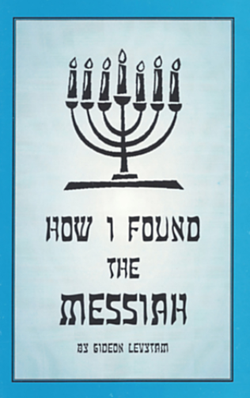
Follow Gideon Levytam's journey and discover how he was led by God, through a series of exciting circumstances, to find the One his people are still waiting for.
Past Episodes

Featured Offer
Follow Gideon Levytam's journey and discover how he was led by God, through a series of exciting circumstances, to find the One his people are still waiting for.
About Holy Scriptures and Israel
As time passed by, the Lord Yeshua took dear brother John Van Stormbroek to himself. The ministry of Holy Scriptures and Israel continued with additional development. In the early 1990’s, a weekly morning Bible class began which brother Gideon Levytam led regularly in the City of Toronto. This weekly open Bible class was held in the Willowdale assembly meeting hall. Eventually, a second mid-week evening Bible class was added. In April 2002, the need for an additional outreach Bible teaching meeting arose. We begun a Saturday (Shabbat) ministry meeting in which a systematic teaching of God’s word is presented to all who attend. Together we learn God’s Word, pray for each need and the salvation of Israel, and sing songs of worship unto our God, praising Him and our Lord Yeshua the Messiah.
In Mid 2004 we started to air on Joy 1250 Radio station a 15 minute Bible teaching program called "The Holy Scriptures and Israel" with Gideon Levytam. The broadcast teaches God’s word from a Hebrew Messianic perspective and has proved to be a blessing to many. It's now aired seven days a week. Our prayer is that many more of our Israeli people will have a clear understanding of who Yeshua is, why we all need him, and come to know him as their Lord and Messiah.
About Gideon Levytam
Contact Holy Scriptures and Israel with Gideon Levytam
426 Simcoe Street
Niagara-on-The-Lake
Ontario L0S 1J0
Canada
(905) 325-1234