

Malachi 1:1-5 Part 2 of 3


God's love for his people Israel part 1
Gideon Levytam: The study of the book of Malachi, chapter 1. After nearly 40 years of rebellion and complaining against God and against His will, constantly saying, "We don't have any food, we don't have any water, we want to go back to Egypt to eat the food from Egypt, back to Egypt," God says, "No, I want you to go to the Promised Land that I will give to you, I promised to your fathers." And yet Israel rebelled again and again.
When they were standing before the shores of the Promised Land, God said to them, "The Lord did not set His love upon you nor chose you because you were more in number than any other people, but because the Lord have loved you." We will never understand the love of God. We will never fathom His unconditional love towards His people. Notice in chapter 10, in the same book of Deuteronomy, in verses 14 and 15, we read, "Behold, the heaven and the heaven of heavens is the Lord's thy God, the earth also, with all that therein is. Only the Lord had delight in thy fathers to love them, and He chose their seed after them, even you above all the people as it is this day."
It's not because Israel or the Jewish people were better than any other nation, but it was simply the election and the love of God towards our forefathers that brought them into such a favor. The love of God towards His people. I read Jeremiah 31:3, "I have loved you with everlasting love." God spoke of Israel in Hosea 11, "Israel is my firstborn and I have loved him."
Sometimes, beloved brothers and sisters, when you are on your own and when you are questioning the Lord, ask yourself the question, "Why is it that God has loved me and brought me into a relationship with Him? What is it in me that God could set His love upon me?" It is fascinating. So you see, when God stated this statement to Israel, Israel, like you and I, have the audacity to question the love of God.
You notice what we read here in verse 2 again, but this time in the second part of verse 2. It says there in Malachi chapter 1, verse 2b, "Yet ye say, wherein hast thou loved us?" In other words, in a different translation, "Yet you say, how is it that you say that You loved us? In what way You really loved us?" And you know what? They neglected to look back at the faithfulness of God throughout the whole history of the people of Israel.
And to say the fact that they have experienced persecution even in those days. A few years earlier in the days of Haggai and Zechariah, God has promised that He will eventually bring about the Messianic kingdom. So when they were sitting now in the temple or in the city of Jerusalem, they were looking back just a few years earlier when the Jewish people built the temple.
With Zerubbabel and Ezra, they built and beautified the temple, and they look back and Haggai said to them by the word of the Lord that the temple that they are building, meaning looking into the future, will be greater than ever before. They were anticipating the Messianic kingdom to come, but it didn't come. They didn't quite understand, like many of us do not understand the program of God and the plans of God and the way He works in our lives.
Instead of saying, "God loved me anyway, in spite of the fact that I am going through difficult times," they began to ask the question, "Does God really love me?" I don't know if you're like me, but when things don't go right in my life, I begin to question. Sadly, of course, does God really care? Does He really love me? If He really loved me, why did this happen to me in my life? People question Him.
If really God loved me, why do I have my health problems? Maybe why my finances are not as well as I would expect them to be? If really God loved me, why do I go through these experiences right now in my life, maybe with my family, maybe with my children, maybe with my health? Does God really love me? That is the question that you and I might raise. That's what they said to Him: "Bameh ahavtanu" in Hebrew. In other words, "In what or wherein You really loved us? Did You really love us? Do You really love us?" We question God.
It is amazing, beloved brothers and sisters, how the human heart is. Instead of recognizing that in every circumstance in our life God knows best and He is sovereign, He allowed things to happen. Yes, we live in a world that is filled with sorrows and trials and tribulations. You remember what Yeshua said in John chapter 16? "In this world you shall have tribulation, but be of good cheer, I have overcome the world."
In other words, you and I might say, "When everything is going to be well and we're going to sit and everything is comfortable, everything is easy, and no problems in our life, then will be the time that we can say that God loved us." No. You know how do we know that God loved us? Just think what happened to Yeshua the Messiah when He died for us on the cross. This is God who became a man, and as a man, He went all the way to the shameful cross where He was penalized for every sin that we have committed, past, present, and future.
You remember what we read in John chapter 13? Having loved His own which were in the world, He loved them all the way through. He could have called 10,000 angels and destroyed the world and be freed from going to the cross, but He did not. A shameful death He died. He suffered on our behalf. You tell me that God does not love you? Again, John 3:16 declares, "For God so loved the world that He gave." He didn't expect from us anything, but He gave His only begotten Son.
But you can see that Israel, like you and I, is challenging God and saying, "Wherein have You loved us? How can You say that You loved us? Look at our situation today. We have all kinds of problems. We have enemies from without. We cannot enjoy what we want to enjoy. The promises that You have given us haven't come to fruition. How can You say that You really love us?"
So God is so gracious, and thank God the way that He is, if He would treat us the way we deserve to be treated, if He would have treated Israel the way Israel deserve to be treated because of their unbelief and violation of His word, Israel will have no longer any future. But God in His grace is dialoguing, is explaining to His people and He is showing to them that really, after all, He does love them. He began to tell them their history.
So notice what He does, and I want you to see that between from verse 2c, the third portion of verse 2, all the way to verse 4, He gives them five-fold reasons or proofs to the fact that He really, really love the people of Israel whom He have chosen to be His chosen people. Notice that the first thing that He said to them in His response to His own people who said, "Wherein have You loved us?" Notice not quite towards the end of verse 2, He stated this statement and He said to them, "Was not Esau Jacob's brother?"
You know what He does? It's so interesting because He takes the Jewish people all the way back to where Jacob and Esau were born. I'd like you to turn with me to Genesis chapter 25. Go back with me to Genesis chapter 25, and I want you to notice that, dear brothers and sisters, that there when God says, "Was not Esau Jacob's brother?" in Genesis chapter 25, He reminds Israel of how Israel as a nation came to be.
And so in Genesis chapter 25, if you remember, we read there in verse 19, "And these are the generation of Isaac (Yitzhak), Abraham's son. Abraham begat Isaac, and Isaac was 40 years old when he took Rebekah (Rivkah) to wife, the daughter of Bethuel the Syrian of Padan-aram, the sister of Laban the Syrian. And Isaac entreated the Lord for his wife because she was barren, and the Lord was entreated of him, and Rivkah his wife conceived."
In verse 22, he continues and he said, "And the children struggled together within her, and she said, 'If it be so, why am I thus?' And she went to inquire of the Lord." So you remember Rivkah, she was actually barren. Yitzhak, Isaac prayed to God and he says, "God, please allow my wife to be pregnant so that she will have a family." So God have answered to the prayer of Yitzhak, of Isaac, and Rebekah conceived and apparently, when she conceived, she had two children in her belly.
Because it does say the children were struggling within her, and she was troubled and she went to inquire of the Lord. She says, "Why is it that I feel the way I feel? It seems to be like there is going a conflict already in my belly before my children are even born." So notice what the Lord said to her in verse 23: "And the Lord said unto her, 'Two nations are in thy womb. Two manner of people shall be separated from thy bowels. The one people shall be stronger than the other people, and the elder shall serve the younger.'"
Verse 24: "And when her days to be delivered were fulfilled, behold, there were twins in her womb." Then verse 25: "And the first came out red, all over like an hairy garment, and they called his name Esau." In English, Esau, in Hebrew, Esav. And then in verse 26: "And after that came his brother out, and his hand took hold of Esau's heel, and his name was called Jacob (Ya'akov), and Isaac was 60 years old when she bore them."
In other words, here's two boys struggling in the belly of Rivkah, in the womb of Rivkah. The first one that was born, his name was Esav because he was hairy. The second one, Ya'akov, held the heel of Esav, and his name was called Ya'akov. It comes from the Hebrew word "heel holder." He held the heel, he came out after him. Here was Esav the first one, the second one was Ya'akov. And now God reminded Israel, "Was not Esau Jacob's brother?"
He took the people of Israel all the way to the time when Yitzhak and Rivkah had two sons, both of them are twins, both of them are struggling already in the womb of the mother. Both of them came in that order; Esav was first and Ya'akov was next. So twins, same mother, same father. Both of them were brought forth out into this world. Both of them were part of the same family.
But now here God is teaching the people of Israel and He's teaching us something that many of us have a lot of problem with. The next statement that we have here in this first chapter of Malachi, again, it is found here at chapter 1. You notice that immediately after He said in verse 2, "Was not Esau Jacob's brother?" says the Lord. Yet notice what He said in the last portion of chapter 1 and verse 2: "Yet I loved Jacob." And if you just continue to read in verse 3: "And I hated Esau (Esav)."
Now when we read such a statement, immediately we ask ourselves the question: "How is it that God said I hated Esav? I loved Jacob?" "Ahavti et Ya'akov v'saneti et Esav" in Hebrew. "I have loved Jacob and He said, but I hated Esau." Of course, to read a verse like that, how many times many people ask me this question, "Brother Gideon, I just don't understand how is it that God could say that He hated Esav."
Now beloved brothers and sisters, that's why it's so good to understand, or we can say this way, that God never hates any human being. God never hates any human being. God hates sin, but He loves the sinner. Nowhere throughout Scripture we ever read of God hating any human being. The only place that it is mentioned it is here, but we need to understand what is He saying here when He said, "Jacob have I loved and Esau have I hated."
Does God hate human being? The answer of course is not. Again, to mention John 3:16 declares, "For God so loved the world," the human race, that He was willing to give His Son the Messiah to die for the human race. So God does not hate any man or any woman, but we need to understand what is the Hebrew Biblical explanation as to these two statements.
So when God loves one and hates the other, we understand it from other passages that God have chosen the one and did not choose the other. It has to do with election. "Was not Esau Jacob's brother?" Yet we read, "Jacob have I loved and Esau have I hated." God does not hate the person of Esau, but God have elected the one and did not elect the other. Now let me prove this to you from Scripture.
So if you go back with me once again to Genesis, the same passage, Genesis chapter 25, and I want to read just a couple of verses there. Notice that first of all, you see that I'm back to the very same passage. Put your finger in Malachi, don't lose Malachi. We are back to Genesis chapter 25. Notice the statement that we read in verse 23, Genesis 25 and verse 23. This is very helpful to see, to understand it, that election or choosing the one and not choosing the other. Notice that it already happened before even the babies or the children were even born.
Look at this, verse 23: "The Lord said unto her," this is Rivkah, "Two nations are in thy womb. Two manner of people shall be separated from thy bowels. And the one people shall be stronger than the other people. And notice that, the elder shall serve the younger." Now God already told Rivkah long before the children even came out into this world that the elder, Esav who came first, will serve the younger, Ya'akov who came after him out. It is an issue of election. It's not the love and hate because God never hate any human being, but it is elected or did not elect.
Let me show it to you a little bit, to develop it a little bit more that we will see that as well when it comes to other passages. Look at Genesis 29 now. Jacob was born, Esau was born. They became two, you might say, nations. They were separated now from each other because after all, Jacob has stolen the birthright from Esav, and he went away. And now notice in Genesis chapter 29, look what we read concerning Rachel and Leah.
You remember Jacob have worked for Laban. Laban was his family member. He went all the way to his house. Laban had two daughters, one of them Rachel (Rahel), the other one Leah. Ya'akov wanted to have one of his daughters to marry her. So you remember in chapter 29, he said to Jacob that he's willing, he wanted to have her as a wife. So said to Laban. Laban said to him, "You've got to work for seven years for Rachel."
So the Bible said in verse 20 of Genesis chapter 29 that Jacob served seven years for Rachel, and they seemed unto him but a few days for the love that he had for her. Can you imagine? He wanted to marry this young lady, and seven years for him became like a few days. That's what a real love is. You labor and you labor and you labor and you labor for years, seven years, but it's like a few days when your heart is set in love upon one.
And so we continue now. You notice where it says a little bit later in verse 29 to 31, his seven years have passed by, and he finally wanted to get his wife Rahel, but what Laban does? He tricks him. And instead of giving to him Rahel that he loved, he gave him the other sister by the name of Leah. He goes in at night, he comes get up in the morning, and lo and behold, it's not Rachel, it's Leah.
And then he had to work an additional seven years to get Rachel. But I want you just to notice what it says, very, very interesting in these verses. This is Genesis 29, verse 30. I'll read verse 29, 30, and 31. It says, "And Laban gave to Rachel his daughter Bilhah his handmaid to be her maid. And he went in also unto Rachel, and he loved," notice it said, "He loved also Rachel more than Leah, and he served him yet seven other years."
And then it says in verse 31, "And when the Lord saw that Leah was hated, He opened her womb, but Rachel was barren." Notice the word: Jacob loved Rachel, but the Lord saw that he hated Leah. But he didn't hate Leah. He just didn't choose Leah. Jacob have I chosen, Esau have I not chosen. It's not a matter of hating because God never hates any man. It's an expression of the fact that one have elected one over the other because that was His sovereign choice.
Now let me develop this just a little bit more because in Deuteronomy, go now to Deuteronomy chapter 21, there is an additional explanation that would help us to understand the love-hate or the election, the sovereignty of God in election. Deuteronomy chapter 21, verses 15, 16, and 17. And I'm reading. Here we find out an instruction that God give to Israel through Moses and he said, "If a man," verse 15, "have two wives."
And notice that, brothers and sisters, one beloved and another hated, and they have borne him children, both the beloved, the one who is loved, and the other one who is hated. And if the firstborn son be hers that was hated, verse 16, "then it shall be when he makes his sons to inherit that which he hath, that he may not make the son of the beloved firstborn before the son of the hated, which is indeed the firstborn."
Now notice that, it's very unusual that a man have two wives. That was not what God have intended from the beginning. Let a man leave his father and his mother and cleave unto his own wife and them two shall be one flesh. But here we can see, here's a situation that God gave an instruction through Moshe. If a man have two wives, the one he loved, the other one he hated, it has a matter of preferences rather than despising and hating one.
That is not the intention that we have here, the thought of hating in the context of Malachi chapter 1 and verse 2 and 3 is simply one was elected and chosen and the other one was not. Because God does not hate any man or any woman. God hates sin while He loves the sinner. And for this He proved when He sent the Messiah Yeshua to die for the sin of this world.
Guest (Male): You have been listening to Holy Scriptures and Israel with Gideon Levytam. Gideon teaches God's word from a Hebrew Messianic perspective. For more information about this ministry, write to Holy Scriptures and Israel, P.O. Box 1411, Niagara-on-the-Lake, Ontario, L0S 1J0, or visit our website at holyscripturesandisrael.com.
You are also invited to Gideon's weekly Bible teaching on Fridays at 11:00 AM and 7:00 PM and Saturdays at 1:00 PM at Willowdale Christian Assembly Hall, 28 Martin Ross Avenue in Toronto. Holy Scriptures and Israel is made possible by your prayers and financial support. If you would like to support the program, visit holyscripturesandisrael.com. God bless you. Shalom, shalom.
Featured Offer
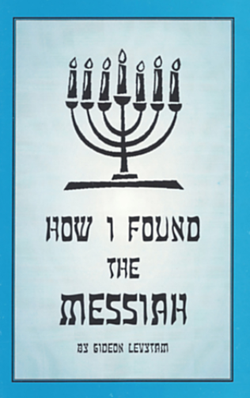
Follow Gideon Levytam's journey and discover how he was led by God, through a series of exciting circumstances, to find the One his people are still waiting for.
Past Episodes

Featured Offer
Follow Gideon Levytam's journey and discover how he was led by God, through a series of exciting circumstances, to find the One his people are still waiting for.
About Holy Scriptures and Israel
As time passed by, the Lord Yeshua took dear brother John Van Stormbroek to himself. The ministry of Holy Scriptures and Israel continued with additional development. In the early 1990’s, a weekly morning Bible class began which brother Gideon Levytam led regularly in the City of Toronto. This weekly open Bible class was held in the Willowdale assembly meeting hall. Eventually, a second mid-week evening Bible class was added. In April 2002, the need for an additional outreach Bible teaching meeting arose. We begun a Saturday (Shabbat) ministry meeting in which a systematic teaching of God’s word is presented to all who attend. Together we learn God’s Word, pray for each need and the salvation of Israel, and sing songs of worship unto our God, praising Him and our Lord Yeshua the Messiah.
In Mid 2004 we started to air on Joy 1250 Radio station a 15 minute Bible teaching program called "The Holy Scriptures and Israel" with Gideon Levytam. The broadcast teaches God’s word from a Hebrew Messianic perspective and has proved to be a blessing to many. It's now aired seven days a week. Our prayer is that many more of our Israeli people will have a clear understanding of who Yeshua is, why we all need him, and come to know him as their Lord and Messiah.
About Gideon Levytam
Contact Holy Scriptures and Israel with Gideon Levytam
426 Simcoe Street
Niagara-on-The-Lake
Ontario L0S 1J0
Canada
(905) 325-1234