

Malachi 1:1-5 Part 3 of 3


God's love for his people Israel part 3
Gideon Levytam: Shalom. Holy Scriptures and Israel is a ministry designed to share with the Jewish people the good news of the Lord Jesus Yeshua the Messiah, and to instruct Christians on the Jewish roots of their faith. And now, teaching God's word from a Hebrew Messianic perspective, here is Gideon Levytam.
This study of the book of Malachi, chapter one. And instead of giving to him Rachel that he loved, he gave him the other sister by the name of Leah. He goes in at night, he comes, gets up in the morning. Look, lo and behold, it's not Rachel. It's Leah.
And then he had to work an additional seven years to get Rachel. But I want you to notice what it says. It's very interesting in these verses. This is Genesis 29:29. I'll read verses 29, 30, and 31. It says, "And Laban gave to Rachel his daughter Bilhah his handmaid to be her maid. And he went in also unto Rachel, and he loved Rachel more than Leah, and he served him yet seven other years."
And then it says in verse 31, "And when the Lord saw that Leah was hated, he opened her womb, but Rachel was barren." Notice the word. Jacob loved Rachel, but the Lord saw that he hated Leah. But he didn't hate Leah. He just didn't choose Leah. Jacob I have chosen, Esau I have not chosen.
It's not a matter of hating, because God never hates any man. It's an expression of the fact that one has been elected over the other because that was His sovereign choice. Let me develop this just a little bit more, because in Deuteronomy 21 there is an additional explanation that will help us to understand the love/hate or the election, the sovereignty of God in election.
In Deuteronomy 21:15-17, we find an instruction that God gave to Israel through Moses. He said, "If a man have two wives, one beloved and another hated, and they have borne him children, both the beloved, the one who is loved, and the other one who is hated. And if the firstborn son be hers that was hated, then it shall be, when he makes his sons to inherit that which he has, that he may not make the son of the beloved firstborn before the son of the hated, which is indeed the firstborn."
It's very unusual that a man has two wives. That was not what God had intended from the beginning. Let a man leave his father and his mother and cleave unto his own wife, and the two shall be one flesh. But here we can see a situation that God gave an instruction through Moses. If a man has two wives, the one he loved, the other one he hated, it has a matter of preferences rather than despising and hating one.
That is not the intention that we have here. The thought of hating in the context of Malachi 1:2-3 is simply one was elected and chosen, and the other one was not. Because God does not hate any man or any woman. God hates sin while He loves the sinner. And for this He proved when He sent the Messiah Yeshua to die for the sin of this world.
I'd like you to turn to a New Testament passage that will illustrate as well for us. Go to Luke 14 with me. I want you to see what Yeshua the Messiah Himself says in relationship to love or hate. Notice what we read in Luke 14:25-26. Here is Yeshua Himself speaking.
The Messiah Himself, we read in verse 25, "And there went great multitudes with him, and he turned and said unto them: If any man come to me and hate not his father and mother and wife and children and brethren and sisters, yea, his own life also, he cannot be my disciple."
What does it mean when Yeshua says if any man hate not his father and his mother? Does Yeshua Jesus the Messiah teach us to hate our parents, to hate our children, to hate our wives, to hate our brethren, to hate even our own life? He cannot be my disciple. What does He mean?
Obviously, what we learn, this is Hebraic. This is a Hebrew way of expression that God gave to our people of all the people of Israel in His word. Love and hate is elected versus not elected. It's just the same as if you would go to buy anything. You would choose one over the other. Jacob I have chosen, and Esau I have not chosen.
Of course, we know the life of Jacob. Someone could say, "How can God say, 'I can understand where God could say I've hated Esau.' But what I can't understand is how can God say 'I love Jacob'?" What we cannot understand is how can God say "I love you," knowing our heart condition, knowing our sinfulness. How can God even love us and choose us to be those with whom He will have an eternal relationship?
So when God responded to Israel who said, "Wherein hast Thou loved us?" Number one, He says, "Was not Esau Jacob's brother?" Look at history. He was a twin brother. Number two, God says, "Yet I loved Jacob." Jacob was not better than Esau. And then He said, "I hated Esau," meaning I did not choose Esau, but I did choose Jacob. It's My sovereign choice. I'm a sovereign God, and I can choose whom I will.
This is what we call in scripture the truth of election. Election. Now, we don't quite grasp it, and we are always willing to tell God whom should He choose and whom should He not, who deserve and who is not. But God does not ask man. God does not ask Israel, neither is He asking you and I. He's sovereign, and He elects whomsoever He will.
Let me show you another verse. Go to Ephesians 1, please, with me. Ephesians 1, now in relationship not only in relationship to Israel, but in relationship to each and every one of us. Look what Ephesians, apostle Paul says in Ephesians 1:3-4.
Paul said there to remind the brethren in Ephesus who were pagan, who were idol worshippers, he said to them in verse three, "Blessed be the God and Father of our Lord Yeshua the Messiah, who has blessed us with every spiritual blessing in the heavenlies in the Messiah, according as he has chosen us in him before the foundation of the world."
Where were we when God elected you and I who became believers in time? God has chosen us before the foundation of the world, as we clearly can see here in Ephesians 1:3-4. Paul said it to the Colossians in Colossians 3. Notice what he said to them in verse 12. "Put on therefore, as the elect of God, holy and beloved, bowels of mercy, kindness, humbleness of mind, meekness, and longsuffering." You are an elect of God. Paul said this to the believers in the city of Colossae.
I read one more verse in 1 Thessalonians 1:4. Notice there what the apostle Paul said to the Thessalonians. He says to them, "Knowing, brethren beloved, your election of God." And I don't have to tell you in John 15 when Yeshua, before He died, He said to the apostle, "Ye have not chosen me, but I have chosen you."
Now you might come with your reasoning, and I might come with my reasoning, and Israel might come with their reasoning. But God is telling to Israel, Jacob I have chosen, and Esau I have not chosen. That is the truth of election. God has elected Israel long before Israel was even coming to an existence where He said in Genesis 25, "The elder shall serve the younger," long before they were even born.
God elected Jacob because He's sovereign and He has a right to choose whom He may. So was not Esau Jacob's brother? The first response. The second response, "Yet I have loved Jacob." And then in Malachi 1:3, He says, "I hated Esau." I did not choose Esau, but I did choose Jacob because I'm sovereign. And even though Jacob is not deserving election, yet it is the sovereignty of God.
And I want you also to notice that God never hurts men. He loves men. But you know what He does? He hates the things that men do because of sin. That's what God hates. Every time you and I sin, God hates that sin, while He loves that sinner. Let me show you another verse. Go to Proverbs. In Hebrew we call it Mishlei. This is a very important verse to read.
God gave Israel through Solomon, Solomon the King of Israel, He gave Israel this list of things that God hates. He never hates men, but He hates sin. Look at this list that we have in Proverbs 6:16-19.
It says, and this is King Solomon, "These six things does the Lord hate. Yes, seven are an abomination unto him." And here's the list. Number one, He hates a proud look. Number two, He hates a lying tongue. Number three, He hates the hands that shed innocent blood. Number four, in verse 18, He hates the heart that devises wicked imaginations. Number five, He hates the feet that be swift to run to mischief. Number six, in verse 19, He hates false witness that speak lies.
And yet the greatest of them all, number seven, is he that sows discord among brethren. Do you know how many times we are not careful in the way that we behave? Instead of building the people of God, we are sowing seeds of discord among God's people. And God hates it. He despised it. And that's why it's the greatest of them all. He said, as it says, six things the Lord hates, but the seventh are an abomination unto him.
A proud look, a lying tongue, hands that shed innocent blood, a heart that devises wicked imaginations, feet that are swift running after mischief, false witnesses, and he—notice He's now centering the person—he that sows discord among brethren.
You know how many assemblies have been divided because we didn't watch the way we said things and acted upon? You know how many times people have ended up separating from each other because we sowed this sin seed of sin to sow discord among the people of God? And God hates it. He hates it. Yet He loved the sinner so much.
So Jacob I have loved, Jacob I have chosen. Esau I have hated. Esau I simply did not choose. I'm sovereign, and I do as I please. And I'm God, and I'm supreme over the face of this world. And so now please go back with me to our chapter.
Just to conclude here for us, now in verse three, after He mentioned the fact that Esau has He not chosen, then He also showed to the people of Israel who complain, "Wherein hast Thou loved us?" He shows us the consequence of Esau's disobedience to Him and his departure from God that brought about the necessity that God punished Esau and his descendants. Because Edom became the nation that descended from Esau.
And so listen to these verses. Very interesting because in the next verse, at the end of verse three, it says here, "I hated Esau." And notice what it says at the end of this verse three: "And I laid his mountains and his heritage waste for the dragons of the wilderness."
In other words, what God said in the end of verse three is that God has now disciplined Esau who departed from Him, and He laid the mountains and the heritage of Esau to be waste. And you know, Edom today is really found today from south from the Dead Sea all the way unto the Gulf of Aqaba there.
Those of you that have been with me to Israel and have been crossing through the Aqaba border into Jordan, all these areas on the other side of the Dead Sea is present day Jordan. And all these areas were occupied by the Edomites, the Ammonites, and the Midianites. Midian, Ammon, and Moab were there.
And God says, notice what He says to us here in verse three, He says He laid his mountains and his heritage waste for the dragons of the wilderness. If you are going to go there, you're going to see the wilderness that exists there. And today, the people of Edom are no longer there. You might say there are other new people who came and occupied the land.
And He continues and He says now in verse four, Edom, who is Esau, descendants of Esau, who were constantly opposing Israel, constantly opposing Jacob, there was a friction that existed from generation to generation between Esau and Jacob. Jacob is not better, but Jacob was elected and chosen by God, and God had a plan for Jacob.
But what happened is when Esau had gone against God's will and against God's people, look what we read in the next verse, verse four. Edom will eventually experience an overthrow. And Edom eventually will be called, as it says here, the people that against whom the Lord has indignation forever.
Look at verse four. Let me read that again. "Whereas Edom saith: We are impoverished, but we will return and build the desolate. Thus saith the Lord of hosts: They shall build, but I will throw down. They shall call them the border of wickedness, and the people against whom the Lord has indignation forever."
You see what God is saying to Israel? You, Jacob, you, Israel, were carried in 586 BC to Babylon. Just the same as Nebuchadnezzar came and destroyed your temple, destroyed your city, Nebuchadnezzar also has destroyed Edom during those days and many other countries around. Read it in Jeremiah 25.
But Edom wants to say, and he will say, "Look, I am going to return and I'm going to build all the rebuild all the desolation." But God says, "No, no, no, Edom. You will not be able to rebuild the desolation. I will throw down, and they shall call them, that is Edom, the border of wickedness, and the people against whom the Lord has indignation forever."
Now God had indignation against His own people, Israel, and He judged them, but He restored them. God had an indignation against Edom, but He judged them, and His indignation is against them not for a season, but forever. Esau is a representation of the old nature that man has. And the old nature needs to be put down when it's belonged because God will not allow the sin nature to rise up.
That's why when we became believers, He gave us new life, new birth, and we now have a new nature, a divine nature, a nature that was received by the Holy Spirit of God. And Edom is a representation of all those who are the enemies of God that are called the border of wickedness. And they are called by all people against whom the Lord has indignation forever.
You're asking Me, Jacob, wherein have I loved you? Just look at your history. People try to destroy you again and again, and you return back to the land. You were supposed to be ending your history, Israel, but I brought you back to Myself. It just reminds me because we just finished a few days ago the memorial of the Holocaust.
And every time I think about that, you think of the six million Jews who died only because they were Jewish. Not because they have done anything wrong to anybody. They may have, like anybody else, but six million. You would think that there would be no restoration anymore because most of the Jews were taken over by Hitler and his machine, killing machine.
But God has a purpose for Israel. He has a plan, and the Jewish people will revive because God has that plan for them. Edom, Esau, the border of wickedness. The people against whom the Lord has indignation forever. Jacob I have chosen, but Esau I have not. And Esau departed and gone further and further, and eventually I judge them and I will yet judge them.
Now finally, beloved brothers and sisters, in verse five, the Lord promised Israel that there is a day coming when Israel will recognize that God really loves them. There is a day coming, beloved brothers and sisters, when Israel will finally realize. They will never anymore ask the question, "Wherein Thou loved us?"
He takes them all the way to the Messianic Kingdom in verse five. And he's speaking about the days that will come, and it will be very soon, hopefully very, very soon from our vantage point of time. It says here in verse five, "And your eyes, Israel, shall see, and ye shall say"—this is your mouth shall speak and say—"The Lord will be magnified from the border of Israel."
There is coming a day, Israel, you will no longer say these words, "Really, wherein have You loved us, Israel?" God is saying to them. There's coming a day when you are going to not only see it and experience that, but you shall proclaim that throughout this wonderful age of the Messianic Kingdom when you will say, "The Lord is magnified."
Notice, the Lord is magnified from where? It says here, from the borders of Israel. Israel will be a nation that through Israel, blessing will flow to all the nations of the world. That is the Messianic Kingdom. Isaiah 2 says, "Many people," verse three says, "shall go and say, 'Come ye and let us go up to the mountain of the Lord, to the house of the God of Jacob.' And he will teach us of his ways, and we will walk in his paths. For out of Zion shall go forth the law and the word of the Lord from Jerusalem."
"Ki mitzion tetze torah u'dvar Adonai m'Yerushalayim." From Zion will come out the law of the Lord, the word of the Lord, and it's going to flow, the word of the Lord will flow out from the city of Jerusalem. That is yet a future day that will come. But Israel will have to come to faith in the Messiah whom today they don't realize that He is Yeshua. But they will eventually in a future day come to acknowledge that He indeed is the promised Messiah of Israel and the savior of the world.
Can we say amen to that? May the Lord bring that to fruition very, very soon. And thank the Lord for the time that we could study Malachi 1:1-5. "I have loved you," God said to His people, Israel.
You have been listening to Holy Scriptures and Israel with Gideon Levytam. Gideon teaches God's word from a Hebrew Messianic perspective. For more information about this ministry, write to Holy Scriptures and Israel, Box 1411, Niagara-on-the-Lake, Ontario, L0S 1J0, or visit our website at holyscripturesandisrael.com.
You are also invited to Gideon's weekly Bible teaching on Fridays at 11:00 AM and 7:00 PM and Saturdays at 1:00 PM at Willowdale Christian Assembly Hall, 28 Martin Ross Avenue in Toronto. Holy Scriptures and Israel is made possible by your prayers and financial support. If you would like to support the program, visit holyscripturesandisrael.com. God bless you. Shalom, shalom.
Featured Offer
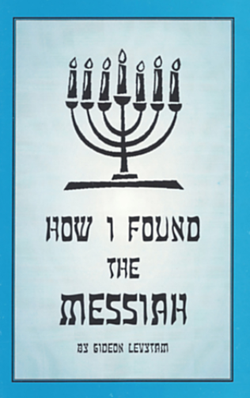
Follow Gideon Levytam's journey and discover how he was led by God, through a series of exciting circumstances, to find the One his people are still waiting for.
Past Episodes

Featured Offer
Follow Gideon Levytam's journey and discover how he was led by God, through a series of exciting circumstances, to find the One his people are still waiting for.
About Holy Scriptures and Israel
As time passed by, the Lord Yeshua took dear brother John Van Stormbroek to himself. The ministry of Holy Scriptures and Israel continued with additional development. In the early 1990’s, a weekly morning Bible class began which brother Gideon Levytam led regularly in the City of Toronto. This weekly open Bible class was held in the Willowdale assembly meeting hall. Eventually, a second mid-week evening Bible class was added. In April 2002, the need for an additional outreach Bible teaching meeting arose. We begun a Saturday (Shabbat) ministry meeting in which a systematic teaching of God’s word is presented to all who attend. Together we learn God’s Word, pray for each need and the salvation of Israel, and sing songs of worship unto our God, praising Him and our Lord Yeshua the Messiah.
In Mid 2004 we started to air on Joy 1250 Radio station a 15 minute Bible teaching program called "The Holy Scriptures and Israel" with Gideon Levytam. The broadcast teaches God’s word from a Hebrew Messianic perspective and has proved to be a blessing to many. It's now aired seven days a week. Our prayer is that many more of our Israeli people will have a clear understanding of who Yeshua is, why we all need him, and come to know him as their Lord and Messiah.
About Gideon Levytam
Contact Holy Scriptures and Israel with Gideon Levytam
426 Simcoe Street
Niagara-on-The-Lake
Ontario L0S 1J0
Canada
(905) 325-1234