
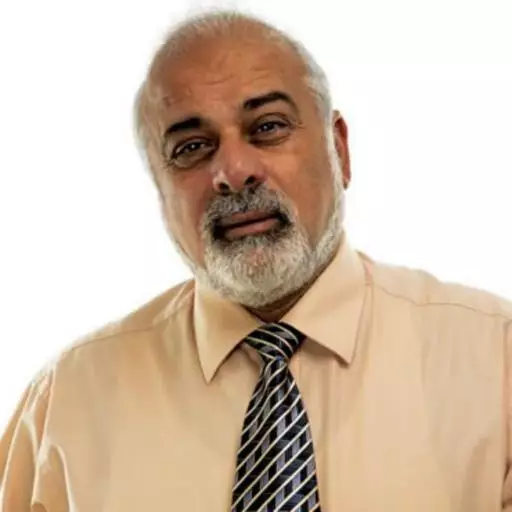
Lamentations 5:1-22 Part 1 of 3


Jeremiah laments in prayer for mercy upon Jerusalem part 1
Announcer: Shalom. Holy Scriptures and Israel is a ministry designed to share with the Jewish people the good news of the Lord Jesus, Yeshua the Messiah, and to instruct Christians on the Jewish roots of their faith. And now, teaching God's word from a Hebrew Messianic perspective, here is Gideon Levytam.
Gideon Levytam: Shabbat shalom, everyone. Open your Bibles. Today, we are going to conclude, with the Lord's help, the last message on the book of Lamentations, Eikhah in Hebrew, the book of "How." The servant of the Lord, Yirmeyahu HaNavi, Jeremiah the prophet, was lamenting over the fall of the city of Yerushalayim to the Babylonian, the destruction of the temple, the burning of the temple and the city of Yerushalayim, the carrying of the Jewish people to Babylon.
Jeremiah in 586 BC was one of those that experienced this destruction, and he began to lament to sing those songs of weeping and songs of lamentation of cry and asking God, "Eikhah? How?" How is it possible that this have happened to the people of God, to the Jewish people, the chosen people, who were judged by God who loved them, who wanted them to be in joy and fellowship with Him? But because of sin and because of disobedience, He had to allow our people of old to be judged and taken captive by the Babylonians.
The fifth chapter of Lamentations began with the word "remember." Verse one says, "Remember, O Lord, what is come upon us: consider, and behold our reproach. Our inheritance is turned to strangers, our houses to aliens. We are orphans and fatherless, our mothers are as widows. We have drunken our water for money; our wood is sold unto us. Our necks are under persecution: we labor, and have no rest.
We have given the hand to the Egyptians, and to the Assyrians, to be satisfied with bread. Our fathers have sinned, and are not; and we have borne their iniquities. Servants have ruled over us: there is none that doth deliver us out of their hand. We gat our bread with the peril of our lives because of the sword of the wilderness. Our skin was black like an oven because of the terrible famine. They ravished the women in Zion, and the maids in the cities of Judah.
Princes are hanged up by their hand: the faces of elders were not honored. They took the young men to grind, and the children fell under the wood. The elders have ceased from the gate, the young men from their music. The joy of our heart is ceased; our dance is turned into mourning. The crown is fallen from our head: woe unto us, that we have sinned! For this our heart is faint; for these things our eyes are dim.
Because of the mountain of Zion, which is desolate, the foxes walk upon it. Thou, O Lord, remainest forever; thy throne from generation to generation. Wherefore dost thou forget us forever, and forsake us so long time? Turn thou us unto thee, O Lord, and we shall be turned; renew our days as of old. But thou hast utterly rejected us; thou art very wroth against us."
Reading this fifth chapter is extremely moving when you think of Jeremiah, Yirmeyahu, praying to God on behalf of the people of Israel. Again, I would like to remind you, dear brothers and sisters, that we have gone over already four chapters in the book of Lamentations. In the first chapter, there was a lamentation of Jeremiah over the destruction of the city of Yerushalayim. In Lamentations chapter two, there was a lamentation of Jeremiah over God's anger against Yerushalayim, Jerusalem.
In Lamentations chapter three, Jeremiah lamented and prayed for the city of Yerushalayim. And in Lamentations chapter four, Jeremiah lamented because of the siege that brought about the fall of the city of Yerushalayim. And now, when we arrive to the fifth chapter, Jeremiah is lamenting and praying for God's mercy for the city of Yerushalayim and for the people of Israel. This is amazing when you really think about it.
Yirmeyahu, Jeremiah, is called in scripture the weeping prophet. He was not merely just giving truth and sharing the word of the Lord with Israel, but his heart was inside. He couldn't see what happened to his very own people and just be so hardhearted and careless. He was so broken, beloved brothers and sisters, for Israel, for his own Jewish people as he saw them being carried to the land of Bavel.
He looked back and what does he see? He sees the temple is burned with fire. He looked back and he sees the walls of Jerusalem are broken down. And he wept, like you and I need to weep when we see the condition that is existing today in the professing church of our Lord Yeshua the Messiah. Jeremiah was not careless. His heart was involved so much. And so in this last lamentation of his, Jeremiah is now praying and asking God for mercy.
Sin brought about judgment, but when judgment comes and we are in the midst of the judgment of God, what can we do? We cannot justify ourselves. He didn't try to justify Israel or justify himself, but he actually turned to God with confession and repentance. If we confess our sins, He's faithful and just to forgive us and to cleanse us from all unrighteousness. This is Yeshua the Messiah.
First John chapter one, verse nine, the apostle Yochanan, John, said to the believers in the days of old, 2,000 years ago. He said, "When we go astray," speaking of believers. He doesn't speak about the unbelieving world now. They need to confess their sins in order to be saved. But the people of God need to repent when we go astray. And God is faithful to restore and to help His people.
So it is so interesting, beloved brothers and sisters, that we noticed so far that in the first four chapters, the way those four chapters were written down is with an acrostic. Chapter one has all the 22 letters of the Hebrew alphabet from Aleph all the way to Tav, which is at the end. And every verse of chapter one was going acrostically in order: Aleph, Bet, Gimel, all the way on to the end of the 22 letters of the Hebrew alphabet.
Chapter two, it was very similar. Verses one to verse 22, the prophet Jeremiah also gave us Aleph, Bet, Gimel, Dalet. Every verse began with a new letter of the Hebrew alphabet. And in the third chapter, we noticed that there is not only 22 verses, but there are 66 verses. And in these 66 verses, every three verses began acrostically with the same order: the first three verses with Aleph, the second three verses with the letter Bet, and so on.
In chapter four, he goes back to the 22 verses and there once again, we also have verse one, Aleph; verse two, Bet; verse three, Gimel, all the 22 letters of the Hebrew alphabet. Now you and I might ask, why is it? What was the purpose behind it? It seemed to be that the Holy Spirit of God somehow allowed us to see it and read it because God is a God who began at the beginning and conclude at the end, and He thoroughly finished whatever He has in mind to accomplish among His people.
Remind me of the book of Philippians, where we read, "He who began a good work in you shall complete it unto the day of Yeshua the Messiah." But now in the fifth chapter, there is also 22 verses, but it's very interesting. For one reason or another, these 22 verses of chapter five do not include all the 22 Hebrew alphabet. In fact, half of them are missing. You only have 11 of the 22 of the Hebrew alphabet.
Very interesting, because the letters Gimel, Dalet, Vav, Khet, Tet, Samekh, Pe, Tsadi, Kof, Resh, and Tav, all those 11 Hebrew alphabets are missing from these 22 verses of the fifth chapter. But not only that, some of the verses of the fifth chapter repeat the same Hebrew alphabet. Some repeat twice, one time it's even repeated three times, and other times it's only one.
So we have 22 verses, like we had in all the other four chapters, but they are not acrostically. Not all the Hebrew alphabet are mentioned there in the beginning of every verse. But nevertheless, there are still 22 verses, equivalent to the 22 Hebrew alphabet. Now, I don't want you to be occupied with the Hebrew alphabet, but I would like you to be occupied in this ministry meeting with the lamentation and the prayer of Jeremiah for mercy, for khesed v'rakhamim in Hebrew, the mercy and grace from God on behalf of the city of Yerushalayim and the Jewish people who were taken captive by the Babylonians.
I want you to notice that the first verse, Jeremiah appeals to God to remember and to consider. You notice how it begins? Lamentations chapter five and verse one. Yirmeyahu is asking the Lord to remember. It says here in Hebrew, "Zakhor Adonai." Remember, O Lord, what is come upon us; consider and behold our reproach. Now, Jeremiah doesn't say to God to remember because God have forgotten.
God haven't forgotten anything. In fact, He's the one who brought about the Babylonians to judge His very own people. He didn't forget anything. But Jeremiah, as us all, and the people of Israel historically, you notice that many times in the Hebrew scripture that the people of Israel, when they needed the Lord, the Lord's mercy and the Lord's help, they often used the word "Zakhor," remember.
And when you and I have problems in our lives, when things are not working so well, and when things are bad and we have issues and problems, we need to turn to the Lord like Jeremiah and ask the Lord, "Lord, look at the situation that I find myself in. Look at what's going on in my life. Look at the conflict and the challenges and remember that these things happened to me. Don't forget." And of course, we know that God has never forgotten His people.
You remember what we read in scripture? "I will never leave you nor forsake you," the Lord said. He remember His people Israel. He remember the believers in the body of Messiah. He have never forgotten His own people. But Jeremiah is appealing to the Lord for mercy on behalf of the people of Israel. And he began by saying to Him, "Remember." Now, it's not the first time in the Bible that the word "Zakhor" is mentioned.
It's found in Genesis chapter eight and verse one, just after the flood. And we read that the Lord remember Noah and his family and the animals that were in the ark. God had judged the world with the flood. No one remained alive here in this world, only one family: Noah, his wife, Shem, Ham, Japheth and their wives, and the rest of the animals that came with him into the ark.
But God remembered. That thought of remembering means that God is faithful to His covenant-keeping people, whoever He have blessed and called to follow after Him. And He is not going to forget them, even though He will allow them to go through the challenging time in their life. Noah was remembered, and now Jeremiah, Yirmeyahu, is asking the God of Israel to remember His people, the Jewish people, who are now in a time, as it says here, "Consider our reproach."
You know the word reproach comes from the Hebrew word "kherpah." We usually use the word "bushah v'kherpah," shame and reproach. Those are the people of God. Just a few years earlier, they have enjoyed the presence of God and the temple in the city of Yerushalayim, the song of the Lord, the worship of the God of Israel. But now look at them. They are taken captive.
No temple, no city, no liberty, no freedom. And look at the shame that they have experienced. So Jeremiah is asking God to remember the condition. Remember, O Lord, what is come upon us, and consider and behold our shame and our reproach. It's the beautiful way to turn our hearts to the Lord when we are in a time of need. There is no room for arrogance. There is no room for pride.
There is even no room for self-justification. "God, I have been pretty good and I have done everything well." No. There is a need of bowing our knees before the Lord and asking Him for mercy and asking Him to look at our condition and that He will be able to help us along the way. So that's how this chapter of the book of Lamentations, the book of Eikhah, begins.
He says, "Remember, O Lord, what is come upon us, and consider and behold our reproach." And as he continue in prayer, in verses two to verse 10, now Jeremiah present before God the list of Israel's wounds and sorrows. He's like making a list. Of course, I don't know how much time he had to make a list, but he knew of the things that have happened to his own nation, to his own people, Israel.
And so Jeremiah presented before the Lord the wounds and the sorrows that his own people have experienced because of the Babylonian captivity and the destruction of the temple. And I just want you to look with me at this list for a moment. In verse two, he says, "Our inheritance and our houses are taken." And I was just thinking about it in preparation for this meeting.
Do you know God had promised Abraham, Isaac, Jacob, Israel, and all the 12 tribes of Israel that He will give them the land for an everlasting inheritance? Read it in Genesis 13, Genesis 15, Genesis 17. God had promised to give the land of Israel as an everlasting inheritance. But look what happened now. Jeremiah is saying in verse two, "Our inheritance is turned to strangers, and our houses are given to an aliens."
In other words, to people who are not belong here. In other words, God took their homes, their inheritance, and He handed it over to other people. And in this case, it is the Babylonians. Now, God is going to give the inheritance to Israel in due time in a future day. We can see even today in the days in which we live that God have already allowed the people of Israel to be restored to the land of Israel.
But Israel is still today partially blinded. As a nation, they haven't accepted that Yeshua is the Messiah and therefore Israel will have to go through a time still of dispersion before they finally will receive the blessing that God had for Israel. But now look at this: all their inheritance, all their possession was given to somebody else. Can you imagine if somebody going to come to your home and take your home, take your house, take your land and own it, and you become homeless?
Terrible experience. So all our inheritance have been turned to strangers and our houses into aliens. I just want to remind you and I, because we are believers in this present day, the Bible teach us that we also today have an inheritance, but the inheritance of the believer in Yeshua the Messiah is not necessarily here and now on earth, but our inheritance belong to us in heaven in the presence of God.
Look what Peter says in 1 Peter chapter one, verse one. Peter, an apostle of Yeshua the Messiah, to the strangers scattered throughout Pontus, Galatia, Cappadocia, Asia, and Bithynia, you are elect according to the foreknowledge of God the Father through the sanctification of the Spirit unto the obedience and sprinkling of the blood of Yeshua, Jesus the Messiah. Grace be unto you and peace be multiplied.
Now notice verses three and four. Blessed be the God and Father of our Lord Jesus the Messiah, which according to His abundant mercy has begotten us again unto a living hope by the resurrection of Jesus the Messiah from the dead to an inheritance, incorruptible, undefiled, that fadeth not away, but notice, reserved in heaven for you. Yours and mine as believers in the present day age of the church age, of the assembly, our inheritance are not here and now on earth, but it is really in heaven.
If all things will fall apart here in this world, eventually the believer has an inheritance that is kept and reserved for us in heaven. It does not fade away. It is not temporary; it is eternal. But it reserved for the believer of the present day in the presence of God in glory in heaven. But for Israel, our people, God gave a land. Not only physical land that He had blessed them with, but He also gave them spiritual blessing.
So what we see here that now the land of promise have been handed over to someone else, strangers have been taking it. Notice what else happened here in verse three. Israel became orphans and fatherless and widows. What happened there? Well, a person who become orphan, that means that he does not have a parents. He has no home to be at. He is fatherless because his father was taken or killed.
The mothers become widows. Why? Because their husbands died. In this case, the context shows us so many of the Jewish people have been killed by the Babylonian in 586 BC when they came and scattered the Jewish people, that many of the Jewish people became orphan, fatherless, widows. What a condition to be at. And it's always in connection with the head of the house is no longer there to lead the family.
In verse four, we read that now even their oppressors, namely the Babylonian, sell them water that belonged to the Jewish people. But the Jewish people had to pay for the water that belongs to them. Look at verse four: "We have drunken our water for money; and our wood is sold unto us." In other words, this is our land, this is our water from the streams, this is the trees that we own, but if we want to use it now, the oppressors says you have to pay in order to be able to use your very own water to drink and your very own wood if you want to heat the house or whatever you want to do, you will have to pay for that which is yours already.
In verse five, we find out that Jeremiah is saying, "Our necks are under the persecution. We labor and have no rest." In other words, they were constantly persecuted by the Babylonians. See, many of them were already taken to Babylon, but some who remain and haven't yet been quite taken or destroyed or killed, they were persecuted.
The persecution of the Jewish people already have been from generation to generation, as it says here in verse five, "Our neck are under persecution and we labor and labor and have no rest." "En menukha," as we say it in Hebrew, no rest. In verse six, Jeremiah continue, he says, "We made a holy alliance with a godless nations because we were in so desperate condition. We have given our hand to the Egyptian and to the Assyrian to be satisfied with bread. There is no food."
So we kind of connected ourselves with the unbelieving Gentile worlds, Gentile nation who opposed the God of Israel because there was no food. So in order to be satisfied with the necessary food, as it says here, we have given our hand to the Egyptian and to the Assyrian. And now notice verse seven. Jeremiah is continue in admitting the fact and really in a sense is like speaking on behalf of the rest of the nation.
"Our fathers have sinned and are not, they died, but we have borne their iniquities." They've sinned and we bear the consequence of their evil doing. You know, it's like this in our life. Whatsoever man soweth, that shall he also reap. When we go in a wrong direction, somehow we influence or we affect others, maybe our children, maybe our parents, maybe our friends, maybe our families, maybe our brothers and sisters. When we go in a wrong direction, it somehow affecting others eventually.
Jeremiah is saying, "Look at this." And in a sense, it's almost like the younger generation later on will speak to the Lord and they will say, "Hey, Lord, you know our fathers have sinned, but we are the one that borne their iniquities." Now, we have to be careful because there are other passages that tells us in the book of Jeremiah and also in the book of Ezekiel 18, Jeremiah 31, that the children will say, "Our fathers ate sour grapes and our teeth are set on edge." In other words, our parents ate wrong food and now that's why we have teeth that are not in order.
Announcer: You have been listening to Holy Scriptures and Israel with Gideon Levytam. Gideon teaches God's word from a Hebrew Messianic perspective. For more information about this ministry, write to Holy Scriptures and Israel, Box 1411, Niagara-on-the-Lake, Ontario, L0S 1J0, or visit our website at holyscripturesandisrael.com.
You are also invited to Gideon's weekly Bible teaching on Fridays at 11:00 AM and 7:00 PM and Saturdays at 1:00 PM at Willowdale Christian Assembly Hall, 28 Martin Ross Avenue in Toronto. Holy Scriptures and Israel is made possible by your prayers and financial support. If you would like to support the program, visit holyscripturesandisrael.com. God bless you. Shalom, shalom.
Featured Offer
Follow Gideon Levytam's journey and discover how he was led by God, through a series of exciting circumstances, to find the One his people are still waiting for.
Past Episodes

Featured Offer
Follow Gideon Levytam's journey and discover how he was led by God, through a series of exciting circumstances, to find the One his people are still waiting for.
About Holy Scriptures and Israel
As time passed by, the Lord Yeshua took dear brother John Van Stormbroek to himself. The ministry of Holy Scriptures and Israel continued with additional development. In the early 1990’s, a weekly morning Bible class began which brother Gideon Levytam led regularly in the City of Toronto. This weekly open Bible class was held in the Willowdale assembly meeting hall. Eventually, a second mid-week evening Bible class was added. In April 2002, the need for an additional outreach Bible teaching meeting arose. We begun a Saturday (Shabbat) ministry meeting in which a systematic teaching of God’s word is presented to all who attend. Together we learn God’s Word, pray for each need and the salvation of Israel, and sing songs of worship unto our God, praising Him and our Lord Yeshua the Messiah.
In Mid 2004 we started to air on Joy 1250 Radio station a 15 minute Bible teaching program called "The Holy Scriptures and Israel" with Gideon Levytam. The broadcast teaches God’s word from a Hebrew Messianic perspective and has proved to be a blessing to many. It's now aired seven days a week. Our prayer is that many more of our Israeli people will have a clear understanding of who Yeshua is, why we all need him, and come to know him as their Lord and Messiah.
About Gideon Levytam
Contact Holy Scriptures and Israel with Gideon Levytam
426 Simcoe Street
Niagara-on-The-Lake
Ontario L0S 1J0
Canada
(905) 325-1234