

Lamentations 1:1-22 Part 1 of 3


Lamentation of the descruction of Israel part 1
Gideon Levytam: Shabbat Shalom everyone. Please open your Bible. Today, we are studying in the book of Lamentations. Eichah, as we said in Hebrew, or Lamentations of Jeremiah. And I'd like you to follow with me as I'm reading the first chapter of Lamentations, Chapter 1, verses 1 to 22.
Guest (Male): How does the city sit solitary that was full of people? How is she become as a widow? She that was great among the nations and princess among the provinces, how is she become tributary? She weepeth sore in the night and her tears are on her cheeks. Among all her lovers, she hath none to comfort her. All her friends have dealt treacherously with her. They are become her enemies.
Judah is gone into captivity because of affliction and because of great servitude. She dwelleth among the heathen. She findeth no rest. All her persecutors overtook her between the straits. The ways of Zion do mourn because none come to the solemn feasts. All her gates are desolate. Her priests sigh, her virgins are afflicted, and she is in bitterness.
Her adversaries are the chief, her enemies prosper. For the Lord hath afflicted her for the multitude of her transgressions. Her children are gone into captivity before the enemy. And from the daughter of Zion all her beauty is departed. Her princes are become like harts that find no pasture, and they are gone without strength before the pursuer.
Jerusalem remembered in the days of her affliction and of her miseries all her pleasant things that she had in the days of old, when her people fell into the hand of the enemy, and none did help her. The adversaries saw her and did mock at her Sabbaths. Jerusalem has grievously sinned. Therefore, she is removed. All that honored her despise her because they have seen her nakedness. Yea, she sigheth and turneth backward.
Her filthiness is in her skirts. She remembereth not her last end. Therefore, she came down wonderfully. She had no comforter. Oh Lord, behold my affliction for the enemy has magnified himself. The adversary has spread out his hand upon all her pleasant things for she has seen that the heathen entered into her sanctuary whom thou didst command that they should not enter into thy congregation.
All her people sigh. They seek bread. They have given their pleasant things for meat to relieve the soul. See, oh Lord, and consider for I am become vile. Is it nothing to you all ye that pass by? Behold and see if there be any sorrow like unto my sorrow, which is done unto me, wherewith the Lord hath afflicted me in the day of his fierce anger.
From above has he sent fire into my bones, and it prevaileth against them. He has spread a net for my feet. He has turned me back. He has made me desolate and faint all the day. The yoke of my transgressions is bound by his hand. They are wreathed and come up upon my neck. He has made my strength to fall. The Lord has delivered me into their hands from whom I am not able to rise up.
The Lord has trodden under foot all my mighty men in the midst of me. He has called an assembly against me to crush my young men. The Lord hath trodden the virgin, the daughter of Judah, as in a wine press. For these things I weep. Mine eye, mine eye runneth down with water because the comforter that should relieve my soul is far from me. My children are desolate because the enemy prevaileth.
Zion spreadeth forth her hands and there is none to comfort her. The Lord has commanded concerning Jacob that his adversaries should be round about him. Jerusalem is as a menstruous or unclean woman among them. The Lord is righteous for I have rebelled against his commandment. Hear, I pray you, all people, and behold my sorrow. My virgins and my young men are gone into captivity.
I called for my lovers, but they deceived me. My priests and mine elders gave up the ghost in the city while they sought their meat to relieve their souls. Behold, oh Lord, for I am in distress. My bowels are troubled. Mine heart is turned within me for I have grievously rebelled. Abroad, the sword bereaves. At home, there is as death.
They have heard that I sigh. There is none to comfort me. All mine enemies have heard of my trouble. They are glad that thou hast done it. Thou wilt bring the day that thou hast called, and they shall be like unto me. Let all their wickedness come before thee and do unto them as thou hast done unto me for all my transgressions for my sighs are many and my heart is faint.
Gideon Levytam: Boy, to read such a chapter in the book of Lamentations. You can just imagine, beloved brothers and sisters, how Jeremiah, Yirmiyahu, who gave us by divine inspiration these five poems or five songs of sorrows called the Lamentations, called the sorrows and the lamentation that he lamented over the condition that existed over the people of Israel. Jeremiah lamented and he wept and he was so sorrowful over the condition that existed among the people of Israel.
And perhaps this description, you can just imagine him bowing or falling to the ground, looking back as he was still in the city of Jerusalem and he's just viewing the destruction of the wall, the burnt up temple in the city of Yerushalayim, which in 586 BC, the Babylonian came and burnt the city and took the Jewish people captive to Babylon. It was in the month of Av, on the ninth day of the month of Av, 586 BC, we call it in Hebrew Tisha B'Av, the ninth of Av.
The Jewish people were carried to Babylon to be there by the rivers of Babylon. So it is amazing to me how God have chosen to give us today, of course to give to Israel historically and to the body of believers today, such a book that is called Eichah in Hebrew, how in Hebrew, Lamentations. That you and I will read that and as we read that, we will be reminded of the ways of God's dealing with his own people.
If you remember, we read earlier in Second Timothy Chapter 1, and it was the Apostle Paul who said to Timothy that he remembered the tears that Timothy had shed. You remember in Second Timothy 1, verse 4, Paul said to Timothy, "Greatly desiring to see thee, being mindful of thy tears that I may be filled with joy." Sha'ul Paul was writing to this younger brother by the name of Timothy who loved the body of Messiah, who loved the people of God and have been seen the condition that prevailing already then and there among the people of God.
He began to weep. He began to cry. He was mourning over the condition of the people of God. This is the body of Messiah, all believers, the body of Christ. But Jeremiah did very much the same when he had experienced the events that happened at 586 BC. And I just want to read one or two more verses about the city of Yerushalayim for us to see why it was so burdening his soul when he saw what happened to the city of Jerusalem.
Turn with me to Second Chronicles Chapter 6, verses 5 and 6. Solomon rehearsed about what God said to David. And look what God said about the city of Yerushalayim, the city of Jerusalem.
Guest (Male): Since the day that I brought forth my people out of the land of Egypt, I chose no city among all the cities or all the tribes of Israel to build an house in that my name might be there. Neither chose I any man to be a ruler over my people Israel. But I have chosen Jerusalem that my name might be there, and I have chosen David to be over my people Israel.
Gideon Levytam: The city of Jerusalem is the chosen city of God which he have set his name in the city of Jerusalem. He have chosen the city of Jerusalem that his name may be in that city. God said to David, which Solomon later on rehearsed as he is looking back and he was building the temple in the city of Jerusalem. In Psalm 132, we have another important verse, Psalm 132, verse 13. And I want to read that for you and I, beloved brothers and sisters. Listen to these word.
Guest (Male): For the Lord has chosen Zion. He has desired it for his habitation. This is my rest forever. Here will I dwell for I have desired it.
Gideon Levytam: Psalm 132 and verse 13 and 14. Well, if God have chosen the city of Jerusalem and he chose Zion, why is it, if you look at this picture, that Jerusalem is destroyed and the Jewish people have been taken captive to be there for 70 years? And in fact, beloved brothers and sisters, the diaspora, the dispersion, the time of the Gentiles began at 586 BC on the ninth day of the month of Av when the Jewish people were scattered.
So now I want us to begin in the study of the first chapter. And in Lamentations Chapter 1, verses 1 to 22, you will also notice that there is the acrostic as the 22 letters are being mentioned here in Lamentations Chapter 1 and verse 1. You can just see that the letters, you perhaps cannot see it because you don't read Hebrew, but if you will notice, the letter Aleph is the first verse, the letter Bet is the second verse, the letter Gimmel is the third verse.
So the first letter of the Hebrew alphabet began with the first verse and is going on progressively, acrostically, for 22 verses of this first chapter. It's also in the second chapter, in the third chapter, and in the fourth chapter. And the only fifth chapter is the one that doesn't have an acrostic, though 22 verses are mentioned there. Well, in chapter 1, the title for this chapter is the lamentation over the destruction of the city of Jerusalem.
And in the first 11 verses, Jeremiah lament over the city. He weep over the city. And you can see that in the first seven verses, Lamentations 1, verses 1 to 7, Jeremiah is really astonished. He's surprised. That's why the verse began, the chapter began with the word Eichah, how. How is it possible? How is it even possible that the city that God had chosen to set his name there, the city that God have loved and placed his name there is now burnt with fire and the Jewish people are scattered and taken captive?
And so the first seven verses, Jeremiah is astonished. He's on the ground, you might say. He's weeping. And he began in verse 1 and he says, notice that in verse 1, how is it that the city that was once full of people now is empty?
Guest (Male): How does the city sit solitary that was full of people? How is she become as a widow? She that was great among the nations and princess among the provinces, how is she become a slave?
Gideon Levytam: As it says here tributary, it's really come from the Hebrew word a slave. In other word, how is it possible the city that was once as we read here in verse 1, one was full of people? Secondly, she was a great city among all the nations of the world. And thirdly, she was a princess among all the provinces. How in the world is it possible that now she sits alone? And then at the end of verse 1, how is it that she became a slave?
Is it possible? Jeremiah is completely overwhelmed when he see the condition that existed. How is it possible? You know, it is possible. You know why it is possible? Because when God's people do not follow God's ways, God will remove his people from a place of privilege, even though they are his own people. And as we apply this spiritually to the body of Christ, to the body of Messiah, when God's people do not follow his ways, God can blow on the light that they have had once and to reduce them into a scattered group of people.
How many a time you heard of local assemblies that once had been situated in a certain city, in a certain town, in a certain street, and a few years later you are coming and you're wondering, "Where is this local of brothers and sisters of this local assembly?" and you find up they are no longer there. Well, why? There was a departure from God's will. The word of God is not been prominent. Jesus the Messiah was not exalted and God can very easily scattered his sheep in judgment.
And so Jeremiah is amazed at this. Notice now he find out and he's lamenting in verse 2, he says she weepeth sore in the night and her tears are on her cheeks. Among all her lovers, she has none to comfort her and all her friends have dealt treacherously with her. They are become her enemies. In other word, when Israel came into the promised land, God said to the people of Israel, "Israel, you are not to affiliate with the nations of the world," as we read it in Deuteronomy Chapter 7.
Don't mix with the nations of the world. Don't adopt their teaching. Don't adopt their gods and idols. Be a separated people unto me. But what happened is now Jerusalem's lovers, notice this expression in verse 2, that among all her lovers she has none to comfort her. Now who are those lovers? Those are the people around, the nations around with whom she had now relationship with them and they affiliated with them, adopted their ways of life and then they turn against her.
Those lovers who once were supposed to be so-called friends and lovers, they all of a sudden turn against her. She weepeth in the sore in the night. Her tears are on her cheeks. Among all her lovers, she has none to comfort her. Jeremiah lament over Jerusalem. And notice all her friends have dealt treacherously with her. They become her enemies. You know what Jeremiah can see and he can share this with us?
He says, "Listen, the people after whom the people of Israel sought to go after turn against her." And instead of being those lovers, they became their enemies. Instead of comforting her, now they could not help her whatsoever in verse 2. Jeremiah is pointing us, notice in verse 3, he continue in lamenting. He says Judah is gone into captivity. That's where you get the Hebrew word Galut, Galta, the diaspora, the dispersion.
It says in verse 3, "Judah is gone into captivity because of affliction and because of a great servitude. She dwells among the heathen. She find no rest, and all her persecutors overtook her between the straits." Between the narrow conditions that she have experienced. In other word, now she have been the Hebrew word Galut, she have been taken to captivity. And you can just imagine one after another, they are walking out of the city of Jerusalem begin their journey away from the promised land to a land that is not theirs exactly as God had warned the people of Israel before even they enter into the land.
He says, "If you are going to follow other nation and go after other god, I will remove you from your very own land." So Judah is gone into captivity and she find no rest. No rest. Beloved brothers and sisters, since 586 BC, when the times of the Gentiles have began and God have removed from the authority and the rulership and the kingship from Judah and handed it over to the Babylonian.
The time of the Gentiles begin. You have the Babylonian, the Medo-Persian, the Grecians, and the Romans. And we are even up till today, for Israel's sake, are still in the time of the Gentiles. And when the time of the Gentile will come into its end, then will be the time when God will restore Israel back to Israel's former glory. But now verse 3, Judah is gone into captivity. What a sad experience Israel experienced.
And you notice how Jeremiah interchanging the word Judah, Jerusalem, Zion or Tzion, or the city? He's speaking about the same group of people that are linked with the city of Jerusalem that God set his name there as he mentioned it there to David the king of Israel. Notice in verse 4, the ways of Zion is nothing but weeping and mourning. It says in verse 4, "The ways of Zion do mourn because none come to the solemn feasts."
All her gates are desolate, her priest and her virgins are afflicted, and she is in bitterness. You know, this verse, Jeremiah is looking and he says, "I remember the days when we used to come to celebrate the feasts of the Lord. We celebrated Pesach. We celebrated the unleavened bread. We celebrated the feast of firstfruits. We celebrated Shavuot, Pentecost. We celebrated the feast of trumpet. We celebrated the day of atonement. We celebrated the feast of booth, the feast of Sukkot."
But now no one is coming anymore to celebrate these feasts that God had given to Israel in Leviticus Chapter 23. Zion is mourning. None come to the solemn feasts. You see, it is a customary was God ordained that at least three times a year all the Jewish people will come from all over the world to celebrate Pesach, Passover, to celebrate Shavuot, the feast of weeks, Pentecost, and to celebrate the feast of Sukkot, the feast of booth.
Deuteronomy tells us this very, very clearly in Deuteronomy Chapter 16 and verse 16. Three times in a year shall all thy male appear before the Lord thy God in the place which he shall choose. And then he gives us in the feast of unleavened bread, this is Passover and Matzot, in the feast of weeks, this is Shavuot and Pentecost, and in the feast of tabernacle, this is Sukkot. And they shall not appear before the Lord empty.
But now they are not coming anymore. And Jeremiah sit there and he's mourning and he sees the fire rising up from the burnt temple. He looking at the walls that are broken. He sees the Jewish people carried away to Babylon. And as they were carried away to Babylon, what does he see? He see the condition. He says, "What will be the time that the feasts will be continuing to be celebrated?"
But now he says no one is coming anymore to celebrate these solemn feasts. In Hebrew we call it Mo'adei Adonai, the appointed feasts that God had given to Israel the nation. And then he continue as he's mourning and he says in verse 5, Jerusalem's enemy became the head. You see in verse 5, "Her adversaries are the chief."
Boy, to read such a chapter in the book of Lamentations. You can just imagine, beloved brothers and sisters, how Jeremiah, Yirmiyahu, who gave us by divine inspiration these five poems or five songs of sorrows called the Lamentations, called the sorrows and the lamentation that he lamented over the condition that existed over the people of Israel. Jeremiah lamented and he wept and he was so sorrowful over the condition that existed among the people of Israel.
And perhaps this description, you can just imagine him bowing or falling to the ground, looking back as he was still in the city of Jerusalem and he's just viewing the destruction of the wall, the burnt up temple in the city of Yerushalayim, which in 586 BC, the Babylonian came and burnt the city and took the Jewish people captive to Babylon. It was in the month of Av, on the ninth day of the month of Av, 586 BC, we call it in Hebrew Tisha B'Av, the ninth of Av.
The Jewish people were carried to Babylon to be there by the rivers of Babylon. So it is amazing to me how God have chosen to give us today, of course to give to Israel historically and to the body of believers today, such a book that is called Eichah in Hebrew, how in Hebrew, Lamentations. That you and I will read that and as we read that, we will be reminded of the ways of God's dealing with his own people.
If you remember, we read earlier in Second Timothy Chapter 1, and it was the Apostle Paul who said to Timothy that he remembered the tears that Timothy had shed. You remember in Second Timothy 1, verse 4, Paul said to Timothy, "Greatly desiring to see thee, being mindful of thy tears that I may be filled with joy." Sha'ul Paul was writing to this younger brother by the name of Timothy who loved the body of Messiah, who loved the people of God and have been seen the condition that prevailing already then and there among the people of God.
He began to weep. He began to cry. He was mourning over the condition of the people of God. This is the body of Messiah, all believers, the body of Christ. But Jeremiah did very much the same when he had experienced the events that happened at 586 BC. And I just want to read one or two more verses about the city of Yerushalayim for us to see why it was so burdening his soul when he saw what happened to the city of Jerusalem. Turn with me to Second Chronicles Chapter 6, verses 5 and 6. Solomon rehearsed about what God said to David. And look what God said about the city of Yerushalayim, the city of Jerusalem.
Featured Offer
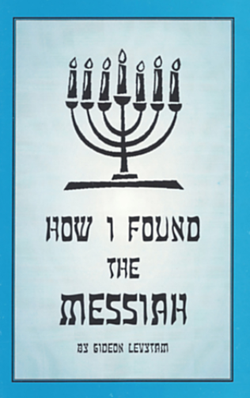
Follow Gideon Levytam's journey and discover how he was led by God, through a series of exciting circumstances, to find the One his people are still waiting for.
Past Episodes

Featured Offer
Follow Gideon Levytam's journey and discover how he was led by God, through a series of exciting circumstances, to find the One his people are still waiting for.
About Holy Scriptures and Israel
As time passed by, the Lord Yeshua took dear brother John Van Stormbroek to himself. The ministry of Holy Scriptures and Israel continued with additional development. In the early 1990’s, a weekly morning Bible class began which brother Gideon Levytam led regularly in the City of Toronto. This weekly open Bible class was held in the Willowdale assembly meeting hall. Eventually, a second mid-week evening Bible class was added. In April 2002, the need for an additional outreach Bible teaching meeting arose. We begun a Saturday (Shabbat) ministry meeting in which a systematic teaching of God’s word is presented to all who attend. Together we learn God’s Word, pray for each need and the salvation of Israel, and sing songs of worship unto our God, praising Him and our Lord Yeshua the Messiah.
In Mid 2004 we started to air on Joy 1250 Radio station a 15 minute Bible teaching program called "The Holy Scriptures and Israel" with Gideon Levytam. The broadcast teaches God’s word from a Hebrew Messianic perspective and has proved to be a blessing to many. It's now aired seven days a week. Our prayer is that many more of our Israeli people will have a clear understanding of who Yeshua is, why we all need him, and come to know him as their Lord and Messiah.
About Gideon Levytam
Contact Holy Scriptures and Israel with Gideon Levytam
426 Simcoe Street
Niagara-on-The-Lake
Ontario L0S 1J0
Canada
(905) 325-1234