

Joel 1:1-7, Part 2


Introduction, The Day of the LORD (The Future Tribulation) Part 2
Unidentified Speaker: Shalom. Holy Scriptures and Israel is a ministry designed to share with the Jewish people the good news of the Lord Jesus Yeshua the Messiah, and to instruct Christians on the Jewish roots of their faith. And now, teaching God's word from a Hebrew messianic perspective, here is Gideon Levytam.
Gideon Levytam: The study of Joel, chapter 1. Has this been in your days, or even in the days of your fathers? Tell it to your children of it, and let your children tell their children, and their children another generation. That which the palmer worm has left has the locust eaten, and that which the locust have left has the cankerworm eaten, and that which the cankerworm has left has the caterpillar eaten. In verses 2, 3, and 4, Yoel is asking the older men of the people of Judah a question. He asking them a question in verse 2, and he says, Hear ye this, old men, and give ear, all ye inhabitants of the land.
Has this been in your days or even in the days of your fathers? The question is, what is the word this? What does he mean when he says, hath this been in your days or in the days of your fathers? You see, what he was telling them is this. At that present time, when Yoel was still there preaching to the people of Judah, apparently what happened, there was a swarms of locusts who came over the land of Judah. The swarms of locusts came and they destroyed completely everything that had life there. We can see that as we are going to move on. The locusts came and one after another they destroyed every living thing that existed in the land.
And you know, it left the land in such a condition that the famine came into the land. The people were hungry. The people were in great need. The people were began to mourn and to weep, and the condition had been so bad among the people of Israel, the people of Judah, because swarms of locusts came. And you see Joel asking the old man, and maybe people were perhaps 100 years old or 90 years old, I don't know, I'm just giving an illustration in our age, somebody who is older person, that when you and I were not even born, that person remembers certain things that he can tell us. And he's asking them, old man, tell me, did it happen in your days, something that happened today here or these days in our land?
Tell us, he said, or he said, what about your fathers or before you? Do you remember your family or your forefathers ever telling you of events that have happened such as this event? Apparently, it didn't happen in the time of the old man before then. It happened at that time, but they could not, there was nothing like that have happened before. And he's telling them in verse 3, he's telling, tell it to your children and let your children tell their children, and let their children tell to their children. In other words, what he's saying is whatever have happened today in our land, the land of Israel, you tell it to your children so they will tell it to their children, and so they will tell it to their children, the third and the fourth generation.
He says, you better tell them so they can pass it along that nothing like this have happened before. The judgment of God came, and he's giving them the process in which it happened. He giving them, in verse 4, he's showing them the 4 waves of locust invasion, one after the other, that came and destroy all the land, all the crop in the land of Israel. It says, by the way, you notice in verse 4, it says, that which the palmer worm has left has the locust eaten. That which the locust have left has the cankerworm eaten. That which the cankerworm has left has the caterpillar have eaten. What we really see here, I know in the English it gives us 4 different type of names of insects.
It gives us palmer worm, locusts, cankerworm, and caterpillar. But in Hebrew, in the Hebrew language, it is written so interesting, and it doesn't give us name of insects, except one, and that is the locusts, but it gives us a progression whereby things have happened. He doesn't tell us that four different groups of insects came, but he tells us that there is one type of insect, the arba, the locust, but they came in four stages. Look at the way the Hebrew is saying. Wherever it says here, that which the palmer worm has left. In Hebrew, the word palmer worm is gazam. Gazam simply mean the biter, the one that bites.
The gazam, the first group came and they bited. The first wave of locusts came and the gazam. Gazam is somebody who chewing and chewing and chewing and chewing and chewing, and he moving on. He chews and he chews and he chews. The second thing, it says the locusts, in the Hebrew it is arba, the swarmer, the one who is swarming through, coming through the land and taking the leftover that the first group didn't take. Then the next thing he says, the canker worm in Hebrew is the word yalech. It's from the lelakek, from the hip, from the tongue, where you lick everything that is left, like a dog will lick everything that is left.
In other words, the third wave of locusts have licked what the second group have left. And finally, in the next point, the caterpillar in Hebrew is the word chasil, and chasil means simply the devourer. In Hebrew, chasil means lehasel, to finish, to devour everything. In other words, just visualize with me, dear brothers and sisters, here is a period of time in the history of Israel where God has sent the locusts to destroy all the crops. So one wave came and did what they wanted. They just chewed and took as much as they could, and they flew, continued forward. As they continue forward, the next group is coming.
The next wave of locusts are coming. What do they do? They are swarming through. They take their portion and they move on. Then the third group is coming of locusts, and what do they do? They lick everything that is left over. And finally, the fourth group is coming, and we call them lechasel or chasil, and they devour anything that is left behind. That's what we really learn here. And you know what he's saying to the people of Judah? He says, you know what? Tell it to your children, the judgment of God, that they will tell it to their children of the judgment of God, that they will tell it to their children about the judgment of God that we have never experienced in the past.
It's happened at that present time. And you notice how oftentimes the Bible shows us, it talks about third and fourth generation. You know, it's very rare, it's very rare for a father to see his son alive, and then his grandson still was born, and then his great-great son. This is a great privilege to see the third and the fourth generation, to have grandchildren and great-grandchildren, but it's very rare to go beyond the fourth generation. You find it in the scripture oftentimes with God speaking about judgment upon the third and the fourth generation. It is a Hebraic way whereby God oftentimes taught the people of Israel concerning various generation.
I want you to see this, please, with me in other passages in the Bible. Please turn to Psalm 78, please. Psalm 78, in the first few verses, we have the same thought. Psalm 78, verses 1 to 7. I'll just read that. Not gonna comment so much here. Psalm 78, the first 7 verses, it says like this. Give ear, O my people, to my law. Incline your ears to the words of my mouth. I will open my mouth in parable. I will utter dark sayings, which we have heard and known, and our fathers have told us. We will not hide them from their children, showing to the generations to come the praises of the Lord and his strength and his wonderful works which he has done.
For he established a testimony in Jacob, he appointed a law in Israel, which he commanded our fathers, that they should make them known to their children, that the generations to come might know them, even the children which should be born, who should arise and declare them to their children, that they might set their hope in God. You see? The Psalmist Asaf is speaking, and he says, you know, God want us to share with our children and their children and their children what God have done to the people of Israel, how God have dealt with our people. Sometime the way he drew us and he saved us and protect us.
Sometime as a loving father, he chastened us and he had to discipline us. Tell it to your children so they can tell it to their children and that they in turn tell it to their children, and that they will set God as their hope. Wonderful to see that. We see it also here in Yoel, exactly the same. Exactly as in tell it to your children, and they will tell it to their children, and that their children will tell it to the next generation. That's the way God operates. He want us to share it with the next generation, that they will ultimately come to know the Lord, to know the God of Israel, and for us today as believers, that they would come to know the Lord Yeshua, the Messiah.
Now, I want you to read with me another verse in the book of Timothy. Turn to 2 Timothy. 2 Timothy, chapter 2, here it again. Paul, a Jewish believer in the Messiah, telling Timothy, a younger Jewish believer in the Messiah, both of them Messianic or Christian as we know it in English today, followers of Yeshua the Messiah, Hebrew Christians of first century. Look how Paul is speaking to Timothy in Second Timothy chapter 2, verses 1 and 2. Look what he does, same thing. Thou therefore, my son, be strong in a grace that is in Messiah Yeshua, in Christ Jesus. And the things which thou has heard of me among many witnesses, the same commit to faithful men who shall be able to teach others also.
You notice that? Here he's not so much speaking about children in the flesh. Here he's speaking about children in Messiah, because he shared the gospel, Paul, and he won someone like Timothy to the Messiah, and he calls Timothy my son. Now, Timothy was not his son in the flesh. Oh yeah, both of them were Hebrews, both of them were Jewish, but he was not a son in the flesh. He was not a child in the flesh of Saul, of Paul. Timothy was his son in Messiah, in the faith. And you know what he's telling to Timothy? He says, Timothy, or he says, my son, he called him, said, be strong in the grace that is in the Messiah Yeshua and the thing which you have learned of me.
Timothy, I have taught you things. You now, I've taught you those things you committed to other faithful men what I've taught to you, and that they in turn will teach others as well. Paul, Timothy, other men, faithful men, who will teach others also. One, two, three, four. That is the way whereby we communicate things to others. You know how important for us, beloved brothers and sisters, what the truths that the Lord have taught you and I, spiritual truths that he taught us from the Bible, we are responsible to teach us to others, not to keep it for ourselves. Mind you, it's a blessing to have it for ourselves, but it's not have been given to us that we might hold it to ourselves and say, you see, I'm better than you, I'm greater than you.
No, the very information, the very spiritual lessons that we have learned from the Word of God is given to us so we might pass it to other men, to other brothers, to other sisters. And the gospel, we are to pass it along to other people around us that they might come to know the Lord Jesus, the Lord Yeshua as their Lord and Savior. It is rather sad when we don't use what the Lord had given to us and share it with other people. It is extremely sad. Not only that we don't give them the benefit, but we also ourselves don't feel the joy in our own hearts and souls because of the very privilege for us to share the things of God with the next generation.
Now, whether they will accept it or not, this is another story, but there is the responsibility that Joel was challenging Israel, the older man, and the Lord is challenging us today to share what God had given us with others so they might benefit and share it with the next people. Now, another thing that I want to mention here, as we are talking about verses 2, 3, and 4, the message to the people that he is declaring, that a invasion of locusts was already warned by God. Israel was warned by God through Moses many years before of a judgment that may come when Israel is departing from his word.
Turn with me now to Deuteronomy chapter 28, and I'm going to show you this from there. Deuteronomy chapter 28 gives us the choice that God had given Israel to either follow him or not. God had given Israel a choice to make. In chapter 28, he says to them in verse 1, "And it shall come to pass, if you shall hearken diligently unto the voice of the Lord your God. Then in verse 2 he says, all these blessings shall come upon thee and overtake thee. Verse 3 says, blessed you shall be in the city, blessed you shall be in the field, blessed you shall be the fruit of thy body. Verse 5, blessed shall be thy basket.
Verse 6, blessed shall thou be when thou comest in, and blessed shall thou be when thy comest out, and so on. Blessing a promise to the people of Israel, to our people of old, had and when they follow the commandments of the Lord. But then in verse 15, it's kind of changing. And in verse 15 he said, but it shall come to pass if thou will not hearken unto the voice of the Lord thy God to observe to do the commandments, his commandments and his statutes, which he commanded you. Notice what it says in verse 16. Cursed shall thou be in the city. Cursed shall thou be in the field. Verse 17. Cursed shall thy basket and thy store.
Cursed shall be the fruit of thy body. Verse 19. Cursed shall thou be when thou comest in, and cursed shall thou be when thou goest out. And then he telling them in these verses, verse 38, look what he says to them. Thou shall carry much seed out into the field and shall gather but little in. Why? Because the locusts shall consume it. Notice in verse 42, all thy trees and the fruit of the land shall the locust consume. God said to Israel through Moses, long time before they entered into the land, he gave Israel the warning and he said, Israel, if you will follow my instruction, you will be blessed.
Israel, if you will not follow my instruction, you will be judged, you will be cursed. And eventually the lokos will come and will destroy everything that you have raised. It says here, thou shall carry much seed into the field and shall gather but a little. You might sow and sow and sow and sow in the field, but very little crop will come. You know why? Because the arbe, the locust will come and will destroy all the things, all the fruit that come up from the seeds that you have sown. Now, another point here before I'm going to move to the next verses, I have to remind you that one of the ten plagues that God have placed upon Egypt was the arbe, the locusts.
The locust was one of the judgments that God placed upon the Egyptian when the Egyptians did not want to allow the people of Israel, the Hebrews, to come out of the land. So in the first four verses, we learned the introduction, who is Yoel, the son of Petuel. Verses 2, 3, and 4 give us the message that was declared to the people by Yoel himself. And the message was, you see what happened to you now? Tell it to your children, that they will tell it to their children, that they will tell it to their children, because here is a judgment that came because we have not been faithful to the Lord. And now, in the next verses, verses 5 to 7, here he is telling them to mourn and to weep and to cry.
Who is speaking first of all? To those who are drunkards. Look at this. He says in verse 5, 6, and 7, he says this: Awake, ye drunkards, and weep, and howl, all ye drinkers of wine, because of the new wine, for it is cut off from your mouth. For a nation is come up upon my land, strong and without number, whose teeth are the teeth of a lion, and he hath the cheek teeth of a great lion. He has laid my vine waste, and he barked my fig tree. He has made it clean, bare, and cast it away. The branches thereof are made white. You know what he does, first of all? You know, he's beginning to talk to the people, the drunkards in among the people of Israel there.
And you know, he's telling them in verse 5, you're not going to have any more wine to drink. He said in verse 5, he said, awake ye drunkards and weep, why how because, he says to them, of the new wine, for it is cut off from your mouth. You see, unfortunately, at that time as well, many of them end up getting drunk. And when they got drunk, they could not any longer get drunk. Can you imagine for a person who is an alcoholic not to have the possibility to get what he desperately need? And so he's telling them, you wake up, he says to them, you begin to wake and we begin to cry because you are in trouble.
You are not going to have what you are seeking after so much because of the swarms of the locust, the waves that destroyed the crop. In verse 6, he says that the locust were like a nation together. It says in verse 6, he says, for a nation is come up upon my land, strong and without number, whose teeth are the teeth of a lion, and he hath the cheek teeth of a great lion. You know, the locusts came like as a nation, like as a multitude. They came and they went all over the land of Israel, and they destroyed everything that they have seen. As it says here, whose teeth are as the teeth of a lion, and he has the cheek teeth of a great lion.
You know, oftentimes the Bible describes to us the locust like a nation. The Bible shows us this, if you please now, for another verse, please go to the book of Proverbs quickly. Proverbs chapter 30, and you see what Shlomo, the king of Israel, says. Proverbs chapter 30, verse 25, 26, and 27. Shlomo says in verse 25, Solomon, the king of Israel, said in verse 25, the locusts have no king, yet go they forth, all of them by bands, in order together. Verse 27, the locos have no king, yet they go forth, all of them by bands. They go like in groups, in bands, even though they have no king. They are going in order together.
And can you imagine? They were marching through the land and they were devouring everything that have existed there in the field of the land. And so what happened? Everything had been destroyed. And you know, how do we know that Yoel himself have experienced this? Because he says here in verse 7 that it's not only happened to the rest of the nation of Israel, but it happened unto him as well. It says in verse 7 of Joel 1, He hath laid my vine waste, and he barked my fig tree. He has made it clean, bare, and he cast it away. The branches thereof are made white. You see, beloved brothers and sisters, when God had punished his people, you know who had to go alongside with the punishment of the people?
None else, but also the prophet himself. You know, the prophets of Israel had to go through the experience of the whole nation. And you know how it is so biblical? Because the New Testament also shows us when one member suffer, all the members are suffer with it. When one member receive glory or honor, all the members are to rejoice and be blessed through it. Well, that is exactly what happened to Yoel here. Yoel lost his own crop as well, as it says here in verse 7, he has laid my vine waste, and he barked my fig tree. He has made it clean bare, and he cast it away. The branches thereof are made white.
And so, so far, beloved brothers and sisters, verses 2, 3, and 4, the message of Joel to the people of Israel, and verses 5, 6, and 7, we find out the weeping of the drunkards. They are to weep because of the condition that existed there in the land. Now, for time's sake, I'm not going to go anymore. For time's sake, I'm going to stop right here because from the verses 8 on, we have the additional lamentation and weeping that is going on here by the rest of the people of Israel. We're going to see that, and then we are going to move to the next point, which is the actual warning about future, future swarms.
This time it will not be of locusts, but the invasion that's going to come upon the land by the demonic activity and also eventually by humans who desire to destroy the nation of Israel. I'm going to stop with this right now, so for time's sake, and I'm looking at the clock. Next week, in the will of the Lord, we're going to continue from verses 8 on.
Announcer: You have been listening to the Holy Scriptures and Israel with Gideon Levytam. Gideon teaches God's word from a Hebrew messianic perspective. For more information about this ministry, write to Holy Scriptures and Israel, Box 1411, Niagara-on-the-Lake, Ontario, L0S1J0, or visit our website at holyscripturesandisrael.com. You are also invited to Gideon's weekly Bible teaching on Fridays at 11:00 AM and 7:00 PM and Saturdays at 1:00 PM at Willowdale Christian Assembly Hall, 28 Martin Ross Avenue in Toronto. Holy Scriptures and Israel is made possible by your prayers and financial support. If you would like to support the program, visit holyscripturesandisrael.com.
God bless you. Shalom, shalom.
Featured Offer
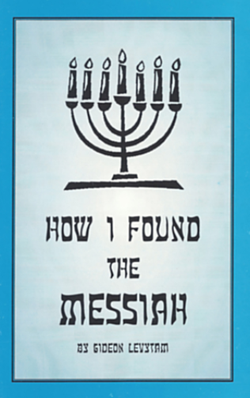
Follow Gideon Levytam's journey and discover how he was led by God, through a series of exciting circumstances, to find the One his people are still waiting for.
Past Episodes

Featured Offer
Follow Gideon Levytam's journey and discover how he was led by God, through a series of exciting circumstances, to find the One his people are still waiting for.
About Holy Scriptures and Israel
As time passed by, the Lord Yeshua took dear brother John Van Stormbroek to himself. The ministry of Holy Scriptures and Israel continued with additional development. In the early 1990’s, a weekly morning Bible class began which brother Gideon Levytam led regularly in the City of Toronto. This weekly open Bible class was held in the Willowdale assembly meeting hall. Eventually, a second mid-week evening Bible class was added. In April 2002, the need for an additional outreach Bible teaching meeting arose. We begun a Saturday (Shabbat) ministry meeting in which a systematic teaching of God’s word is presented to all who attend. Together we learn God’s Word, pray for each need and the salvation of Israel, and sing songs of worship unto our God, praising Him and our Lord Yeshua the Messiah.
In Mid 2004 we started to air on Joy 1250 Radio station a 15 minute Bible teaching program called "The Holy Scriptures and Israel" with Gideon Levytam. The broadcast teaches God’s word from a Hebrew Messianic perspective and has proved to be a blessing to many. It's now aired seven days a week. Our prayer is that many more of our Israeli people will have a clear understanding of who Yeshua is, why we all need him, and come to know him as their Lord and Messiah.
About Gideon Levytam
Contact Holy Scriptures and Israel with Gideon Levytam
426 Simcoe Street
Niagara-on-The-Lake
Ontario L0S 1J0
Canada
(905) 325-1234