

Joel 1:1-7, Part 1


Introduction, The Day of the LORD (The Future Tribulation) Part 1
Unidentified Speaker: Shalom. Holy Scriptures and Israel is a ministry designed to share with the Jewish people the good news of the Lord Jesus Yeshua the Messiah, and to instruct Christians on the Jewish roots of their faith. And now, teaching God's word from a Hebrew messianic perspective, here is Gideon Levytam.
Gideon Levytam: Well, shalom everyone. Thank you for your patience with us. I would like you please to go to the Old Testament today with me. I want you to turn to the prophet Yoel, as we call him in Hebrew, is English is Joel, in Hebrew is Yoel. And I would like to take for a few meetings together that Prophet Joel. And the reason that I chose to take the Prophet Joel, or as we call him in Hebrew, Yoel, is because of the previous messages that we have had concerning the feast of Shavuot, the feast of weeks. The Prophet Yoel is an essential book to study, and why he is very important in the minor prophets is because Yoel is prophesying, is speaking forth concerning the future of the people of Israel.
Yoel was a prophet that proclaimed concerning a period of time which is known in the Bible, in the Hebrew scriptures, as the Day of the Lord, Yom Adonai. And I would like to follow up on this book because it will help us to distinguish and to understand the plans that God had for the nation of Israel and to see how it comes about. Yoel is very practical. Yoel is very up to date, very much realistic, loving the people of Israel, loving the God of Israel, loving the truth of the scripture, and he wanted to communicate with his people things concerning the future time. We are going to read a few verses, first of all, if you open that book, we are going to read one point at a time.
We are going to move through that book. By the way, in the English, we have three chapters to the book of Yoel. In the Hebrew, it's a little bit different. We're going to talk a little bit about that as well, but we can see it's not a long book. It's one of the shortest books in the Old Testament, and yet Yoel has much to say that will be very helpful for us. Listen to what we read in the first verses of the prophet Yoel of the first chapter. The word of the Lord that came to Joel, Yoel, the son of Petuel. Hear this, ye old men, and give ear, all ye inhabitants of the land. Has this seen in your days, or even in the days of your fathers?
Tell ye your children of it, and let your children tell their children, and their children another generation. That which the palm worm hath left hath the locust eaten, and that which the locust hath left hath the cankerworm eaten, and that which the cankerworm hath left hath the caterpillar have eaten. Awake, ye drunkards, and weep, and howl, all ye drinkers of wine, because of the new wine, for it is cut off from your mouth. For a nation is come up upon my land, strong and without number, whose teeth are the teeth of a lion, and he hath the cheek teeth of a great lion. He hath laid my vine waste and abarked my fig tree.
He has made it clean bare and cast it away. The branches thereof are made white. And I'm going to stop here because that is where the break is found in this first chapter. Let me give you some introduction concerning this book, Yoel, Joel. Joel, in the Hebrew scriptures, in the Tanakh, find itself as one of the 12 minor prophets. It is called minor prophet not because it is not an important book, not because the message there is not important, but simply because the message and the book itself is not as long as other books such as Isaiah and Jeremiah and Ezekiel. That's why it is part of what is called by the Jewish rabbis today as the minor prophets.
There are 12 minor prophets, and really chronologically, the book of Joel was basically the second one that had been written in the history of Israel. Around 800, 900 BC, that book had been written and proclaimed to the Jewish people. You know, it is interesting when we read the minor prophets that there were certain minor prophets prophesied to the people of Israel, the northern tribes. Certain minor prophets have prophesied to the people of Judah, the southern part of Israel, and certain minor prophets have prophesied to the people of Judah after Judah have come back from captivity. Joel was preaching before the people of Judah went into captivity.
His Hebrew name is Yoel. Yoel is two Hebrew words, Ya or Yo and El. El means God. Ya or Yo is a really portion of the Hebrew name of God Jehovah. Yoel really simply means Jehovah is God. The Lord is God. Verse 1 tells us that he was a son. In English, it says, the word of the Lord that came unto Yoel, notice verse 1, the son of Petuel. Again, it is an abbreviation or short for two Hebrew words. Again, the word El is God, but Petu or Patuh may speak of the openness or the largement of God. He was a man that by the name of Yoel, who was the son of his father's name was Petuel, and some suggest that it simply means the enlargement or the openness of God's heart towards the nation of Israel.
Now, we do not know much about him because really we don't read so much about the background where he was born and the rest of his family. The only thing that we read that the word of the Lord came unto Yoel, the son of Petuel. His name and his father's name. His name is Yoel, his father's name is Petuel, the enlargement of God. Thirdly, by way of introduction, Yoel's prophecy was very important. Yoel's prophecy was speaking about coming judgment upon the people of God, upon the nation of Israel. Remember, always bear in mind that privilege come with responsibility. It is applied to Israel historically, it is also applied to us today.
We oftentimes have to say that we like privileges, but we do not like responsibility. This is a problem that always exists. It exists in our life individually, it exists in our families, it exists in a local church, a local assembly, it exists in an entire church. We like privileges, but we oftentimes neglect responsibility. Well, here we find out that Joel or Yoel was speaking to the nation of Israel. His prophecy was concerning coming future judgment that God will have to pour out upon Judah, upon his people, whom he loved dearly, but he must discipline and judge. And his prophecy is essential because he's going to be teaching them from practical things that have happened in the time where they were living.
You remember Jesus oftentimes, where Yeshua the Messiah, when he was speaking to his disciples, he was walking with his disciples in Galilee, for example, and all of a sudden he's come up with a parable. He says, for the kingdom of heaven is like a man goes out to sow seeds. Some fell by the wayside, some fell among thorn, some fell in a rocky ground, some fell upon good ground. This is a Jewish or a biblical way of telling things. You look at the natural, you look at the experiential, you look at the things that actually did exist, and you take those things and you apply them spiritually, or you show them how those things are coming about.
What Yeshua was speaking to his disciples, he also meant spiritually. Just like the Israeli sower went down in Galilee and sowed seeds, and Yeshua could point to them and he says, look at these seeds, they fell in this kind of ground. Look at these seeds fell in among thorns. You see, what he was telling them physically that actually happened at that time, spiritually he wanted to show them that's the way it is spiritually. As we go around and sow the word of God, the word of God will fall upon various grounds, rocky grounds, among thorns, and by a wayside, and good ground. It is only the good ground that the seeds will fall into, that there will be fruit, that there will be something for God.
And just like you and I would go and present the message of the Messiah today, the word that God used us to proclaim will fall upon various ground. Some will fall also among good ground and bring forth much fruit. Yoel right now is showing the people of Judah about an invasion of locusts that occurred in among the people of Israel, and you showing them just like this invasion of locusts that took place in the land of Israel and destroyed all the crop. That's the kind of invasion that is going to come in a future day and will totally destroy the crop, and man will be destroyed because of the rejection of God.
And you will see this as we are going to follow this one step at a time. So it just like there was a destruction of the crop in the land of Israel because of the invasion that happened historically, also there is coming a day where there will be invasion that will come upon the people of Israel. And so this is the prophecy that Yoel is going to speak about. Another thing that is important by way of introduction that we have to bear in mind here, the theme of the book, really, of the book of Yoel, is the day of the Lord. The day of the Lord. I mentioned it before, and I'll mention it again. Every time in the Old Testament, in the Hebrew scripture, in the Tanakh, the word the day of the Lord is mentioned.
It is always in connection with the time of trial and troublous time. It's not in connection with pleasant things. The day of the Lord biblically is a day of judgment. It's a day of what we know it today in the New Testament language is tribulation. Tsarat Yaakov from the prophet. Tribulation, a time of trial, and that is the theme of the book. Notice for a moment in chapter 1 and verse 15, which we didn't read today, it says, Alas for the day of the Lord is at hand. Notice chapter 2 and verse 1. Blow the trumpet in Zion, sound an alarm in my holy mountain. Let all the inhabitants of the land tremble, for the day of the Lord cometh.
Notice chapter 2 and verse 11. And the Lord shall utter his voice before his army, for his camp is very great, for he is strong and executeth his word, for the day of the Lord is great and very terrible, and who can abide in it? Notice in verse 31 of chapter 2, verse 31, the sun shall be turned into darkness, the moon into blood, before the great and terrible day of the Lord come. Notice chapter 3 and verse 14, multitudes in the valley of decision, for the day of the Lord is near in the Valley of Decision. This is very clear. Every time Yoel is speaking about the day of the Lord, it is associated with trouble.
It is associated with judgment. It is associated with God unleashing his wrath upon mankind here in this world. A holy and a righteous God is judging a world that refused to accept what he offered to him. Now, one more point, or actually two more points that we want to mention. In the New Testament, in the New Covenant, in the Brit Hadasha, twice this book Yoel is being quoted. One time we've already dealt with when we studied the feast of Shavuot, the feast of weeks, in Acts chapter 2, verses 17 to 21. You can look at it in your own time at home. The second time that it is mentioned, it's mentioned in Romans chapter 10 and verse 13.
Romans chapter 10 and verse 13, and I just want to read that verse. Romans 10, verse 13, for whosoever shall call upon the name of the Lord shall be saved. The book of Yoel is being quoted two times in the Brita Hadasha, and every time it is quoted, it's very interesting, it is quoted in the section that specifically has to do with the people of Israel. Acts chapter 2 has to do with the Jewish people, you remember, who gathered together at the birth of the church, and Peter used this as an object lesson to speak to them. And in Romans chapter 10 and this verse, verse 13, it has to do with, you remember that Paul is longing for the restoration of Israel, and he said, Brethren, my heart's desire and prayer to God for Israel that they might be saved.
And he's using a certain portion, a verse, one verse from Joel, where he's quoting, Whosoever shall call upon the name of the Lord shall be saved. Very interesting, the way in which these two verses had been quoted in the New Covenant, in the Brita Kadasha. Now this is by way of introduction. Basically, beloved brothers and sisters, when we are going to study, you notice that Yoel is going to speak about three invasion. Number one is something that occurred in his time. Number two, something that will occur in the tribulation. And number three is something that will occur again in the tribulation at the end of the tribulation time.
Let me add to it. Number one, the first invasion will be or is locusts invasion. Invasion of insects which destroyed the land of Israel. Number two, he's going to speak about invasion in the tribulation period, which is a demonic invasion. We're going to get to that in due time. And number three, he's going to speak about the third invasion that has to do with human invasion. Insect, locust invasion, demonic invasion, and human invasion. All these invasions of the land are mentioned here somehow in the text, and also we can connect it with other passages which we are going to go through as we are following step by step through the book of Yoel.
By the way, in Hebrew, locusts is arbe in Hebrew, and oftentimes in the Bible, arbe, the locusts, have been mentioned as a judgment that God will bring upon mankind. And I'll show you this as we are going to follow up verse by verse. So, verse 1, it's simply the introduction or the beginning where we are learning about the call or the word that the Lord have given or came to Yoel, the son of Petuel. So now, if you turn back to this chapter right now, Yoel chapter 1, in verses 2 and 3 and 4, we have the message that is being declared to the people of Judah. Look at the message. He began by questioning in verse 2, and he says, hear this, ye old men, and give ear, ye or all ye inhabitants of the land.
Has this been in your days, or even in the days of your fathers? Tell it to your children of it, and let your children tell their children, and their children another generation. That which the palmer worm has left has the locust eaten, and that which the locust have left has the cankerworm eaten, and that which the cankerworm has left has the caterpillar eaten. In verses 2, 3, and 4, Yoel is asking the older men of the people of Judah a question. He asking them a question in verse 2, and he says, Hear ye this, old men, and give ear, all ye inhabitants of the land. Hath this been in your days or even in the days of your fathers?
The question is, what is the word this? What does he mean when he says, hath this been in your days or in the days of your fathers? You see, what he was telling them is this. At that present time, when Yoel was still there preaching to the people of Judah, apparently what happened, there was a swarms of locusts who came over the land of Judah. The swarms of locusts came and they destroyed completely everything that had life there. We can see that as we are going to move on. The locusts came and one after another they destroyed every living thing that existed in the land. And you know, it left the land in such a condition that the famine came into the land.
The people were hungry. The people were in great need. The people were began to mourn and to weep, and the condition had been so bad among the people of Israel, the people of Judah, because swarms of locusts came, and you see Yoel asking the old man, and maybe people were perhaps 100 years old or 90 years old, I don't know, I'm just giving an illustration in our age, somebody who is older person, that when you and I were not even born, that person remembers certain things that he can tell us. And he's asking them, old man, tell me, did it happen in your days, something that happened today here or these days in our land?
Tell us, he said, or he said, what about your fathers or before you? Do you remember your family or your forefathers ever telling you of events that have happened such as this event? Apparently, it didn't happen in the time of the old man before that. It happened at that time, but they could not, there was nothing like that have happened before. And he's telling them in verse 3, he's telling, tell it to your children, and let your children tell their children, and let their children tell to their children. In other words, what he's saying is whatever have happened today in our land, the land of Israel, you tell it to your children so they will tell it to their children, and so they will tell it to their children, the third and the fourth generation.
He says, you better tell them so they can pass it along that nothing like this have happened before. The judgment of God came, and he's giving them the process in which it happened. He giving them in verse 4, he's showing them the 4 waves of locust invasion, one after the other that came and destroy all the land, all the crop in the land of Israel. It says, by the way, you notice in verse 4, it says, that which the palm worm has left has the locust eaten. That which the locust have left has the canker woman eaten. That which the cankerworm has left has the caterpillar have eaten. What we really see here, I know in the English it gives us four different type of names of insects.
It gives us palmerworm, locusts, cankerworm, and caterpillar. But in Hebrew, in the Hebrew language, it is written so interesting, and it doesn't give us name of insects, except one, and that is the locusts, but it gives us a progression whereby things have happened. He doesn't tell us that four different groups of insects came, but he tells us that there is one type of insect, the arba, the locusts, but they came in four stages. Look at the way the Hebrew is saying. Whoever it says here, that which the palmer worm has left. In Hebrew, the word palmer worm is gazam. Gazam simply mean the biter, the one that bites.
The gazam, the first group came and they bited. The first wave of locusts came and the gazam. Gazam is somebody who chewing and chewing and chewing and chewing and chewing, and he moving on. He chews and he chews and he chews. The second thing, it says the locust, in the Hebrew it is arba, the swarmer, the one who is swarming through, coming through the land and taking the leftover that the first group didn't take. Then the next thing he says the canker worm in Hebrew is the word yalech. It's from the lelakek, from the hip, from the tongue, where you lick everything that is left, like a dog will lick everything that is left.
In other words, the third wave of locusts have licked what the second group have left. And finally, in the next point, the caterpillar in Hebrew is the word chasil, and chasil means simply the devourer. In Hebrew, Hasil means to finish, to devour everything. In other words, just visualize with me, dear brothers and sisters, here is a period of time in the history of Israel where God has sent the locusts to destroy all the crops. So one wave came and did what they wanted. They just chewed and took as much as they could, and they flew, continued forward. As they continue forward, the next group is coming.
The next wave of locos are coming. What do they do? They are swarming through. They take their portion and they move on. Then the third group is coming of locos, and what do they do? They lick everything that is left over. And finally, the fourth group is coming, and we call them lechasel or chasil, and they devour anything that is left behind. That's what we really learn here. And you know what he's saying to the people of Judah? He says, you know what? Tell it to your children, the judgment of God, that they will tell it to their children of the judgment of God. That they will tell it to their children about the judgment of God.
Announcer: You have been listening to the Holy Scriptures and Israel with Gideon Levytam. Gideon teaches God's word from a Hebrew messianic perspective. For more information about this ministry, write to Holy Scriptures and Israel, Box 1411, Niagara-on-the-Lake, Ontario, L0S1J0, or visit our website at holyscripturesandisrael.com. You are also invited to Gideon's weekly Bible teaching on Fridays at 11:00 AM and 7:00 PM and Saturdays at 1:00 PM at Willowdale Christian Assembly Hall, 28 Martin Ross Avenue in Toronto. Holy Scriptures and Israel is made possible by your prayers and financial support. If you would like to support the program, visit holyscripturesandisrael.com.
God bless you. Shalom, shalom.
Featured Offer
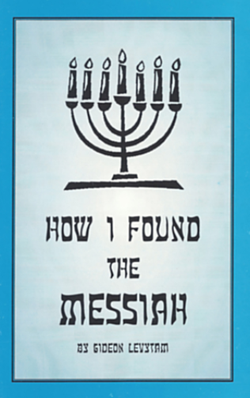
Follow Gideon Levytam's journey and discover how he was led by God, through a series of exciting circumstances, to find the One his people are still waiting for.
Past Episodes

Featured Offer
Follow Gideon Levytam's journey and discover how he was led by God, through a series of exciting circumstances, to find the One his people are still waiting for.
About Holy Scriptures and Israel
As time passed by, the Lord Yeshua took dear brother John Van Stormbroek to himself. The ministry of Holy Scriptures and Israel continued with additional development. In the early 1990’s, a weekly morning Bible class began which brother Gideon Levytam led regularly in the City of Toronto. This weekly open Bible class was held in the Willowdale assembly meeting hall. Eventually, a second mid-week evening Bible class was added. In April 2002, the need for an additional outreach Bible teaching meeting arose. We begun a Saturday (Shabbat) ministry meeting in which a systematic teaching of God’s word is presented to all who attend. Together we learn God’s Word, pray for each need and the salvation of Israel, and sing songs of worship unto our God, praising Him and our Lord Yeshua the Messiah.
In Mid 2004 we started to air on Joy 1250 Radio station a 15 minute Bible teaching program called "The Holy Scriptures and Israel" with Gideon Levytam. The broadcast teaches God’s word from a Hebrew Messianic perspective and has proved to be a blessing to many. It's now aired seven days a week. Our prayer is that many more of our Israeli people will have a clear understanding of who Yeshua is, why we all need him, and come to know him as their Lord and Messiah.
About Gideon Levytam
Contact Holy Scriptures and Israel with Gideon Levytam
426 Simcoe Street
Niagara-on-The-Lake
Ontario L0S 1J0
Canada
(905) 325-1234