

Introduction to Malachi Part 3 of 3


An introduction to the book of Malachi part 3
Gideon Levytam: Shalom. Holy Scriptures and Israel is a ministry designed to share with the Jewish people the good news of the Lord Jesus, Yeshua the Messiah, and to instruct Christians on the Jewish roots of their faith. And now, teaching God's word from a Hebrew Messianic perspective, here is Gideon Levytam.
The study of the book of Malachi, chapter one. Why do you cast me off? Why go I mourning because of the oppression of the enemy? Send out light. Speak about the Messiah. Send out light and your truth. Let them lead me. Let them bring me unto your holy hill and to your tabernacles. Then I will go unto the altar of God, unto God my exceeding joy. Yes, upon the harp will I praise you, oh God, my God. Notice verse five. Why are you cast down, oh my soul? And why are you disquieted within me? Hope in God, for I shall yet praise him who is the health of my countenance and my God.
In other words, during these 400 years of waiting and anticipating the coming of the Messiah, where God did not speak to Israel directly, Israel was to prepare themselves for the coming of the Messiah. But beloved brothers and sisters, when the Messiah finally came, Israel as a nation was not ready to accept him as our Messiah, the Messiah of Israel and the savior of the world. And you remember as the Messiah came and John the Baptist presented him before the nation of Israel, John the Baptist gave warning to the leaders of Israel. And he was telling them that they better repent and turn back to God because the Messiah, the kingdom of God, is at hand. The Messiah is right at the door. Accept him, Israel. And he was pleading with the people of Israel.
And so you can see that there is a link between Malachi the prophet and the Gospel writers and the Apostles because, at least in three books if not more, the prophet Malachi is quoted by the New Testament Hebrew writer. And I would like you with me for a moment to turn to three passages in the New Testament. Malachi chapter 1:2-3 are quoted by the Apostle Paul in Romans chapter nine. So turn to Romans chapter nine with me, please. Malachi chapter 1:2-3. It says here in verse two, "I have loved you," says the Lord. "Yet you say, 'Wherein have you loved me?' Was not Esau Jacob's brother?" says the Lord. "Yet I have loved Jacob, and I have hated Esau, laid his mountains and his heritage waste for the dragons of the wilderness."
Look what Paul is quoting in Romans chapter nine when he is speaking about Israel to the brothers and sisters in the city of Rome. In Romans chapter 9:13, the Apostle Paul said, "It is written: Jacob have I loved, and Esau have I hated. Jacob have I loved, and Esau have I hated." Where did the Apostle Paul take this quotation? He took this quotation from Malachi chapter 1:2-3. We're going to talk about it in the study of this book. When God said, "Jacob have I loved, and Esau have I hated," God never hates anyone. God loves the world, and he gave his only begotten son that all who will believe in him will receive salvation. But it is a biblical way to express the fact that Jacob have I chosen, and Esau I have not chosen. We will talk about it some more when we get to the next verses of Malachi chapter one.
So the first chapter, Malachi chapter 1:2-3 are quoted by Saul-Paul in Romans chapter 9:13. Secondly, Malachi chapter 3:1, and I'm going to read it. "Behold, I will send my messenger, and he shall prepare the way before me. And the Lord, whom you seek, shall suddenly come to his temple, even the messenger of the covenant, whom you delight in. Behold, he shall come," says the Lord of hosts. This Malachi 3:1 is quoted in the Gospels. If you now turn to Mark chapter one, notice this: how the New Testament is quoting the Tanakh, the Old Testament. Mark chapter 1:2. I'll read verses one and two. "The beginning of the Gospel of Yeshua HaMashiach, Jesus the Messiah, the Son of God."
And then notice verse two: "As it is written in the prophets: behold, I send my messenger before your face, which shall prepare your way before you." Mark was writing and quoting what Malachi was predicting about the one that will announce the coming of the Messiah. We know him as Yochanan, John the Baptist. He is announcing. He's the messenger that we spoke about earlier. He will be the one that will prepare the way before the Messiah, as he will come, and Israel should have accepted him. So, once again, Malachi 3:1 is quoted by Mark 1:2, by Matthew 11:10, and by Luke 1:76. Three times in three Gospels, Malachi 3:1 is quoted.
Now the third passage that is quoted by the New Testament writers is in Malachi chapter 4:5-6, which deals with the second coming of the Messiah. I love these verses because those verses show us that one day Israel will be restored and the hearts of the fathers will be restored to the children. I'm reading Malachi chapter 4:5-6. "Behold, I will send unto you Elijah the prophet." Interesting because Pesach, Passover, is now, and the Seder just finished. The service has just finished in various Jewish homes. And in every Jewish home, they will open the door. And the boy or the girl will go and open the door, waiting for the coming of Elijah the prophet to restore the people of Israel back to the Lord.
Where do you think our own people take it from? They take it here from Malachi chapter 4:5-6. "Behold, I will send unto you Elijah the prophet before the coming of the great and dreadful day of the Lord. And he shall turn the heart of the fathers to the children, and the heart of the children to their fathers, lest I come and smite the earth with a curse." That is the last verse of the book of Malachi. Well, it is quoted, brothers and sisters, in Luke chapter one and in Mark chapter nine. But let's just read one verse, Luke chapter one, please. And there you will find it in verse 17. Luke chapter 1:17. In fact, I will read verses 15, 16, and 17 of Luke chapter one.
We read: "For he shall be great in the sight of the Lord, and he shall drink neither wine nor strong drink. And he shall be filled with the Holy Spirit even from his mother's womb." This is speaking about John the Baptist. But then the writer now connects this with Malachi chapter four and the last verse. It says in verses 16 and 17: "And many of the children of Israel shall he turn to the Lord their God. And he shall go before him in the spirit and the power of Elijah to turn the hearts of the fathers to the children, and the disobedient to the wisdom of the just, to make ready a people prepared for the Lord."
So what we really see, dear brothers and sisters, is that there is a link between what Malachi was raised by God to speak to the remnant of Israel in Jerusalem and when the Gospels had their beginning and the presentation of Jesus, Yeshua the Messiah. Many years ago, before I became a believer in the Lord Jesus, the Lord Yeshua the Messiah, I was handed out by my future mother-in-law a complete Bible in Hebrew. And when she gave me the Bible in Hebrew, I thought it would be only the Tanakh, the Old Testament. But to my surprise, I noticed that after the Old Testament, the Tanakh is finished, there's another book, the second half, you might say, of that book, of that Bible.
And when I opened that, in the beginning, I didn't want to open it at all because I knew they were trying to get me to believe in this man called Jesus. But somehow I dared by the spirit of God to open. And the first verse that I read in the New Testament, in the Brit Chadashah: "The book of the generation of Yeshua HaMashiach, Jesus the Messiah, the Son of David, the Son of Abraham." Immediately I could see the link between the Tanakh, what is called today the Old Testament, the Hebrew scriptures, and the Brit Chadashah, the New Covenant, the New Testament. And I could see the link.
The link is that the same people to whom God spoke, our own forefathers, the people of Israel in the days of Malachi, are the same people, or a few generations later, of the same nation who are descendants of Abraham, Isaac, and Jacob. And this man by the name of Yeshua the Messiah was the Son of David, Ben David, the Son of Abraham, Ben Avraham. There is a link between Malachi and Matthew, the Old Testament and the New Testament, the prophets of old and the Apostles who gave us the scripture in those days when Yeshua called them to serve him in the land of Israel. So there is a link, but there is also a quotation. Three times or three verses from the book of Malachi are quoted in the New Testament, in the Brit Chadashah, the New Covenant.
Now, a few more points, brothers and sisters, just bear with me. What is the theme? Anytime you study any book in the Bible, you have to ask yourself: what does God seek to communicate with the readers? Every time the Apostles wrote a letter, what is the reason why the Apostles, the Shlichim, wrote a letter? For example, in Galatia, there was a problem: legalism. So the Apostle Paul wrote a letter to the Galatians. In Colossae, there was another problem: they were not holding up the head. The Messiah was not acknowledged as the head of the body of Christ. The book of Colossians was written.
The book, for example, of Philippians was written because there was joylessness and there was friction among some of the believers. So the Apostle wrote them that the joy of the Lord is our strength. He said to them, "Rejoice evermore." There was a lack of joy, and he wrote the book of Philippians. The book of Corinthians, for example, there was a problem. There was a problem in a local assembly at Corinth. So the Apostle Paul took the whole letter, First Corinthians, and he wrote them and described the problem that existed in the city of Corinth, and he wrote them that letter.
It's the same thing when it comes to the book of Malachi and any other prophet that spoke to our people, Israel. The theme was that he gave them a message to prepare themselves before the Messiah was going to come. And Israel, who were suffering for so many generations, he showed them that the reason that they were suffering is not because of anything that God had done, but they suffer because of their very own disobedience to the Lord. So Israel was wondering if God loved them at all.
And God responded through Malachi, and he showed them point by point, "I love you. I care for you. I have chosen you, but you departed from the will of the Lord." That's why he is writing to them this book of Malachi, to prepare Israel for the coming of the Messiah and not to assume that God didn't love them. God surely loved his own people. There are actually in scripture four verses that I really love to read about the love of God. First of all, in relationship to the world, John 3:16: "For God so loved the world that he gave his only begotten Son that whosoever believeth on him should not perish but have everlasting life."
Secondly, in relationship to Israel, Jeremiah chapter 31: "I have loved you with an everlasting love," Jeremiah 31:3. Thirdly, in relationship to the body of Christ, the body of Messiah, where we read in Ephesians chapter five that Christ, the Messiah, died for the assembly, for the ecclesia, for the church. And then finally in the book of Galatians where the Apostle Paul said, "The Son of God who loved me and gave himself for me," Galatians 2:20. God's love to Israel, to the assembly, to the world, and for each and every one individually is sure. The problem is not with God. The problem is with us, with men who fail to submit to the word of God.
Now go back to Malachi chapter one. A couple more notes, a couple more points, as part of the introduction before we conclude. Look at verse one once again. Look at verse one, and I want you to notice that in verse one, it begins with the word "the burden." The burden. The Hebrew word is "massa," as I mentioned earlier. Massa is something that you carry, and it's very heavy. And God had a load to say, to speak to Israel about. Israel departed from the Lord, and God raised Malachi, the servant, to give them something that was burdening the heart of God.
It was heavy, you might say. And Malachi, he had to carry this load, you might say, and to dish it to Israel and to bring it to Israel and to expose the condition that existed in our own nation's history. So that load that he was carrying is a load of sharing with the people how sad things were in those days, even though they are already back to the land. They built the temple, they go through the motion, they have the sacrificial system, but the heart was not with them—not with all, of course.
The priests were away from the Lord. The people themselves were away from the Lord. There were things that happened during those days, brothers and sisters, as we mentioned: sorcery, adultery, false swearing, oppression, not fearing the Lord. That was a burden on the heart of Malachi as he was speaking to his own nation that he loved so much. So it became a load, a heavy, heavy load that he carried as he's preaching the word of God.
Now, finally, I want you to notice that in this book of Malachi, there's really not four chapters. In the Hebrew text, there are only three chapters, while in the English text, there are four chapters. Chapter four is actually verse one is verse 19 of chapter three in the Hebrew. Verse two is verse 20, verse three is verse 21, verse four is verse 22, verse five is verse 23, and verse six is verse 24. There are actually only three chapters in the Hebrew text. For one reason or another, in the English text, we have four chapters.
But the manner whereby this book was presented or given is that God made a declaration, and Israel responded with a question. God said something about Israel, and Israel is responding and says, "Wherein have we done this and that?" So let me just give you this, and then we're going to stop with the introduction. Notice in chapter one and verse two: God declared, Israel responded. "I have loved you," says the Lord. God's statement. Israel responded: "Yet you say, 'Wherein have you loved us?'"
Look at verse six. God declared once again. In verse six he says, "The Lord of hosts says unto you, oh priests, that despise my name." Israel responded, and they say, "You say, 'Wherein have we despised your name?'" Notice again in verse seven. God declared something: "You offer polluted bread upon my altar." And look at Israel's response: "Yet you say, 'Wherein have we polluted you?'"
Notice now chapter two and verses 13 and 14. God declared, verse 13: "And this have you done again, covering the altar of the Lord with tears, with weeping, and with crying out in so much that he regards not the offering anymore or receives it with good will at your hand." And then verse 14: "Yet you say, 'Wherefore? Why? We haven't done it.'" Notice that. Look at chapter two and verse 17. Again, he said, "You have wearied the Lord with your words." God is speaking through Malachi, and then Israel said, "Yet we have said, 'Wherein have we wearied him?'" Israel responded, "We haven't done it. Why have we done such a thing?"
Look at then chapter three and verse seven. Again, God declared something: "Even from the day of your fathers you are gone away from my ordinances and have not kept them. Return unto me, and I will return unto you, says the Lord of hosts." And then notice what Israel said: "But you said, 'Wherein shall we return?'" "We have already. We are here. We are okay." Notice in chapter three and verse eight. God said, "Will a man rob God? Yet you have robbed me," God said to Israel. And look at what Israel's responding: "But you say, 'Wherein have we robbed you?'"
And finally in verse 13: "Your words have been stout against me, says the Lord." And then Israel: "Yet you say, 'What have we spoken so much against you?'" In other words, beloved brothers and sisters, we have here a conversation, you might say. God exposes his people Israel, and Israel tries to respond with, "We haven't done that. We are not that bad. We haven't done that or haven't done that. We are going through the motion. You see, we have the temple, we have the sacrificial system, we have everything. We have gone through the motion. Why do you say this about us?"
Seven or eight times, God declared a statement, and Israel responded, "We haven't done so." It's like, if we might say that in closing, it's really exactly what is going on today in a professing church, a professing assembly of our Lord Yeshua the Messiah. There is a form. There is a religion. There is a system of man. But many times, our hearts are not in. We are many times saying one thing and doing another thing. We have a religion.
But many times we have to admit—and again, I'm not speaking about anybody, I'm speaking for myself, every one of us have to speak for himself—we fail the Lord in so many ways. And in order for us to be victorious believers, we need to humble ourselves before the Lord. We need to realize—we had this in our Bible class yesterday—we have to realize that God resists the proud but he gives grace to the humble. Humble yourself under the mighty hand of God, and he will exalt you in due time.
God wants his people, he wants us, like he wanted Israel our people of old, to have a healthy relationship with him. And when we fail, we fail, we have to be honest enough to go before the Lord on our knees and say, "Lord, I fail. And I thank you that you knew that ahead of time, that you are willing to restore me." And the Lord will restore us and bless us.
So by way of introduction, Malachi 1:1: "The burden of the word of the Lord to Israel by Malachi," by my messenger, by the one that he raised to share with Israel the concern that God had for his people Israel and to prepare them for the coming of the Messiah. Well, may the Lord bless his word. May the Lord help us to grow and to appreciate his word today.
Featured Offer
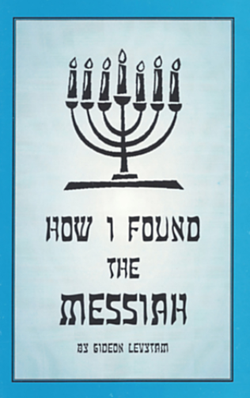
Follow Gideon Levytam's journey and discover how he was led by God, through a series of exciting circumstances, to find the One his people are still waiting for.
Past Episodes

Featured Offer
Follow Gideon Levytam's journey and discover how he was led by God, through a series of exciting circumstances, to find the One his people are still waiting for.
About Holy Scriptures and Israel
As time passed by, the Lord Yeshua took dear brother John Van Stormbroek to himself. The ministry of Holy Scriptures and Israel continued with additional development. In the early 1990’s, a weekly morning Bible class began which brother Gideon Levytam led regularly in the City of Toronto. This weekly open Bible class was held in the Willowdale assembly meeting hall. Eventually, a second mid-week evening Bible class was added. In April 2002, the need for an additional outreach Bible teaching meeting arose. We begun a Saturday (Shabbat) ministry meeting in which a systematic teaching of God’s word is presented to all who attend. Together we learn God’s Word, pray for each need and the salvation of Israel, and sing songs of worship unto our God, praising Him and our Lord Yeshua the Messiah.
In Mid 2004 we started to air on Joy 1250 Radio station a 15 minute Bible teaching program called "The Holy Scriptures and Israel" with Gideon Levytam. The broadcast teaches God’s word from a Hebrew Messianic perspective and has proved to be a blessing to many. It's now aired seven days a week. Our prayer is that many more of our Israeli people will have a clear understanding of who Yeshua is, why we all need him, and come to know him as their Lord and Messiah.
About Gideon Levytam
Contact Holy Scriptures and Israel with Gideon Levytam
426 Simcoe Street
Niagara-on-The-Lake
Ontario L0S 1J0
Canada
(905) 325-1234