

Introduction to Lamentations Part 2 or 3


An introduction to the book of Lamentations
Guest (Male): Shalom. Holy Scriptures and Israel is a ministry designed to share with the Jewish people the good news of the Lord Jesus Yeshua the Messiah and to instruct Christians on the Jewish roots of their faith. And now, teaching God's Word from a Hebrew Messianic perspective, here is Gideon Levytam.
Gideon Levytam: The study of Lamentations chapter 1, introduction, sad condition that happened to our own people at about 586 BC. As we go back and we look at this picture of the Lamentations, we notice immediately that in Hebrew the name of the book is actually not Lamentations. In Hebrew we call it Eicha.
Eicha simply means how. In fact, the name of the book is How. How is it possible that the chosen people of God find themselves in such a condition, a people and a city that was favored by God? How is it even possible that this thing would happen to the people of God? So while in Hebrew the word is Eicha, in English the word is Lamentations.
And how did we get the word Lamentations? Because the 70 Rabbis who translated the Hebrew scriptures into Greek at about 250 years BC—it's called the Septuagint—they named the book of Eicha in the Greek from the Hebrew Eicha to where we get the name Lamentations. And why did they name it this way? It's because of the content of the book.
The book contained lamentations, or we might call it in another word, it contained weeping and sorrowing and an expression of care for the city and the people that have been taken away from the city of Jerusalem. In fact, in the Greek it's called Threnoi, which simply means lamentations in plural. And lamentations simply means the cry, the lamentation, the weeping over a situation that happened in the life of one person or a nation.
And that's how in the English we get the name Lamentations. And as we look now in this picture here, you notice now that in the Hebrew scripture, the Tanakh, in the order of the Hebrew scripture, the book of Lamentations is part of the Writings. If you would open a Hebrew Bible today in the Hebrew text, the order: the Torah (Genesis, Exodus, Leviticus, Numbers, Deuteronomy), the Prophets (beginning from Joshua all the way to Malachi), but when it comes to the Writings: Psalms, Proverbs, Job, Song of Solomon, Ruth, Lamentations, Ecclesiastes, Esther, Daniel, Ezra, Nehemiah, and 1st and 2nd Chronicles.
In the Old Testament, the Hebrew scripture, the book of Lamentations is part of the Writings. But in the English which you and I hold ourselves today, the book of Lamentations is placed immediately after the book of Jeremiah, the prophet Jeremiah. After that you have Lamentations and oftentimes when you open your Bible you notice it says "The Lamentations of Jeremiah." The English put it in the order in which it was placed when the Hebrew was translated into the Greek by the 70 Rabbis who translated it into Greek for the benefit of the world, and therefore this is placed in the order of events rather than the order in which it was originally placed in the Hebrew text.
Now, just bear with me by way of introduction because it is very important to introduce the book before we even get to the actual text itself. Now there were three deportations that happened in the history of our people Israel. In 605 BC, Daniel and his friends were carried to Babylon and some of the articles that were taken by the Babylonian. Later on in 597 BC, Ezekiel was carried away out of the land of Israel. And finally at 586 BC, we read or we understand that now the whole city of Jerusalem was destroyed, the walls were broken down, the temple was burnt with fire.
And at that time Jeremiah, that is Yermiyahu, was still in the land of Israel and he himself was one of the only ones, you might say, from the prophets of Israel that was literally there to experience the destruction of Israel. And if you look at the first slide that we have here, you can just imagine as they watch the condition there. The walls are broken down, the people of Israel are being taken away, the temple is destroyed, and he's lamenting, the people are lamenting and weeping. And if you can look at this, he's crying to God as he sees the condition that is existing there in the city of Jerusalem.
It had been said that in July, the month of July, on the 9th of Av, the city of Jerusalem was burnt with fire. I want you to notice here that in the Writings there are five books known to be in Hebrew Megillot, scrolls. It begins with the Song of Solomon, Ruth, Lamentations, Ecclesiastes, and Esther. These five scrolls—we call them scrolls or in Hebrew Megillot—each one of these five scrolls are read during a different season in Jewish worship in the synagogues today.
For example, the first one, the Song of Solomon, is usually being sung in the feast of Passover in the synagogue. Why? Because the Song of Solomon speaks about the relationship between King Solomon and Shulamite, speaks of love and God in love brought the people of Israel out of the land of Egypt and redeemed them unto Himself. Then we have the book of Ruth immediately after, and the book of Ruth is usually being read in the synagogue during the feast of weeks, Pentecost.
Why? Because Pentecost, the feast of weeks, the gleaning was there and everyone was gleaning like Ruth the Moabitish woman, she gleaned in the field of Boaz. And what we know very well that during the feast of Shavuot, the people of Israel were called to bring all that which they have gleaned during the early days of the spring and they brought it to give thanks to the Lord during the feast of Pentecost. We jump for a moment over Lamentations and the book of Ecclesiastes that is mentioned also after Lamentations.
The book of Ecclesiastes is usually read in a synagogue during the feast of Sukkot, the feast of Tabernacles. And why? Because Ecclesiastes reminds us that there will be an end. "Remember your creator in the day of your youth." You realize that you're not going to be here forever, you're going to have an end. And therefore you have to make sure that you have a relationship with God. And the feast of Tabernacle, Sukkot, brings us to a climax, to an end of the seven feasts of the Lord which will ultimately bring the celebration and it speaks about the Messianic kingdom.
We also notice that we have the fifth Megillah is the book of Esther. And when is Esther usually read? During the feast of Purim. The feast of Esther, the whole book of Esther, the whole scroll of the book of Esther is being read during this time in a synagogue. Why? Because it reminds us how supernaturally God has delivered our people from Haman, that wicked man who wanted to kill all the Jews. And how the hands of God—even though the name of God is not mentioned in the book of Esther—yet the hand of God who raised someone like Esther the queen and Mordecai the Jew.
Mordecai is the one that told to Esther, "Perhaps you came to this situation in your life to be the queen for such a time as this." But as I mentioned, there is the fifth scroll called the Lamentations. And that book of Lamentations which we are going to study together is oftentimes read during the month of Av. We call it Tisha B'Av, the 9th of Av. Why? Because on the 9th of Av in the Hebrew calendar, the temple in Jerusalem was burnt with fire by the Babylonian.
And not only this, beloved brothers and sisters, because on the 9th of the Hebrew month of Av, which is the 5th month in the Hebrew scripture, also in 70 AD, on the 9th of Av, the second temple was destroyed by the Romans. In fact, in Jewish history, the Rabbis look at the 9th of Av and they record many atrocities that happened to the people of Israel during the month of Av on the 9th day of the month of Av. We call it in Hebrew Tisha B'Av, the 9th of Av.
And the 9th of Av is not a biblical holiday that is found in Leviticus 23, one of the seven feasts of the Lord. But the month of Av became to all Israel a month or a day of the year that is very similar to the day of atonement when there is mourning, when there is weeping, where there is sorrow, where there is remembrance of what happened to the people of Israel and how the temple had been destroyed. And now the second temple in 70 AD was destroyed.
And I wanted to remind you that it was Yeshua, Jesus, our Messiah, who said in Luke chapter 21 verse 24, "They shall fall by the edge of the sword, and they shall be led away captive into all nation, and Jerusalem shall be trodden down by the Gentiles until the times of the Gentiles be fulfilled." So the times of the Gentiles began in 586 BC on the 9th day of the Hebrew month of Av where the temple was destroyed and the Jewish people had been carried away into Babel.
What a sad, sad condition that existed in those days that brought about this man by the name of Jeremiah to lament and to write these five poems or five songs of sorrow over his own people Israel, the city of Yerushalayim, and the temple of God that was burnt with fire. In fact, I would like to suggest this: that had we had the condition, the spiritual condition that Jeremiah had, we would also lament over the condition of the people of God today who are divided, who are scattered, who are broken to pieces.
Whom the Lord is outside knocking at the door as we read in Revelation chapter 3 in the day of the Laodicean. "Behold I stand at the door and knock. If any man hear my voice and will let me come in, I will come in and sup with him and he with me." Because the Lord is outside, knocking on the door, desiring to come in. And no wonder, beloved brothers and sisters, we don't have to blame anybody, we have to look at our very own heart.
I remember days ago when I was a younger believer, I remember when we used to go to meeting and had prayer meetings—now I'm speaking about 40 years ago—where the brethren were praying and crying over family that are unsaved, souls that are lost, broken condition, division among the people of God. I remember in some small ways. And think about it, beloved brothers and sisters, had we had the heart of the Apostle Paul, Sha'ul Paul, who was so burdened with the condition of the assemblies, who said to the Ephesian, "I know that after my departure, grievous wolves will come, will not spare the flock."
And he says, "I remember that for two years with tears I shared this with you." The Apostle Sha'ul Paul said this to the elders of the people of Ephesus. He was broken before the Lord, like Yermiyahu, who was broken before the Lord over the condition of the people of God. But of course, sadly, we are not in such a spiritual state and therefore we carry on. "Oh yes, we are believers, we go to heaven, our ticket had been paid for, we are saved," but our hearts are not stirred within us in a way that God had expected from us to have.
And you notice, beloved brothers and sisters, as we're going to study the book of Lamentations, Jeremiah was not pointing the finger at everybody else, but he was confessing his sins, the sins of his people. Like Ezra, like Nechemia, like Daniel, who never only blame everybody else, "All are wrong and I'm the only one who is right." They were broken before the Lord and they were weeping before the Lord and saying, "We have sinned before you." Not they, but they included themselves.
These are the kind of men and women of God that we can learn from. For whatsoever things were written aforetime, they were written for our learning that we will learn from that and apply it to our own heart so we will be men and women, brothers and sisters, boys and girls in some small measure like this man called Yermiyahu. And so we just by way of introduction, I like you to bear with me as I'm giving you some additional information.
Turn to the book of Jeremiah for a moment itself, just before Lamentations. We read the first verse in Lamentations chapter 1, "How does the city sit solitary, that was full of people! How is she become as a widow! She that was great among the nation and princess among the provinces, how is she become tributary, to become a slave!" Then notice what we read in Jeremiah chapter 1 about the man Jeremiah himself. First of all, the name Jeremiah comes from the Hebrew word Yermiyahu.
The Hebrew word Yermiyahu: Yarem, Yah, Hu. "May Jehovah be exalted." Or some suggest that "Jehovah will exalt us." He is the one that is able to Larem, Leharim, Leromem, Legadel, to raise and to lift us up out of the dust and the condition that we find ourselves in. In Jeremiah chapter 1 and verse 1, 2, and 3, we read of him. It says, "The words of Jeremiah—or Yermiyahu—the son of Hilkiah, of the priests that were in Anathoth in the land of Benjamin, to whom the word of the Lord came in the days of Josiah the son of Amon, king of Judah, in the thirteenth year of his reign."
"It came also in the days of Jehoiakim the son of Josiah, king of Judah, unto the end of the eleven years of Zedekiah the son of Josiah, king of Judah," and notice at the end of verse 3, "unto the carrying away of Jerusalem captive in the fifth month." Jeremiah was called by the Lord to be a servant and a prophet among our people of Israel, and he was the one that was called by God in the days of Josiah. Josiah was a godly king who was awakened to the fact that Israel had violated the word of God and he restored the worship of the Lord.
Josiah became a king at 627 BC. So Jeremiah was preaching to the people of Israel from about 627 BC all the way to about 586 BC until the carrying away of the Jewish people to Babylon. If you notice, it's nearly 40 years that Jeremiah was preaching and prophesying to the people of Israel, warning our people and saying to them, "Beware, judgment of God will come, listen to the word of the Lord, return O Israel back to your God."
But Israel did not listen to the words of Jeremiah. And as we mentioned here, by 586 BC, the Jewish people were carried away by the Babylonian to the land of Babel. It is also interesting to note here that Jeremiah's father was a priest. You notice verse 1, "The words of Jeremiah the son of Hilkiah, of the priests." His father, Hilkiah, was a Levite, a priest. And therefore Yermiyahu himself was a priest also. He was a priest and a prophet at the same time.
And where did they live? According to verse 1, "The priests that were in Anathoth in the land of Benjamin." Anathoth is about five miles north of Jerusalem today and it was a little place or a city that was allotted by the people of Benjamin to the Levitical priesthood. Every tribe—because the Levites did not have any possession in the land of Israel—so every tribe was to give a little place or a location where the Levites, the Leviim could live.
They didn't have an inheritance here in this world, or even in the land of Israel. They were the ones that were the priests, they were the ones that were leading the people of Israel in their worship. And they were the ones who lived in various towns of the portion of the land that belonged to the various tribes of the people of Israel. And so Jeremiah prophesied for about 40 years to our own Jewish people from the time of Josiah until the time where the Jewish people were carried away to Babylon.
And then he himself eventually had been taken, according to Jeremiah chapter 43, he was taken to the land of Egypt and there he stayed for a while when the Jewish people were carried away. And you can just imagine as he was carried away, he's looking back and he sees the condition of the city, that the temple is burnt, the smoke is running above, the walls are broken to pieces and the Jewish people are carried away and he began to put down in pen these lamentations. One lamentation after another as he's lamenting over the condition of the people of Israel.
Now there are some lessons that we have to bear in mind that we learn from the book of Lamentation. Again, look again, the name Lamentation, in Hebrew the word is Eicha, meaning how. How is it possible that the condition are like that? How is it possible that the city that sits solitary now, that was full of people, look what happened to this city! Desolation, carried away the Jewish people away and he began to, you might say, sing and lament over the people whom he loved so much.
Now there are certain lessons that we learn as we're going to study this book together. And I would like to suggest that there are three lessons that we learn from the book of Lamentation. The first lesson that I would like to suggest that we learn from the book of Eicha is that God will judge sin. God who is holy, He will punish His own people and we can be definitely assured by the word of God that God will judge His erring people who rebel against Him.
Never mind the world outside, He will judge the unbelieving world. But God will also discipline His own people. He loves His people, He chose His people, He brought them into a relationship with Him, He brought them into the land that He had promised to Abraham, Isaac, and Jacob our forefathers, but when they will rebel against Him, He will definitely discipline the very people whom He loves so much. Let me remind you of a verse that Peter wrote to the assembly to whom he was sharing the word the early days in 1st Peter chapter 4 and verse 17.
Simon Peter said to the brothers and sisters in their locality, 1st Peter chapter 4 and verse 17, "For the time is come the judgment must begin at the house of God. And if first it begin at us, what shall be the end of them that obey not the gospel of God?" God will discipline His people and you know what, brothers and sisters, it's very natural. You and I are parents, and when we have our own children that we love them, when they are at their age under responsibility and we are responsible over them, at times we will discipline them.
Does that mean that we hate them? Not at all. Does that mean that we want their evil or their bad? Not at all. "Whom the Lord loveth he chasteneth, and he scourgeth every son whom he receiveth." It was Solomon who said it in the book of Proverbs. So disciplining His people is natural for God. He loves His people, but when they turn away from Him, what do you think He's going to do? He will have to discipline His own people.
Secondly, that we learn from the book of Lamentation is that there is a consequence to sin. Secondly, there is a consequence to sin, as we find it for example in Galatians chapter 6. And I'll read now another verse in a New Testament, Galatians chapter 6 and verse 7, we learn this from the book of Lamentation. The Apostle Paul said, "Be not deceived, God is not mocked, for whatsoever a man soweth, that shall he also reap." There is no doubt, beloved brothers and sisters, that we learn from Eicha, from Lamentation, from the songs that Jeremiah is singing—the mourning, the lament, the wailing that he wails here—that whatsoever man soweth, he will eventually will have to reap.
Guest (Male): You have been listening to Holy Scriptures and Israel with Gideon Levytam. Gideon teaches God's word from a Hebrew Messianic perspective. For more information about this ministry, write to Holy Scriptures and Israel, Box 1411, Niagara-on-the-Lake, Ontario, L0S 1J0, or visit our website at holyscripturesandisrael.com. You are also invited to Gideon's weekly Bible teaching on Fridays at 11:00 AM and 7:00 PM and Saturdays at 1:00 PM at Willowdale Christian Assembly Hall, 28 Martin Ross Avenue in Toronto.
Holy Scriptures and Israel is made possible by your prayers and financial support. If you would like to support the program, visit holyscripturesandisrael.com. God bless you. Shalom, shalom.
Featured Offer
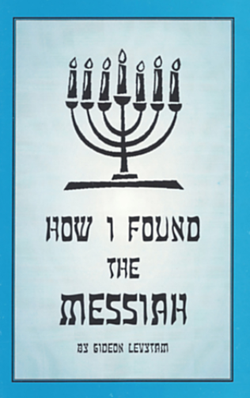
Follow Gideon Levytam's journey and discover how he was led by God, through a series of exciting circumstances, to find the One his people are still waiting for.
Past Episodes

Featured Offer
Follow Gideon Levytam's journey and discover how he was led by God, through a series of exciting circumstances, to find the One his people are still waiting for.
About Holy Scriptures and Israel
As time passed by, the Lord Yeshua took dear brother John Van Stormbroek to himself. The ministry of Holy Scriptures and Israel continued with additional development. In the early 1990’s, a weekly morning Bible class began which brother Gideon Levytam led regularly in the City of Toronto. This weekly open Bible class was held in the Willowdale assembly meeting hall. Eventually, a second mid-week evening Bible class was added. In April 2002, the need for an additional outreach Bible teaching meeting arose. We begun a Saturday (Shabbat) ministry meeting in which a systematic teaching of God’s word is presented to all who attend. Together we learn God’s Word, pray for each need and the salvation of Israel, and sing songs of worship unto our God, praising Him and our Lord Yeshua the Messiah.
In Mid 2004 we started to air on Joy 1250 Radio station a 15 minute Bible teaching program called "The Holy Scriptures and Israel" with Gideon Levytam. The broadcast teaches God’s word from a Hebrew Messianic perspective and has proved to be a blessing to many. It's now aired seven days a week. Our prayer is that many more of our Israeli people will have a clear understanding of who Yeshua is, why we all need him, and come to know him as their Lord and Messiah.
About Gideon Levytam
Contact Holy Scriptures and Israel with Gideon Levytam
426 Simcoe Street
Niagara-on-The-Lake
Ontario L0S 1J0
Canada
(905) 325-1234