

Introduction to Lamentations Part 1 of 3


An introduction to the book of Lamentations
Guest (Male): Shalom. Holy Scriptures and Israel is a ministry designed to share with the Jewish people the good news of the Lord Jesus, Yeshua the Messiah, and to instruct Christians on the Jewish roots of their faith. And now, teaching God's word from a Hebrew Messianic perspective, here is Gideon Levytam.
Gideon Levytam: Shabbat Shalom everyone. Today we are going to begin the study of a new book, the book of Lamentations. In Hebrew, the book is Eichah. The Lord laid on my heart, as I was praying about the decision of which book to study together, the importance of the study of the book of Lamentations. The reason for that, of course, is because the book of Lamentations, or the book of Eichah, presents before us the heart of the man by the name of Yirmeyahu, Jeremiah.
He had such a burden for the condition that existed among our people of old, the people of Israel, where God in judgment allowed the city of Jerusalem to be destroyed, allowed the temple of Jerusalem to be burned, allowed the Jewish people to be taken captive and to be taken to Babylon, and allowed them to experience the consequence of their disobedience to the God of Israel. I would like always, as you know in our Bible teaching, to make an application.
How does that apply to us today who are believers, both Jewish and non-Jewish? We are part of the assembly, the ecclesia. We belong to the Lord Yeshua Jesus the Messiah. We have been saved by grace. God has brought us into this wonderful truth to be part of the body of Messiah. We have a hope to be with him one day in heaven, but also the condition of the church over the last 2,000 years of church history does not prove to be much better than the history of our people Israel.
Over the years, they had such a privilege to be a chosen nation, a nation that God blessed to be part and parcel of a relationship with him. Today, I would like simply to give us an introduction to the book of Eichah, Lamentations. The first thing I want to do, of course, is to read one verse. Please turn with me to the book of Lamentations, to the book of Eichah. I would like to read the first verse for this ministry meeting today as an introduction.
Jeremiah, Yirmeyahu, says, "How does the city sit solitary that was full of people? How is she become as a widow, she that was great among the nations and princess among the provinces? How is she become tributary or a slave?" In Hebrew, it is read: "Eichah yashvah vadad ha’ir rabati am rabati vagoyim sarati bamedinot haytah lamas." Jeremiah began this interesting writing about his lamentation, his concern for the people of Israel that have experienced destruction, desolation, and obviously a departure from the land that was promised to their forefathers.
If you just read the book of Lamentations and think about it from our present-day age, nearly 2,000 years since the Lord Jesus, Yeshua the Messiah, came from heaven, died on the Roman cross, was buried, raised, and went to heaven, sent the Holy Spirit of God, and built the body of Christ, the body of Mashiach, look at the condition of the body of Messiah in these last days in which we live today. Let me begin, by way of introduction, reading another verse that is found in the New Testament in Romans chapter 15.
I want to remind you, beloved brothers and sisters, that the New Testament writers also were teaching the early believers in various towns and cities, whether it was Rome, Corinth, or the area of Galatia in Asia Minor, Philippi, Colossae, or Thessalonica. They were charging the believers in their local assemblies never to forget the history of Israel and to remember that the history of Israel has become a lesson for us today, an example in the life of all the people of God.
In Romans chapter 15, Sha’ul, Paul, wrote to the early believers. Remember, this was 2,000 years ago, not today, because the Brit Chadashah, the New Covenant, was written 2,000 years ago by the early apostles. Paul already then said to the believers at Rome in Romans 15:4, "For whatsoever things were written aforetime were written for our learning, that we through patience and the comfort of the scriptures might have hope." Paul wrote to the brethren in the local assembly at Rome and said that whatever happened to Israel, our people, in their history is serving to be a lesson for us today.
We learn from Israel's experience and see where we fit, how we conduct ourselves, and how that applies to us as believers who are part of the body of Messiah. Think for a moment with me, beloved brothers and sisters, of the background of Israel. We read in the Hebrew scripture that the Jewish people, our own nation, was called a chosen people. Remember how God chose Avraham, Yitzchak, and Ya’akov. He brought Avraham all the way from Mesopotamia to the promised land of Canaan.
Abraham, of course, had a son by the name of Yitzchak. Yitzchak had a son by the name of Ya’akov. Ya’akov had 12 sons, the 12 tribes of the people of Israel. How wonderful God had blessed them and promised them a blessing. He would make from Abraham a nation that would be a testimony to the world in which we live today. So, our own nation, our own people of Israel, Jacob and his sons ended up going down to Mitzrayim, to Egypt.
There they were for many, many years, and after years of being away from the promised land of Canaan, God allowed our own nation, the Hebrew people, to come out of Egypt. He taught them a lesson: you will take a lamb, you will kill the lamb, you will put the blood on the doorpost and the lintel, and when I see the blood, I will pass over you. Lo and behold, hundreds and thousands and tens of thousands—in fact, it says 600,000 only male—came out of the land of Egypt.
Nearly two million Hebrews left Mitzrayim and began their journey to the promised land. For 40 years, our nation was in the wilderness, and in the wilderness, God taught them many lessons. During the time when Israel was in the desert, they rebelled many times against the Lord, the one who brought them out of Egypt, the one who loved them so much and was willing to bear with his own people whom he had chosen. Finally, after about 40 years, he brought them and stood them before the promised land.
Remember how Israel was supposed to get into the promised land. Many of the older generation died; in fact, all the older generation died physically in the wilderness. They were under the blood and came out of Egypt, but they died physically because of their rebellion. God allowed the new generation, headed up by Yehoshua bin Nun and Kalev ben Yefunneh, to enter into the promised land and to begin to conquer the land that God had promised to the people of Israel.
During the time of Yehoshua bin Nun, Joshua, every tribe was supposed to take his possession. It didn't take too long for them to become tired and maybe disobedient, and many of them did not possess all the land which God had intended to give to the people of Israel. They will possess it in the future in the Messianic kingdom, but during those days, they did not possess all the land. Because of disobedience, they couldn't enjoy the promises that God had for them in the land.
Like us today, God has promised us spiritual blessings in the heavenlies if we will submit to his authority, but we fail many times in our life. No wonder many professing Christians or people who claim to belong to the Lord don't enjoy the things of God because we are not always submissive to the authority of the word of God. Yet, God bore with them and graciously allowed them to be in the land. He raised among our people of Israel the Shofetim, that is, the judges.
When the judges were raised, like a Samson or like Yiftah or like Devorah, for a while they followed the godly leaders, but it didn't take long when they rebelled and turned away. God allowed the Midianite, the Ammonite, the Philistines, and all the nations around to cause our people to become servants to their enemies for years. Yet, God never forsook the Jewish people. He always had in mind for them to be a blessing to the world. Once the judges ended, God raised the kings.
You know very well the first king was Sha’ul, Sha’ul Hamelech, Saul the king. Saul the king didn't want to follow the Lord; he was the people's choice, head and shoulders above everyone, but yet he did not follow the Lord. God said to Shmuel, "I will raise a man which is after mine own heart." He raised a man by the name of David, Melech Yisrael, David the King of Israel. He was that beloved one that God raised to lead the nation of Israel.
Indeed, as long as David was right with God, he was a blessing to our people and the nation of Israel. But even David became what is known to be a bloody man, and God did not allow him to build a house for God, the temple in Jerusalem. He said, "You are not going to build it, but your very own son who is going to come out of your bowels, he will build a house unto my name." When David died, he allowed his son Shlomo, Solomon, to become the king of Israel.
Shlomo, when he was young, was used by the God of our fathers to build a temple in the city of Jerusalem. Magnificent temple; there was no sight like this temple in the whole world. Nations after nations and leaders came from all corners of the universe to worship the God of Abraham, Isaac, and Jacob in the temple in the city of Yerushalayim. The temple was the house of God where he dwelt between the cherubim, the keruvim, where God received the praises of Israel.
As David says in the 22nd Psalm, "Thou that inhabitest the praises of Israel." The nations of the world came there to worship the Lord, but even King Shlomo Hamelech did not remain as he ought to have been, faithful to the God of Israel. It didn't take a long time before he was attracted to the gods of the nations. He ended up marrying 700 wives and 300 concubines, and they took away his heart from the will of God.
King Solomon departed from the ways of the Lord. Later on, as we read in the book of Ecclesiastes, he gave counsel to our own nation Israel and said, "Remember thy creator in the day of thy youth." Sure enough, God said to Solomon that he eventually would rend the kingdom from him, but it would not be in his days; it would be in the days of his son. His son became the king of Israel, and in pride and arrogance, he thought that he would treat the people in the wrong way.
God rent the kingdom from him, and that's how we began the division of the kingdom of Israel into two kingdoms: the kingdom of Israel in the north and the kingdom of Judah in the south. They were two separate nations fighting against each other, instead of enjoying themselves because of the God of Israel, they ended up fighting with each other. Again, by way of application, look at the condition that exists today among the professing church of our Lord Yeshua the Messiah.
The friction, the lack of love, care, and concern for the people of God, and the divided condition of the body of Christ in this day in which we live. It is the same, even worse, because we live in a day of grace today, while our people of old Israel were living during the days that God separated them from all the nations. They didn't have what we have today; they didn't have the full canon of scripture, they didn't have the Holy Spirit of God indwelling every believer, and they didn't have the Messiah's death, burial, and resurrection.
All was in anticipation. Yet, you see God bore with them. As the kingdom was divided, the two kingdoms did not continue in God's way. They went further and further from the ways of the Lord until the time where God said, "That's it." By the time we come to 2nd Kings chapter 25, God came in judgment upon the people of Judah as he had come in judgment earlier upon the people of Israel and scattered them, sending them into the diaspora, the dispersion.
Chapter 25 of 2nd Kings says, "And it came to pass in the ninth year of his reign, and in the tenth month, and in the tenth day of the month, that Nebuchadnezzar, King of Babylon, came, he and all his host against Jerusalem, and he pitched against it, and they built forts against it round about. And the city was besieged unto the eleventh year of King Zedekiah." Notice it says here that Nebuchadnezzar besieged Jerusalem and made walls around it with armies.
We call it in Hebrew matzor. He did not allow anything to come in or come out until it almost choked the city of Jerusalem, choked the Jewish people, and brought them to their wits' end. By the time you read a little bit further in 2nd Kings chapter 25, in verse 8, it says, "And in the fifth month, on the seventh day of the month, which is the nineteenth year of Nebuchadnezzar, king of Babylon, came Nebuzaradan, captain of the guard, a servant of the king of Babylon unto Jerusalem."
Listen to this, beloved brothers and sisters: "And he burned the house of the Lord, and the king's house, and all the houses of Jerusalem, and every great man's house burned he with fire." Verses 10 and 11: "And all the army of the Chaldees that were with the captain of the guard brake down the walls of Jerusalem round about. And the rest of the people that were left in the city, and the fugitives that fell away to the king of Babylon with the remnant of the multitude, did Nebuzaradan the captain of the guard carry away."
By the time that we arrive at 2nd Kings chapter 25 and verse 11, the city of Jerusalem was besieged, the wall was broken, the temple was burned with fire, and the Jewish people were carried to the land of Babylon. Of course, we can quote, as I have been quoting many times, Psalm 137: "By the rivers of Babylon, there we sat down and we wept as we remembered Zion. There in Babylon, they that took us captive said unto us, 'Sing unto us one of Zion's songs.'"
The Jewish people who were there by the rivers of Babylon said, "How shall we sing the Lord's song in a strange land?" This was the sad condition that happened to our people at about 586 BC. As we go back and look at this picture of the Lamentations, we notice immediately that in Hebrew, the name of the book is actually not Lamentations. In Hebrew, we call it Eichah. Eichah simply means "How". In fact, the name of the book is "How".
How is it possible that the chosen people of God find themselves in such a condition? How is it possible that this thing would happen to the people of God, a people and a city that were favored by God? While in Hebrew the word is Eichah, in English the word is Lamentations. How did we get the word Lamentations? Because the 70 rabbis who translated the Hebrew scriptures into Greek at about 250 years BC—it's called the Septuagint—they named the book of Eichah in the Greek where we get the name Lamentations.
They named it this way because of the content of the book. The book contained lamentations, or we might say, it contains weeping, sorrowing, and an expression of care for the city and the people taken away from the city of Jerusalem. In fact, in the Greek, it's called Threnoi, which simply means "lamentations" in plural. Lamentation simply means the cry, the lamentation, and the weeping over a situation that happened in the life of one person or a nation.
That's how in the English we get the name Lamentations. As we look now in this picture, you notice that in the Hebrew scripture, the Tanakh, the book of Lamentation is part of the writings. If you would open a Hebrew Bible today in the Hebrew text, the order is: the Torah; the prophets; and then the writings. The writings include Psalms, Proverbs, Job, Song of Solomon, Ruth, Lamentation, Ecclesiastes, Esther, Daniel, Ezra, Nehemiah, and 1st and 2nd Chronicles.
In the Hebrew scripture, the book of Lamentation is part of the writings. But in the English, the book of Lamentation is placed immediately after the book of Jeremiah. Often when you open your Bible, you notice it says "the Lamentations of Yirmeyahu", or Jeremiah. The English put it in the order in which it was placed when the Hebrew was translated into the Greek by the 70 rabbis for the benefit of the world. Therefore, this is placed in the order of events rather than the order in which it was originally placed in the Hebrew text.
Bear with me, by way of introduction, because it is very important to introduce the book before we get to the actual text itself. There were three deportations that happened in the history of our people. In 605 BC, Daniel and his friends were carried to Babylon, and some of the articles were taken by the Babylonians. Later on, in 597 BC, Yechezkel, Ezekiel, was carried away out of the land of Israel. Finally, at 586 BC, we understand that now the whole city of Jerusalem was destroyed.
The walls were broken down, and the temple was burned with fire. At that time, Jeremiah was still in the land of Israel. He himself was one of the only ones from the prophets of Israel who was literally there to experience the destruction of Israel. As they watched the condition there, the walls were broken down, the people of Israel were being taken away, and the temple was destroyed. He's lamenting, and the people are lamenting and weeping.
He is crying to God as he sees the condition existing in the city of Jerusalem in 586 BC. It had been said that in the month of July, on the ninth of Av, the city of Jerusalem was burned with fire. I want you to notice here that in the writings, there are five known in Hebrew to be Megillot, or scrolls. It begins with the Song of Solomon, Ruth, Lamentation, Ecclesiastes, and Esther. These five scrolls are each read during a different season in Jewish worship in the synagogues today.
Guest (Male): You have been listening to Holy Scriptures and Israel with Gideon Levytam. Gideon teaches God's word from a Hebrew Messianic perspective. For more information about this ministry, write to Holy Scriptures and Israel, Box 1411 Niagara-on-the-Lake, Ontario, L0S 1J0, or visit our website at holyscripturesandisrael.org.
You are also invited to Gideon's weekly Bible teaching on Fridays at 11:00 AM and 7:00 PM and Saturdays at 1:00 PM at Willowdale Christian Assembly Hall, 28 Martin Ross Avenue in Toronto. Holy Scriptures and Israel is made possible by your prayers and financial support. If you would like to support the program, visit holyscripturesandisrael.org. God bless you. Shalom, shalom.
Featured Offer
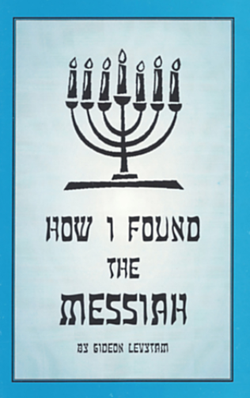
Follow Gideon Levytam's journey and discover how he was led by God, through a series of exciting circumstances, to find the One his people are still waiting for.
Past Episodes

Featured Offer
Follow Gideon Levytam's journey and discover how he was led by God, through a series of exciting circumstances, to find the One his people are still waiting for.
About Holy Scriptures and Israel
As time passed by, the Lord Yeshua took dear brother John Van Stormbroek to himself. The ministry of Holy Scriptures and Israel continued with additional development. In the early 1990’s, a weekly morning Bible class began which brother Gideon Levytam led regularly in the City of Toronto. This weekly open Bible class was held in the Willowdale assembly meeting hall. Eventually, a second mid-week evening Bible class was added. In April 2002, the need for an additional outreach Bible teaching meeting arose. We begun a Saturday (Shabbat) ministry meeting in which a systematic teaching of God’s word is presented to all who attend. Together we learn God’s Word, pray for each need and the salvation of Israel, and sing songs of worship unto our God, praising Him and our Lord Yeshua the Messiah.
In Mid 2004 we started to air on Joy 1250 Radio station a 15 minute Bible teaching program called "The Holy Scriptures and Israel" with Gideon Levytam. The broadcast teaches God’s word from a Hebrew Messianic perspective and has proved to be a blessing to many. It's now aired seven days a week. Our prayer is that many more of our Israeli people will have a clear understanding of who Yeshua is, why we all need him, and come to know him as their Lord and Messiah.
About Gideon Levytam
Contact Holy Scriptures and Israel with Gideon Levytam
426 Simcoe Street
Niagara-on-The-Lake
Ontario L0S 1J0
Canada
(905) 325-1234