

Hebrews 5:11 to 6:12, Part 2


Warning #3 - Progress to Maturity, Part 2
Unidentified Speaker: Shalom. Holy Scriptures and Israel is a ministry designed to share with the Jewish people the good news of the Lord Jesus Yeshua the Messiah, and to instruct Christians on the Jewish roots of their faith. And now, teaching God's word from a Hebrew messianic perspective, here is Gideon Levytam.
Gideon Levytam: The study of Hebrews chapter 5 to chapter 6. I have fed you with milk and not with meat, for hitherto ye were not able to bear it, neither ye are now able to bear it. It was not only a Hebrew problem of first century, it was a non-Hebrew problem of first century, and I would like to suggest that it is an issue that is even today in this present day. There are many Christians, many Messiah followers, people who have accepted the Lord Jesus, the Lord Yeshua as their Lord and Savior, but instead of growing and becoming a pillars, those brothers and sisters that we can come to with every problem in our life and tell them the stories that we have, and they can encourage us and we can encourage them, instead they are like little babies that need to be burped again and again and again and again.
And this is really challenging for us today. This is a warning that has been given to the early believers of first century. Notice what it says in verse 13 now. In verse 13, it says, what baby is like, baby's behavior is like. Notice what baby's behavior is like in verse 13. For everyone that using milk is unskillful in the word of righteousness, for he is a babe. A baby is unskillful. You can see it, but he cannot walk or she cannot walk yet. They cannot crawl. They cannot be useful or unskillful in their walk, in their physical walk. And how is this true when it's come to the spiritual life of the believer?
How oftentimes we can apply it to ourselves. We are unskillful in our spiritual growth. We are not growing spiritually. Why? Because we haven't took heed to the word of God. We haven't, as it says here, we have dull hearing, and we have need to someone will teach us again and again and again, instead of ourselves being those that teach others. Now he continue in verse 14. What maturity is like, how a mature believer conduct himself, we find out in verse 14. But strong meat belong to them that are of full age, even those who by reason of use have their senses exercised to discern between good and evil.
He doesn't say that a believer does not sin. What he's saying that a believer recognize this, realize the need of growth, and that they are maturing, and then they can sense, they can be exercised, they have discernment for certain things in life. The believer's growth, the necessity of the believer's growth. Now, beloved brothers and sisters, these things I did not initiate this, I did not write that, it's written here. It's written for you and I. It's written for our learning, like the Apostle Paul said in 1 Corinthians chapter 10, that all these things that have happened unto them were written for our learning, that we will grow.
And this is a question that we all have to ask ourselves. So here is the context, you see, that's the text, and the connection is immediately with the first few verses of chapter 6. And so let's go into those verses. In verses 1 to 8, the apostle continues as he's speaking to these early Hebrew believers, and here he's telling to those believers the need for progress in the life of the people of God. The need to move forward and grow and not remain like we have when we were first became believers in Yeshua the Messiah. Now here's the text itself. Those 8 verses need to be interpreted in the light of first century early Jewish believers.
We must recognize this as we read those verses. Now, I'm going to reread them now and then going to go over them. Therefore, verse 1, leaving the beginning or the principle of the doctrine of the Messiah, let us go on unto maturity or perfection, not laying again the foundation of repentance from dead works and of faith towards God, of the doctrine of washings or baptisms, and of laying on of the hands, and of resurrection of the dead, and of eternal judgment. And this will we do if God permits. And as he continue on, for it is impossible for those who were once enlightened and have tasted of the heavenly gift and were made partakers of the Holy Spirit and have tasted of the good word of God and of the power of the world to come, if they shall fall away, to renew them again unto repentance.
See, they have crucified to themselves the Son of God afresh and put him to an open shame. For the earth which drinketh in the rain that cometh often upon it, and bringeth forth herbs, meet for them by whom it is dressed, receiving blessing from God. But that which beareth thorns and briers is rejected, and is nigh unto cursing, whose end is burnt. Let's go here, verse by verse, and just deal with these verses. The first thing you notice in verse 1 to 3, the apostle is encouraging them to move on and to grow. By the way, he does not talk here at all about salvation. He's talking here of the necessity of growing in grace and in the knowledge of Yeshua the Messiah.
Look what he's saying. Living the principles of the doctrine of the Messiah, let us go on unto perfection. What does he mean here? When he says living the principles of the doctrine of the Messiah, he doesn't mean forsaking the teaching of the Messiah, no. But when he said this word principles, it is moving on from the basic, moving on from the beginning, moving on from the foundational truth that we have learned from the beginning. Moving on, continuing or not staying there, moving on from the shadow to the reality, moving on from the basic to that which is making a person mature and appreciating the person and the work of the Lord Jesus the Messiah.
That's why he said, living or moving forward from the principle or from the beginning and basic teaching of the Messiah, let us go on unto maturity. The word here for perfection, obviously, it's not becoming perfect because we can never, on our own here in this world, will ever be perfect. We are perfect positionally because of Christ, because of the Messiah. But he wanted the believers to move on into maturity in verse 1. And then he's saying, let us. See, let us, by the way, he's including himself. He doesn't only say let you or let some of you, but he said let us, the writer, as well as the reader, because the writer need to grow as well.
The writer, the one who wrote that passage himself, need to grow spiritually. So he's saying, let us grow and move on unto maturity. And then he gives us, in verse 1b, to including verse 2, he gives us 6 things that are foundational for those who know the gospel, who know the Lord Jesus the Messiah. 6 things. Number 1, not laying again the foundation of, number one, repentance from dead works. Number two, faith towards God. Number three, the doctrine of washings, baptisms. It's, by the way, the word baptisms is in plural. There's not only one baptism that he's talking about, various washings that the Jewish people have knew, that the Hebrews have knew from history.
The washings through the laver in the tabernacle, if you remember, the all kind of washings that have existed that God had given the people of Israel. Then he continue, and of the layings of the hands, and of resurrection of the dead, and of eternal judgment. Notice those six things? Those six things are important to understand. The first one, of course, is the repentance from dead works. You know what was dead works? Everything that you do ritual, everything that they have done with rituals in the past, before the Messiah came, was dead works. It was only a ritual. It's a works that was a shadow that pointed to the coming of Messiah, to the reality.
He says, when the Messiah have come, he said, listen, he said, do not lay again that A, B, C. Do not always go back to those rituals. And how many times dead works appear in the life of Christians. Now, remember, works are very important, but when someone think that those works will bring them salvation, it is a dead works. We have been saved by grace, and we are to use whatever the Lord have given to us to have good works, but not in order to be saved, but because a person is saved. But many times there are many works that are done, rituals that we do that you can see that they are dead. There's no life in them.
And that's why he's telling them, listen, that's foundational. That's his pointing to the Messiah. He says, don't lay this again. Don't go back to the, don't lay it again, this foundation. Here's the second thing. Faith towards God. You know, once we have become believers in the Lord Jesus, the Messiah, we have to understand that. By grace I am saved through faith once, one time. We don't need to be saved again and then get lost again. He's saying to them, the faith towards God, this is once and for all faith unto salvation. Understand this, he's saying to them. Then he continue in the next, by the way, this deals with our conversion.
When a person become a believer in Yeshua the Messiah, the works that we have done in the past pointed to the Messiah. When we have accepted him as our Messiah, once and for all we become saved. That is in our initial entering into our relationship with God. Now we are to grow and to mature. He continue in the next verse, and he's saying, now the doctrine of baptism. And as I mentioned earlier, the word baptisms here is in plurals. This is washings. You know how many washings God had given, all diverse kind of washing that he have given to our people, Israel of old? Even today, by the way, we have talked about it in our Bible studies.
When a couple are getting married, there is a certain mikva, washing that the woman had to do to symbolize her purity. When Yochanan HaMatbil, John the Baptizer, he baptized people in the Jordan, that was not yet a believer's baptism or Christian baptism as we know it, messianic baptism. That was a baptism unto repentance. There were existing all types of washings, but that was foundational. That was shadow that speak about the person and the work of the Messiah. There was a ceremonial things. You know how many times we're doing all kind of ceremonial things that have no spiritual value. It become merely a ceremony.
He says, okay, you know it, you've done it. Just move on beyond these initial things that you have done when you became a believer. Notice the next thing, the laying on of the hands. You know what? There is no command in the New Testament to lay hands on somebody. There is a suggestion there, but you know where did it come from? It came from the Old Testament, the Tanakh scripture. We read it today in Leviticus chapter 1. When an Israeli individual will come to the temple to bring an offering unto the Lord, they were laying their hands on top of the sacrifice. And you know what it said when they laid their hands upon the sacrifice?
The sin of the Israeli individual had been transferred to the sacrifice. And it spoke about the Messiah who took upon himself the sin question. That is in the sin offering. In the burnt offering, the reverse had happened. The burnt offering is the value of the sacrifice had been brought over, given to the person who have accepted the sacrifice. Both aspects, we see the value of the sacrifice, the sins of the sinner, both have been transferred from the one to the other. And he said to them, you know, do not lay again those foundational things, the doctrine of baptisms, faith towards God, repentance of dead works, and the laying of the hands.
You can read this in Leviticus 1, we have read it today, and also in the book of Acts, we know that they have used that to identify somebody when they committed him to the Lord's work and so on. They would lay their hands, but there's no command for such for us today. There is an maybe a guidance of someone to do that, but in the Old Testament, they had to do that. They had to lay their hand upon that sacrifice. He continue here in verse 2b at the end, it says the fifth thing is the resurrection of the dead. You see, the question of the resurrection of the dead is a question that have been settled.
There is a resurrection of the dead. Daniel have taught us in Daniel chapter 12 that there is a resurrection of the dead. Isaiah has spoken to the people of Israel, telling them about the future resurrection of the dead. That is a foundational truth. We're gonna move on. We are entering, you see, they're entering from Old Testament teaching in connection with the nation of Israel, moving on to this present day dispensation, faith in our Lord Yeshua the Messiah for both Jewish and non-Jewish individuals in the body of Christ, in the body of Messiah. And finally, that it says in verse 2 at the end where it's talking about the fact of the eternal judgment.
You notice at the end of verse 2, and of eternal judgment. You know, it is still seems to be people arguing about the fact, will unbelievers will be eternally judged? Well, you can look at scripture, and the Bible does teach us that there is an eternal judgment for the unregenerated one, and there is an eternal blessings for those who believe in Yeshua the Messiah. Revelation chapter 20, the great white throne judgment teach us that there is a judgment that is eternal for those who reject the Lord Jesus, the Lord Yeshua the Messiah. And so you see, he did not want them to continue on to lay again and again and again to be occupied with the ABC of the truths that they have already known when they have accepted him.
He wanted them to move on into maturity. And so verse 1 and 2, he's telling them, do not lay again the foundation, the ABC, and move on. And that's why verse 3 says, and this we will do if God permits. And it is true that God will permit to help them to move forward into maturity. Now, here it is, the text that we are going to discuss for a few more moments, in verse 4, 5, and 6. Verse 4 says this: It is impossible for those who were once enlightened and have tasted of the heavenly gift, and they were made partakers of the Holy Spirit, and they have tasted of the good word of God, and of the power of the world to come, if they shall fall away, to renew them again unto repentance, seeing they have crucified to themselves the Son of God afresh, and put him to an open shame.
Now, from the reading and listening that I have done, I've heard three views upon this passage. The first views that liberal Christians hold is the view that a person, once he got saved or she got saved, when they have sinned a certain sin, or if they are not continuing to walk all the day faithfully to the Lord, they are capable of losing their salvation. That's one group of individuals who believe in this. Now, I'll tell you right here, I disagree completely with this view. I don't believe for a moment that anyone can get saved on his or her own because our salvation is totally a work of the Lord Jesus the Messiah.
We have never performed anything in our life in order to receive this salvation, and I want to prove this for you for a moment. Turn to Romans chapter 8. The Apostle Paul wrote to the Romans, and we are studying Romans right now, and in fact, we are studying this chapter. Romans chapter 8, the Apostle Paul said to the Romans believers in verse 1, there is therefore now no condemnation for those that are in the Messiah Yeshua. If a person belongs to the Lord Jesus the Messiah, there is no condemnation to those that belong to the Lord Yeshua the Messiah. At the end of the chapter, Romans chapter 8, Romans chapter 8 and verse 31.
What shall we say to these things? If God be for us, who can be against us? He that spared not his own son but delivered him up for us all, how shall he not with him also freely give us all things? Who shall lay hand to the charge of God's elect? It is God that justifieth. Who is he that condemneth? It is the Messiah that died, yea, rather that is risen again, who is even at the right hand of God, who also maketh intercession for us. And look at that last verses, verse 35. Who shall separate us from the love of Christ, of the Messiah? Shall tribulation, or distress, or persecution, or famine, or nakedness, or peril, or sword, as it is written, for thy sake we are killed all the day long.
We are accounted as sheep for the slaughter. Nay, in all these things we are more than conquerors through him that loved us. And listen to the last verse, what a beautiful verses, the last verse, 38 and 39. For I am persuaded, the apostle says, that neither death, nor life, nor angels, nor principalities, nor power, nor things present, nor things to come, nor height, nor depth, nor any other creature shall be able to separate us from the love of God, which is in the Messiah, Yeshua, our Lord. Beloved brothers and sisters, Paul wanted to drive into the believers at Rome to let them understand that their salvation, their justification had been completed when the Messiah died for them and they accepted him.
He wanted to assure them that no one can be against them successfully, even though they will accuse them because they have failure in their life. He wanted to give them the assurance that no one could lay anything against them to charge them because the Messiah have died for them. He wanted to let them know that no one can condemn them because the Messiah gave them justification, and he wanted them to know that nothing will separate them from the love of the Lord Jesus the Messiah. And beloved, you know, if you get a hold of this truth, if you make it appropriated to your own heart, recognizing that it is the Lord Jesus, the Messiah, that paid for us on the tree, and it is nothing that I have done that you have done to receive salvation, then you can ground yourself in that fact that your salvation is secure.
I am persuaded, he said, that neither death, nor life, nor angels, nor principalities, nor power, nor present things, nor things to come, nor height, nor depth, nor any other creature shall be able to separate us from the love of God. And that's not other creature, no Satan, and no other human being, not even yourself can separate yourself from the love of God. And why I'm saying yourselves? Because some people say, you know, I was saved years ago, but I can unsave myself. How can you unsave yourself? You cannot jump out of the hands of God even if you wanted because John chapter 10, the Lord Jesus the Messiah saying this in verse 27, my sheep hear my voice and I know them, and they follow me, and I'll give unto them eternal life.
Listen, they shall never perish. What is eternal life? It's not 6 months, 6 years, or 60 years. Eternal life is eternal life, is life eternal in the person of the Lord Jesus. They shall never perish, neither shall any man pluck them out of my hands. My Father, which has given them to me, is greater than all, and no man is able to pluck them out of my Father's hand. I and my Father are one. No one is able to pluck himself from the hands of the Father. We are kept by the hands of the Father. We are unable to unsave ourselves because we were unable to save ourselves in the first place, beloved brothers and sisters.
Our salvation does not depend upon our performance, and that's why I completely disagree with the view of those that say that we can get saved one day and get lost the other day. My dear friend, if you think that you are only saved, and the next time you reject the Lord Jesus the Messiah and you say that he is not your Lord and Savior, you have to make sure in the first place that you have actually accepted him as your Lord and Savior in the first place. You're either in or you're out. You're either saved or you're lost. You're either believer or you're unbeliever. You're either going to heaven or you're going to hell.
There is no in between to anyone. Notice what Ephesians says in chapter 2 in verses 9 and 10. Ephesians, the Apostle Paul said to the believers, he said to them, don't think that you save yourself. In verse 8, he says, by grace are you saved, and it is through faith, and it is not of yourself, it is a gift of God.
Announcer: You have been listening to the Holy Scriptures and Israel with Gideon Levytam. Gideon teaches God's word from a Hebrew messianic perspective. For more information about this ministry, write to Holy Scriptures and Israel, Box 1411, Niagara-on-the-Lake, Ontario, L0S1J0, or visit our website at holyscripturesandisrael.com. You are also invited to Gideon's weekly Bible teaching on Fridays at 11 a.m. and 7 p.m. and Saturdays at 1 p.m. at Willowdale Christian Assembly Hall, 28 Martin Ross Avenue in Toronto. Holy Scriptures and Israel is made possible by your prayers and financial support. If you would like to support the program, visit holyscripturesandisrael.com.
God bless you. Shalom, shalom.
Featured Offer
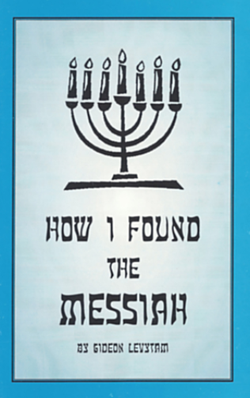
Follow Gideon Levytam's journey and discover how he was led by God, through a series of exciting circumstances, to find the One his people are still waiting for.
Past Episodes

Featured Offer
Follow Gideon Levytam's journey and discover how he was led by God, through a series of exciting circumstances, to find the One his people are still waiting for.
About Holy Scriptures and Israel
As time passed by, the Lord Yeshua took dear brother John Van Stormbroek to himself. The ministry of Holy Scriptures and Israel continued with additional development. In the early 1990’s, a weekly morning Bible class began which brother Gideon Levytam led regularly in the City of Toronto. This weekly open Bible class was held in the Willowdale assembly meeting hall. Eventually, a second mid-week evening Bible class was added. In April 2002, the need for an additional outreach Bible teaching meeting arose. We begun a Saturday (Shabbat) ministry meeting in which a systematic teaching of God’s word is presented to all who attend. Together we learn God’s Word, pray for each need and the salvation of Israel, and sing songs of worship unto our God, praising Him and our Lord Yeshua the Messiah.
In Mid 2004 we started to air on Joy 1250 Radio station a 15 minute Bible teaching program called "The Holy Scriptures and Israel" with Gideon Levytam. The broadcast teaches God’s word from a Hebrew Messianic perspective and has proved to be a blessing to many. It's now aired seven days a week. Our prayer is that many more of our Israeli people will have a clear understanding of who Yeshua is, why we all need him, and come to know him as their Lord and Messiah.
About Gideon Levytam
Contact Holy Scriptures and Israel with Gideon Levytam
426 Simcoe Street
Niagara-on-The-Lake
Ontario L0S 1J0
Canada
(905) 325-1234