

Hebrews 3:1-2, Part 2


Yeshua Is Greater than Moses, Part 2
Announcer: Shalom. Holy Scriptures and Israel is a ministry designed to share with the Jewish people the good news of the Lord Jesus Yeshua the Messiah, and to instruct Christians on the Jewish roots of their faith. And now, teaching God's word from a Hebrew messianic perspective, here is Gideon Levytam.
Gideon Levytam: The study of Hebrews chapter 3. What is the meaning of the word apostle? Apostle means a sent one, one that had been sent. You see, when Yeshua left this world and returned to heaven, he sent those apostles for mission, for ministry, to proclaim the message of the gospel to the world. And here we have him being called by the writer an apostle, apostolos in the Greek. In Hebrew, shaliyach or nishlach, a person that had been sent by God. Now that is very interesting. Some suggest that perhaps the book of Hebrews was written by Shaul, Paul, but the reason that Paul did not put his name into this letter is because the name apostle is applied to Yeshua, and Paul, who usually write a letter, says, I am the apostle of Yeshua the Messiah, sent of Yeshua the Messiah, and he removed his name from this letter because he's not worthy compared to this one wonderful person, the true apostle, the true messenger, the true sent one.
You see, he's saying to them, he says, consider this apostle. Consider him. Now I'm going to show you he's going to lead them in to compare him to Moses, and I want you to see that he's greater than him, but consider him, he's saying to them, as a sent one. Now you remember we sang today, for God so loved the world that he gave his only begotten son. You see, God the Father sent his son. He sent him to this world. He came to this wicked world, and you know what men did to him? Instead of embracing him and telling him, Lord, we want to acknowledge you as our Lord and our Savior, they took him, they rejected him, and they placed him on a tree and they crucified him.
And they said, we will not have this man to rule over us. And beloved, that is exactly what happened today. 2000 years later, the same thing. The sent one from God is being rejected of man. He's despised and rejected of man, we read in the prophet Isaiah, they still reject him today. I just unfortunately read in the Hebrew newsletter, very sadly, that just a few days ago they burned hundreds of New Testament in one of the cities. And when you think about it, men still reject him. In Israel, in Canada, in the world around, people still reject the person of the Lord Jesus, the Messiah. They would like to have religion, but just not the Messiah, not Christ, not Yeshua.
That's the way we are by nature. We will have not this man to rule over us, and yet he was sent by God. He was sent by God into this world. He's the shaliach, the apostolos, the one that is sent by God with a commission, with a message, with an action to do on behalf of man. Now let me show you, if you turn to the Gospel of John, I want you to see some of the verses that are very interesting. You remember the verse that we have been singing for God so loved the world, John 3:16? Look at the next verse after John 3:16, we have John 3 and verse 17. He says, for God sent not his son into the world to condemn the world, but that the world through him might be saved.
That's why he was sent. God did not send his son to condemn the world, John 3 verse 17, but God sent his Son to this world in order that the world might be saved. John chapter 3, verse 34. For he whom God has sent speaketh the words of God, for God giveth not to him the spirit by measure. Him whom God have sent, He's sent by God. John 3 and verse 34. Same gospel, John chapter 5 and verse 36, we read, listen to this. But I have greater witness than of John, for the works which the Father has given me to finish the same works that I do. It bear witness of me that the Father hath sent me. That's what Yeshua said all the time.
I'm here, I've been sent by God. I'm the apostolos, I'm the apostle, I'm the shaliach. I've been sent by God to finish the work here, to accomplish a redemption. What a lovely verses to think about the Lord call himself as the one that had been sent by God. And we can go on, chapter 6 and verse 29 of the Gospel of John. Yeshua answered and said unto them, this is the work of God that you believe on him whom he has sent. You want a real works to do for God? Believe on him whom God has sent. That's the real works that you need to do to believe on him whom God have sent. The same chapter in verse 57, as the living Father has sent me, as I live by the Father, so he that eateth me, even he the same shall live.
In other words, appropriate yourself, believe on me, accept me. I am the one that have been sent by God. He's the apostle that they are to consider. Interesting, eh, how the Lord is being called an apostle, and that's, I believe, the only time in the Bible that he's called, but it simply means that he's a sent one. He's a sent one with a message to proclaim to this world, and there are more verses. John 7:29, John 8:42, John 10:36, John 11:42, John 17 and verse 3, John 20 and 21. There are various verses that deal with the fact that he was sent by the Father to this world, not to condemn the world, but that the world through him might be saved.
Did they accept him? Did a multitude of accept him? Well, unfortunately, no. But here we have those Hebrews to whom the writer is writing, and he said to them, you are holy brethren. You are partakers or sharers of the heavenly calling. Consider the sent one. Consider him. And you know, brothers and sisters, you and I have all the time to do this, an exercise on a daily basis. We need to consider him, to consider him every time. Try to compare what the world has to offer, what religion have to offer, what all the system of the world can offer to us, what all these religions that existing today, what they can offer us in comparison with this one that was sent by the Father.
Nothing. They cannot offer anything in comparison to what Yeshua have offered. He gave his life. He shed his blood. He paid the price for our sin and our sins, and he made us holy brethren, partakers of the heavenly calling. But he's not only this apostle. You notice it says he's also called here the high priest. He's also high priest. Now we not going to dwell on the high priestly ministry of the Lord here because there are many chapters that deal with his being a high priest. What is the difference with a priest and a prophet? A prophet come with a message from God to the people. He is an apostle.
That's what happened with Yeshua as an apostle. He came from God to the people with a message. What the priest does is exactly the reverse. He come from man unto God, he's back to the people, he's face to God, and he's offering and sharing on behalf of the people. We can say it also in a different way, which we have in Peter. He's a royal priest. We are royal priests, and we are also holy priests. The holy priest facing God, the royal priest facing the people. This is exactly what we have here, the two aspects. The Lord Yeshua the Messiah is an apostle sent from God to the people, but he's also the high priest on behalf of the people facing God and presenting us before this wonderful, loving God of ours.
And so he's telling them in this verse 1, just verse 1 itself is filled with so much rich ministry to our hearts. The holy brethren, partakers of a heavenly calling, consider the one who is the apostle, the sent one, the one who is the high priest of our confession. Did you confess the name of the Lord? You see, he said our confession, not only profession, because the word here says profession, but actually it should be confession. If thou shalt confess with thy mouth Yeshua as Lord and believe in your heart that God had raised him from the dead, thou shalt be saved. Romans teaching us this. It's not only mere profession, I say something that I'm not, but it is the true confession.
And he used that word, not only the Hebrews, but him and the Hebrews, because he says, the apostle and the high priest of our, mine and yours, our confession. And then he says, Yeshua. He using that name of this lovely name of the name of Yeshua. In Greek, of course, Yisus, translated into the English Jesus, but actually it's his Hebrew name, and you shall call his name Yeshua, which means salvation, for he will save his people from their sins. Consider him. Consider him. And now he's moving on, and in the second verse, showing us that he is really greater than Moses. And notice what he does here in verse 2.
In verse 2, he's showing to us the faithfulness of the Lord Yeshua and the faithfulness of Moses, which was very important to those Hebrews, and he's still important. He's saying, who was faithful to him that appointed him as also Moses was faithful in all his house. You see, he's showing to us now, okay, Hebrews, you always look up to Moshe Rabenu, to Moses. And it's true. We still look up and think of Moses, what a great man this man have ever been. And we are honoring the servants of God we are to honor. And so he's showing to them, you know, you are looking up to Moses. You think very much of him.
He's the one who gave you the law, the instruction for the sacrificial system. He's the one who gave you instruction how to build a temple, all of the holy place, the holy of holies, and all the articles that involve in the temple and so on. Yes, he is to be respected and recognized. He was a faithful servant, but Hebrews, you need to also get a hold of the fact that here is another one that was faithful as well. And that's why he's saying to them, who was faithful to him that appointed to him, just like Moses, who was faithful in all his house. Moses was faithful in all his house, and Yeshua, the apostle, the high priest, he was faithful to whatever God had sent him to do.
You notice he doesn't knock Moses. He doesn't tell them, oh, Moses is bad and Yeshua is good. No, he doesn't do that. He recognized the fact because even the writer himself understand the uniqueness of the person of Moshe, of Moses. And he's making a comparison, he's showing them just the same like Moses was faithful, also Yeshua was faithful to the one who sent him. And you notice that it says there that Moses was faithful in all his house. What does it mean here? In all his house. He doesn't talk about his house with his wife and his two children or three children, whatever amount of children he had, though we need to be faithful in our very little corner that God had placed us.
But the house here is representative of the whole nation of Israel. When he's talking about the whole house, he doesn't talk only about the house that he lived in with his wife and children. He's talking about the whole house of Israel. And indeed, beloved brothers and sisters, when we read the history of this man, Moshe, how faithful he have been, how committed to God he have been, how he loved the nation of Israel so much. He wanted the best for the nation of Israel, and he was indeed this faithful servant of God for the nation of Israel. Do you remember the story in Exodus chapter 32, when Moses went up to the mountain to get the law?
And when he went up to the mountain to get the law, the people of Israel said, where is this man? Where is this man? He haven't come down yet. So they went to Aaron and he said to him, Aaron, he says, this Moses haven't come down yet. Make us a god. So what did Aaron do? Aaron told them, you bring me whatever you have, the gold and whatever they have had. They brought all the earrings and all the gold that they have had, and Aaron have prepared for them a golden calf. Beloved, even before the law came into the camp, the law was already broken. The first commandment, thou shalt have no other god before you.
And that golden calf. And lo and behold, Moses come down from the mountain. And what does he see? He see all the children of Israel that were just redeemed, brought out of Egypt, brought out of bondage and slavery. Instead of waiting on the God of Israel who brought them out, they were playing and worshiping his golden calf. And had he brought the tables of the law into the camp, the whole nation would have been consumed in a moment. But you know what he did? He broke the Ten Commandments, and he broke it into pieces, and he refined it, he made the nation, the people to drink out of it. And he said, if you remember, who is on the Lord's side, come unto me, if you remember in Exodus chapter 32.
But I want to read the verses there in Exodus to show us how faithful Moses had been. Look what he did. Exodus chapter 32. Look what he did there after this have happened. You would think he would want to destroy the nation of Israel, and he didn't care for the nation of Israel. We read, listen, after the molten calf had been made in Exodus 32 and verse 4, where Israel said, these be thy gods, O Israel, which brought you out of the land of Egypt. At the end of the chapter we read, and Moses said in verse 29, consecrate yourself today to the Lord, even every man upon his son and upon his daughter, that he may bestow upon you a blessing this day.
And it came to pass on the morrow that Moses said unto the people, ye have sinned this great sin, and now I will go up unto the Lord. Preadventure, I shall make an atonement for your sin. And Moses returned unto the Lord, and he said, O these people have sinned a great sin and have made them gods of gold. Yet now, if thou will forgive their sins, and if not, blot me, he said, I pray thee, out of thy book which thou had written. Look at the faithful servant of the house of Israel. He says, God, this nation have sinned a great sin, and he says, I want you to forgive this nation, but if you will not forgive them, he says, God, blot my name from the book which you have written.
That's the kind of servant Moses had been. The Bible called him a man that had been faithful unto God. In the book of Numbers, chapter 12, look what God says about Moses. Numbers chapter 12 and verse 7, God says, My servant Moses is not like this. He is faithful in all his house. God has to say this about Moses, and indeed Moses was a faithful servant unto God. And so now you see why Israel appreciated him so much, because he was a faithful servant unto God. But now he's telling them in the second verse of Hebrews chapter 13, I want you also to see how faithful Yeshua had been. And brothers and sisters, you just read the history of the Lord Jesus the Messiah.
You can see that every step of the way that he took upon the face of this world, he was a faithful servant of God. In fact, we read in the Old Testament in the prophet Isaiah, behold my servant. God presented prophetically the Messiah as a faithful servant, a faithful servant. And you know, that's is saying so much, so many lessons we can learn from that. How many time, if we look at ourselves, and we can say, how many time I haven't been faithful, haven't been faithful to the Lord, Haven't been committed to where I go to the meetings. Haven't been faithful to maybe my children or my wife or my husband or my parents.
How unfaithful we have been many times in our lives. We know that. We know that very well. God desire from his people to be faithful. In the book of Corinthians, it says it is required from a servant that he may be found faithful. That's what God is expecting from men. Now go back to the Gospel of John, and I just want to show you about Yeshua, how faithful he have been, because he's presenting Yeshua here. He says, look, he says he was faithful to him that appointed him, just like Moses was faithful in all his house. Look at this, John chapter 4 and verse 34, Yeshua is speaking. Listen, my meat and my drink, he says, is to do the will of him that sent me and to finish his work.
He's talking to the people, he's talking to the leadership, and he said, you know, my food, my meat and my drink is to do the will of God, the one who sent me. That's why I came to this world. I came to be faithful, to finish the work that God had given me to do. John chapter 6, verse 38. I came down from heaven not to do my own will, but the will of him that sent me. You know, we are so self-willed so much in our lives. Here we see a man that was not self-willed at all. I came down from heaven not to do my own will, but to do the will of him that have sent me. John 8 and verse 29, he's continuing speaking of himself.
He says, I do always those things which is pleasing Him. John 8, verse 29b. For I do always those things that pleases Him, that pleases God. Do we do always the things that please God? What a challenge it is for us. And John 10 and verse 17, he says, Therefore does my Father love me because I lay down my life that I might take it again. That's why he laid down his life that he will take it again, and God have honored him. He loved his son because Yeshua the Messiah came to lay down his life. And so in this second verse, it says that Moses was faithful in all his house, but Yeshua was also faithful to the one who have sent him.
Consider him. Consider Yeshua. Look at him. Look at the beauty of this person. Look at the greatness of this person. And now he's continuing in verse 3. For this man was counted worthy of more glory than Moses. Why? In as much as he who has builded the house has more honor than the house. You see what he's saying? He showed them Moses, he showed them Yeshua, and he presented both, and he says, now consider him. If Moses was faithful in all his house, Yeshua was also faithful in everything that God has sent him to do. Now he's saying in verse 3, this man, again, you notice he's speaking about the humanity of Yeshua.
He's talking to him about him as man. This man, that namely Yeshua, counted worthy of more glory than Moses, in as much as he who has builded the house has more honor than the house. Now you notice that Moses was faithful to the house, but Moses was part of the house. He was a servant in the house. He didn't build the house. He was a servant in the house. But Yeshua did not only was part of the house, but he builded the house. You see, he's the one who is the master builder, the one who built this house, and now he's not talking about a physical house like we have here, a building with mortar and cement and brick and towers and steeples and stained glass windows.
No, he's talking about the house of God, which compose every believer in Yeshua the Messiah. That's why I don't like this expression, I go to church, or I go to the house of God. It's not correct biblically. It's incorrect. You cannot go to the house of God. You can go to the building where the house of God or part of the house of God meet, but you don't go to the house of God. The house of God is a composition of every believer in Yeshua the Messiah, and I'm going to show you this in the next time, that the true house of God is a composition of all those that believe in Yeshua the Messiah. We're going to talk about it in our next session, but I want you today just to meditate about this thought.
Consider this apostle, the sent one, and the high priest. He was sent by God to finish the work on the tree. And now he's gone to God to represent the believer before God, lifting up his holy hands as this great high priest, interceding on behalf of his people after he finished the work which God has sent him to do. May the Lord help us to consider him and to be occupied with him every day of our life.
Guest (Male): You have been listening to the Holy Scriptures and Israel with Gideon Levytam. Gideon teaches God's word from a Hebrew messianic perspective. For more information about this ministry, write to Holy Scriptures and Israel, Box 1411, Niagara-on-the-Lake, Ontario, L0S1J0, or visit our website at holyscripturesandisrael.com. You are also invited to Gideon's weekly Bible teaching on Fridays at 11:00 AM and 7:00 PM and Saturdays at 1:00 PM at Willowdale Christian Assembly Hall, 28 Martin Ross Avenue in Toronto. Holy Scriptures and Israel is made possible by your prayers and financial support. If you would like to support the program, visit holyscripturesandisrael.com.
God bless you. Shalom, shalom.
Featured Offer
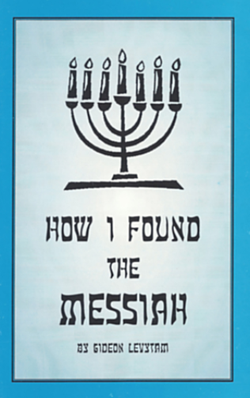
Follow Gideon Levytam's journey and discover how he was led by God, through a series of exciting circumstances, to find the One his people are still waiting for.
Past Episodes

Featured Offer
Follow Gideon Levytam's journey and discover how he was led by God, through a series of exciting circumstances, to find the One his people are still waiting for.
About Holy Scriptures and Israel
As time passed by, the Lord Yeshua took dear brother John Van Stormbroek to himself. The ministry of Holy Scriptures and Israel continued with additional development. In the early 1990’s, a weekly morning Bible class began which brother Gideon Levytam led regularly in the City of Toronto. This weekly open Bible class was held in the Willowdale assembly meeting hall. Eventually, a second mid-week evening Bible class was added. In April 2002, the need for an additional outreach Bible teaching meeting arose. We begun a Saturday (Shabbat) ministry meeting in which a systematic teaching of God’s word is presented to all who attend. Together we learn God’s Word, pray for each need and the salvation of Israel, and sing songs of worship unto our God, praising Him and our Lord Yeshua the Messiah.
In Mid 2004 we started to air on Joy 1250 Radio station a 15 minute Bible teaching program called "The Holy Scriptures and Israel" with Gideon Levytam. The broadcast teaches God’s word from a Hebrew Messianic perspective and has proved to be a blessing to many. It's now aired seven days a week. Our prayer is that many more of our Israeli people will have a clear understanding of who Yeshua is, why we all need him, and come to know him as their Lord and Messiah.
About Gideon Levytam
Contact Holy Scriptures and Israel with Gideon Levytam
426 Simcoe Street
Niagara-on-The-Lake
Ontario L0S 1J0
Canada
(905) 325-1234