
Hebrews 10:1-18, Part 2


Yeshua Is A Greater Sacrifice, Part 2
Unidentified Speaker: Shalom. Holy Scriptures and Israel is a ministry designed to share with the Jewish people the good news of the Lord Jesus Yeshua the Messiah, and to instruct Christians on the Jewish roots of their faith. And now, teaching God's word from a Hebrew messianic perspective, here is Gideon Levytam.
Gideon Levytam: The study of Hebrews chapter 10. But I want you to understand that their sins were forgiven, but only temporary until the next sacrifices were offered, and then the sins were forgiven temporarily until the next one, and the next year, and the next year, and the next year. But forgiveness they have had, but never complete removal of sin. Always the remembrance of sin. There's a verse or two that we need to read in the book of Leviticus. If you please turn to the book of Leviticus, I want to just read these verses in Leviticus chapter 4. Look what we read in Leviticus chapter 4. Four times in the book of Leviticus, in Hebrew, Vayikra, four times we read that their sin will be forgiven to them when they would bring the sacrifices.
First of all, in the first two verses of Leviticus chapter 4, first two or three verses, and the Lord said unto Moses, saying, Speak unto the children of Israel, saying, If a soul shall sin through ignorance against any of the commandments of the Lord concerning things which ought not to be done, and shall do against any of them, if the priest that is anointed do sin according to the sin of the people, then let them bring for his sin, which he had sinned, a young bullock without blemish unto the Lord for a sin offering. And then he continue to bring also a bullock unto the door and how to bring the sin offering unto the door.
But notice what he says later on in verse 20. And he shall do with the bullocks as he did with the bullock for the sin offering, so shall he do with this, and the priest shall make an atonement for them, and listen, and it shall be forgiven him. Verse 26, and he shall burn all his fat upon the altar as the fat of the sacrifice of the peace offering, and the priest shall make atonement for him as concerning his sin, and it shall be forgiven him. Verse 31, and he shall take away all the fat thereof, and the fat is taken away from off the sacrifice of the peace offering, and the priest shall burn it upon the altar for a sweet savor unto the Lord, and the priest shall make an atonement for him, and it shall be forgiven him.
Verse 35, and he shall take away all the fat thereof, and the fat of the lamb is taken away from the sacrifice of the peace offering, and the priest shall burn them upon the altar according to the offerings made by fire unto the Lord, and the priest shall make an atonement for his sin that he has committed, and it shall be forgiven him. You notice four times we find out that sin and sins will be forgiven when the sacrifices, whether it is a peace offering or a sin offering or trespasses offering, the sin will be forgiven, but you never read that it will be removed. You see, it's one thing for me to forgive you, it's another thing for me to remove the wrong that you have done for me, or I to you.
Let's say we have done something wrong to each other, and I'm coming to you, or you're coming to me, and you say, Brother Gideon, could you please forgive me the wrong that I have done for you? And I say, you know what? I forgive you. But you see, always before my mind, I remember what that person have done for me. I remember that. You see, it's kept in my mind, but I forgive, and it's a good thing to do to forgive sin, to forgive wrong. But it's one thing to forgive wrong, it's another thing to reckon the wrong as if it had never happened. This is a different thing, and we know very well that God, in the person of the Son, not only that he forgave our sin, but he removes sin completely from his presence.
And that's where we are going back now to Hebrews chapter 10, and you notice that in verses 1 to 4, where we just read, we saw that there was a need for a better sacrifice. But now in verses 5, 6, 7, 8, and 9, we see that there was a provision of a better sacrifice. There was a way where God had provided a better sacrifice, and that's what he does in verses 5, 6, 7, 8, and 9. And notice that. First of all, verse 5, wherefore. In verse 5, he's now taking us to an Old Testament passage. Now remember, beloved brothers and sisters, because the one who wrote is Jewish and the ones who read were Jewish, or the one who wrote was Hebrew and the ones who read were Hebrews, he could only quote to them the Hebrew scriptures.
He could only quote to them what he had in his hands. Even the book of Hebrews itself was not yet ready. He was just enacting it, writing it to those Hebrews. So what does he do? He go back to the Tanakh. He go back to the Psalms. And you look what he says. Wherefore, when he cometh into the world, speaking about Yeshua the Messiah, the Lord Jesus Christ, the Lord Jesus the Messiah, when he cometh into the world, this is he, Yeshua, he said, sacrifice and offering thou wouldst not, but a body thou hast prepared me. In burnt offering and sacrifices for sin thou has had no pleasure. Then said I, lo, I come in the volume of the book it is written of me to do thy will, O God.
Now you see, the Hebrew writer is pointing to another Hebrew writer in the book of Psalms, namely David. And what David wrote historically in the book of Tehilim, in the book of Psalm, became a messianic psalm, a psalm in Psalm 40 that had pointed to the Messiah of Israel, the Savior of this world. And so he's saying now, he shows us in those verses, verses 5, 6, and 7, he's actually quoting in verses 5, 6, and 7, Psalm 40, verses 6, 7, and 8. And in that Psalm, it says like this, and I think I'm going to turn to the Psalm, Psalm 40, and look what it says in Psalm 40. Sacrifice and offering thou didst not desire.
Mine ears hast thou opened. Burnt offering and sin offering thou has not required. Then said I, lo, I come in the volume of the book it is written of me. I delight to do thy will, O my God, yet thy law is within my heart. The writer, the Hebrew writer to the Hebrew believers, quoting for them Psalm 40, verses 6, 7, and 8. But it's very interesting. You notice that all of a sudden, he takes the psalm that David wrote, and he gives us David's speech as it was Mashiach speech. What David said prophetically in Psalm 40 is actually what Yeshua the Messiah said when he came here to this world to give his life a ransom for many.
And you notice he quoting, but he make a little change here that you and I might say, and many people do say, wait a minute, what he wrote in Psalm 40, verse 6 is a little bit different in what the writer writes in Hebrews chapter 10 and verses 5, 6, and 7. It seems like he writes something a little bit different because it says in verse 6 of Psalm 40, sacrifice and offering thou did not want or did not desire, mine ears hast thou opened. Burnt offering and sin offering thou has not required. Now look what it says in Hebrews chapter 10 and the verse in which we have began in verse 5, it says, wherefore he saith when he come into the world, he said, sacrifice and offering thou wouldst not, but a body hast thou prepared for me.
You see, in Psalm 40, verse 6, it says, my ears you have opened, and in Hebrews 10, verse 5, it says, a body you have prepared for me. Now, of course, immediately the people who do not want to acknowledge the word of God, they are many times says, you see, there's a problem here, you see. What the psalmist says in Psalm 46, the Hebrew writer quoted completely different. You see, there is some kind of a contradictions in your Bible, you see, and that's why I do not want to accept the Lord Yeshua as my Messiah, as my Lord. Well, listen, beloved brothers and sisters, the writer did not make any mistake at all.
What he was quoting in the book of Hebrews is the Septuagint. The Septuagint is a translation of the Hebrew Tanakh from Hebrew to Greek. And it was translated, by the way, by 70 rabbis who knew Hebrew very, very well. So they took the passage that is mentioned here in the Hebrew, original Hebrew text, and they have translated from mine ears has now opened, and they have taken this word, of course, the writer took it and he have applied it to the word ears, simply he takes a body you have prepared for me. Now, why he take from the ears you have opened to a body you have prepared? Why does he do this shift from the ears to the body?
And I tell you why. And at least most Bible scholars teach that and understand that. See, the ear, we all have two ears, but sometimes the Bible use the singular word ear. The ear speaks of obedience. When we listen to the word of God and submit to the word of God, it's really the ear is the avenue where God would come in, and we are subjecting the whole body for the Lord in obedience. You see, God does not want us to listen from one ear and to get it out from the other ear and not be obedient to his will. God is expecting from the believer to be obedient to him. But you see what happened when the writer, when the psalmist says, you know, God really sacrificed an offering you did not desire.
What he meant by that, the psalmist meant by that, is that, you know, you did not only want sacrifices externally without the condition of heart. To only offer sacrifice without to have a heart condition become ritualism, you see? This is exactly what we read in the book of Isaiah chapter 1, where God says, I'm already tired from your sacrifices. You're bringing the sacrifices and your heart condition is so far away from me. And God was not pleased with Israel when they have only brought the sacrifice and there was not the heart condition comes along with this. If you can read in verse 11 of Isaiah 1, To what purpose is the multitude of your sacrifices unto me, saith the Lord?
I am full of the burnt offerings of rams and of the fat of the beast, and I delight not in the blood of bullocks and of the lambs and of the goats. He's saying to them, to what purpose you bringing the sacrifices when your hearts is so far away from me, when your bodies is not in subjection to me? That's what he's saying to the people of Israel. So when the psalmist says in Psalm 40, sacrifice and offering you did not desire, he does not mean that God did not institute the sacrificial system. What he mean is when you bring a sacrifice, you bring your heart condition with it. I don't need your ritualism.
And you and I know it very well. We can go to a church meeting today, and we can come to the meeting, we can go through the motion when our hearts is not at all in the things of the Lord. Our mind is somewhere else, our thoughts is in another place. The Lord is just seeing our hearts, and he knows, by the way, and he knows our hearts even right now. He knows that oftentimes we are not here. We're only in body here, but our mind is elsewhere. He says, I don't want that. You see, we do exactly oftentimes what Israel have done historically. Israel brought the sacrifices, went through the routine, and said to God, God, I'll talk to you later.
God does not desire that. God wants sincerity. He wants the sacrifices because in order to receive forgiveness of sins, you need the blood to be poured, but he wants our hearts to come along with it. So the psalmist says, sacrifice and offering you did not desire, and then he said, but my ears you have dugged, you have opened in Hebrew it says, My ears you actually dug and you have opened. And what does he mean by that? That my ears have been so much dug through that every message of God sunk into my heart, and there was a life that is devoted for the Lord. That's what he's really saying here.
And so he says, sacrifice and offering you really didn't want, but you have prepared mine ears, you have opened mine ears so I can be suitable as a true servant, as a true priest, as a true sacrifice for you, my God. That's what Yeshua is saying. So the Hebrew writer, he takes it and instead of using the word mine ears you have opened, he take it and he use this expression, a body you have prepared for me. And you see how true, beloved, when you think of Yeshua the Messiah, his body was totally devoted to God. You know, like the sacrifices that had been offered historically by Israel, by the Hebrew people, by the people of Israel, the animals had to be without blemish.
The animals had to be without any defect in their bodies. There was no defect in the sacrifices because they typified the Messiah. They pointed to the Messiah. That's why they could not offer any sacrifices with the broken bones. Anything that had blemish in it could never be offered. And so here we see the Messiah saying, and how beautiful he says, a body you have prepared for me. And what does he mean by that? That every step he took in his life, everything that he have done with his body was pleasing to the Father, was pleasing to God. May he prove in his life as the body was prepared for him, his body was a body that was used totally for God.
In every area of his life, he pleased God, and he became a suitable sacrifice for God, a fulfillment that had been pointed out of him by the old sacrifices. He continued and he says in Psalm 40, verse 6b, it says, burnt offering and sin offering thou has not desired. Then said I, lo, I come in the volume of the book it is written of me. I delight to do thy will. O my God, yea, thy law is within my heart. You see, Yeshua, the law of God was placed in his heart. It was his life to do the will of the Father, to do the will of God. Even at the moment, the last moment of his life here on earth, if you remember the Garden of Gathshmanim and the Garden of Gethsemane, when you remember that he anticipated the crucifixion, the death on the cross, and he sweat was as if great big drops of blood that fell to the ground.
You know why they were so large? His sweat was because he had a perfect body, a perfect soul, a perfect human spirit, never was seen in his life, and now he was anticipating to become a sacrifice. And as he was anticipating to become the sacrifice, he began to understand and to realize now the sin question is going to be laid upon him. And he says, Father, Father, you remember that? Take this cup away from me. This is the cup of God's indignation against sin. If it is possible, Father, take this cup away from me. But it didn't stop there. He says, nevertheless, not my will, but thine be done.
He subjected himself to God's, the Father's requirement. And that's why it says here, lo, I come in the volume of the book it is written of me to do not my will, but thy will, O God. I didn't come to do my thing and to do my will. I came to do the will of the Father, the God who have sent me into this world. And by that he fulfilled to the letter Psalm 40, verses 6, 7, and 8, because he did come to do the will of the Father. And you notice it says, in the volume of the book it is written of me. Do you want to find Jesus? You find him in the scripture. Everything in the Bible speaks of him, from Genesis to Revelation, from Genesis to Malachi, from Bereshit to Malachi.
Every book, whether it is Old Testament Tanakh or whether it is the Brit Hadasha, the New Testament, everything is pointing to the Messiah, Yeshua. In the volume of the book, it is written of me. And it is amazing how people cannot find the Lord. And you know why they cannot find the Lord? Because they reject the book, and they reject the author of the book, and they reject the fact that God says about them that they have sinned before him, and they reject the things of God. And no wonder they cannot find the person of Yeshua, the Messiah, in the scripture. In the volume of the book it is written of me, I come to do thy will, O God.
Verses 5, 6, and 7 of our chapter, Hebrew chapter 10. And then now quickly notice, not only that his body had been prepared, this is the Septuagint translation of the Hebrew Tanakh, then we read in verses 8 and 9, God had no pleasure in sacrifices without obedience. Without obedience, all sacrifices of all, without obedience of the one who came, God had not pleasure. Look what it says in verse 8. Above, namely in the book of Psalm, when he said, Psalm 40, sacrifices and offering and burnt offering and offering for sin thou wouldst not, neither hads pleasure therein, which are offered by the law.
You see, he says God had no pleasure therein because those who had brought them, when they, some of them, when they have offered them, they came without proper obedience to God. Then it says in verse 9, then said he, this is Yeshua the Messiah, lo, I come to do thy will, O God. He taketh away the first, this is the old covenant, the law, that he may establish the second, establishing the new covenant, the Brit haKhadasha that we know from the book of Jeremiah chapter 31. You see what he did here? He, by virtue of his work on the tree, by virtue of doing the will of God, he noticed he took away, notice it says very clearly, he taketh away the first.
That's the law mentioned already in verse 8 at the end, but he established the second. And the second, beloved, is the covenant, the new covenant, which he established, the Messiah Yeshua have established in his blood. And that teaches us, beloved brothers and sisters, of the provision of the better sacrifice of our Lord Yeshua the Messiah. So, Messiah's sacrifice not only atone for sins, but removes sins, and we see it now. Here is the effectiveness of this, is found in verse 10. And look what it says in verse 10. By the which will we, this is the Hebrew believers of first century and you and I, we are, notice that, we are sanctified through the offering of the body of Yeshua, the Messiah.
How many times it says here? Once and for all. You notice this verse had to be sunk into the brain and heart of every believer in Yeshua the Messiah. I'm repeating this verse. By the which will, we are sanctified through the offering of the body of Yeshua the Messiah once for all. We are, the word sanctified means set apart. The word sanctified is reckoned as holy and righteous before God. The word sanctified simply means that God had been satisfied with the work of the Messiah, and he set us apart. He cleansed our sin and sin, and he removed them forever from before his eyes and before his face.
By the which will, the will of God that is, we are sanctified by the offering of the body of Yeshua the Messiah once and for all. You see, here we have the effectiveness. What is the effectiveness is that we don't have to offer this again and again and again and again. Once for all time. That's it. It's done. It is finished. We don't need to offer sacrifices anymore. And Hebrews, he's saying to them, don't go back to the temple. Don't go back to the temple in Jerusalem to offer sacrifices again because you have been sanctified forever. It's been dealt with, finished. You see what happened if a person go back into the sacrificial system, he was really saying that the blood and the body of Yeshua the Messiah was really not sufficient to remove sin forever.
It is only temporary. That's wrong to say that, and that's why God says the effectiveness of the Bethel sacrifice is completely sanctify the believer once and for all. And so now, after he said in verses 1 to 10 that the Messiah's sacrifice take away sin, now from verse 11 to 18, he shows us that we do not need to repeat again and again and again this sacrifice. Look at this, verse 11. It says now, and every priest standing daily, now you notice he moved from yearly to daily, every priest standing daily ministering, offering oftentimes the same sacrifices which can never take away sins. But this man, namely Yeshua, after he had offered one sacrifice for sins, forever sat down on the right hand of God.
You see, in verse 11, we see that the priest used to bring not only now yearly, but daily. Every day they would come and they would offer all the time they would offer the same sacrifices.
Announcer: You have been listening to the Holy Scriptures and Israel with Gideon Levytam. Gideon teaches God's word from a Hebrew messianic perspective. For more information about this ministry, write to Holy Scriptures and Israel, Box 1411, Niagara-on-the-Lake, Ontario, L0S1J0, or visit our website at holyscripturesandisrael.com. You are also invited to Gideon's weekly Bible teaching on Fridays at 11 a.m. and 7 p.m. and Saturdays at 1 p.m. at Willowdale Christian Assembly Hall, 28 Martin Ross Avenue in Toronto. Holy Scriptures and Israel is made possible by your prayers and financial support. If you would like to support the program, visit holyscripturesandisrael.com.
God bless you. Shalom, shalom.
Featured Offer
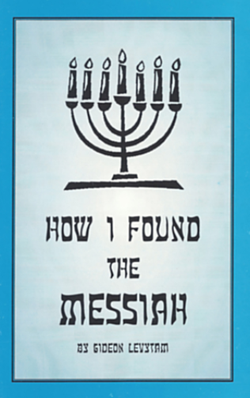
Follow Gideon Levytam's journey and discover how he was led by God, through a series of exciting circumstances, to find the One his people are still waiting for.
Past Episodes

Featured Offer
Follow Gideon Levytam's journey and discover how he was led by God, through a series of exciting circumstances, to find the One his people are still waiting for.
About Holy Scriptures and Israel
As time passed by, the Lord Yeshua took dear brother John Van Stormbroek to himself. The ministry of Holy Scriptures and Israel continued with additional development. In the early 1990’s, a weekly morning Bible class began which brother Gideon Levytam led regularly in the City of Toronto. This weekly open Bible class was held in the Willowdale assembly meeting hall. Eventually, a second mid-week evening Bible class was added. In April 2002, the need for an additional outreach Bible teaching meeting arose. We begun a Saturday (Shabbat) ministry meeting in which a systematic teaching of God’s word is presented to all who attend. Together we learn God’s Word, pray for each need and the salvation of Israel, and sing songs of worship unto our God, praising Him and our Lord Yeshua the Messiah.
In Mid 2004 we started to air on Joy 1250 Radio station a 15 minute Bible teaching program called "The Holy Scriptures and Israel" with Gideon Levytam. The broadcast teaches God’s word from a Hebrew Messianic perspective and has proved to be a blessing to many. It's now aired seven days a week. Our prayer is that many more of our Israeli people will have a clear understanding of who Yeshua is, why we all need him, and come to know him as their Lord and Messiah.
About Gideon Levytam
Contact Holy Scriptures and Israel with Gideon Levytam
426 Simcoe Street
Niagara-on-The-Lake
Ontario L0S 1J0
Canada
(905) 325-1234