

Hebrews 10:1-18, Part 1


Yeshua Is A Greater Sacrifice, Part 1
Unidentified Speaker: Shalom. Holy Scriptures and Israel is a ministry designed to share with the Jewish people the good news of the Lord Jesus Yeshua the Messiah, and to instruct Christians on the Jewish roots of their faith. And now, teaching God's word from a Hebrew messianic perspective, here is Gideon Levytam.
Gideon Levytam: Please turn with me this afternoon to Hebrews chapter 10 today, and we are going to read the first 18 verses of Hebrews 10. And so the writer is writing, and he says in verse 1, for the law, having a shadow of good things to come and not the very image of the thing, can never with those sacrifices which they offered year by year continually, make the comers thereunto perfect. For then would they not have ceased to be offered? Because that the worshippers, once purged, should have no more conscience of sins. But in those sacrifices, there is a remembrance again made of sins every year. For it is not possible that the blood of bulls and of goats should take away sins.
Wherefore, when he cometh into the world, he saith, Sacrifice and offering thou wouldst not, but a body hast thou prepared me. In burnt offering and sacrifice for sin thou has had no pleasure. Then said I, Lo, I come in the volume of the book it is written of me to do thy will, O God. Above where he said, Sacrifice and offering and burnt offering and offering for sin thou wouldst not, neither hadst thou pleasure therein, which are offered by the law. Then saith he, Lo, I come to do thy will, O God, he taketh away the first, that he may establish the second, by the which will we are sanctified through the offering of the body of Yeshua the Messiah once for all.
And every priest standing daily ministering and offering oftentimes the same sacrifices which could never take away sins, but this man, after he had offered one sacrifice for sins, forever sat down on the right hand of God, from henceforth expecting till his enemies be made his footstool. For by one offering he has perfected forever them that are sanctified, whereof the Holy Spirit is also witness to us. For after that he had said before, this is the covenant that I will make with them after those days, saith the Lord. I will put my laws in their hearts, and in their minds will I write them, and their sins and iniquities will I remember no more.
Now, where remission of this is, there is no more offering for sin. And I stop here in this verse. Very interesting chapter, and of course I'm just touching right now the first half of the chapter, because when we're going to continue, you will see that in the next half of Hebrews chapter 10, the apostle give them the fourth warning that he gives to them in the book of Hebrews. There are five warnings that he's given. The next one after chapter 10 found in chapter 12, but in chapter 10, the first part of the chapter, we are really dealing with the fact that the sacrifice of Yeshua, the Lord Jesus the Messiah, is greater than the sacrifices that have been given in the past.
But let's remember, beloved brothers, again, and I'm doing it every time to refresh our minds, that we will remember that we are studying a book that was written to Hebraim, to Hebrews. We are studying a book that were written to Jewish people of first century who believe in the Messiah and always had the danger to go back to the rituals, to go back to the sacrifices, to go back to the God-ordained system, but had been fulfilled in the Messiah, and it was not necessary anymore to do what they have been given by God, but when Yeshua have come, they should have been continuing following after Yeshua the Messiah.
So, up till now, up till the end of chapter 9, we had a superior priesthood, chapter 7. We have the fact that he is functioning under a superior covenant, this is chapter 8, and that he is serving in a superior sanctuary, this is chapter 9. And now we are going to talk about a superior sacrifice. And you see, beloved, look at this, there are three facts in this chapter, which is going to show us that Yeshua's sacrifice is greater than all the others. That's what the apostle is trying to show us here in this chapter. Three proofs to the fact that Yeshua's sacrifice is superior than the sacrifices that have been given before.
And the first fact is found in verses 1 to 10. What is the first fact? The first fact is simply this, that the Messiah Yeshua's sacrifice not only atone or cover sin, but the Messiah's sacrifice removes sin completely. That's the first fact that we need to learn, and those Hebrew believers needed to learn, that his sacrifice, when Yeshua the Messiah died for us on the tree, his sacrifice not only covered our sin and our sins, but completely removed sin away from the presence of the Lord. And you know, we need to learn that because sometime even Christians, even believers in Yeshua, have a sense of guilt of sin.
What I mean by that, they don't understand that once and for all, sin and the guilt of sin have been removed away from the child of God, from the believer. The guilt of sin have been removed away by the work of Christ, by the work of the Messiah, and there is no more the need of fearing God and saying, well, maybe God have not completely dealt with my sins. And then there is a fear of being in the presence of the Lord because we think that our sins haven't been dealt with because we do not understand what the Bible teaching us. And so look what he's telling us, and he does here in verses 1 to 10, he shows us 3 things.
Number 1, there was a need of a better sacrifice, verses 1 to 4. Number two, there is a provision of a better sacrifice, verses 5 to 9. And number three, there is an effectiveness of the better sacrifice, verse 10. That's what he does in the first 10 verses. There was a need of a better sacrifice. There was a need of it, and therefore it came in the person and the work of the Messiah. Look, verses 1, 2, 3, and 4 of chapter 10. For the law, having a shadow of good things to come, and not the very image of the things, can never with those sacrifices, plural, which they, this is the Hebrews of old, have offered year by year continually, make the comers thereunto perfect.
Look what he says, first of all, in verse 1. The law has been a shadow of good things to come. A shadow is not the reality. A shadow is that which is a picture of that which is real. So he's saying to them, the law and all the sacrificial system which God have established, having a shadow of good things to come. That's what was the law and what the sacrifices which Israel have offered historically. It was a shadow of good things that were going to come, but only a shadow. And he continued in the same verse, and he said, not the very image of the thing can never, with those sacrifices which they offer year by year continually, make those that came unto God perfect.
You see, he's saying, by the way, you notice that he's using the word year by year here in verse 1, because he's specifically talking of the yearly sacrifices which have been brought by Aaron, ultimately Aaron to the Holy of Holies, the blood that Aaron had brought into the Holy of Holies, Kodesh HaKodashim, it is the blood that made God satisfied, and God had been pleased with the nation which once a year he allowed the high priest to come into his presence, and that yearly sacrifice to speak about the Day of Atonement, where atonement has been made for the nation of Israel, for the totality of the nation.
But you see what he says? Every year when they came, every year when they offer, and notice he used the word they, the they, of course, it's not every individual in Israel, it is the high priest himself who would come into the Holy of Holies, and there were many high priests that follow. After Aaron died, another one rose. After he died, another one rose, and they were offering sacrifices daily and weekly and monthly, but also yearly. And here he's speaking about Yom Kippur, Yom HaKippurim. But you see what it says, that they were offering every year, and they were offering continually, but it says here, it could never make those that came unto the presence of the Lord perfect.
It never gave them a sense of complete removal of sin. It always reminded them of sin again and again. You see what he's saying in verse 2? For then, in other words, if it would have made them perfect, would they not have ceased to be offered? You see what he said? If they were come into the presence of God and offered the sacrifice, of course, the sacrifice was killed earlier in the brazen altar, but ultimately the blood have come all the way into the immediate presence of God and have been sprinkled before the Ark of the Covenant, and God have been pleased with this because he spoke of the blood that deal with the question of sin.
But you see, the very fact that they needed to do it every year again proved that they never had a perfect conscience. They never had the freedom in understanding that their sin had been removed, otherwise they would not had to bring it again. That's what he says in verse 2. For then would they have not stopped or ceased to be offered? You see, the very fact that you need to bring sacrifice again only proved that what you have done before only covered your sin and sins temporarily, for a season. It's only atoned for sin for a season, but never removed it. And that's why he says in verse 2, for would they not have ceased to be offered?
Why? Because that the worshippers, once purged, should have had no more conscience of sins. You see, he's saying that if that was sufficient, the one sacrifice, then the worshippers will have no more conscience of sins. But the problem that they did have a conscience of sins. When they brought the sacrifices, the animal sacrifices, those animal sacrifices, animals who died, never removed sins, only atoned. So it says in the next verse, in those sacrifice, verse 3, verse 3 says, those sacrifice, the animal sacrifices reminded the approchers of sins. But in those sacrifices there is a remembrance again made of sins, and again every year.
You see, those sacrifices have been brought in the Day of Atonement in Yom HaKippurim, instead of putting the conscience or giving the conscience freedom from guilt, you know what they have done? They have reminded the approachers of sins again and again. They reminded of them that, oh, oh, oh, oh, I need to offer this again next year, and I need to do it again the following year because it reminded them the necessity of bringing the sacrifice again. And that's what he's telling them, there was a need of a better sacrifice. There was definitely a need, and that's what he says in verse 4, for it is not possible that the blood of bulls and of goats should take away sins.
You know, today, beloved brothers and sisters, today we don't even have sacrifices in the land of Israel. Today, we don't even have a temple in the land of Israel. We don't even have a high priest in the land of Israel. We don't have an altar in the land of Israel. We don't have the blood shed on the altar. We don't have even the Holy of Holies. But 2,000 years ago, when the writer wrote to these first century Hebrew believers, Jewish believers, Israeli believers, they have had the temple in existence. They have had the sacrifices going, and so they were inclining to go back to offer those sacrifices with the high priest or with the rest of the nation, and the writer telling them, no, no, no, he says to them, you are believers in the Messiah.
You have to understand that it is not possible that the blood of bulls and the blood of goats should take away sins. It's not possible. Therefore, it's not necessary to go back to the temple to offer those sacrifices because the Messiah have come and you have trusted in him, and therefore, when you trusted in Yeshua, you ought not to go to offer those sacrifices. Now, we have to understand that those animal sacrifices that had been given by God, they were God ordained. It was not bad to offer them. In fact, it was important to offer them. But all those particular sacrifices pointed to the future day, as we have read in verse 1.
They were a shadow of good things to come. They were not the essence, they were not the reality, they were a picture. They were shadow, they were temporarily was given by God, but they were given by God. And so if Israeli in the past would decide not to offer sacrifice, God would have to deal with them. But in what kind of condition he or she would have come if they would offer sacrifice? Do you think that Aaron could barge in into the immediate presence of God, into the Holy of Holies with the blood, without a proper attitude? You see, it's not sufficient, of course, to bring sacrifice. God wanted them to have the right attitude.
And so they brought the sacrifices which were right, which were pointed to the Messiah, but they should have also offered those sacrifices with a right condition of heart. We're going to get to it in a moment. And so that's why he's saying that those sacrifices which they offer could not remove sin. They forgave sin temporarily, but never removed them. For it is not possible that the blood of bulls and of goats should take away sins. But I want you to understand that their sins were forgiven, but only temporary until the next sacrifices were offered, and then the sins were forgiven temporarily until the next one, and the next year, and the next year, and the next year.
But forgiveness they have had, but never complete removal of sin, always the remembrance of sin. There's a verse or two that we need to read in the book of Leviticus. If you please turn to the book of Leviticus, I want to just read these verses in Leviticus chapter 4. Look what we read in Leviticus chapter 4. Four times in the book of Leviticus, in Hebrew, Vayikra, four times we read that their sin will be forgiven to them when they would bring the sacrifices. First of all, in the first two verses of Leviticus chapter 4, first two or three verses, and the Lord said unto Moses, saying, Speak unto the children of Israel, saying, If a soul shall sin through ignorance against any of the commandments of the Lord concerning things which ought not to be done, and shall do against any of them, if the priest that is anointed do sin according to the sin of the people, then let them bring for his sin, which he had sinned, a young bullock without blemish unto the Lord for a sin offering.
And then he continue to bring also a bullock unto the door, and how to bring the sin offering unto the door. But notice what he says later on in verse 20. And he shall do with the bullocks as he did with the bullock for the sin offering, so shall he do with this, and the priest shall make an atonement for them, and listen, and it shall be forgiven him. Verse 26. And he shall burn all his fat upon the altar, as the fat of the sacrifice of the peace offering, and the priest shall make atonement for him as concerning his sin, and it shall be forgiven him. Verse 31, and he shall take away all the fat thereof, and the fat is taken away from off the sacrifice of the peace offering, and the priest shall burn it upon the altar for a sweet savor unto the Lord, and the priest shall make an atonement for him, and it shall be forgiven him.
Verse 35, and he shall take away all the fat thereof, and the fat of the lamb is taken away from the sacrifice of the peace offering, and the priest shall burn them upon the altar according to the offerings made by fire unto the Lord, and the priest shall make an atonement for his sin that he has committed, and it shall be forgiven him. You know, the fourth time we find out that sin and sins will be forgiven when the sacrifices, whether it is a peace offering or a sin offering or trespasses offering, the sin will be forgiven, but you never read that it will be removed. You see, it's one thing for me to forgive you, it's another thing for me to remove the wrong that you have done for me, or I to you.
Let's say we have done something wrong to each other, and I'm coming to you, or you're coming to me, and you says, Brother Gideon, could you please forgive me the wrong that I have done for you? And I say, you know what? I forgive you. But you see, always before my mind, I remember what that person have done for me. I remember that. You see, it's kept in my mind, but I forgive, and it's a good thing to do to forgive sin, to forgive wrong. But it's one thing to forgive wrong, it's another thing to reckon the wrong as if it had never happened. This is a different thing, and we know very well that God, in the person of the Son, not only that he forgave our sin, but he removes sin completely from his presence.
And that's where we are going back now to Hebrews chapter 10, and you notice that in verses 1 to 4, where we just read, we saw that there was a need for a better sacrifice. But now in verses 5, 6, 7, 8, and 9, we see that there was a provision of a better sacrifice. There was a way where God had provided a better sacrifice, and that's what he does in verses 5, 6, 7, 8, and 9. Notice that. First of all, verse 5, wherefore. In verse 5, he's now taking us to an Old Testament passage. Now remember, beloved brothers and sisters, because the one who wrote is Jewish, and the ones who read were Jewish, or the one who wrote was Hebrew, and the ones who read were Hebrews, he could only quote to them the Hebrew scriptures.
He could only quote to them what he had in his hands. Even the book of Hebrews itself was not yet ready. He was just enacting it, writing it to those Hebrews. So what does he do? He go back to the Tanakh. He go back to the Psalms, and you look what he says. Wherefore, when he cometh into the world, speaking about Yeshua the Messiah, the Lord Jesus Christ, the Lord Jesus the Messiah, when he cometh into the world, this is he, Yeshua, he said, sacrifice and offering thou wouldst not, but a body thou has prepared me. In burnt offering and sacrifices for sin, thou has had no pleasure. Then said I, lo, I come in the volume of the book it is written of me to do thy will, O God.
Now you see, the Hebrew writer is pointing to another Hebrew writer in the book of Psalms, namely David. And what David wrote historically in the book of Tehilim, in the book of Psalm, became a messianic psalm, a psalm in Psalm 40 that had pointed to the Messiah of Israel, the Savior of this world. And so he's saying now, he shows us in those verses, verses 5, 6, and 7, he's actually quoting in verses 5, 6, and 7, Psalm 40, verses 6, 7, and 8. And in that Psalm, it says like this, and I think I'm going to turn to the Psalm, Psalm 40, and look what it says in Psalm 40. Sacrifice and offering thou didst not desire.
Mine ears hast thou opened. Burnt offering and sin offering thou hast not required. Then said I, lo, I come in the volume of the book it is written of me. I delight to do thy will, O my God, yet thy law is within my heart. The writer, the Hebrew writer to the Hebrew believers, quoting for them Psalm 40, verses 6, 7, and 8. But it's very interesting. You notice that all of a sudden, he takes the psalm that David wrote, and he gives us David's speech as it was Mashiach speech. What David said prophetically in Psalm 40 is actually what Yeshua the Messiah said when he came here to this world to give his life a ransom for many.
And you notice he quoting, but he make a little change here that you and I might say, and many people do say, wait a minute, what he wrote in Psalm 40, verse 6 is a little bit different in what the writer writes in Hebrews chapter 10 and verses 5, 6, and 7. It seems like he writes something a little bit different because it says in verse 6 of Psalm 40, sacrifice and offering thou did not want or did not desire, mine ears hast thou opened. Burnt offering and sin offering thou hast not required.
Announcer: You have been listening to the Holy Scriptures and Israel with Gideon Levytam. Gideon teaches God's word from a Hebrew messianic perspective. For more information about this ministry, write to Holy Scriptures and Israel, Box 1411, Niagara-on-the-Lake, Ontario, L0S1J0, or visit our website at holyscripturesandisrael.com. You are also invited to Gideon's weekly Bible teaching on Fridays at 11 a.m. and 7 p.m. and Saturdays at 1 p.m. at Willowdale Christian Assembly Hall, 28 Martin Ross Avenue in Toronto. Holy Scriptures and Israel is made possible by your prayers and financial support. If you would like to support the program, visit holyscripturesandisrael.com.
God bless you. Shalom, shalom.
Featured Offer
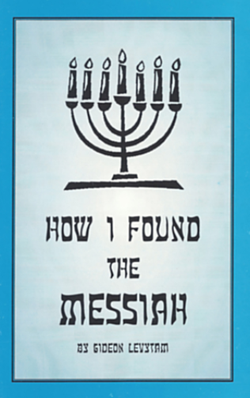
Follow Gideon Levytam's journey and discover how he was led by God, through a series of exciting circumstances, to find the One his people are still waiting for.
Past Episodes

Featured Offer
Follow Gideon Levytam's journey and discover how he was led by God, through a series of exciting circumstances, to find the One his people are still waiting for.
About Holy Scriptures and Israel
As time passed by, the Lord Yeshua took dear brother John Van Stormbroek to himself. The ministry of Holy Scriptures and Israel continued with additional development. In the early 1990’s, a weekly morning Bible class began which brother Gideon Levytam led regularly in the City of Toronto. This weekly open Bible class was held in the Willowdale assembly meeting hall. Eventually, a second mid-week evening Bible class was added. In April 2002, the need for an additional outreach Bible teaching meeting arose. We begun a Saturday (Shabbat) ministry meeting in which a systematic teaching of God’s word is presented to all who attend. Together we learn God’s Word, pray for each need and the salvation of Israel, and sing songs of worship unto our God, praising Him and our Lord Yeshua the Messiah.
In Mid 2004 we started to air on Joy 1250 Radio station a 15 minute Bible teaching program called "The Holy Scriptures and Israel" with Gideon Levytam. The broadcast teaches God’s word from a Hebrew Messianic perspective and has proved to be a blessing to many. It's now aired seven days a week. Our prayer is that many more of our Israeli people will have a clear understanding of who Yeshua is, why we all need him, and come to know him as their Lord and Messiah.
About Gideon Levytam
Contact Holy Scriptures and Israel with Gideon Levytam
426 Simcoe Street
Niagara-on-The-Lake
Ontario L0S 1J0
Canada
(905) 325-1234