

Esther 7:1-10, Part 2


The Doom of Haman the Jews Enemy Part 2
Guest (Male): Shalom. Holy Scriptures and Israel is a ministry designed to share with the Jewish people the good news of the Lord Jesus Yeshua the Messiah and to instruct Christians on the Jewish roots of their faith. And now, teaching God's word from a Hebrew Messianic perspective, here is Gideon Levytam.
Gideon Levytam: The study of Esther, chapter seven. And so she was seeking to maintain the Jewish people and not to allow them to be killed. So she shared this with the King Ahasuerus when she appealed to him at that moment. So verses three and four is Esther's response to King Ahasuerus. Tell me, what is your request, and it will be performed for you even to the half of the kingdom.
Now, if you would be there and you would see King Ahasuerus and then you see Esther and Haman there, and Esther is saying to him, "King, my husband, I'm now going to lose my life and my people are going to be killed. We are going to be destroyed. We are going to be slain. We are going to be perish." The King is really amazed. What do you say? Don't I know what is the plan that I have for you?
And so in verse five and verse six, we find out the King's answer to Esther, the Queen. He's answering her and he said unto her, notice that verse five, and the King Ahasuerus answered and he said unto Esther the Queen, "Who is he? And where is he that dare to presume in his heart to do such a thing?" Who is the person?
He didn't know, beloved brothers and sisters, that this Haman was planning all this. Oh yeah, we know that he gave him the permission about some people, but he never knew that these people that Haman wanted to destroy, they are people that belong to his own wife, Esther the Queen. And so King Ahasuerus says, "Who is he? And where is that person?"
It also tells us, brothers and sisters, that this king was not really, you might say, he was careless. Can you imagine to allow one of your servant to come to you and say, "Listen, there are certain group of people that are not valuable for you, I'm just going to destroy those people," and the king give him the ring, he says, "Go ahead, do what you wish." He must have been irresponsible, careless.
He was maybe you might say, as some said, he was a selfish man, only make sure that things are right for him, never cared for the people who were under his authority in the world in which he reigned over. And so we find out that he's asking this question in verse five, "Who is this person?" By the way, the word for enemy, "Who is this enemy?" In verse four, the word for enemy come from the Hebrew word "tsar". "Tsar" means narrow. And it comes from the word "tsarot", which those of us who know Hebrew, "tsarot" or in Yiddish "tsoris", means trouble. That's the root word, enemy. There is one that is causing trouble to the Jewish people.
And I mentioned that in our previous meetings, that we, as Jewish people, had enemies throughout the whole history of Israel. In every generation, there's always someone who rise up who want to do Satan's work to seek to destroy all the Jewish people. Whether it is Pharaoh, or whether it is Hitler, or whether it is Antiochus, or whether it is any man even in those days as I mentioned before, those who seek to destroy the Jewish people.
And somehow by the grace of God, God is preserving the people of Israel for the future day in which he is planning to restore them and to make them a nation of blessing to the world. And it is also the same thing with the body of Messiah, the church. Jesus the Messiah said in Matthew chapter 16, "I will build my assembly, my church, and the gates of Hades shall not prevail against it."
People try to destroy the body of Christ, the body of Messiah, persecution of believers everywhere in this world. And yet God is sustaining and preserving his people even today. Just look what's going on in the Middle East. Just look what's going on in Europe and many other areas in which people want to do away with those who believe in Yeshua the Messiah. But no one will succeed to destroy those that belong to Yeshua the Messiah.
And so we learn many lessons here, beloved brothers and sisters. And here we are heading now to the doom of the enemy of the Jewish people. And so we find out here is where Esther was bold enough to point now to this wicked man by the name of Haman. Look at this, and I'm reading now verse six. Esther point to Haman, the Jews' enemy.
And Esther said, "The adversary and the enemy is this wicked Haman." This word "Haman Hara" in Hebrew, wicked is "Ra", evil, this wicked man by the name of Haman. Finally, she pointed to the man that sought to destroy the Jewish people. "He is this wicked man, he is an enemy." Notice that she call him "the adversary, the enemy is this wicked man by the name of Haman."
He might be a servant of yours, he might be second to King Ahasuerus, but he was a wicked man who sought to destroy the people of God, the people of Israel. And things, beloved brothers and sisters, from here on, things completely changed. Here's Haman who up to this point was second to the king. He was the one that anything he wanted, the king will grant him. But now is a time of his doom.
And he is going to experience the consequence of his evil doing. And so she pointed to Haman. And she says, "Here is that man." And you notice how things change, brothers and sisters, immediately in verse 6b, Haman fear and sudden terror. All of a sudden, things completely change in the life of Haman. We read in verse 6b that "then Haman was afraid before the king and the queen."
Things change for him in a moment. It teaches us a great lesson. When man continue on in his own way, there's a day coming where God is going to deal with that person once and for all. You remember what the Bible teach us: "Be sure your sin will find you out." "Whatsoever man soweth, that shall he also reap," the Bible teaches us.
That's why it's always good for the people of God to acknowledge their weakness and the need of the grace of God and not to walk in pride to think I don't need God, I don't need anyone, I'm the captain of my ship, I'm the pilot of my plane, I can do my own thing, I don't need anyone. One day God is going to deal with those who oppose him and not only oppose him, oppose his plan, oppose his program.
The Jewish people are not better than any other nation in the world. But God has a program and a plan for Israel the nation. He promised to Abraham, "Those that bless thee I will bless, and him that curseth thee I will curse." And you can see, beloved brothers and sisters, that Haman who sought to destroy the Jewish people, now things change.
He's no longer happy to do his own thing, planning to destroy Mordecai, setting up a huge tree ready now to hang Mordecai, carelessly put fear upon thousands and thousands of Jewish people saying, "Listen, on the 13th day of the month of Adar, you are all going to be destroyed." But now his turn has arrived. And the table change. And so we find out that Esther pointed to him all of a sudden a terror came into his heart.
He is no longer the same man who was previously before he came into the banquet. He is now in fear is there before the king and the queen. I want you to turn to the book of Proverbs for a moment. Proverbs chapter six. Look what we read there in verse 12: "A naughty person, a wicked man, walk with a forward mouth," or a corrupt mouth.
"He winketh with his eyes, he speaketh with his feet, he pointeth with his fingers. Forwardness," or he plot evil, "is in his heart. He deviseth mischief continually. He soweth discord." Now notice verse 15, what Solomon the King of Israel is saying: "Therefore shall his calamity come suddenly. Suddenly shall he be broken without remedy."
Haman was haughty person. He was a wicked man. He walked with a corrupt mouth and said what he said and did what he did. But sooner or later, in due time, in God's providence, his judgment day will come. If you go back to chapter five of the book of Proverbs, and notice what we read in verse 21: "For the ways of man are before the eyes of the Lord, and he pondereth all his goings."
"His own iniquities shall take the wicked himself, and he shall be holden with the cords of his sins. He shall die without instruction, and in the greatness of his folly, he shall go astray." Well, beloved brothers and sisters, this is exactly what we learn in Scripture. Here's a man that didn't care for a moment of God's plan, of God's things. He didn't care of the Jewish people, of the people of Israel, and he sought to destroy them.
And the time come. And all of a sudden, we find him in a fear, a sudden fear, sudden terror that fell upon him. And so quickly, beloved brothers and sisters, notice that in the next verses, verses seven, eight, nine, and ten, we find Haman's final doom, the doom of Haman, this wicked man who plotted to destroy the people of Israel.
And so we read, beloved brothers and sisters, in verse seven, he now began to beg for his life. He was ready to destroy the Jewish people and he cared nothing about it. He was willing to pay so much money to the king just that he will get his own way. But now in verse seven, notice that, "the king arising from the banquet of wine in his wrath, he went unto the palace garden, and Haman stood up to make request for his life to Esther the queen, for he saw that there was evil determined against him by the king."
Two things we find out in verse seven, beloved brothers and sisters. First of all, the king when he heard that a man who was seeking to destroy his wife, the queen, to kill her and her people is Haman, he couldn't stay in the same place. He went quickly out to the palace garden and he was pondering. Says "Wait a minute," I can just imagine. He probably was saying in chapter three and verse one, "I promoted Haman. I gave him a great position to be the greatest leaders in the Persian Empire."
"In verse ten of chapter three, I gave him my ring. And I allowed him to use my ring to do whatsoever he want. I trusted him." Then later on in chapter three he says "I committed everything to him so he would be able to take any action he wanted." In chapter six and on, Haman, if you remember, came to the palace and he asked from the king to give to the man whom the king desired to honor, to give him the clothes he wear, the horse he ride on, and the crown he wears.
And he perhaps was pondering and he says "Wait a minute. I had a man in the midst, and he is the one who sought to do things against me. He is the one who turned around and actually usurped my place and my position and sought to run things in his own way." He was so angry he couldn't stay there. He went to ponder in the palace garden once he found out through Queen Esther that it was Haman.
But while the king goes out to ponder, look what we find out about Haman. He's begging for his life. It says here in verse 7b, "and Haman stood up to make request for his life to Esther the queen, for he saw that there was evil determined against him by the king." Now it is so interesting that the man who was ready to kill everybody, all the Jewish people, now he began to beg for his very own life.
Again we learn from Scripture that the Lord is always teaching us that one has to be extremely careful recognizing that we cannot just carry on and do our own thing and determine our own thing because one day we are going to stand before God. The day of judgment will come one day and brothers and sisters, listen: it's not only for unbelievers who have to accept the Messiah because if they reject the Messiah today, they will have to stand before him one day.
Today he offering himself as the Lamb of God who gave himself for the sin of this world. But one day he is going to be the Lion of the Tribe of Judah in the Great White Throne judgment where all those who refuse to accept him will end up to be judged for time and for eternity. But not only for the unbelievers, even for us. One day we are going to stand before the judgment seat of the Messiah, and the Lord will evaluate how did we live our lives.
And we will have to our shame many times to say "Lord, I failed you in so many ways," and to repent before him, but of course our salvation is secure not because of any good deed that we have done but because of what Yeshua have done for us. So it teaches us an amazing lesson. All of a sudden now he ask "Please keep me alive. Speak to the king, I beg you." He saw that there was determination of the king to destroy him as it says here at the end of verse seven, "that there was an evil determined against him by the king."
So the table have turned. Things are completely different right now. And so finally, beloved brothers and sisters, in verse eight, we have Haman's doing when the king came. Notice what it says: "Then the king returned from the palace garden into the banquet of the wine," and what happened? What does he see? He sees now Haman falling upon the bed where Esther was.
Can you imagine, he was begging here. He fell there on his knees you might say, "Please speak to the king that he will not kill me, they will not do away with me." And imagine when the king comes from outside, what does he see? Notice that it says when the king came in, he says, "Will he force the queen also before me in the house?" He came in what does he see? He see him begging her on the bed there, is on his knees there beseeching her, seeking from her to help him.
The king assumed that he is forcing his wife. He is forcing the queen. He says, "Will he force the queen also before me in the house?" The king was extremely angry when he came in and you notice that it says here: "As the king's word went forth out of his mouth, they cover Haman's face." You see what happened when the servant of the king heard what the king was saying: "Will he also force the queen in my house?" Immediately the servants knew that that's the end of Haman.
They took something, they covered his head never anymore to see King Ahasuerus. That was the response of the king to what Haman when he heard what Haman has planned to do. Again brothers and sisters, I would like to remind you that all this happened when the king up to this point never knew that his wife was a Jewish girl. She kept it away from him. Now finally she said to him, "I and my people." He understood that these are the people, the Jewish people that Haman wanted to destroy.
And so in verses nine and verse ten, we have first of all the suggestion of the servant of King Ahasuerus. His name is Harbonah. You find his name mentioned in chapter one in verse ten. He was one of the closest servant to King Ahasuerus. He said, notice what he suggest to the king. It says here: "Behold also the gallows fifty cubits high which Haman had made for Mordecai, who had spoken good for the king, standeth in the house of Haman."
In other word he was saying there is a big tall gallows, "etz" in Hebrew, a tree. It remain behind in the house of Haman. He prepared a tree in order to kill Mordecai the Jew who has saved you, King. Here's an opportunity to use that tree. Instead of Mordecai to be hanged, Haman was going to be hung on that very tree. And so, beloved brothers and sisters, the king said in verse nine: "Hang him thereon."
Look at the statement of the king: "Hang him thereon." So he gave the command to hang Haman there. And so it says in verse ten, and this is the conclusion here, the doom of Haman in verse ten, "they hanged Haman on the gallows that he had prepared for Mordecai and then was the king's wrath pacified." He then finally had peace after he hung Haman. It is an amazing story that we read here. This is not only actually a story, it happened in history, in the history of this world how the man that sought to destroy the Jewish people eventually find himself hanging on the very same tree that he prepared for Mordecai the Jew.
Now I want to conclude with one or two remarks. What's the lesson it is for us here? There's a great lesson for us here in this passage in this seventh chapter. I'll make one or two points. The first thing that I would like to mention is this: this chapter teaches us that we as believers at time are not where we should be. We are not always close to the Lord, we are not always where the Lord set his name there. We are at time scattered and not in the place that the Lord is pleased.
But God in his providence, God in his sovereignty, he still watches over his people. He care for the people of God. He cared for the Jewish people, he cares for them today, he will preserve the people of Israel for the future day. But he care for you and I. When we are away from the Lord, it's not a blessing for us, we are always going to lose out, find ourselves in a time of difficulties and challenges. And the safest thing for believers is close to the Lord. That's the first thing that I want to mention.
Secondly, we find out that God in his providence going to accomplish all what he has in mind. Doesn't matter who will rise and who will fall eventually. They are here and they are gone, but the people of God will be sustained all the way to the end of the days that God had planned for them. Thirdly, there's a lesson for us because Haman here is a picture of the Antichrist, the counterfeit Messiah.
Do you know that in a future day there will be one that will rise again to seek to destroy the people of Israel? We read about him in Daniel chapter seven, and in Daniel chapter 11, and in Second Thessalonians chapter two. He's called the wicked king. He's called the counterfeit Messiah. He's called as we have said in English, the Antichrist. A man that will rise up one day in the time of the tribulation where he will claim to be God to seek to take the place of the Messiah.
And he will also have an end because ultimately God's plan will come to fruition and he will accomplish all what he purposed for himself. And here we see that Haman is a picture of the Antichrist who will rise up in the future day and God ultimately will destroy him and will establish what he had planned for the people of Israel. I'm going to read two or three verses to conclude in Second Thessalonians chapter two, if you just turn with me for a moment to there, from verses five to eight. Let me read these verses for us all.
"Remember ye not," Paul is saying, "that when I was yet with you I told you these things? And now ye know what withholdeth or what restraining that he might be revealed in his time. For the mystery of iniquity doth already work. Only he who now letteth will let until he be taken out of the way. And then shall that wicked be revealed whom the Lord shall consume with the spirit of his mouth and he will destroy with the brightness of his coming."
"Even him whose coming is after the working of Satan with all power and sign and lying wonders." See the apostle Paul taking us over the ages, anticipating the coming of the counterfeit Messiah who will ultimately be destroyed by the Lord Jesus the Messiah. That wicked one will be revealed one day whom the Lord shall consume with the spirit of his mouth and shall destroy with the brightness of his coming.
Jesus the Messiah haven't come as yet, but he will come. And he will destroy those that oppose him and specifically in the context of Second Thessalonians the one that is called the counterfeit Messiah whom he will ultimately destroy just like God destroyed that wicked man by the name of Haman. May the Lord help us to grasp this, to understand it, to appreciate the word of God and stay close to the person of Yeshua the Messiah.
Guest (Male): You have been listening to Holy Scriptures and Israel with Gideon Levytam. Gideon teaches God's word from a Hebrew Messianic perspective. For more information about this ministry, write to Holy Scriptures and Israel, Box 1411, Niagara on the Lake, Ontario, L0S 1J0, or visit our website at holyscripturesandisrael.org. You are also invited to Gideon's weekly Bible teaching on Fridays at 11:00 AM and 7:00 PM and Saturdays at 1:00 PM at Willowdale Christian Assembly Hall, 28 Martin Ross Avenue in Toronto. Holy Scriptures and Israel is made possible by your prayers and financial support. If you would like to support the program, visit holyscripturesandisrael.org. God bless you. Shalom, shalom.
Featured Offer
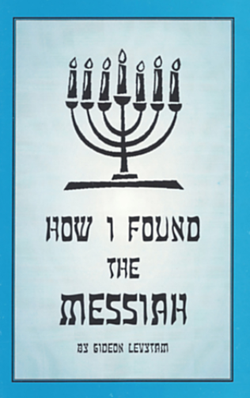
Follow Gideon Levytam's journey and discover how he was led by God, through a series of exciting circumstances, to find the One his people are still waiting for.
Past Episodes

Featured Offer
Follow Gideon Levytam's journey and discover how he was led by God, through a series of exciting circumstances, to find the One his people are still waiting for.
About Holy Scriptures and Israel
As time passed by, the Lord Yeshua took dear brother John Van Stormbroek to himself. The ministry of Holy Scriptures and Israel continued with additional development. In the early 1990’s, a weekly morning Bible class began which brother Gideon Levytam led regularly in the City of Toronto. This weekly open Bible class was held in the Willowdale assembly meeting hall. Eventually, a second mid-week evening Bible class was added. In April 2002, the need for an additional outreach Bible teaching meeting arose. We begun a Saturday (Shabbat) ministry meeting in which a systematic teaching of God’s word is presented to all who attend. Together we learn God’s Word, pray for each need and the salvation of Israel, and sing songs of worship unto our God, praising Him and our Lord Yeshua the Messiah.
In Mid 2004 we started to air on Joy 1250 Radio station a 15 minute Bible teaching program called "The Holy Scriptures and Israel" with Gideon Levytam. The broadcast teaches God’s word from a Hebrew Messianic perspective and has proved to be a blessing to many. It's now aired seven days a week. Our prayer is that many more of our Israeli people will have a clear understanding of who Yeshua is, why we all need him, and come to know him as their Lord and Messiah.
About Gideon Levytam
Contact Holy Scriptures and Israel with Gideon Levytam
426 Simcoe Street
Niagara-on-The-Lake
Ontario L0S 1J0
Canada
(905) 325-1234