

Esther 5:1-14, Part 2


The Boldness of Esther Before the King of Persia Part 2
Narrator: Shalom! Holy Scriptures and Israel is a ministry designed to share with the Jewish people the good news of the Lord Jesus Yeshua the Messiah and to instruct Christians on the Jewish roots of their faith. And now, teaching God's word from a Hebrew Messianic perspective, here is Gideon Levytam.
Gideon Levytam: The study of Esther chapter 5. It was Jonah the prophet who was three days and three nights in the fish's belly. The number three is so important, and I just want you to notice with me, if you just turn to the prophet Hosea, and I want you to notice what it says in Hosea chapter 6, verses 1 and 2, in connection with the number three. Notice it says, "Come, let us return unto the Lord, for he has torn and he will heal us. He has smitten and he will bind up." Notice verse 2: "After two days will he revive us, namely Israel. In the third day, he will raise us up and we shall live in his sight."
See, the prophet Hosea was speaking prophetically about the future restoration of Israel as a nation. The two days mentioned here is often applied by Bible teachers to 2,000 years of history of the church age in which we live today. And the third day has a reference to a future where God will restore Israel. Notice: "On the third day, he will raise us up, namely Israel," Hosea is speaking. And then he says at the end of this same verse, "And we shall live in his sight." See, Israel, even today, is far away from where God intended our people to be.
But there will come a day when Israel shall live in his sight. Verse 3 said, "And then shall we know if we follow on to know the Lord. His going forth is prepared as the morning, and he shall come unto us as the rain, as the latter and the former rain unto the earth." There is a future that is awaiting for the nation of Israel on the third day. It is interesting. Most of us don't even realize as we read this passage and connect it with other events in human history. And notice like Esther, she said, "On the third day," she said, "I'm going to approach the king." And so notice I'm back in Esther chapter 5, in verse 1. On the third day, she's now approaching the king.
It says Esther, what does she do? She put on her royal apparel and she stood in the inner court of the king's house, over against the king's house, and the king sat upon his royal throne in the royal house over against the gate of his house. Three times the word "royal" is mentioned. The Hebrew word for royal is *malchut* or *malchuto*. And here is the queen. Notice Esther is very bright, she's very wise. And she's wanting to approach the king now in order to help her people, the Jewish people. And so she comes to him, she dressed... remember in the previous chapter 1, the king wanted that Vashti will come with her royal apparel.
But Vashti didn't want to come because the king was drunk and everybody else was drunk around there. So Vashti says, "I'm not coming." She lost the kingdom. Now Esther, she was not foolish. She was a wise Jewish girl. She knew her history. So she's approaching now to the king and she comes to him, she dressed with her royal apparel. Why? Because the king is sitting on his royal throne. He is in his royal house. She's coming with royal clothes, appearing before the king, approaching him. But she was very wise. Notice what it says here in verse 2: Esther immediately as she was just standing by, she obtained the favor of the king.
You know, she was very attractive, a Jewish girl. And it was so, verse 2, when the king saw Esther the queen standing in the court, she didn't come in, she didn't barge in. She just stood there in a sense that he will see her. So she stood there outside by the court and immediately we read that she obtained favor in his sight. And the king held out to Esther the golden scepter that was in his hand. So Esther drew near and she touched the top of the scepter. You notice there and the scepter speaks of royalty, authority, of kingship.
You remember in Genesis chapter 49, when Jacob, before he died, he said about the 12 tribes of Israel, he was blessing the 12 tribes of Israel, and he said, "The scepter shall not depart from Judah, nor the lawgiver from between his feet." The kingship over the nation of Israel will ultimately be given to the descendants of the tribe of Judah. So the scepter was an important show of authority, show of position. And here is the king now, he got the attention of Esther, she obtained favor in the king's eyes, and he's handing over the scepter to Esther. And Esther just touched the top of it, accepting the fact that he is inviting her.
Beautiful to see this. But brothers and sisters, I want to make an application. Remember that the Bible teaches us that whatsoever things were written aforetime (Romans 15:4) were written for our learning. And therefore, we can learn from that and we can make an application that how much God wants us to draw near to him. You see, it says here that after she obtained favor (verse 2) and then she touched the golden scepter that was in the hand, so Esther drew near and she touched the top of the scepter. The thought of being drawn near. You know, what a loss for us when we don't draw near to God.
When we don't draw near to the person of Yeshua the Messiah and we stay at a distance. Many times, we are not enjoying the blessing that God is intending for his own people, the people of God. The writer who wrote to the Hebrew believers, and I'm going to read that verse in connection with this, Hebrews chapter 10, verse 22: "Let us draw near with a true heart in full assurance of faith, having our hearts sprinkled from an evil conscience and our bodies washed with a pure water. And let us hold fast our profession of our faith without wavering, for he is faithful that promised."
You see, the apostle who wrote to the early Hebrew believers wanted to encourage them to be drawing near to the Lord Yeshua the Messiah with full assurance of faith. We can draw near to him, we can ask him, we can let him know the problems. You see, Esther was not sure how his reaction will be. But we know the reaction of our King Messiah Yeshua. We know that he will allow us to be drawn near. He actually invites us to come closer to him. But she had to be careful. Again, she remembered very well how his previous wife was set aside completely, and how he was ready to sign a statement that all the Jewish people will be killed in one day on the 13th day of the month of Adar.
So she, perhaps coming with trembling in some way, and yet she came and somehow by the providence of God, the king handed her the scepter, she touched it, and she drew near. And you can see how the king's heart is in the hands of the Lord, because immediately in verse 3, we find out that then the king said unto her, "What wilt thou, Queen Esther? What do you want, Esther? And what is thy request, Esther? It shall be even given to thee to the half of the kingdom." Now, can you imagine? He offered Esther half of the kingdom.
He offered Esther, he was so delighted in the fact that she saw her. And apparently, remember, 30 days she was not in his presence, she was not called by the king. Nevertheless, again, I would like to tell you, beloved brothers and sisters, the providence of God working in the heart of King Ahasuerus and he said to her, "It shall be given unto thee the half of the kingdom. What is your request, Esther? Just ask." Now, what would you do if King Ahasuerus will ask you? I'd say, "Well, give me a quarter of the kingdom. I don't need all the half." But nevertheless, you see, she was a very bright woman because she had in her mind her Jewish people.
And I think it's so commendable. It's so commendable she took the step moving forward, you might say putting her life at stake, and simply saying as we read at the end of chapter 4 in verse 14, "And if I perish, I perish." If I perish, I perish. So the king offering to her, it was so beautiful in verses 1 to 3, Esther drew near. And it was on the third day. And just one more thought, beloved brothers and sisters, it was on the third day that Yeshua HaMashiach rose from among the dead. He was delivered for our offenses, but he was resurrected for our justification, Romans chapter 4 teaches us.
You see, if the Messiah did not rise from among the dead, we would have no hope. But he rose, not only to forgive our sins, but to justify us, to declare the believer in the Messiah Yeshua as if he or she had been just. Individual justification. And so the resurrection is emphasized here in these three verses. Well, notice now we continue in verses 4 to 8. Esther is inviting the king and Haman unto a *mishte*, a banquet. So she is wisely, when he asked her, she had an opportunity. "Wait, wait, wait, you're asking me what I want? You offer me half of the kingdom?" She could have asked him right here and then, "King, here's the situation."
But she was wise, and she delayed the request. And so in verses 4 to 8, Esther's invitation to the king to come to a banquet. It says in verse 4 the invitation itself. And here, brothers and sisters, very interesting verse, this verse 4, because Esther answered and she said to him, "If it seem good unto the king, let the king and Haman come this day unto the banquet that I have prepared for him." So she's inviting him to a banquet. She inviting him to a banquet. You see, this king knows of many, many banquets throughout the book of Esther, you find him constantly having a time of so-called drinking and having good celebration all the time. So he's just another banquet he will be happy to come to.
And so she's inviting him to a personal banquet. And you notice she says in that verse 4, the Queen Esther said to him, "Let the king and Haman," this evil, wicked man, "come this day unto a banquet that I have prepared for him." Now, I want to mention something about this verse 4. Many throughout, if you just look around and hear many Bible teachers, some believe that in this verse 4, there is what you call an acrostic where you find the word "Jehovah," Jehovah, is mentioned in four Hebrew words in this text. That's why some people trying to figure out, they say how come in the book of Esther there is not one time no God mentioned, no Elohim mentioned, no Lord Adon mentioned, no Jehovah mentioned, no prayer mentioned? How is it possible?
So some believe that there are four places in the book of Esther, chapter 1 verse 20, chapter 5 verse 4, chapter 5 verse 13, and chapter 7 and verse 7, where there is acrostic where the name Yud Hei Vav Hei is mentioned in the text. And how they glean that? In this word, notice it says here and Esther answered, "If it seem good unto the king," and here from the second half of verse 4, "let the king and Haman come this day." In the Hebrew it says: *Yavo HaMelech VeHaman HaYom*. *Yavo* - Yud. *HaMelech* - Hei. *VeHaman* - Vav. *HaYom* - Hei. Yud, Hei, Vav, Hei. That's what some believe.
Now, I'm very suspicious over that because you can take every verse in the Hebrew text and you can make out of it anything you wish if you want. You can write all kinds of things if you want. One has to be extremely careful about this. By the way, it's mentioned in the same chapter, verse 13, it's also an acrostic according to these who teach us that where it says, "Yet all this availeth me nothing." It is the same thing. *VeChol Zeh Einenu Shaveh Li*. The last letter of every word here speaks of the word Jehovah, the acrostic, the code that the name of Jehovah is mentioned in this chapter according to those who teach this.
In verse 4, it's the first letter of every word. In verse 13, it's the last letter of every word, suggesting that the beginning and the end of Haman is right here found in Esther chapter 5. And so, beloved brothers and sisters, this is what some believe. I'm just conveying this to you. But I would like us to realize, we believe that the book of Esther is part of the canon of scripture. And even though the name of God by divine design is not mentioned, nevertheless the hands of God, the sovereignty of God, and the providence of God is seen throughout the book of Esther.
So in verse 4 is the invitation. King, you come, Haman come, come this day unto a banquet that I have prepared for thee. And so in verse 5, the king and Haman response to Esther's invitation. Then the king said unto Haman to make haste that he may do as Esther has said. So the king and Haman came to the banquet that Esther had prepared. And so notice that he's rushing Haman to come because Esther desire. And you can see how Esther wisely with very few words drawing the king to come to her banquet because in her plan, she want to help the Jewish people. She want to save her people from destruction.
Because there was a wicked man by the name of Haman who wanted to destroy her nation, her people. She was drawing King Ahasuerus for a right reason while Haman was drawing King Ahasuerus for a wrong reason. You can see the motive here. Her motive was a good motive. His motive was an evil motive. But both have been the one that kind of attracted King Ahasuerus. Remember earlier, Haman says, "Oh, there are people that you don't need. They are not worthwhile for you. Don't worry, you don't need to search who they are, but they are not good for you." And King Ahasuerus without to read the text just signed it and gave an instruction to destroy all the Jews.
She in a wise way does the same thing, but what she does is not for evil but for good. And you know, motives are very important. We ought to have right motives in our hearts. And sometimes we don't say the whole story, but the motive need to be for a blessing, not for a curse. The motives we cannot judge, only God can judge, but we ought to have a motive that is right in order to be a blessing for God's people. And so notice in verse 6 now, the King Ahasuerus second time that he question her. So they come to the banquet that she prepared now and they are now again in this banquet.
So we read that the king said unto Esther in verse 6 at the banquet of wine, "What is thy petition? And it shall be granted thee." And notice what he says, "And what is thy request? Even to the half of the kingdom, it shall be performed." You see, in the verse 3, he says it will be given to you. But in verse 6, he says, "Count it as done. You not only ask for that, but I'm want to assure you, Queen Esther, consider it done. It shall be performed for you, Esther." And so Esther is hearing this from the mouth of the king. And you would say, "Wow, here's another opportunity now. I'm going now to tell to the king exactly what I want right now."
But again, Esther hold on her peace. She doesn't say anything. She prolong the discussion concerning what she was going to say because she looks for the right time. You know, sometimes we go and we want to ask something from someone or to say something to someone, and we say, "Wait a minute, it's not quite the right time. He is not in a good mood right now," or whatever it is the reason. "I'm not going to say right now. I'm going to delay it until the right time." Now, of course, the king, it seems to be was ready to answer, to give her everything she want. And again I would like to show you, brothers and sisters, that though she has plans and though she have her own thoughts, her own plan to try to get the words out of her mouth in order to save the Jewish people, she still delayed a second time.
And so in verses 7 and 8, Esther answer the king the second time and this time she hold back once again and invite him to the second invitation to come to another banquet that she will make later on, the following day. Verse 7 and 8: "Then answered Esther and said, 'My petition and my request, here it is: If I have found favor in the sight of the king, and if it please the king to grant my petition and to perform my request, let the king and Haman come to the banquet that I shall prepare,'" now it's a future, "'for them, and I will do tomorrow as the king hath said.'"
So she defer the request from the king for the next day. Now, you and I might ask, we don't understand Esther, why are you doing so? You had the opportunity to do it here and now. The first time and the second time, on that day, twice he said to you, "What is thy request? Even to the half of the kingdom." In Hebrew we say *ad chatzi hamalchut*. That's mean ask whatever you want. Do you remember it was Herod, this wicked king, in the time when Yeshua was in the land of Israel and Yohanan HaMatbil was there? You remember when Yohanan HaMatbil, John the Baptist, said to the King Herod who took Herodias, the wife of his brother, and he took her, and what Yohanan HaMatbil, John the Baptist, said to him? "It's wrong what you are doing."
So the king put him in prison. And then Herodias' daughter came and danced before him. And he was so attracted to her and he said to her, as we read there in the Gospel, what did he say to her? "You ask for me and I'm going to give you up to half of the kingdom. Just ask of me and I'll give you up to half of the kingdom." And then we find out that eventually she asked for the head of Yohanan HaMatbil and they cut off his head. What a shame. What a shame. But here's a man who stood for the Messiah, who stood for the God of Israel, and he lost his life.
So Esther here is delaying now the request from the king for the following day. How precious it is to see the wisdom that she have, and yet at the same time the providence of God. And again I would like to say as Proverbs 21:1 says: "The heart of the king is in the hands of the Lord, and he moves that in every way he want. He can harden the king's heart, he can soften the king's heart." He have done so to Pharaoh, he have done so to Cyrus, he have done so to Nebuchadnezzar, he have done to many kings. God is able to harden and to soften because the heart of the leaders are not really in their own hands. God is the one that ultimately is shifting things around as it is pleasing unto him.
Well, these are the first eight verses of Esther chapter 5. Esther approached the king, requesting him to come to that special banquet that she's going to say to him. Now, we're not going to hear yet about this until the following chapter. But now, here we can see now from verse 9 to the end of the chapter, we see the pride that existed in the heart of Haman HaRasha, Haman this evil man. *Ga'avah*, you know we call it in Hebrew, *ga'avah*, the pride. The Bible teaches us that pride comes before a fall. God resists the proud, but he give grace unto the humble. God is the one that desire to see meekness and humility in the life of mankind.
But here we can see the pride of Haman which represent the old nature that we all have. Remember Haman was an Agagite. Haman was an Amalekite. The Amalekites have fought our people of Israel right when they left the land of Egypt. They attacked the weak one at the back. They attacked the elder ones in the back. They attacking constantly the people of Israel. And it's represent the flesh, the old nature that attacks us every day in our life. God want us to do the right thing, the flesh say do the wrong thing. God says, "You follow me," the old nature says, "No, I got to do my thing."
And the flesh profiteth nothing, that scripture teaches us. "I know that is in me, that is in my flesh," the apostle Paul said, "there is no good thing." That's why we fight, that's why we hate, that's why we lust, that's why we covet, that's why we war, that's why we have all the problem that exist in the world because this old self is been represented by the Amalek, the giant. It is me, me, me. I just read the other day a song about it. It says, "Me, my, and mine just carry on on the way." And me say to mine, "What you think about me?" You know, it's like the old selfishness nature that we have.
It's only me. Two children fight over a toy. "It's mine, mine, it's mine, it's mine." And we too, many times, it's me, it's mine, it's I, it's not you. But the only one that represent really the truth the way the Lord wanted us to be is Yeshua the Messiah. He was the one that was equal with God, made himself of no reputation, and came down to this world to give his life for us. And so dear brothers and sisters, look at this, from these next verses 9 to 14, we see Haman's pride and self-delusion.
Narrator: You have been listening to Holy Scriptures and Israel with Gideon Levytam. Gideon teaches God's word from a Hebrew Messianic perspective. For more information about this ministry, write to Holy Scriptures and Israel, Box 1411, Niagara-on-the-Lake, Ontario, L0S 1J0, or visit our website at holyscripturesandisrael.com.
You are also invited to Gideon's weekly Bible teaching on Fridays at 11:00 AM and 7:00 PM and Saturdays at 1:00 PM at Willowdale Christian Assembly Hall, 28 Martin Ross Avenue in Toronto. Holy Scriptures and Israel is made possible by your prayers and financial support. If you would like to support the program, visit holyscripturesandisrael.com. God bless you. Shalom, shalom.
Featured Offer
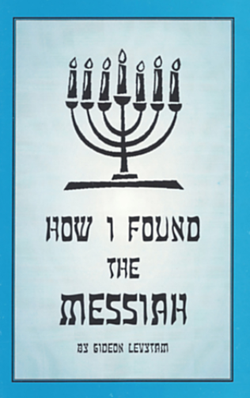
Follow Gideon Levytam's journey and discover how he was led by God, through a series of exciting circumstances, to find the One his people are still waiting for.
Past Episodes

Featured Offer
Follow Gideon Levytam's journey and discover how he was led by God, through a series of exciting circumstances, to find the One his people are still waiting for.
About Holy Scriptures and Israel
As time passed by, the Lord Yeshua took dear brother John Van Stormbroek to himself. The ministry of Holy Scriptures and Israel continued with additional development. In the early 1990’s, a weekly morning Bible class began which brother Gideon Levytam led regularly in the City of Toronto. This weekly open Bible class was held in the Willowdale assembly meeting hall. Eventually, a second mid-week evening Bible class was added. In April 2002, the need for an additional outreach Bible teaching meeting arose. We begun a Saturday (Shabbat) ministry meeting in which a systematic teaching of God’s word is presented to all who attend. Together we learn God’s Word, pray for each need and the salvation of Israel, and sing songs of worship unto our God, praising Him and our Lord Yeshua the Messiah.
In Mid 2004 we started to air on Joy 1250 Radio station a 15 minute Bible teaching program called "The Holy Scriptures and Israel" with Gideon Levytam. The broadcast teaches God’s word from a Hebrew Messianic perspective and has proved to be a blessing to many. It's now aired seven days a week. Our prayer is that many more of our Israeli people will have a clear understanding of who Yeshua is, why we all need him, and come to know him as their Lord and Messiah.
About Gideon Levytam
Contact Holy Scriptures and Israel with Gideon Levytam
426 Simcoe Street
Niagara-on-The-Lake
Ontario L0S 1J0
Canada
(905) 325-1234