

Esther 4:1-17, Part 1


Esther Decides to Help the Jewish People Part 1
Guest (Male): Shalom. Holy Scriptures and Israel is a ministry designed to share with the Jewish people the good news of the Lord Jesus Yeshua the Messiah and to instruct Christians on the Jewish roots of their faith. And now, teaching God's word from a Hebrew Messianic perspective, here is Gideon Levytam.
Gideon Levytam: Shabbat Shalom, everyone. Please open your Bibles to the book of Esther. We're going to read the fourth chapter today. Beautiful book that the spirit of God had given to us in the canon of scripture. There are many lessons that we can learn from the history of the Jewish people, our own people, historically, how God had preserved our people Israel throughout history.
Let's read Esther chapter four. I begin from verse one. When Mordecai perceived all that was done, Mordecai rent his clothes, and put on sackcloth with ashes, and went out into the midst of the city and cried with a loud and bitter cry. And came even before the king's gate, for none might enter into the king's gate clothed with sackcloth. And in every province, whithersoever the king's commandment and his decree came, there was great mourning among the Jews, and fasting, and weeping, and wailing; and many lay in sackcloth and ashes.
So Esther's maids and her chamberlains came and told it her. Then was the queen exceedingly grieved; and she sent raiment to clothe Mordecai, and to take away his sackcloth from him. But he received it not. Then called Esther for Hatach, one of the king's chamberlains, whom he had appointed to attend upon her, and gave him commandment to Mordecai, to know what it was and why it was.
So Hatach went forth to Mordecai unto the street of the city, which was before the king's gate. And Mordecai told him of all that had happened unto him, and of the sum of the money that Haman had promised to pay to the king's treasuries for the Jews, to destroy them. Also he gave him the copy of the writing of the decree that was given at Shushan to destroy them, to show it unto Esther, and to declare it unto her, and to charge her that she should go in unto the king, to make supplication unto him, and to make request before him for her people.
And Hatach came and told Esther the words of Mordecai. Again Esther spake unto Hatach, and gave him commandment unto Mordecai; All the king's servants, and the people of the king's provinces, do know, that whosoever, whether man or woman, shall come unto the king into the inner court, who is not called, there is one law of his to put him to death, except such to whom the king shall hold out the golden scepter, that he may live. But I have not been called to come in unto the king these thirty days.
And they told to Mordecai Esther's words. Then Mordecai commanded to answer Esther, "Think not with thyself that thou shalt escape in the king's house, more than all the Jews. For if thou altogether holdest thy peace at this time, then shall there enlargement and deliverance arise to the Jews from another place; but thou and thy father's house shall be destroyed. And who knoweth whether thou art come to the kingdom for such a time as this?"
Then Esther bade them return Mordecai this answer, "Go, gather together all the Jews that are present in Shushan, and fast ye for me, and neither eat nor drink three days, night or day. I also and my maidens will fast likewise; and so will I go in unto the king, which is not according to the law. And if I perish, I perish." So Mordecai went his way, and did according to all that Esther had commanded him.
I would like to remind us all that when we study the book of Esther, we notice that throughout the book of Esther, we don't even have one time the name of God mentioned. Not even one time the name of Lord, or Adonai, or Jehovah mentioned. Not even one time the word prayer is mentioned throughout the book of Esther.
It seems to be that the spirit of God, by divine design, allowed this to remain in such a way to show us and to teach us an important spiritual lesson. You remember that the Apostle Paul in the Brit Chadashah, in the New Covenant, says whatsoever things are written aforetime were written for our learning. It is written for your benefit and for my benefit today because you and I learn from what the Bible teaches us concerning the history of our nation, the nation of Israel.
Christians anywhere and everywhere throughout history can read this text and learn a very important lesson. Every believer wherever we are, boys, girls, men, women, we can read this story and we find out how God in his love for the nation of Israel, in his providence, protecting his wayward nation who find themselves in the land of Persia. Israel was there because of disobedience.
After 70 years that have been promised to be kept in captivity, God had called the whole nation of Israel to return back to the land. Ezra chapter one, the call of Cyrus, Coresh, the king of Persia, he have challenged all our Jewish people to come back to the land of Israel. But unfortunately, only a minority returned back to the city of Jerusalem and to the land of Israel.
And so the vast majority of Jewry remain outside of the land of Israel. Well, this is exactly what we learn here in the book of Esther. The Jewish people, Mordecai HaYehudi, Mordecai the Jew, Esther HaYehudiah, Esther the Jewish girl, and all other Jewish people remain outside of the land. They were not where they should have been. They should have been back in Jerusalem and in Israel. But yet God in his providence protecting the Jewish people.
Well, in the last chapter, we concluded in chapter three of the letters that were sent to all the nations of which Ahasuerus was in charge over, 127 provinces or as we call them in Hebrew, medinot, nations, countries. 127 nations, letters were sent by Haman, this wicked, evil man, and the letters declared the destruction of all the Jewish communities worldwide.
Haman, this wicked man, declared a date. The date will be the 13th day of the 12th month, which is the month of Adar. And all the Jewish people will be killed according to the letters that he sent. If you will notice that, it does say in the previous chapter, notice that in chapter three and verse seven, in the first month, that is in the month of Nisan, and in the 12th year of the king Ahasuerus, they cast Pur, that is lot.
And then notice what it says at the end there, that the date was chosen and the date was the month of Adar. And in that time, the Jewish people were called to be destroyed. I'm reading a little bit further in verse 13 of chapter three. And the letters were sent by posts into all the king's provinces, to destroy, to kill, to cause to perish all Jews, both young and old, little children and women, in one day, beloved brothers and sisters, in one day.
And what is this date? Verse 13 B of chapter three. Even upon the 13th day of the 12th month, which is the month of Adar, and to take the spoil of them for a prey. Imagine, it's a declaration of destruction of the whole Jewish community that this evil, wicked man by the name of Haman have declared. Letter was sent, 127 provinces received this letter. In a sense, beloved brothers and sisters, it was what we call Jewish annihilation, complete destruction of the Jewish people.
Hitler sought to do it, the Pharaohs sought to do it, the Herods sought to do it, and all history teaches us the desire of the world to destroy the Jewish people. Well, men can try, but God by his grace has a purpose and a plan for his people. So in chapter four, we have really, Esther had to make a decision now that she's the queen to assist in the preservation of her own Jewish nation.
And so in the first three verses of Esther chapter four, we have the great mourning among the Jewish community. Can you imagine when you have a declaration like this, what can you do? You might say you are completely at the mercy of those under whom you are living. You had nothing that you can do except really mourn and weep and seek help from somewhere.
So again, no mention of God, no mention of prayer. Yet we have Mordecai in verses one, two, and three, and the Jewish community, weeping and really being broken. Notice it says in verse one, Mordecai bitter cry. When Mordecai perceived all that was done, Mordecai rent his clothes and put on sackcloth and ashes and went out into the midst of the city and cried with a loud voice and a bitter cry.
It's so much clearer in the Hebrew text. It says, "Va-yiz'ak ze'akah gedolah u-marah." He cried such a cry that everyone could hear that cry. Of course, we don't read now at this moment that he cries to God in prayer. No, but he know very well his history. He know very well what men sought throughout the ages to do to his own Jewish people. But he himself, notice, he put sackcloth on, he put ashes on.
And by the way, the first time that we find out that men put sackcloth and ashes is found in the earlier chapters of the book of Genesis, in chapter 37, where we find Jacob, Jacob putting upon himself this sackcloth and ashes, a confession, a time of mourning and repentance. And here you find out that Mordecai the Jew put it upon himself and crying with a great cry, he is crying.
We find this expression of sackcloth and ashes throughout the scripture. Daniel put sackcloth and ashes upon himself when he went to the Lord in prayer. Again, to remind you, we don't find Mordecai doing so here because he's not in a right location in a right spiritual state. But you may assume so because even though God's name is not mentioned, he's putting upon himself sackcloth, he's putting upon himself ashes, and he's crying this great cry so everyone could hear him.
Imagine the bitterness that he had in his own heart, knowing that soon, a certain date of the 13th day of the month of Adar, his people will be destroyed, including him, including all the Jewish community worldwide. And so Mordecai was crying that cry. In verse two, he's approaching all the way to the king's court.
You notice he cannot get in because no one will ever be able to enter into the king's court with sackcloth and ashes. But he came even to the king's gate, for none might enter into the king's gate clothed with sackcloth. He have arrived as close as possible. Now, of course, who is inside the palace? Esther, his niece.
Who is there in the palace? All the people who are in charge of the affairs of the Persian kingdom. So he came near as far as to the gate, and there he was crying with a loud voice and he was mourning publicly. Everyone could hear him, everyone could see, well, this man must be in a terrible need that he cry such a cry as this.
And so we read that in verse three, that in every province, whithersoever the king's commandment and his decree came, there was a great mourning among the Jews, and fasting, and weeping, and wailing; and many lay in sackcloth and ashes. In fact, what we really learn is that Mordecai set an example. He was the one who become for us here, as we read this text, a leader among the Jewish community.
He set an example in Shushan the palace, but it's not only Mordecai. According to verse three, every province, every nation where the Jewish people were living there, there was a great mourning. The word for mourning is evel. It's just like death. You know, when you go to a person whose member of his family or her family passed away, and they will sit at home for Shiva, we call it in Hebrew, where we sit down for seven days of the death of someone.
We are mourning. We are mourning the loss of a loved one, a person that was dear to us. Now it didn't happen yet. It was going to happen in the month of Adar later on. But as far as Mordecai was concerned, knowing the determination of Haman, he and all the Jewish community, listen to this, they were fasting, they were weeping, they were wailing; and many lay down with sackcloth and ashes.
What a picture, beloved brothers and sisters, how he took it to heart in understanding that there was a person that sought to destroy the people of Israel, the Jewish community worldwide. Now again, I would like to remind you, if you just turn with me for a moment to Second Chronicles in the Tanakh, in the Old Testament, we find out an expression that King Solomon, King Shlomo, have asked the Lord when he built the temple in the city of Jerusalem.
Notice what King Solomon said in Second Chronicles chapter six and verse 34. King Solomon said, "If thy people," verse 34, "go out to war against their enemies, by the way that thou shalt send them, and they pray unto thee towards this city which thou hast chosen, and the house which I have built for thy name; then hear thou from the heavens their prayer and their supplication and maintain their cause.
If they sin against thee (for there is no man which sinneth not) and thou be angry with them and thou will deliver them before their enemies and they carry them away captive unto a land far off or near. Yet if they bethink themselves in the land whither they are carried captive, and turn and pray unto thee in the land of their captivity, saying, 'We have sinned, we have done amiss, and have dealt wickedly'; if they return to thee with all their heart and with all their soul in the land of their captivity, whither they have carried them away captive, and pray towards this land which thou gavest unto their fathers and towards the city which thou hast chosen and towards the house which I have built for thy name; then hear thou from the heavens."
Now again, I would like us to see, King Solomon have shared this with the Lord and asked this for those who will repent and turn back to God and seek his way in restoration. Of course, we do not hear the name of God mentioned here in the book of Esther. But you can see, beloved brothers and sisters, that Mordecai in some small way knew his history and knew very well that there is a need of repentance.
And even though the name of God is not mentioned, we can assume that somehow God was speaking to him and alerting him of the necessity to be broken before God even though the name of God is not mentioned here in this chapter or in this book. So we find the Jewish people mourning. What about you and I sometimes when we have a problem in our life and a situation arise in our own life?
How important for us not to stay at a distance, not to stay away from the Lord, but it's so important for us to turn back to the Lord in prayer. It's so important for us to repent and to cry to the Lord for mercy. And if we don't do so, we perhaps will be like the Jewish people of old who have been away from the land. Yet God will preserve his people.
He will discipline them. He will as a father deal with his own children. He will deal with us. But we are called constantly to return to the ways of the Lord and to come with repentance. And the attitude of Mordecai is definitely seen here in the first three verses that are before us. Great mourning among the Jewish people throughout all the lands of the Persian Empire in the first three verses.
Well, what happened is in verses four to nine, we find out that Esther is hearing about what is going on. And so we find out that she hears of the decree of the killing of all the Jewish people. So in the next verses, Esther, and I'm reading now verse four, Esther's maidens and her chamberlains came and they told her.
Then was the queen exceedingly grieved, and she sent raiment to clothe Mordecai, and to take away his sackcloth from him, but he received this not. It seems to be for one reason or another that Esther was not yet aware of it. I don't know why. We do not read why, but she had to hear it from someone else. So what does she do? She heard that Mordecai is mourning.
She heard that Mordecai is having sackcloth and ashes upon all his body. So what does she do? She send him a change of clothes. She says, "Listen, you don't need to be like this. I'm the queen. I can send you some clothes and order that you will not be in that state, clothes in such a way. Why are you in such a condition?"
Well, Mordecai sending to her back the clothes. She apparently did not know yet what is going to happen. Perhaps she was away from a public place. Everybody already heard this, but she was not able to know that. We do not know why. But the point is that she is sending clothes to Mordecai so he will change and he will not be anymore dressed in such a way.
So Esther sent her servant to know what's going on. Why is it that Mordecai, you are dressed like this? You notice verse five and verse six. She call Hatach, after the refusal of Mordecai. She call Hatach the king's chamberlain, whom he had appointed to attend upon her. She gave him a commandment to Mordecai to know what this was, what it was and why it was.
And Hatach went forth to Mordecai unto the street of the city, which was before the king's gate. When I read this passage, I was just kind of wondering, how's it possible? She's the queen. She ought to know everything that is going on among the 127 provinces that King Ahasuerus was ruling over. Well, how come she did not know? Well, let me remind you, and we're going to see it a little bit later, it seems to be that the king and the leaders that he gathered around him, including Haman, they were making plans.
They were not sharing. He was not asking his wife whether he should do such a thing or not. Just the same like he didn't ask Vashti. He was counseling with his governors what to do about Vashti, his wife. You can see that though the king had a wife and a queen who was his, yet he didn't consult with her. He didn't do things along together with her.
He was the monarch, he make the decision. His wife, the queen, did not even know about this. It is showing us that really King Ahasuerus was very selfish. He did not really inquire and consult with his wife, the queen. He didn't do it with Vashti, the first queen, and he doesn't do it with Esther, the second queen.
She doesn't even know what is the reason that Mordecai the Jew is covered with sackcloth and with ashes. So she asked through her servant, she wanted to know what it was, what it was and why it was. She didn't know yet about the fact that Haman, this wicked man, have planned to destroy the Jewish community. Well, beloved brothers and sisters, that tells us a lot about King Ahasuerus.
It shows us that he had a bride, he had a wife, but she was really not a priority in his life. He has his own plan, his own program. He wanted to do whatever he wished to do and he didn't ask the counsel of his wife. And so in verses seven and eight, Mordecai has to inform the queen of Persia about the declaration that Haman have declared.
So we read, notice that, beloved brothers and sisters, verses seven and eight. Mordecai inform Esther's servants of all that have happened unto him, and of the sum of money that Haman had promised to pay to the king's treasure for the Jews to destroy them. And he gave him a copy of the writing of the decree that was given at Shushan to destroy them, to show it unto Esther and to declare it unto her and to charge her that she should go in unto the king.
Guest (Male): You have been listening to Holy Scriptures and Israel with Gideon Levytam. Gideon teaches God's word from a Hebrew Messianic perspective. For more information about this ministry, write to Holy Scriptures and Israel, Box 1411, Niagara-on-the-Lake, Ontario, L0S 1J0. Or visit our website at holyscripturesandisrael.com.
You are also invited to Gideon's weekly Bible teaching on Fridays at 11:00 AM and 7:00 PM and Saturdays at 1:00 PM at Willowdale Christian Assembly Hall, 28 Martin Ross Avenue in Toronto. Holy Scriptures and Israel is made possible by your prayers and financial support. If you would like to support the program, visit holyscripturesandisrael.com. God bless you. Shalom, shalom.
Featured Offer
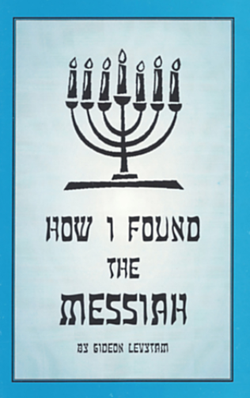
Follow Gideon Levytam's journey and discover how he was led by God, through a series of exciting circumstances, to find the One his people are still waiting for.
Past Episodes

Featured Offer
Follow Gideon Levytam's journey and discover how he was led by God, through a series of exciting circumstances, to find the One his people are still waiting for.
About Holy Scriptures and Israel
As time passed by, the Lord Yeshua took dear brother John Van Stormbroek to himself. The ministry of Holy Scriptures and Israel continued with additional development. In the early 1990’s, a weekly morning Bible class began which brother Gideon Levytam led regularly in the City of Toronto. This weekly open Bible class was held in the Willowdale assembly meeting hall. Eventually, a second mid-week evening Bible class was added. In April 2002, the need for an additional outreach Bible teaching meeting arose. We begun a Saturday (Shabbat) ministry meeting in which a systematic teaching of God’s word is presented to all who attend. Together we learn God’s Word, pray for each need and the salvation of Israel, and sing songs of worship unto our God, praising Him and our Lord Yeshua the Messiah.
In Mid 2004 we started to air on Joy 1250 Radio station a 15 minute Bible teaching program called "The Holy Scriptures and Israel" with Gideon Levytam. The broadcast teaches God’s word from a Hebrew Messianic perspective and has proved to be a blessing to many. It's now aired seven days a week. Our prayer is that many more of our Israeli people will have a clear understanding of who Yeshua is, why we all need him, and come to know him as their Lord and Messiah.
About Gideon Levytam
Contact Holy Scriptures and Israel with Gideon Levytam
426 Simcoe Street
Niagara-on-The-Lake
Ontario L0S 1J0
Canada
(905) 325-1234