

Esther 2:1-18, Part 2


Esther Becomes the Queen of Persia Part 2
Guest (Female): Shalom. Holy Scriptures and Israel is a ministry designed to share with the Jewish people the good news of the Lord Jesus, Yeshua the Messiah, and to instruct Christians on the Jewish roots of their faith. And now teaching God's Word from a Hebrew Messianic perspective, here is Gideon Levytam.
Gideon Levytam: The study of Esther, chapter 2. This thing was really upon his heart. But there's another thing that we do not know, beloved brothers, from the Bible here, but we know it from history: that apparently, King Ahasuerus failed in invading Greece. Remember there would be the kingdom of Greece that's going to come after that in the image that we have seen. We have seen Babylon, Persia, and Greece.
The Grecian people became more powerful as time went on, and King Ahasuerus wanted to defeat the Grecians. He sent military and ships against Greece, but he failed his mission. That happened sometime at the feast in chapter 1, which was about 483 BC. The invasion was about 481 BC, and the return was about 479 BC. About four years passed between chapter 1 and chapter 2, and King Ahasuerus returned defeated. He was not successful in taking over Greece, and he was so discouraged on one hand because of his defeat or unsuccessful mission. On the other hand, he came back to his palace, and guess what? Vashti is no longer there.
We read in verse 1 of chapter 2, "After these things, when the wrath of King Ahasuerus was appeased, he remembered Vashti, and what she had done, and what the decree that was given against her." He now looks back and he remembers, as we have it in chapter 1, verse 19 and 20, that he made a decree. Vashti is no longer to be my wife. He signed it and he made a law, a decree that is never to be altered according to the Medes and the Persian laws.
He's looking back and he remembers Vashti, his wife, and what happened to her. I would like to say, beloved brothers and sisters, that you will notice that between chapter 1 and chapter 2, there are four years that have passed by. If you go back to chapter 1 and you notice in verse 3, he made that large feast in the third year of his reign. Then turn around and go to chapter 2 and verse 16, and you will notice that Esther became queen at the end of verse 16 in the seventh year of his reign. About four years passed by between chapter 1 and chapter 2. Now he's looking back, and you find that he's rather sad because of his defeat, and he's rather sad because he made that foolish law that he divorced his wife, Vashti. He rather now feels the consequence of his doing.
We read in verses 2, 3, and 4 of Esther, chapter 2, that once again, his counselors are giving him an advice. If he would have been a wise king, he would not take any advice from these men, because these men who gave him advice gave him rather poor advice. "Divorce your wife, make sure that all our wives submit to our authority." They still had their wives, and their wives had to submit to their authority, but here comes King Ahasuerus: no wife, no one to submit to his authority as a wife. He feels very sad. He's listening again to their counsel, and notice they give him a fourfold counsel in verses 2, 3, and 4a. They use the word "let" four times.
Verse 2: "Let there be fair young virgins brought for the king." Verse 3: "Let the king appoint officers in all the provinces." Verse 3b, at the end: "Let their things for purification be given unto them." Verse 4a: "Let the maiden which pleased the king be queen instead of Vashti." They gave him fourfold advice. "King, let us give you an advice. Let's make a special beauty contest. You are the king of Persia. You want to have a queen to be a wife. You are missing Vashti, your wife that you divorced. Let us make a special contest of various maidens that are going to come from all over the Persian Empire."
Just imagine again, look at the Persian Empire. They have chosen women from all over the land that was controlled by Ahasuerus, Xerxes the king of Persia. Four things they said. Number one: "Let there be fair young virgins brought for the king." In other words, they will take young ladies who never knew a man, and let them be chosen from all the people of the land. Secondly: "Appoint officers," and they will go to all the provinces of his kingdom. That word for "provinces" in the Hebrew is "medinot". It's more than just provinces, it's really countries, nations. Remember, beloved brothers and sisters, you have Libya, you have Egypt, you have all India and all the areas that he controlled here. They were bringing women, young maidens that never knew a man from everywhere of the Persian Empire.
Thirdly, they said to him in verse 3, at the end: "Let their things for purification be given unto them." You give those beautiful young maidens all what they need to purify themselves, that they're going to be ready for you, King, and you will make a choice which person will become your queen. The final suggestion by these counselors is in verse 4: "Let the maiden which pleases the king be queen instead of Vashti." There was no freedom, no liberty for anyone to say no. If the king was delegating individuals to go to and fro around the Persian kingdom to find all the younger women to bring them into the king's palace to be selected, no one could do anything. No one could say no, because the Persian Empire King Ahasuerus was a monarch. He did what he want, how he want, when he want, to whom he want, and nothing can be changed.
Imagine, beloved brothers and sisters, they are going from area to area. They sent letters, they sent messengers, and they were searching for young maidens to come to be into that special event, into the special contest. The most beautiful woman will now become the queen of Persia. Lo and behold, the counsel of these wise men of King Ahasuerus. It's amazing to see how easy it is for him to listen to the counsel of his advisors. Sometimes one can give a good counsel, but sometimes one gives rather bad counsel. Obviously, it was a very bad counsel that they have given him to divorce his wife. We learn from scripture that we are being taught husbands, love your wife, in Ephesians chapter 5, as the Messiah loved the assembly and gave himself for them, for her, for the church, for the assembly.
We know that we are called to love our wives and to seek to bless our wives, but here is the counsel of divorcing your wife for no reason. The only reason is because she says no because you were drunk, and you want her paraded before everyone else. The counsel that they gave him was rather poor. Here is another poor counsel, because notice that the contest depends merely upon an external appearance. The more you're going to put all kinds of perfume and you're going to look nicer, you'll see how long time these girls were: 12 months under the oil of this and oil of that. Can you imagine for 12 months they were preparing themselves for King Ahasuerus? How long does it take for one to make himself or herself beautiful? You ladies, I'm sure five minutes and you are looking very well, but look what happened here.
12 months, he says: "Give them the things to purify them, to get them ready for King Ahasuerus." What we learn here, and I'm challenging all of us today, especially the young ones here: when one looks for a bride, for a wife, it's not only the external appearance. Men look as on the outward appearance, but the Lord looks at on the heart. Yesterday, I met a young couple and I knew the girl's parents, and it was so encouraging to me. The young man that I met, his future wife to be, they are going to get married soon. I was so impressed. I was told by others, "We heard that this young girl is a godly girl." I'm thinking, what a blessing. Some of you have benefited to have a wife that is a godly young girl that have been a blessing to you and will be a blessing to you forever.
As long as you continue on with the Lord, she will be a blessing. This is the thing, beloved brother and sister, the proverbs of Israel says: "He who found a wife found good, and obtained a favor of the Lord." "Matza isha, matza tov," as the proverbs, as King Solomon said. Of course, Solomon was not the best example, but nevertheless, the Lord used Solomon to give instruction to the nation of Israel. They are suggesting to him to get a wife from all the nations of the world that will be merely beautiful outwardly. It's nice to look attractive. It's nice to look beautiful and we thank God for that, but you don't marry a woman on the basis of her outward appearance. You want to have her heart to love the Lord, to love the Lord Jesus, love Yeshua the Messiah, who want to be a godly woman that will love God and love His word and live for Him.
That is a blessing that this man, of course, he's not a king of Israel, he does not believe in a living God, but nevertheless, it doesn't matter where you are and who you are, you still don't evaluate a person on a basis of the outward appearance. Beloved brothers and sisters, the king, of course, again listened to the counsel of his servants, to their advice. In verses 5, 6, and 7, you see the providence of God. You can see the sovereignty of God. God is, you might say even though His name is not mentioned in the book of Esther, but you can see that His hand is controlling the affairs that have existed in those days in the life of King Ahasuerus. By the way, you notice in verse 4b, it says: "And the thing pleased the king; and he did so." In other words, it pleased the king. Their suggestion pleased the king.
In chapter 1, they suggested to divorce his wife; it pleased the king. In chapter 2, they suggested to collect women from all over the nation of the world; it pleased the king. He did what he want. He went by his external feeling, but he didn't do anything that has to do with wisdom that he needed to be wise in what he was doing. Notice that in verses 5, 6, and 7, we are introduced for the first time in the book of Esther to a Jewish man by the name of Mordecai, and to a Jewish woman, his cousin, in Esther chapter 2 as well. Notice the first time that we are introduced to these two Jewish individuals. Later on, we'll find that there will be many more. We find in verse 5 the genealogy of "Mordecai ha-Yehudi", Mordecai the Jew.
It says here: "Now in Shushan the palace, there was a certain Jew, whose name was Mordecai, the son of Jair, the son of Shimei, the son of Kish, a Benjamite." We are introduced immediately to Mordecai. It is interesting that Mordecai was not a Hebrew name. Mordecai is a name that is rooted in Marduk, the god of the Babylonian. I would like to remind you, beloved brothers and sisters, that when our Jewish people were taken down from Jerusalem and Israel to the land of Babylon, the Babylonian knew very well how are we going to draw them away from the God of Israel. The best way to do is first of all to change their names. If you just for a moment turn with me to Daniel, I just want to point out in chapter 1 and verses 6 and 7, we read those words. Look how the Babylonian knew how to control these Jewish boys and girls and to change their mindset to be occupied with the gods of the Babylonian and later on the Persian.
It says: "Now among these were the children of Judah, Daniel, Hananiah, Mishael, and Azariah. Unto them the prince of the eunuchs gave names: for he gave unto Daniel Belteshazzar; and to Hananiah, Shadrach; and to Mishael, Meshach; and to Azariah, Abed-nego." See what they did? They took these young Jewish boys, specifically in the book of Daniel: Daniel, Hananiah, Mishael, and Azariah, and they gave them different names. Daniel means "God is my judge". Hananiah means "Jehovah" or "Yehovah had grace" or "gave me grace". Mishael means "who is like unto God?" And Azariah means "Jehovah is my helper".
What did they do, the Babylonian and the Persian? The Jewish boys, the Jewish girls, they changed their name. Instead of them through their name reminded of the living God of Israel, of Abraham, Isaac, and Jacob, instead of occupying their mind even through the calling one another by name, instead of keeping them occupied with the God of Abraham, Isaac, and Jacob, they changed their name to be occupied with their gods. To Daniel, they called him Belteshazzar: "the god Bel will protect your life," that's what is the meaning. Then you have Hananiah, they call him Shadrach, has to do with Marduk, like Mordecai, very similar. Then we have Mishael, they call him Meshach, that has to do with another god of the Babylonian, and of course, Abed-nego was given to Azariah, which means "the servant of Nego" or "Nebo", this is another god of the Babylonian.
They were worshipping idols, but the Hebrews, the people of Israel, were worshipping the true and the living God. So change their names, keep them studying the books of the Babylonians and not the Bible, the Torah, not the Tanakh, and this way we will sway them to be drawn away from the God of Israel. Satan is very crafty, and he does so even today. He take boys and girls, men and women who grew up in home of believers, those that believe that Yeshua is the Messiah. The parents sending them to school or to university or to college, and it doesn't take too long where the professors tell them: "Your God and your Yeshua, your Jesus is not the Messiah, He is not the Savior." In no time, those who do not have a backbone and those who do not stand for the Lord, they are being drawn away from God.
They are being drawn away from the Bible, from the word of God, and they ultimately find how many of believers today, of believers in Yeshua and Jesus the Messiah, who raised the children from their mother's belly, they raised them upon the truth of the word of God, and they find later on their children is gone away, far away from the things of the Lord and the things of Yeshua the Messiah. It's rather sad, but Satan is working, and yet at the same time, beloved brothers and sisters, God is also working as well. Back to Esther, chapter 2, and we are here in verse 5, we are introduced to a man that is called "Mordecai ha-Yehudi", Mordecai the Jew. We have his genealogy here in this verse 5.
It says his name was Mordecai, he was son of Jair, who was the son of Shimei, who was the son of Kish, who was from the tribe of Benjamin. You and I remember very well that Kish was the father of the first king of the people of Israel by the name of Saul. Kish was his father. Then if you remember what happened, how Saul was chosen to be the first king of Israel. He was head and shoulder above everyone. He was a very handsome man, a tall man, he was a choice of the people. But Benjamin is a tribe from the 12 tribes of Israel. He was a tribe that was called to serve God, and out of this tribe came the first king of Israel. In fact, beloved brothers and sisters, the Apostle Paul, whose Hebrew name is also Saul, he was from the tribe of Benjamin as well.
He was the one who says: "I'm a Hebrew of the Hebrew, I'm of the tribe of Benjamin. I'm a Jew, but I'm from the tribe of Benjamin." God had raised Apostle Paul, Saul, to become the apostle to the Gentiles, to the uncircumcision, and he's the one that the Lord used to spread the gospel of the grace of God among the nations of the world. How God used this man who suffered so much for the name of the Lord Yeshua, Jesus the Messiah. Both of them were descendants: Saul the first king, Saul the apostle to the uncircumcision, both of them came from the tribe of Benjamin. Mordecai as well, he was from the tribe of Benjamin. Notice, by the way, that even though he's called a Jew, which link him with Yehudah, Judah, yet he's from the tribe of Benjamin, a distinct tribe.
Benjamin and Yehudah were really together at the time where the kingdom was divided. From the time that the kingdom was divided, everyone, whether he's from Benjamin or Judah, is called "Yehudi", Jew. "Yehudi" means a praiser of God. But here we have, it's kind of sad, because even though he was a Jew, and even though he was of the tribe of Benjamin, his parents were taken down. You see that when the Babylonian came and took down the Jewish people from the land of Israel, 605, 597, and 586, three times they took the Jewish people away from Jerusalem to Babylon. Some of his parents or his grandparents of Mordecai were taken captive by the Babylonian and they lived in the land of Babylon for many years.
Mordecai remained there in the land. His Jewish name, his Hebrew name is not mentioned in scripture, but his name Mordecai, really link him with Marduk, the god of the Babylonian, is mentioned here. In a sense, it's kind of strange, but it teaches us some lessons. You see, the Jewish people should have been back in the Promised Land. Mordecai, what are you doing in Babylon? If you would have been a good Jewish devoted man, you would have been taking the opportunity to go back to the Promised Land. But apparently, beloved brothers and sisters, Mordecai have chosen to stay away from Jerusalem, away from the land of Israel, away from the temple on Temple Mount in the Persian Empire, in Shushan the palace.
He in a sense didn't even live his life in a way that is pleasing to God. Even though we know what he did here, and we can commend him for what he did, but it's rather describe before us a sad condition of "Mordecai ha-Yehudi", Mordecai the Jew. Again, I would like to make a parallel for us today. It's like a believer in Jesus the Messiah, who should have been occupied with the Lord Jesus, gathered together unto His name, spending time in living for Him, but no. He lives away from the people of God, away from the gathered saints. He's not enjoying fellowship with the Lord. He's a believer, he belong to God, but he is not enjoying the things that God have intended for him.
It says in verse 6 about Mordecai the Jew, we are in Esther chapter 2, it says he's the son of Kish, a Benjamite, who had been carried away from Jerusalem with the captivity which had been carried away with Jeconiah, king of Judah, whom Nebuchadnezzar the king of Babylon was carried away. You see we have a clear explanation that when the King Nebuchadnezzar came and took the Jewish people to Babylon, he also took some of the family of Mordecai. Mordecai perhaps never see Jerusalem. He was born in Babylon, and there he grew up and he remained until the time in which we read here. Then we read, beloved brothers and sisters, of another Jewish person. This time is Esther. But then it is interesting in Esther's case, the book of Esther gives her Hebrew name.
It says, "And he brought up," verse 7, "Hadassah, that is, Esther, his uncle's daughter: for she had neither father nor mother, and the maid was fair and beautiful; whom Mordecai, when her father and mother were dead, he took for his own daughter." Apparently, Hadassah, which is the Hebrew word for myrtle, is a beautiful trees that are growing special fruit in the land of Israel and elsewhere. Hadassah also received a pagan name, which is called Esther. Esther, again according to scripture, Esther was the god of fertility, again of the pagan world of the Babylonian, and she was named that in order to sway her away from her people and her God. So we find out that her name is Hadassah. We know very well that Hadassah is a very famous name among our people Israel. You have Hadassah Hospital in Mount Scopus in Jerusalem, in Ein Kerem in Jerusalem, very famous hospitals that were named after Hadassah, that is Esther. Many, many Jewish girls are called today both Hadassah and also Esther.
Guest (Female): You have been listening to the Holy Scriptures and Israel with Gideon Levytam. Gideon teaches God's word from a Hebrew Messianic perspective. For more information about this ministry, write to Holy Scriptures and Israel, Box 1411, Niagara-on-the-Lake, Ontario, L0S 1J0, or visit our website at holyscripturesandisrael.com. You are also invited to Gideon's weekly Bible teaching on Fridays at 11:00 AM and 7:00 PM, and Saturdays at 1:00 PM at Willowdale Christian Assembly Hall, 28 Martin Ross Avenue in Toronto. Holy Scriptures and Israel is made possible by your prayers and financial support. If you would like to support the program, visit holyscripturesandisrael.com. God bless you. Shalom, Shalom.
Featured Offer
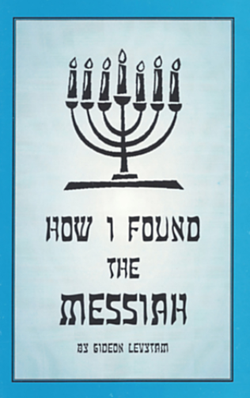
Follow Gideon Levytam's journey and discover how he was led by God, through a series of exciting circumstances, to find the One his people are still waiting for.
Past Episodes

Featured Offer
Follow Gideon Levytam's journey and discover how he was led by God, through a series of exciting circumstances, to find the One his people are still waiting for.
About Holy Scriptures and Israel
As time passed by, the Lord Yeshua took dear brother John Van Stormbroek to himself. The ministry of Holy Scriptures and Israel continued with additional development. In the early 1990’s, a weekly morning Bible class began which brother Gideon Levytam led regularly in the City of Toronto. This weekly open Bible class was held in the Willowdale assembly meeting hall. Eventually, a second mid-week evening Bible class was added. In April 2002, the need for an additional outreach Bible teaching meeting arose. We begun a Saturday (Shabbat) ministry meeting in which a systematic teaching of God’s word is presented to all who attend. Together we learn God’s Word, pray for each need and the salvation of Israel, and sing songs of worship unto our God, praising Him and our Lord Yeshua the Messiah.
In Mid 2004 we started to air on Joy 1250 Radio station a 15 minute Bible teaching program called "The Holy Scriptures and Israel" with Gideon Levytam. The broadcast teaches God’s word from a Hebrew Messianic perspective and has proved to be a blessing to many. It's now aired seven days a week. Our prayer is that many more of our Israeli people will have a clear understanding of who Yeshua is, why we all need him, and come to know him as their Lord and Messiah.
About Gideon Levytam
Contact Holy Scriptures and Israel with Gideon Levytam
426 Simcoe Street
Niagara-on-The-Lake
Ontario L0S 1J0
Canada
(905) 325-1234