

Esther 1:10-22, Part 1


A Drunken King Divorces his Sober Wife Part 1
Guest (Male): Shalom. Holy Scriptures and Israel is a ministry designed to share with the Jewish people the good news of the Lord Jesus Yeshua the Messiah and to instruct Christians on the Jewish roots of their faith. And now, teaching God's word from a Hebrew Messianic perspective, here is Gideon Levytam.
Gideon Levytam: Shabbat Shalom everyone! Please open your Bibles to the book of Esther. This Jewish woman that was used by God in a supernatural way to deliver our people of Israel from the hands of Haman, the hater, the enemies of the Jews. This one book is written to teach us the many lessons that the Lord want to teach His own people, and specifically, it teaches us of the providence of God. And the passage we are studying today is Esther chapter one, verse 10 to 22.
Guest (Male): On the seventh day, when the heart of the king was merry with wine, he commanded Mehuman, Biztha, Harbona, Bigtha, and Abagtha, Zethar, and Carcas, the seven chamberlains that served in the presence of Ahasuerus the king, to bring Vashti the queen before the king with the crown royal, to show the people and the princes her beauty: for she was fair to look on.
But the queen Vashti refused to come at the king's commandment by his chamberlains: therefore was the king very wroth, and his anger burned in him. Then the king said to the wise men, which knew the times, (for so was the king's manner toward all that knew law and judgment: and next unto him was Carshena, Shethar, Admatha, Tarshish, Meres, Marsena, and Memucan, the seven princes of Persia and Media, which saw the king's face, and which sat the first in the kingdom;)
What shall we do unto the queen Vashti according to law, because she hath not performed the commandment of the king Ahasuerus by the chamberlains? And Memucan answered before the king and the princes, Vashti the queen hath not done wrong to the king only, but also to all the princes, and to all the people that are in all the provinces of the king Ahasuerus.
For this deed of the queen shall come abroad unto all women, so that they shall despise their husbands in their eyes, when it shall be reported, the king Ahasuerus commanded Vashti the queen to be brought in before him, but she came not. Likewise shall the ladies of Persia and Media say this day unto all the king's princes, which have heard of the deed of the queen. Thus shall there arise too much contempt and wrath.
If it please the king, let there go a royal commandment from him, and let it be written among the laws of the Persians and the Medes, that it be not altered, that Vashti come no more before king Ahasuerus; and let the king give her royal estate unto another that is better than she.
And when the king's decree which he shall make shall be published throughout all his empire, (for it is great,) all the wives shall give to their husbands honour, both to great and small. And the saying pleased the king and the princes; and the king did according to the word of Memucan: for he sent letters into all the king's provinces, into every province according to the writing thereof, and to every people after their language, that every man should bear rule in his own house, and that it should be published according to the language of every people.
Gideon Levytam: I'm going to stop with the reading here of the first chapter. Well, we have covered in our last ministry meeting the first nine verses of this chapter and we also talked about how our own people Israel finding themselves in Babylon, then later on Persia, and then later on by the Grecians and ultimately by the Romans Empire under their leadership and the control of the Gentiles. Yeshua said in the Gospel of Luke that the times of the Gentiles will begin but it will also have an end. And the end will be, of course, we know that from scripture, at the second coming of the Messiah, the King of Israel, the King of the Jews, who will rule as King of kings and Lord of lords over Israel and every nation and all the nations of the world.
But we are living here and now today, just the same like these Jewish people lived 2,500 years ago. This is about 521 BC. These Jewish people, including Mordecai and Esther and many of these Jewish people, lived in Persia. They were under the leadership of the Persian Empire. And that king was Ahasuerus and we know that he was Xerxes, the king of Persia, who ruled over the then-known world.
Well, he wanted to make a big show off and he wanted to invite everyone to come to the palace, to the capital city called Shushan. And he invited everyone and he showed to everyone all what he has and all what he possessed. He made a great feast. We read about it in verse five. And when these days expired, the king made a feast unto all the people that were present in Shushan, the capital city of Persia. And he made this feast as long as seven days. We also read, beloved brothers and sisters, there was plenty to drink. According to verse seven, they gave them drink in vessels of gold, royal wine they gave him and all kind of vessel, and the drinking was without limitation. And everybody's drinking.
Then the king, according to Esther 1, verses 10 on, wanted to continue on and to show everybody his wife, the queen. And here we learn some important lessons. You notice, first of all, in verses 10, 11, and 12, we have a drunken king requesting his sober queen, his sober wife to come to him and to show herself, to display herself before all those leaders who came from all the 127 provinces. Look what we read. We read in verse 10, "And on the seventh day," notice, the seventh day was the last day of the feast.
The king must be at that time completely under the power of the wine. On that last day, it says here, when his heart was merry with wine, that he commanded and notice we have the seven chamberlains. The Hebrew word for chamberlains is sarisim and sarisim are really eunuchs. People who were eunuchs, his servants, who served him as they are together in his kingdom. They were his servants. So what does he do? He's asking those seven servants of him to go and bring before him his wife, Queen Vashti.
But I want you just to note that he was taken over by the wine. Notice it says in verse 10, "And on the seventh day, when the heart of the king was merry with wine." Apparently, you can see that the king by that time was really under the control of the alcoholic beverage, you might say, under the control of the wine. And that shows us what happen when you are under the control of wine. It doesn't give you anymore to have a sober thinking. You don't think right. You'd say things you shouldn't say, you'd do things you shouldn't do, because you are no longer normally functioning. You are under the control of the wine.
And so when he's happy and things are going on well for him and everybody's drunk and everybody's having a great time, then the king began to ask something that was really unreasonable. It teaches us an important lesson here that we are to not allow ourselves to be under the control of that which will lead us astray. Let me show you a verse in Proverbs for a moment. I just want to connect it with King Ahasuerus. Notice Proverbs chapter 20 what we read there by King Solomon, verse one. King Solomon says, "Wine is a mocker, strong drink is raging, and whosoever is deceived thereby is not wise."
It's not an issue of getting a glass of wine and drinking it with a meal, as some do, because wine is healthy in that sense. But to be under the control of the wine when you are no longer sober, wine is a mocker, strong drink is raging, and whosoever is deceived thereby is a fool, is not wise. Look at chapter 31 of the same book of Proverbs, verse one and four and on. Verse one, it says here, "The words of King Lemuel, the prophecy that his mother taught him." Lemuel is King Solomon. His mother was the one who taught him and spoke to him. And she said to him in verse four, "It is not for kings, O Lemuel, to drink wine, nor for princes strong drink."
Why? He continues, "lest they drink and forget the law, and pervert the judgment of any that are afflicted." Brothers and sisters, you see, this is a king that was ruling over 127 provinces. He was married, and his wife was Vashti, the queen of Persia. And instead of honoring his wife, he wanted to display her before all those drunken men who came from all over the 127 provinces. In other words, what we really learn from this, that he was not treating his wife in a right way.
Remember, he was a Gentile king, yes. He was a king of Persia and Media, yes. But nevertheless, he should have treat his wife in a right way and not make her a display before all those that were drunken with the wine of the king. And so we find out that the king is telling all his servants to go to Queen Vashti. According to Esther chapter 1 and verse 10, we have those seven names: Mehuman, Biztha, Harbona, Bigtha, and Abagtha, Zethar, and Carcas. These are all his servants. He's sending them to bring his wife so she will be displayed before all these drunken men.
Imagine what kind of thinking that this king have had. He should have been the opposite, honoring his wife and respecting his wife. This is exactly what we are taught in the New Testament, in the scripture. Both to Israel, God have taught our people Israel, and the New Testament, the church, the assembly, God teaching us that we are to honor our wife, that we are to respect her and not to make her a public shame before the people that came there at that party.
So on the seventh day of the feast, this king who is drunk is asking his wife to come and display herself before all the people that came. Notice that he send his eunuchs. That word for chamberlains come from the Hebrew word sarisim. You know, what is the sarisim, the eunuchs? The eunuchs were the servants of the king. But you see, they were castrated because he didn't want them to get involved in anything else. They were only to serve him. Yeshua taught us in Matthew chapter 19 that there are those who are sarisim, those who are eunuchs that made themselves eunuchs for the kingdom of God. There are those eunuchs that were born eunuchs, they were born castrated, unable to reproduce. But there were also those who were made, made by men, they were made eunuchs by force.
Apparently, here, those servants, they were made by force because they were to serve only the king and not to do anything else. And therefore they were sent by him as servants of the king, as chamberlains of the king. They were going to approach Queen Vashti to come to present herself before the people at that party. Now imagine also it says here in verse 11, "to bring Vashti the queen before the king with the crown royal." In other words, she would come with her crown. She would come and she would show the people and the princes her beauty, for she was fair to look on.
So imagine what a shameful thing it would have been for her to submit to what he expected from her. It is not an issue of him calling her to come and to be with him. It's not an issue of him calling his wife to be beside him, but it was truly, you might say, a presentation of shame. It was a humiliating request that he asked from Queen Vashti to approach him. I want to remind you, those of us who are husbands, we are called to honor our wives. We are taught in scripture that we are to honor our wives and to respect them and to recognize them and to seek to be a blessing to them.
Ephesians chapter five tells us, husband, love your wives, as the Messiah loved the assembly, the church, and gave himself for her. Peter says in 1st Peter 3 in verse seven, treat them with honor as a weaker vessel. Recognize that they are to be honored by you, the husbands. And as long that we do so, there's blessings from the Lord. But here's a drunken king expecting his wife to be displayed in such a humiliating way before people who came from all over the world that are merely drunk by the seventh day of this feast.
So these are great lessons for us as believers in Yeshua the Messiah, that we are to behave exactly the opposite. And that's what happened. That's why in Ephesians 5 it says, be not drunk with wine wherein is excess, but be controlled by the Spirit of God. Let us be led by the Spirit of God. And so that's the first verses, verses 10, 11, and 12. Well, when the king do not get his own way, he's making additional decision. And those decisions are ultimately made because he was not thinking right, he was not sober.
Then you can see in verse 13 to verse 20 that a drunken, angry king receive advice from his counselors that was really unwise that led him ultimately to divorce his wife. See, we read verse 13, it says, "Then the king said unto the wise men which knew the times, for so was the king's manner towards all that knew law and judgment." Well, the king is drunk, the king is angry, we have already read that in the previous verses. So now what does he do? He's asking for counsel.
So he is calling the wise men of Medo-Persia. And we have a list of them, notice that. The first seven men in verse 10, they were eunuchs. They were servants. But in the next verse, verse 14, we have another seven, but these ones are wise men of Persia, Medo-Persia. We have the names in verse 14. It says here: Carshena, Shethar, Admatha, Tarshish, Meres, Marsena, and Memucan. Seven, he called them here in verse 13, wise men of Medo-Persia. So he's calling them to come to get counsel from them.
What to do in a case like this? I'm calling my wife, and she doesn't come. You know, it's funny that sometimes instead of going to the wife and talking to the wife, we go to everybody else and we tell them private matters that I should speak with my wife. So he need seven wise men of all Medo-Persia to give him counsel of something foolish that he have done with his very own wife. If he would approach her and talk with her, she would say, "King, what do you want me to do? Do you want me to present myself and parade myself before you drunken and all the many of them, hundreds and thousands who came from 127 provinces drunk under the control of the alcohol? That's what you want your wife to be? And that's what you want your wife to do?"
You know how different, I was talking to my wife today, and I said, "Honey, where is it in the Bible that you have a husband that treated his wife in a right way?" And we were thinking about that. And you know, brothers and sisters, all of us fail. We always fail in treating our wife. There's one that never fail in treating his wife and his bride, and this is Yeshua the Messiah. He treated his wife Israel in such a special way. He loved the nation of Israel and he treated our people Israel in such a gracious way, but Israel failed and have gone astray.
The Messiah in the Brit Chadashah that we learn in the new covenant, the Messiah loved the assembly, the church, and gave himself for her, but we who are part of the church have gone astray also. And when we look at history, I was just saying maybe it was Abraham, he really treated his wife. Well, Abraham was a godly man, but he also fail in relationship to his wife. Maybe David, well, David didn't necessarily dealt with his wife the way he should have. He had more than one wife anyway. Well, maybe Solomon. Well, no, I don't think Solomon treated his wife because he had 700 wives and 300 concubines. And we were looking throughout the biblical account and really, really, really, we have to say as husbands that we had fail in many, many ways. But nevertheless, we are exhorted in the scriptures to love our wives, to treat them well, to honor them as a weaker vessel. And when there are problems, personal problems, we should talk with each other and not go to seven other people.
Guest (Male): You have been listening to Holy Scriptures and Israel with Gideon Levytam. Gideon teaches God's word from a Hebrew Messianic perspective. For more information about this ministry, write to Holy Scriptures and Israel, Box 1411, Niagara-on-the-Lake, Ontario, L0S 1J0, or visit our website at holyscripturesandisrael.com. You are also invited to Gideon's weekly Bible teaching on Fridays at 11:00 AM and 7:00 PM and Saturdays at 1:00 PM at Willowdale Christian Assembly Hall, 28 Martin Ross Avenue in Toronto. Holy Scriptures and Israel is made possible by your prayers and financial support. If you would like to support the program, visit holyscripturesandisrael.com. God bless you. Shalom, shalom.
Featured Offer
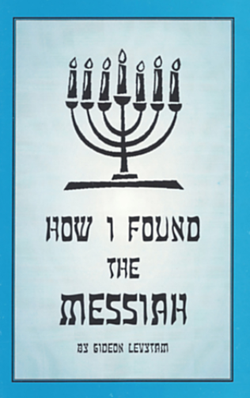
Follow Gideon Levytam's journey and discover how he was led by God, through a series of exciting circumstances, to find the One his people are still waiting for.
Past Episodes

Featured Offer
Follow Gideon Levytam's journey and discover how he was led by God, through a series of exciting circumstances, to find the One his people are still waiting for.
About Holy Scriptures and Israel
As time passed by, the Lord Yeshua took dear brother John Van Stormbroek to himself. The ministry of Holy Scriptures and Israel continued with additional development. In the early 1990’s, a weekly morning Bible class began which brother Gideon Levytam led regularly in the City of Toronto. This weekly open Bible class was held in the Willowdale assembly meeting hall. Eventually, a second mid-week evening Bible class was added. In April 2002, the need for an additional outreach Bible teaching meeting arose. We begun a Saturday (Shabbat) ministry meeting in which a systematic teaching of God’s word is presented to all who attend. Together we learn God’s Word, pray for each need and the salvation of Israel, and sing songs of worship unto our God, praising Him and our Lord Yeshua the Messiah.
In Mid 2004 we started to air on Joy 1250 Radio station a 15 minute Bible teaching program called "The Holy Scriptures and Israel" with Gideon Levytam. The broadcast teaches God’s word from a Hebrew Messianic perspective and has proved to be a blessing to many. It's now aired seven days a week. Our prayer is that many more of our Israeli people will have a clear understanding of who Yeshua is, why we all need him, and come to know him as their Lord and Messiah.
About Gideon Levytam
Contact Holy Scriptures and Israel with Gideon Levytam
426 Simcoe Street
Niagara-on-The-Lake
Ontario L0S 1J0
Canada
(905) 325-1234