

Esther 1:1-9, Part 2


Introduction Part 2
Guest (Male): Shalom. Holy Scriptures and Israel is a ministry designed to share with the Jewish people the good news of the Lord Jesus Yeshua the Messiah and to instruct Christians on the Jewish roots of their faith. And now, teaching God's word from a Hebrew Messianic perspective, here is Gideon Levytam.
Gideon Levytam: This study of Esther chapter one, introduction, he will ultimately do his own will. We just struggle and we go through challenges in our lives and we don't understand sometimes things in our lives. But this is the lesson that we learn from the book of Esther, that ultimately God is going to accomplish his very own will in the lives of God's people.
Look at the events that are going on today. The nation Iran celebrated their independence for so many years. The present-day Iran is really the Persia of biblical time, of which we have in that image that Nebuchadnezzar had seen. And they are celebrating by burning the flags of Israel and have anti-Israel slogans and anti-America slogans as well, but specifically against the Jewish people, our nation Israel, the people of Israel, as if they want to destroy the Jewish people out of the face of this earth.
And yet God in his wisdom has a plan for the Jewish people. In the time that we read here in the book of Esther and Ezra and Nehemiah, that was in the time when the Persian kings were ruling over this great empire and God had allowed Cyrus, Koresh, to let the Jewish people return to the land. But some of our own people remained outside of the land, and these are the events that we learn about here in the book of Esther.
So the author may be Mordecai the Jew. The date was between about 483 to 473 BC. The purpose is to teach us of the sovereignty of God and the providence of God. He's in charge of the affairs of this world. All will ultimately come to acknowledge that he is the King of Kings and Lord of Lords, but he cares over the affairs of his own people and he takes care of them.
Now the next thing that I would like to mention by way of introduction of the book of Esther is the theme. What is the main thing that we learn here from the book of Esther? It doesn't matter what the world does, ultimately the Jewish people will survive throughout the ages because God will preserve the Jewish people for his own purposes and own plan.
The theme teaches us that even though we don't have God's name, Jehovah or Elohim, mentioned even once in the book of Esther, and even though we don't have once the mention of the word prayer, Mitpallel, yet God overall, his hands preserve his own people even though they are outside of his own will. They should have been going to the land of Israel. They should have gone back to the Promised Land, but they didn't. They were satisfied to live outside of the land.
They were perhaps very prosperous, doing very well. They say, "What's the point? I'm not going to go back to the Promised Land because I'm doing better here. I have a financial gain here. I don't need to go back to the city of Jerusalem and to the land of Israel." Well, they discover very quickly that there are many who want to destroy them and to do away with them, and yet God preserved the people of Israel.
Also with respect to the theme of the book of Esther, there are two individuals, Mordecai and Esther, that have been so emboldened to stand up for their own brethren, for the Jewish people, that they receive a special strength not knowing even where it came from to stand for the preservation of their own people, the people of Israel. So we find Mordecai and Esther's action of boldness, and they really delivered their own Jewish people, humanly speaking, from destruction by one who is the hater of the Jewish people, the Jews' enemy.
And then finally, another thing with respect to the theme, we find also the wickedness of a man by the name of Haman. He was the enemy of the Jewish people. He desired and he sought very hard to destroy all the Jewish people in the provinces of Persia. Look in the history of our nation. We had Pharaohs, Hamans, Hitlers, Herods; we had all sorts of enemies of the Jewish people.
Today there are many around the nation of Israel. There were always enemies that came against God's people. And you and I as part of the body of Messiah, we also have enemies that constantly hate us and desire to destroy us from enjoying the things of the Lord. So the theme is God's name is not mentioned, prayer to God is not mentioned, boldness of two individuals Mordecai and Esther, and the wickedness of Israel's enemy. You can see it as we're going to study Esther.
Now the four individuals that are very prominent in this book are Esther, Mordecai, King Ahasuerus, and Haman. By the way, the name Esther is not her Hebrew name. It's actually Hadassah. In chapter two of the book of Esther, verse seven, it says, "And he," this is Mordecai, "brought up Hadassah, that is Esther, his uncle's daughter, for she had neither father nor mother and the maid was fair and beautiful, whom Mordecai, when her father and mother were dead, he took her for his own daughter."
Actually, Esther comes from a pagan Persian name, Star. But her actual Hebrew name is Hadassah, which means Myrtle. It's like the Myrtle tree. You have the fruit of the trees of the Myrtle trees. Today if you go to Israel, you go to the city of Jerusalem, you have the Hadassah Hospital that was named after this woman by the name of Hadassah.
But as all our Jewish people went down to Babylon, to Daniel they gave a name. To Hananiah, Azariah, and Mishael they gave pagan names: Shadrach, Meshach, and Abednego. The Hebrew names that are so beautiful, they have given to them names that were Babylonian and Persian. But she became such a beautiful character in the history of Israel that Esther became very prominent and we learn to love that name because she was indeed as a star shining for the people of Israel there in the land of Persia.
Now one more thing before we go into the verses themselves, there is one verse that is very prominent here in the book of Esther. This is in Esther chapter four and verse 13 and 14. "Then Mordecai commanded to answer Esther and he said to her, 'Think not with thyself that thou shalt escape in the king's house more than all the Jews. For if thou altogether hold thy peace at this time, then shall there enlargement and deliverance arise to the Jews from another place. But thou and thy father's house shall be destroyed and who know whether thou art come to the kingdom for such a time as this?'"
This is really the theme verse here in this book of Esther. Mordecai is saying to Esther, "Esther, you may have been placed in the kingdom in such a favored position right now because who knows whether you have come to the kingdom for such a time as this." What was that time? We're going to learn a little bit about it when the enemies of our own Jewish people sought to destroy all the Jews that lived in Persia.
And somehow by the providence of God, God allowed Hadassah, that is Esther, to come into the kingdom to preserve the Jewish people from being totally destroyed. And that teaches us an amazing lesson. Maybe the Lord allows you and I to be in such situations in our lives, whether it is in our home setting or work setting or local congregational setting, wherever we are. We never know why we are there.
Perhaps the Lord allowed us to be there for a special time and a special reason for a special need that may exist in the lives of others. And brothers and sisters, this is what we learn from the book of Esther. The author may be Mordecai. The date 483 to 473 BC. The purpose is the sovereignty of God and the providence of God in the life of his own people.
The theme is no mention of God, no mention of prayer, the Jewish people are away from the land and yet God preserving his own people even though many enemies seek to destroy them. The main characters: four, Hadassah, Esther, Mordecai, Ahasuerus, and Haman. And the main verse is "whether thou art come into the kingdom for such a time as this."
So this is just the introduction that I would like to give to you before we go into the actual verses themselves. Well, today we're going to only look at the first nine verses and I would like to just highlight these verses. Notice first of all, in Esther one verses one and two: "Now it came to pass in the days of Ahasuerus, this Ahasuerus which reigned from India even unto Ethiopia over 127 provinces, that in those days when the King Ahasuerus sat on the throne of his kingdom which was in Shushan the palace."
Let's just pause here for a moment. Can you imagine the king of Persia? He ruled basically all the then-known world. Notice it says from India, in Hebrew it's Hodu, all the way down to Libya and to Ethiopia. The Persian empire was a huge kingdom, 127 provinces that he ruled over, this man by the name of Ahasuerus. It says from India, this is Hodu, even until Ethiopia, that is Kush.
In every province the Persians ruled a little bit differently than the Babylonians. They have allowed the nations to govern. That's why Cyrus allowed the Jewish people to go back to the land to govern themselves, but they used to pay taxes to him. They used to be under his authority. He was the king of the Medo-Persians in those days. His name is Ahasuerus. That is not his actual name. It is his title.
Many believe that he was the Xerxes that actually was the son of Darius the First. And the word Ahasuerus, in English you say Ahasuerus, but in Hebrew we say Ahasverosh. This is merely the title of the king that ruled over the Persian Empire, just like you have the Caesars that ruled over the Roman Empire and you had the Pharaohs who ruled over the Egyptian Empire. You have the Ahasuerus who ruled over the Persian Empire.
So the first two verses we see the king himself, Ahasuerus, who is the one who has this great kingdom, all the way from India until what is known as present-day Ethiopia and Sudan. Can you imagine the large kingdom that the Persians have had in those days? You can see that the Mede and the Persian are being seen in that image that Nebuchadnezzar seen.
The two arms and the chest represent the Medes and the Persians. They united together and they formed, you might say, one nation, but the one that took the prominence was Persia over the Mede and therefore you often find the name "the Persian Empire" rather than only "the Medes" because the Persians were prominent in those days.
So verses one and two introduce to us the king of Persia, Ahasuerus, and his rule over 127 provinces. These are nations he's ruling. And you notice that the capital city is Shushan the Palace, Ha-Birah. The Persians took over Babylon and basically what you have is the Persians ruling over 127 provinces and the capital city is called Shushan the Palace.
Next we have, in verse three we find that the King Ahasuerus made a feast. It says in the third year of his reign, this is about 483 BC, he made a feast unto all his princes and his servants, the power of Persia and Media, the nobles, the princes of the provinces being before him. So the King Ahasuerus decided to make a large feast and he invites everyone to come to that feast.
According to verse three, it shows us a little bit of his pride and arrogance. In a sense you can see that there is a measure of pride that rises up here in the heart of King Ahasuerus, Xerxes that we read of him in this chapter. So he is inviting everyone for that special feast, all of the princes, all his servants, all the nobles of all the provinces. Everybody came before the King Ahasuerus.
Well, you notice immediately in verse four, it takes place before the feast began. He showed them everything that he owned, for 180 days. Now imagine, when he showed them the riches of his glorious kingdom and the honor of his excellent majesty for many days, even 180 days. This is about six months. Can you imagine he's inviting everybody to come to Shushan, the capital city of Persia? He's showing to everyone, "Hey look at this."
He was a wealthy man. And what does he do? According to verse four, he shows his riches and then he shows the honor that he has. It shows some kind of pride in the heart of this man by the name of Xerxes or Ahasuerus. It shows that he really wanted to elevate himself, not recognizing that what he has was allotted to him by God and that the God of Israel, the God of the universe, the God of heaven have allowed him to rule and reign over this great empire.
But no, he has to invite everyone and show everyone, "Look at my wealth, look how great I am. And not only this, look at the honor that I receive in my kingdom." You see, remember the verses that teach us that pride cometh before a fall? That God is going to teach lessons. God resisteth the proud but he giveth grace unto the humble.
But no, he doesn't show it for a week, for two weeks, for a month, but for 180 days. A biblical month is 30 days. 30 times six is 180. 180 days, the equivalent of six months, he shows off before all the leadership of the 127 provinces the greatness of his kingdom and the power that he has and the splendor of his own honor that he has. It already shows us that it's rather sad about this king.
And so he didn't even begin the feast yet. "First I'm going to show you what I own and now I'm going to have you celebrate with me." Then the feast happened in the palace in Shushan the capital city. And we read in verse five: "And when these days were expired, the king made a feast unto all the people that were present in Shushan the palace, both unto the great and the small, for seven days in the court of the garden of the king's palace."
So now he began the feast there in his own palace. Everybody could come and see what the king owns and what he possesses, and the beginning of the celebration lasted for seven days. Not one day. When we go for a feast or for a celebration, usually we do it for one day or one evening. But no, one day, and then a second day, and then a third day, and then a fourth, for seven days. Beloved brothers and sisters, can you just imagine what kind of feast this King Ahasuerus, the king of Persia, had provided for the people that came from all the 127 provinces?
As we continue, we see the splendor of the palace of the king. He was such a wealthy man. It says here in verse six: "Where were white and green and blue hangings, fastened with cords of fine linen and purple to silver rings and pillars of marble. The beds were of gold and of silver upon the pavement of red and blue and white and black marble."
I mean, can you imagine pillars of marble that were there? And then the pavement was all kinds of colors. There were silver and gold and purple and so on. This man was a wealthy man and unfortunately, in pride, he was presenting this before the people that came from the 127 provinces.
But not only that, he wanted to show his wealth and to show his honor and to show everybody the hangings that he had in his own palace and his castle, but then the party began. And in verse seven and eight, there was a lot involved in there with drinking. And it's unfortunate, it seems to be everywhere today that when you go to a party everything has to do with drinking, specifically with alcohol, and getting dizzy and drunk and celebrating.
Well, according to verse seven and verse eight, he gave them drink in vessels of gold, these vessels being diverse one from another. Can you imagine he has a big vessel, a small vessel, this kind of cup, this kind of mug, all kind of shapes? But with gold, it's all the wealth that he shows to them. The royal wine was presented to them according to verse seven, in abundance according to the state of the king. The king was so happy to be able to show everyone, "Just look what I own and you come and celebrate me and the honor that I have, the riches that I possess. Have a drink, have a good time."
It says in verse eight that the drinking was according to the law. None did compel. However much you want to drink, you carry on and drink. For so the king had appointed to all the officers of his house that they should do according to every man's pleasure. So the party had begun. The drinking had taken over.
And I remember the verse that came to my mind as I was preparing for this, the passage that King Solomon received from his mother. He should have listened to his mother, who said to him, "It's not for kings to drink wine. It's not for kings to be taken up with alcohol." Why? Because then you're not sober anymore. You can't think right anymore. You can't make the right decisions anymore.
And remember what the Apostle Paul said to the believers at Ephesus: "Be not drunk with wine wherein there is excess, but be controlled, be guided by the Spirit of God." In other words, you can see that what they really were doing here ultimately led to destruction in that kingdom. And the lesson here, beloved brothers and sisters, is to show us that it's far better to be under the guidance of God, in submissiveness to his will, than to carry on in a way that is not pleasing to the Lord.
We find out that the drinking that was going on in Shushan the palace led ultimately to what we're going to learn in the rest of the story in the book of Esther. And finally in verse nine, it's not only that he did so, but he was married and his wife was called Vashti. Vashti apparently was a very attractive lady. She was the queen. She also made a party.
According to verse nine, "Also Vashti the queen made a feast for the women in the royal house which belongeth unto the King Ahasuerus." She also made a feast. So you can just imagine in Shushan the palace, the feast was so huge in the palace where Ahasuerus was and in the area where Queen Vashti was, and everybody celebrating and feasting and drinking.
Ultimately we can see the events that will follow in the study of the book of Esther. Again I just want to close with these remarks by way of introduction of the book. It teaches us the important lesson even though God's people are not in the right place where they should have been, even though God's people are not in the spiritual state where they should be, yet God in his providence is working out his own will in the lives of his own people.
That does not justify God's people to have their own way, not at all. But still it shows us that God is in control over the affairs that exist in this world, whether in the past or whether in the present or whether it will be in the future. God will ultimately work all things to bring about the purpose and the will that he has for the human race. May the Lord just help us as we study this that we will appreciate the lessons in the book of Esther.
Guest (Male): You have been listening to Holy Scriptures and Israel with Gideon Levytam. Gideon teaches God's word from a Hebrew Messianic perspective. For more information about this ministry, write to Holy Scriptures and Israel, Box 1411 Niagara-on-the-Lake Ontario, L0S 1J0. Or visit our website at holyscripturesandisrael.com. You are also invited to Gideon's weekly Bible teaching on Fridays at 11:00 AM and 7:00 PM and Saturdays at 1:00 PM at Willowdale Christian Assembly Hall, 28 Martin Ross Avenue in Toronto. Holy Scriptures and Israel is made possible by your prayers and financial support. If you would like to support the program, visit holyscripturesandisrael.com. God bless you. Shalom, shalom.
Featured Offer
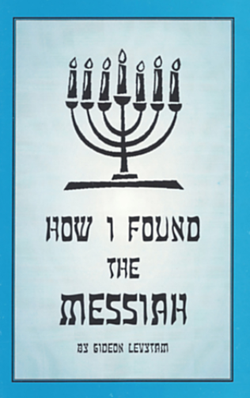
Follow Gideon Levytam's journey and discover how he was led by God, through a series of exciting circumstances, to find the One his people are still waiting for.
Past Episodes

Featured Offer
Follow Gideon Levytam's journey and discover how he was led by God, through a series of exciting circumstances, to find the One his people are still waiting for.
About Holy Scriptures and Israel
As time passed by, the Lord Yeshua took dear brother John Van Stormbroek to himself. The ministry of Holy Scriptures and Israel continued with additional development. In the early 1990’s, a weekly morning Bible class began which brother Gideon Levytam led regularly in the City of Toronto. This weekly open Bible class was held in the Willowdale assembly meeting hall. Eventually, a second mid-week evening Bible class was added. In April 2002, the need for an additional outreach Bible teaching meeting arose. We begun a Saturday (Shabbat) ministry meeting in which a systematic teaching of God’s word is presented to all who attend. Together we learn God’s Word, pray for each need and the salvation of Israel, and sing songs of worship unto our God, praising Him and our Lord Yeshua the Messiah.
In Mid 2004 we started to air on Joy 1250 Radio station a 15 minute Bible teaching program called "The Holy Scriptures and Israel" with Gideon Levytam. The broadcast teaches God’s word from a Hebrew Messianic perspective and has proved to be a blessing to many. It's now aired seven days a week. Our prayer is that many more of our Israeli people will have a clear understanding of who Yeshua is, why we all need him, and come to know him as their Lord and Messiah.
About Gideon Levytam
Contact Holy Scriptures and Israel with Gideon Levytam
426 Simcoe Street
Niagara-on-The-Lake
Ontario L0S 1J0
Canada
(905) 325-1234