

Esther 1:1-9, Part 1


Introduction Part 1
Guest (Male): Shalom. Holy Scriptures and Israel is a ministry designed to share with the Jewish people the good news of the Lord Jesus Yeshua the Messiah and to instruct Christians on the Jewish roots of their faith. And now, teaching God's word from a Hebrew Messianic perspective, here is Gideon Levytam.
Gideon Levytam: Shabbat Shalom, everyone. We are going to study the book of Esther today that tells us of the dealing of God with our nation, Israel, and with the Jewish people throughout the ages. We are going to start with reading the first nine verses of Esther, chapter one, and introduce the book for your encouragement and your blessing.
Now it came to pass in the days of Ahasuerus. This is Ahasuerus which reigned from India even unto Ethiopia over 127 provinces. That in those days, when the King Ahasuerus sat on the throne of his kingdom, which was in Shushan the palace, in the third year of his reign, he made a feast unto all his princes and his servants; the power of Persia and Media, the nobles and princes of the provinces, being before him.
When he showed the riches of his glorious kingdom and the honor of his excellent majesty many days, even 180 days. And when these days were expired, the king made a feast unto all the people that were present in Shushan the palace, both unto great and small, seven days, in the court of the garden of the king's palace.
Where were white, green, and blue hangings, fastened with cords of fine linen and purple to silver rings and pillars of marble. The beds were of gold and silver upon a pavement of red and blue and white and black marble. And they gave them drink in vessels of gold, and royal wine in abundance according to the state of the king.
And the drinking was according to the law; none did compel: for so the king had appointed to all the officers of his house, that they should do according to every man's pleasure. Also Vashti the queen made a feast for the women in the royal house which belonged to King Ahasuerus.
Now, I am thinking today is the 11th day of the month of February. Next month on the 11th of March, the actual feast of Purim begins in Israel and around the world, the feast that is called in Hebrew Hag Purim, the feast of Esther. As we're going to study together the book of Esther, we will learn how important it is in the canon of scripture, but also in the history of our nation, the nation of Israel, and how it is so important to learn that and to apply it to you and I today.
There are two more verses that I would like to read with you in the study of the book of Esther, which I am reading many times in the study of Old Testament scripture. So turn with me to Romans chapter 15 and verse 4. Saul Paul wrote to the Roman believers in the city of Rome, and he said to them, "For whatsoever things were written aforetime were written for our learning, that we through patience and comfort of the scriptures might have hope."
Then 1 Corinthians chapter 10, and there we read in verse 11, again Saul Paul wrote to the Corinthian believers and to them he said, "Now all these things happened unto them," this is our nation Israel, "for an example: and they are written for our admonition, upon whom the end of the world are come."
And so, beloved brothers and sisters, the Apostle Paul wrote to believers like you and I that what happened to our own Jewish people teaches a very important lesson to all believers, even in the present-day age in which you and I live today. Now let me just mention by way of introduction a few things about the book of Esther.
The period of time in which our own nation Israel had been taken captive by the Babylonian, and God had given a vision to King Nebuchadnezzar of the time that is called the times of the Gentiles. Our Lord Yeshua Jesus the Messiah, in the Gospel of Luke, mentioned about the times of the Gentiles. The times of the Gentiles began about 606, 605 BC, and it will end at the second coming of the Messiah Yeshua when He is going to come to reign and to rule this world as King of Kings and Lord of Lords.
We have the image that Nebuchadnezzar saw, and that image he received a revelation from God about the times which the Gentiles will rule this world. The times of the Gentiles will involve four nations: number one, the Babylonian; number two, the Medo-Persian; number three, the Grecian empire; and number four, the Roman empire. Bavel, Paras, Javan, Roma. It began in 605 BC when the Babylonian came and took the Jewish people, Judah, captive to Babylon, and about 605 BC, Daniel was taken captive.
Then later on in 597 BC, Jehoiachin was taken captive, and then in 586 BC, Zedekiah was taken captive and all our Jewish people were now in Bavel. The temple was destroyed, if you remember in our study of Nehemiah, the walls of Jerusalem were burned down, and the Jewish people, our own nation, find itself in Bavel where they were saying, if you remember, Psalm 137, "By the rivers of Babylon, there we sat down and wept as we remember Zion. There they that took us captive said unto us, 'Sing unto us one of Zion's songs,' and they said, 'How shall we sing the Lord's song in a strange land?'"
So here our Jewish people had been taken captive to Bavel. And just the same like there were three deportations by the Babylonian: 605, 597, and 586, there was also a threefold return to the land of Israel. The dates are 538, Zerubbabel came back to rebuild the temple in Jerusalem. 458, Ezra returned with another group to beautify the temple in Jerusalem. And about 444 BC, Nehemiah returned and he rebuilt the walls of the city of Yerushalayim. And then the people of Israel were for a while there in the land of Israel until other events have occurred later on.
So when we are here in the book of Esther, we are sometimes at about 483 to 473 BC. You see, there were many who returned back to the land of Israel to rebuild the temple and to rebuild the wall of Jerusalem, but those many were about 50,000 or 60,000 Jewish people. The vast majority of the Jewish people remained in Bavel, in Babylon. They remain under the authority of the Babylonian and then later on under the authority of the Medo-Persian empire.
And the time in which we are talking about in the book of Esther is sometime during the Persian kingdom. The events of the book of Esther took place about ten years, 483 to 473 BC. Our own Jewish people were in Persia at that time and then they remained there and didn't want to come back to the city of Jerusalem, to the land of Israel, to live in that very promised land that God had given to father Abraham, Isaac, and Jacob.
Now it is not different today. There are about 13, 14 million of our own Jewish people that live in the whole world today after the Holocaust that happened, six million of the people of Israel, of our Jewish people, died by the Nazis and many more have died over the generations. But just like today, there are about seven and a half million of our own Jewish people in the land and the other half or so are still in the dispersion, in the diaspora, including those of us that are still here today, Jewish people who are still in various areas of the world today and not in the land of Israel.
And so in a similar way to the time of the book of Esther, we can see today that the Jewish people are still not yet in the land as a whole and they're waiting for the final day of restoration. But it is very important, beloved brothers and sisters, how do we apply this to the body of Messiah, to the church today, to the Ecclesia. It is in a very similar way. There are those who return to the principles that have been taught in the word of God according to the teaching that we have in the Brit Hadashah, in the New Covenant.
But there are those who are believers who are not back into the studying of the word of God, gathering around the Lord Jesus Yeshua the Messiah, learning from His word, living for Him here in this world. In a very similar way, the church, the assembly, finds itself in the same condition as Israel historically. So this is just to give you an idea about the times and the events that we find ourselves in when we study the book of Esther. It's in the time where the Medo-Persians were reigning, where we see things that happen in the Persian empire to the Jewish people who remain outside of the promised land.
Now when it comes to the author of the book of Esther, many ask who wrote this book of Esther. It is one of the two books in the whole word of God that were given to us with the title of a name of a woman: Esther, a Jewish lady, and Ruth, a Gentile lady. Esther, somebody suggest it was written by either Ezra or Nehemiah because it happened in the era of Ezra and Nehemiah. But some suggest also that it had been written and put together by Mordecai the Jew.
So we do not know really who is the author of the book of Esther, but one thing we do know: that it is part of the canon of scripture, that God has allowed it to be part of the Tanakh. Megillat Esther, the scroll of Esther, is being read every year by our people in the synagogues, especially in the feast of Purim. So the date I mentioned is again around 483 BC to about 473, ten to twelve years the events that happened here in the book of Esther. And it is an interesting event that we can learn so much that will help us in our spiritual growth.
Now another thing that I want to mention by way of introduction about the book of Esther is many ask the question, "What is the purpose that God had given us such a book in the canon of scripture? What can we learn from the book of Esther?" And so the answer may be in two ways. The first thing that we discover about the book of Esther, that the purpose of the book is to show to us the sovereignty of God.
That God is sovereign, that He is the one that has chosen the nation of Israel. He is the one that have called Abraham out of Mesopotamia and have promised that through Avraham, Yitzhak, Yaakov and his sons, Israel, there will be a blessing flowing to all the nations of the world. So God is sovereign. He have chosen the Jewish people, the people of Israel, for a purpose. In fact, I would like you to turn with me to Genesis chapter 12 in verses 1, 2, and 3.
Notice the sovereignty of God. He is the one that is electing the nation of Israel, have elected Abraham, and He made a covenant with Abraham. According to Genesis chapter 12, we read, "Now the Lord," verse one, "had said unto Avram: 'Avram, notice that, get thee out of thy country and from thy kindred and from thy father's house unto a land that I will show thee.'"
Verse two: "'And I will make of thee a great nation, and I will bless thee and make thy name great, and thou shalt be a blessing. And I will bless them that bless thee and I will curse him that curseth thee, and in thee shall all the families of the earth be blessed.'" Notice this, beloved brothers and sisters, God is sovereign. We don't read that Abraham chose God, but we read that God have chosen Abraham.
We don't read that Abraham is the one that have electing God, the true and living God. It was the true and living God that have chosen Abraham and have elected him and have promised to him according to this Abrahamic covenant, "I will make you a blessing," He said to him, "and in thee shall all the families of the earth be blessed." This is so important, these three verses in Genesis chapter 12, that it's teaching us the sovereignty of God.
God is the one who's chosen Israel. God is the one who made a promise to Israel to make them a blessing, and God is surely going to bring it to pass. Look what we find out throughout the Jewish people. We have the Tanakh in our hands, we have the Brit Hadashah in our hand, the Old Covenant, the New Covenant in our hand. We have the prophets, we have the covenants, we have the many promises that have been given to us in the scripture, including of course the Messiah Himself, Yeshua that came through the nation of Israel.
So it teaches us the sovereignty of God. He's sovereign. He chooses whomsoever He will. He's the one who is electing those that ultimately will come to Him. And you and I as well today, brothers and sisters, you and I as believers in Yeshua the Messiah. In fact, I want you to turn with me to Ephesians chapter one for a moment as well and to show you the sovereignty of God with respect to believers today in this present day dispensation. And there are many other verses that I can make reference to.
Notice that Ephesians chapter 1 and verse 3: "Blessed be the God and Father of our Lord Jesus Christ, our Lord Yeshua HaMashiach, who has blessed us with every spiritual blessing in the heavenlies in Christ, in Mashiach." And then verse 4 says, "According as He has chosen us in Him before the foundation of the world, that we should be holy and without blame before Him in love."
You see, just like He's chosen Israel the nation and the Jewish people for a purpose before the nation was even formed, God in His sovereign mercy and grace have chosen us believers today. Whether you are here locally in this country or you coming from any other nation, think about it, there are believers today, every people, tongues, and nation, and you and I are proof to it: Jewish people, non-Jewish people. He have chosen us and have brought us to Himself on a basis of the finished work of Yeshua the Messiah. God is sovereign, and He chooses whomsoever He will, and He will surely bring it to pass.
Now there is a second reason why we believe and we understand that the book of Esther teaches us some lesson. Not only the sovereignty of God, beloved brothers and sisters, but it also teaches us the providence of God. Now this word, as a Hebrew boy, I don't usually know all these words, so I have to discover in the English what does that mean, the providence of God. In Hebrew, we call it hashgacha elyonah. Hashgacha elyonah means that God is not only sovereign to choose, but God is the one that bring everything to pass.
Everything He is accomplishing in this world to bring His will as He intending to do that. Somebody explained the word providence in these words. It says, "the means whereby God direct all things to do His very own will." So sometimes the Lord allow things to happen in the life of God's people, and He bring it about, in other words, He direct everything. His hands is moving about, and He bring and He allow things to happen in the life of His own people that ultimately it will reach in a way that it will accomplish His very own will.
I'll give you an example, a verse that we all know very much that we often quote in the book of Romans, Romans chapter 8 and verse 28: "For we know that all things work together for good to them that are called according to God's purpose." In other words, God have a purpose in your life. God have a purpose in my life, and all the things that happen to us in our life work together for good. It doesn't mean that all good things work together for good, but all things—the good as well as the bad—working together for the purposes of God to be accomplished in the life of God's people.
God has a plan for Israel. God has a plan for the Jewish people. God has a plan for the body of Messiah. God has a plan for every individual specifically, those whom He have chosen. He has a plan for us. And sometimes unfortunately we don't like the way whereby He brings about His plan in our lives: maybe some sufferings, maybe some trials in our lives. You remember like we just read in Psalm 119, that all the trials and the suffering that the Lord have allow us in our own personal life, He is allowing us to experience this, but ultimately He will bring about all things to do His own will.
This is the providence of God. Not only the sovereignty of God but the providence of God, hashgacha elyonah. He sees us. He knows your problems. He knows your trials. He knows the challenges that we face in our own life. He knows what our own Jewish people have been going through for many, many generations. He knows what the body of Christ, the church, the Ecclesia, is experiencing. He knows everything, and He allowed the events to flow that it will ultimately bring about His own will in the life of His own people.
Now I want to read another verse or two. I want you to see how Paul explained this. We'll read one Old Testament and one New Testament verse in connection with the providence of God. Look at Ephesians chapter 1 and verse 11. Saul Paul was writing to the believers at Ephesus and he said to them: "In whom also we have obtained inheritance, being predestinated," listen to this, "according to the purpose of Him who work all things after the counsel of His own will."
You see what he is saying to the Ephesians? He says God have a purpose. God has a plan. God works all things after the counsel of His own will. He has a will for you. He has a will for me. He has a will for God's people, Israel. He has a will for the church, for the assembly as well, and He works all things to accomplish His very own purpose. And that's what we learn from the book of Esther: the sovereignty of God and the providence of God in Israel's history.
Now go back to Daniel for a moment, chapter 4 and verse 35. Look at this. Here we find out as Daniel was speaking to King Nebuchadnezzar. Look what Daniel said, similar to what Saul Paul wrote to the Ephesians. He said, "And all the inhabitants of the earth are reputed as nothing." Listen to this: "And He doeth according to His will in the army of heaven and among the inhabitants of the earth, and none can stay His hand or say unto Him, 'What doest Thou?'"
You see, all things that happening in this world, beloved brothers and sisters, today are really allowed by God and ultimately working His own purposes. He will ultimately do His own will. We just struggle and we go through challenges in our life and we don't understand sometimes things in our life. But this is the lesson that we learn from the book of Esther: that ultimately God is going to accomplish His very own will in the lives of God's people.
Look at the events that are going on today. The nation Iran celebrated their independence for so many years. The present-day Iran is really the Persia of biblical time of which we have in that image that Nebuchadnezzar have seen. And you know what they are doing? They're celebrating by burning the flags of Israel and have anti-Israel slogans and anti-America slogans as well, but specifically against the Jewish people, our nation Israel, the people of Israel, as if they want to destroy the Jewish people out of the face of this earth.
And yet God in His wisdom has a plan for the Jewish people. And in the time that we read here in the book of Esther and Ezra and Nehemiah, that was in the time where the Persian kings were ruling over this great empire and God have allowed Cyrus, Koresh, to let the Jewish people return to the land, but some of our own people remained outside of the land. And this is the events that we learn about here in the book of Esther.
Guest (Male): You have been listening to the Holy Scriptures and Israel with Gideon Levytam. Gideon teaches God's word from a Hebrew Messianic perspective. For more information about this ministry, write to Holy Scriptures and Israel, Box 1411, Niagara-on-the-Lake, Ontario, L0S 1J0, or visit our website at holyscripturesandisrael.com. You are also invited to Gideon's weekly Bible teaching on Fridays at 11:00 AM and 7:00 PM and Saturdays at 1:00 PM at Willowdale Christian Assembly Hall, 28 Martin Ross Avenue in Toronto. Holy Scriptures and Israel is made possible by your prayers and financial support. If you would like to support the program, visit holyscripturesandisrael.com. God bless you. Shalom, shalom.
Featured Offer
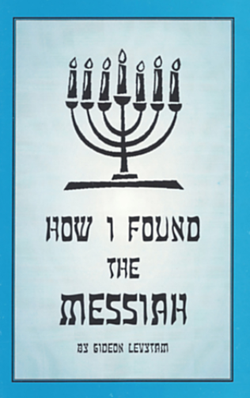
Follow Gideon Levytam's journey and discover how he was led by God, through a series of exciting circumstances, to find the One his people are still waiting for.
Past Episodes

Featured Offer
Follow Gideon Levytam's journey and discover how he was led by God, through a series of exciting circumstances, to find the One his people are still waiting for.
About Holy Scriptures and Israel
As time passed by, the Lord Yeshua took dear brother John Van Stormbroek to himself. The ministry of Holy Scriptures and Israel continued with additional development. In the early 1990’s, a weekly morning Bible class began which brother Gideon Levytam led regularly in the City of Toronto. This weekly open Bible class was held in the Willowdale assembly meeting hall. Eventually, a second mid-week evening Bible class was added. In April 2002, the need for an additional outreach Bible teaching meeting arose. We begun a Saturday (Shabbat) ministry meeting in which a systematic teaching of God’s word is presented to all who attend. Together we learn God’s Word, pray for each need and the salvation of Israel, and sing songs of worship unto our God, praising Him and our Lord Yeshua the Messiah.
In Mid 2004 we started to air on Joy 1250 Radio station a 15 minute Bible teaching program called "The Holy Scriptures and Israel" with Gideon Levytam. The broadcast teaches God’s word from a Hebrew Messianic perspective and has proved to be a blessing to many. It's now aired seven days a week. Our prayer is that many more of our Israeli people will have a clear understanding of who Yeshua is, why we all need him, and come to know him as their Lord and Messiah.
About Gideon Levytam
Contact Holy Scriptures and Israel with Gideon Levytam
426 Simcoe Street
Niagara-on-The-Lake
Ontario L0S 1J0
Canada
(905) 325-1234