

Ephesians 4:1-10, Part 1


Walk Worthy of Your Calling Part 1
Narrator (Male): Shalom. Holy Scriptures and Israel is a ministry designed to share with the Jewish people the good news of the Lord Jesus Yeshua the Messiah and to instruct Christians on the Jewish roots of their faith. And now, teaching God's word from a Hebrew Messianic perspective, here is Gideon Levytam.
Gideon Levytam: Shabbat Shalom. The Bible reading for today will be from Ephesians chapter 4. We're going to read today the first 10 verses of Ephesians chapter 4. We have covered the first three chapters of the book of Ephesians, a letter that Shaul (Paul) wrote to the brothers and sisters at Ephesus. In the first three chapters, Paul spoke about the beautiful, the precious, the very unique blessings that the Ephesians have been blessed with.
They have been brought into such a favored place in being seated with the Messiah because of the finished work that he have accomplished for them. And you and I, of course, as believers in Yeshua the Messiah, are seen positionally seated with Yeshua, with Christ, in heavenly places. But now, he's coming down from this heavenly scene. In the next three chapters, Ephesians 4, 5, and 6, the Apostle Paul is taking the Ephesians into the here and now.
From doctrine to duty, from position to practice. And here is where the rubber meets the road. Here we really can say how much grace and help we need from the Lord to live here and now in light of all the blessing that we have been brought into. So, let's read Ephesians chapter 4, the first 10 verses, and please follow me.
And Paul is writing and he says, "I therefore the prisoner of the Lord, beseech you that ye walk worthy of the vocation wherewith ye are called. With all lowliness and meekness, with longsuffering, forbearing one another in love; endeavoring to keep the unity of the Spirit in bond of peace. There is one body, and one Spirit, even as ye are called in one hope of your calling; one Lord, one faith, one baptism, one God and Father of all, who is above all, and through all, and in you all.
But unto every one of us is given grace according to the measure of the gift of Christ. Wherefore he saith, 'When he ascended up on high, he led captivity captive, and gave gifts unto men.' Now that he ascended, what is it but that he also descended first into the lower parts of the earth? He that descended is the same also that ascended up far above all heavens, that he might fill all things."
I'm going to stop with verse 10, even though we could continue on to read up to verse 16. But it is sufficient for us today with the first 10 verses of chapter 4. Now, as I mentioned before, beloved brothers and sisters, here the Apostle Paul is moving from doctrine to duty, from position to practice. And you remember he mentioned earlier in the first three chapter of the unique place that those believers have been brought into.
Imagine, every one of us realized, Jew and Gentile, but specifically he was writing to the Goyim, to the Gentiles who became believers, that we have been chosen in Mashiach, in Christ, before the foundation of the world. And we have been brought in time into that relationship, into this union of this wonderful place of being link with our Lord Yeshua the Messiah. So, in chapter 1, he was speaking about this wonderful place that he had called them into that blessed favored place.
Chapter 2, you remember he said to them that they were dead in sins and God had quickened you, made you alive because of our Lord Jesus the Messiah, and be brought into this favored place. Chapter 3, he was speaking about that mystery that was not revealed in time past, but now is revealed unto us in this present day: that the Gentiles and the Jewish believers in Yeshua will be part of this one body.
So, he finalized these three chapters by praying. And you remember how he prayed for this cause, chapter 3 and verse 14, "I bow my knees unto the Father of our Lord Yeshua the Messiah." And he went into this beautiful prayer, which we have covered in our last meeting together. So now, chapter 4, he began to talk about the walk, the practical aspect of the believer's life. And I want you just to notice how many time he use the word "walk" here.
Notice that he began in verse 1, "I therefore a prisoner of the Lord, beseech you that ye walk." Notice that word for walk. It's mentioned quite a few time here. In chapter 4 and verse 17, again he says, "This I say therefore and testify in the Lord that ye henceforth walk not as other Gentiles walk in vanity of their mind." In other words, walk differently. Your life as a believer ought to be different than the way you have been walking in the past.
Notice that in chapter 5 and verse 2, he said, "Walk in love, as the Messiah also have loved us." Again and again, he use this expression to walk. Notice if we'll go one more verse a little bit later on, he is again speaking about the necessity to walk in such a way that it is pleasing to the Lord. I have a lineup of verses that deal with the necessity to walk differently in a way that we have walked in the past.
Notice in verse 8 of chapter 5, "For ye were sometimes in darkness, but now ye are light in the Lord: walk as children of light." Notice verse 15 of chapter 5, "See then that ye walk carefully, circumspectly, not as fools, but as wise." The epistle of Ephesians is filled with these word: walking in love, walking in light, walking carefully. That is where the Apostle Paul bring us now from heaven, the position, to the practical walk of the believer.
So, now, in these first 10 verses, we have three major points that I would like to emphasize today in this ministry meeting. The first thing is we are called to endeavor to keep the unity of the Spirit. You will see that in verses 1, 2, and 3. Secondly, in verses 4, 5, and 6, the Apostle Paul present before the Ephesians the sevenfold facts of the unity of all believers.
And finally, in our message today, the Apostle Paul present before us the gift-giver and his work on our behalf. How did we become part of this body and how did he, the Messiah Yeshua, gave us gifts to be used for the benefit of the people of God? And so, let's read this text one verse at a time and let us look over. By the way, the Greek word for "walk" is peripateo. In Hebrew, it's simply the word lehit’halech.
Lalechet in Hebrew, lehit’halech means to walk here in this world. Lehit’halech is where we live down here on earth, where we take our steps forward, wherever we go here in this world. We are walking here in this world. We live our lives in our homes, in school, at work, on the job. Wherever we are in our common relationship with people around us, the Hebrew word lehit'halech mean to walk in a way in which we would conduct ourselves that it is pleasing to the Lord.
So, the Apostle Paul begin here in the very first verse of our chapter and he says, "I therefore a prisoner of the Lord, beseech you that ye walk worthy of the vocation wherewith ye are called." Now, let me highlight some words here in this first verse. He use first of all the word "therefore." Again, I mention every time when the Apostle Paul use the word "therefore" or "for this cause," he's taking us back to what he have already said before.
What did he say? We have already pointed out that we are such a blessed people and have been brought into such a favored place in the presence of the Lord positionally. In light of this, therefore, in view of this position, I want you to understand what you gotta do here upon the face of this earth. And he says "therefore," in light or on the basis of what you are positionally, now I want you to have your life suitable in connection with your position.
And he says, "I the prisoner." Now, notice again, as I mentioned before, he already said that he's a prisoner in chapter 3 and verse 1. He is mentioning again that he is a prisoner, but he's not the prisoner of Rome, though he was a prisoner of Rome indeed, but he says, "I'm a prisoner of the Lord." The Lord have attracted him so much, he captured him so much, that he was a willing prisoner on behalf of the Lord Jesus Yeshua the Messiah.
Even though he was locked in Rome and chained in Rome, he was really chained in his heart to the Lord Yeshua the Messiah. Then notice another thing, beloved brothers and sisters, that he doesn't command the believers. He doesn't say, "I command you to do such a thing." No, but he beseech the brethren. The Greek here for the word "beseech" is like begging. Brothers and sisters, I beseech you, I beg you.
He doesn't command because he is actually appealing to the heart of the conscience of the believers. You see, we cannot live the life of Mashiach, the life of Christ, or the Christian or the Messianic life, by force. It is the wooing of the Spirit of God that woo us because of the love of the Lord. And that's what the Apostle Paul does. He says, "I beseech you, brothers and sisters, beloved saints at Ephesus."
He's saying to us, "I beseech you, brothers and sisters in the fellowship of Holy Scriptures and Israel, I beseech you that ye walk worthy of the vocation wherewith ye are called." The word for "vocation" mean is a calling. You know, we have been called from above. God have called us. He have saved us. He had brought us to himself and he's calling us to live in this world for his own pleasure and for his own blessing.
And that's why the Apostle Paul says, "I am a prisoner, I beseech you that you walk worthy of the calling." We have been called by God to be part of the heavenly company and we are to live our lives in a suitable way that will bring honor to the Lord. Now, what happened? Can you imagine when a person is called by the Lord, he is saved or she is saved, but they do not seek to live a life in light of the calling in which we have been called?
Imagine how does that displease the heart of God. That's what happen when we at time are not living in this light or don't have this desire to live for the Lord. Not only that it is dishonoring him, but it displease his heart. He is not finding rest and satisfaction with the people whom he called. So, Paul beseeching us. He did the same thing, beloved brothers and sisters, when he beseech the Romans in verse 1 of Roman 12.
"I beseech you therefore, brethren, by the mercies of God, that ye present your bodies a living sacrifice, holy, acceptable unto God, which is your reasonable service." Here he's telling to the Ephesians, "I beseech you therefore that you walk worthy on the basis of your calling." He had called us. He have chosen us. He had made us a people that belong to him in glory. And therefore, we are to walk worthy of the calling wherewith we have been called.
Now, if we have been called by God to be part of the body of Mashiach, the body of Messiah, how are we going to walk? What kind of way, what manner, are we going to walk? Are we going to walk now in the way we used to walk in the past? Are we going to conduct ourselves the way we used to conduct ourselves before we became believers in Yeshua the Messiah? The answer is definitely resounding "No!" No more.
We used to be this way, but there ought to be a change in a life of the believer in a practical way. And so, he gives us in verse 2 the spiritual qualities of which every one of us ought to walk, the spiritual quality for a worthy walk. In verse 2, you notice that he gives us this list of four things that he mention here in verse 2. Let me read them. First of all, with all lowliness; secondly, with all meekness; thirdly, with all longsuffering; and fourthly, with all forbearance, forbearing one another and to do so in love.
Now, those four words that are mentioned here in this verse 2 are exactly the opposite of what we are by nature. Notice the expression: lowliness, meekness, longsuffering, and forbearance. Now, how are we going to live together as believers in the body of Messiah if we will not have those four graces or four qualities for a worthy walk? It's not possible because we all have sin nature.
We all are proud by nature. We all have the inclination to exalt ourselves. We cannot bear much suffering and we are all often not willing to forbear with one another. How are we going to be able to live the lives of the believers in the body of Mashiach, the body of Christ? Well, he gives us these four things. Well, just the first one, you notice the expression "lowliness" is really another word for humility.
It’s very difficult for us to be humbled because we are by nature proud. You know how sin came into the world? Exactly by pride. "God," Adam said in his mind, "you have given me everything to the north, to the south, to the east, and to the west, but you didn't give me that fruit of the tree of the knowledge of good and evil and I want that." And by disobedience in pride, he have taken of the fruit and he have plunged the human race into sin.
How do you think Satan, Lucifer, fell in the judgment when God judged him? Isaiah 14, Ezekiel 28, he have lifted up himself and he says, "I will be like the most high." And therefore, God judged him. Pride comes before fall. And it is so difficult for the human nature to humble himself, to take the place of humility among the people of God. Can you imagine what would happen if we are all going to have this attribute, you might say, or this grace to be humble?
To be willing not to push my way around and not to get my own way. Can you imagine what a blessing and how much harmony among the people of God would be when God's people will take a place of humility as it says here in our verse, to have lowly, not to exalt oneself, but to humble ourselves. There are many verses that we can look in the scripture, but you remember what we read: "Humble yourself under the mighty hand of God and he will exalt you in due time.
God resist the proud, but he give grace unto the humble, unto the lowly." One of the most beautiful verses in the Bible was verses that spoke concerning our Lord Yeshua the Messiah. Remember what he said about himself in Matthew chapter 11? Just turn there for a second. In Matthew chapter 11, Yeshua invited people to come to him. And he said this at the end of the chapter, Matthew chapter 11 and in verse 28, he says, "Come unto me all ye that labor and heavy laden and I will give you rest.
Verse 29: Take my yoke upon you and learn of me for I am meek and lowly in heart." That’s the same word "lowly" here that we have in Ephesians chapter 4, that we are to walk with all lowliness. Now, why do you think there's so many frictions in many homes, in many friendships, in many local church groups and congregation groups? You know, most of division that occur among God's people, it's because of pride.
Most of divisions, not because of doctrine, though doctrine is essential and important, but most of division and broken relationship occur in our lives because of pride. And here is the glorified son of God telling us through this servants of his, Shaul Paul, "Listen," he said, "if you are going to conduct yourself in a right way, you must develop this in your own personal life, this grace, you might say, or a quality that is so needed today, to have simply lowliness, humility in the lives of every believer in Yeshua the Messiah."
I mentioned James 4:6 and 1 Peter 5 verses 5 and 6 and we can just go on and go on many verses that we have in scripture concerning the necessity to have a lowliness, a humility, a humble heart in the life of all believers. If we are going to practice this among ourselves, you'll see what a difference it’s going to make among the people of God. What a joy it will be to be in midst of the people of God.
But he doesn't stop here because that's only the first thing he's mentioning in the same verse, verse 2. Not only all lowliness—by the way, you notice he use the word "all," it doesn't say "some." You know, we might say, "You know, I'm willing to have some lowliness or some humility up to here and that's all." No, he says with all because he cannot give us any lower standard. He gives us the standard of the person of our Lord Yeshua the Messiah. With all lowliness.
Secondly, notice he use the word for "meekness." You know, sometime we will think of the word "meekness." The word "meekness," it is power under control. We have to understand that meekness, it's not weakness. Meekness, it is power under control. You remember when Moshe, Moses, in the book of Numbers we read of him in chapter 12 and verse 3, where his brother Aharon and his sister Miriam spoke against him?
And the Bible does say, and it's actually Moshe himself who wrote the book of Numbers, he gives us this expression that is mentioned, it says, "Now the man Moshe was very meek above all the men which were upon the face of this earth." His brother and sister spoke against him and he in his meekness, he didn't sought to empower himself against his brother and sister to speak against them and to act against them.
In meekness, he simply have allowed them to speak and the Lord himself who came and spoke on his behalf. So, meekness, it is really power under control. You know, we don't have to always get our own way. Meekness is one of the most precious attribute or precious spiritual quality for a worthy walk here in this world. And so, we read of the Lord himself in the gospel that he was meek and lowly in heart.
We read earlier lowliness, but Yeshua the Messiah himself was a meek man, a man that humble himself and went all the way to the cross. And what a lesson to learn with respect to meekness: to have the power to walk with the Lord but to have it under control. We don't have to force our own way. Thirdly, notice this third expression in verse 2 is longsuffering. You know, to suffer long, to be willing to bear with each other.
As it says here, to have that longsuffering among the people of God in this world in which we live in. This is again another spiritual quality for a worthy walk: to be willing to be patient and not to force one way all the time. Longsuffering. Now, sometime we wonder, we ask, "Well, how long, how much can we take it?" Well, notice the Apostle says, he doesn't give us limit, he doesn't set a limit, he doesn't say "up to here and no more."
No, but to be longsuffering, to bear with one another as long that is needed in order to benefit the people of God. So, that expression "longsuffering" is mentioned so many times in scripture. In Colossians chapter 3 and verse 12 says this, "Put on therefore as the elect of God, holy and beloved, bowels of mercies, kindness, humbleness of mind, meekness, longsufferings." Another word for longsuffering is simply patience.
We need so much patience as we walk here in this world. Well, if we don't have patience, well, don't ask God, "God, give me patience and I want it now!" You know how God gonna give you patience? Tribulations, Romans, worketh patience. Do you want to learn patience? Well, patience you learn through trouble. The Lord gonna send us trouble so he will teach us patience, longsuffering. Well, we'll learn it by experience.
When we rub shoulders with each other, when we deal with all sort of issues in life, how much the Lord want us to have this quality, this spiritual grace, spiritual qualities to enable us to have a walk that is worthy of our calling. This is in verse 2. Now, the fourth thing, of course, is connect with that and it says, "forbearing one another in love." The fourth word is forbearance and again we have mentioned it in Colossians chapter 3 and verse 13, forbearing, bearing with each other.
You know, we are coming from various walks of life, various background. The Ephesians as well, they were Gentiles believers who got saved and became part of the body of Messiah. And now they are living together. They’re part of this local assembly in the city of Ephesus. Well, they had friction. They had issues to deal with. How they can continue to live with each other? To be able to function as a local assembly?
To communicate with the world around them? Well, they needed also forbearing with one another. And it’s beautiful that the Apostle Paul add the word "in love." Well, love covers multitude of sins. Love is the glue whereby we are able to be a blessing to each other. Love is what’s needed, is unconditional love, does not depend if he or she will respond to me in one way or another, if they will do what I say, if they will want what I do want.
No, but love is that which enable us to forbear with one another and continue to have this walk that is worthy of our calling. So, Paul gives us here those four spiritual qualities or spiritual graces to enable us to walk the worthy walk, the walk of the believer. Well, now, notice that in verse 3, he is telling them, if you are going to be able to walk together, brothers and sisters of the Ephesians, well, look what you need to do.
He says in verse 3, you are to endeavor to keep the unity of the Spirit in bond of peace, in bond of Shalom. Now, this is an important thing to learn. Often time people are trying to make unity. Notice the Apostle Paul doesn’t say to make unity, but he says to keep the unity. Secondly, it doesn’t say to make the unity of the body.
Narrator (Male): You have been listening to Holy Scriptures and Israel with Gideon Levytam. Gideon teaches God's word from a Hebrew Messianic perspective. For more information about this ministry, write to Holy Scriptures and Israel, Box 1411, Niagara-on-the-Lake, Ontario, L0S 1J0. Or visit our website at HolyScripturesandIsrael.com.
You are also invited to Gideon's weekly Bible teaching on Fridays at 11:00 AM and 7:00 PM and Saturdays at 1:00 PM at Willowdale Christian Assembly Hall, 28 Martin Ross Avenue in Toronto. Holy Scriptures and Israel is made possible by your prayers and financial support. If you would like to support the program, visit HolyScripturesandIsrael.com. God bless you. Shalom, Shalom.
Featured Offer
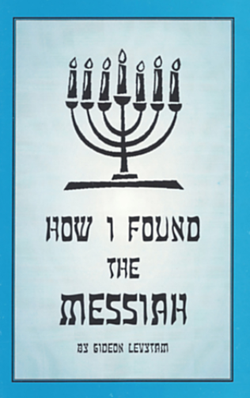
Follow Gideon Levytam's journey and discover how he was led by God, through a series of exciting circumstances, to find the One his people are still waiting for.
Past Episodes

Featured Offer
Follow Gideon Levytam's journey and discover how he was led by God, through a series of exciting circumstances, to find the One his people are still waiting for.
About Holy Scriptures and Israel
As time passed by, the Lord Yeshua took dear brother John Van Stormbroek to himself. The ministry of Holy Scriptures and Israel continued with additional development. In the early 1990’s, a weekly morning Bible class began which brother Gideon Levytam led regularly in the City of Toronto. This weekly open Bible class was held in the Willowdale assembly meeting hall. Eventually, a second mid-week evening Bible class was added. In April 2002, the need for an additional outreach Bible teaching meeting arose. We begun a Saturday (Shabbat) ministry meeting in which a systematic teaching of God’s word is presented to all who attend. Together we learn God’s Word, pray for each need and the salvation of Israel, and sing songs of worship unto our God, praising Him and our Lord Yeshua the Messiah.
In Mid 2004 we started to air on Joy 1250 Radio station a 15 minute Bible teaching program called "The Holy Scriptures and Israel" with Gideon Levytam. The broadcast teaches God’s word from a Hebrew Messianic perspective and has proved to be a blessing to many. It's now aired seven days a week. Our prayer is that many more of our Israeli people will have a clear understanding of who Yeshua is, why we all need him, and come to know him as their Lord and Messiah.
About Gideon Levytam
Contact Holy Scriptures and Israel with Gideon Levytam
426 Simcoe Street
Niagara-on-The-Lake
Ontario L0S 1J0
Canada
(905) 325-1234