
Ephesians 1:1-2, Part 2


Introduction Part 2
Narrator: Shalom. Holy Scriptures and Israel is a ministry designed to share with the Jewish people the good news of the Lord Jesus Yeshua the Messiah and to instruct Christians on the Jewish roots of their faith. And now, teaching God's word from a Hebrew Messianic perspective, here is Gideon Levytam.
Gideon Levytam: The study of Ephesians introduction because it says in verse 9 of Acts chapter 13, then Sha'ul, who also is called Paul, was filled with the Holy Spirit and he set his eyes on him. Notice this very important verse: then Sha'ul, he was already saved, long time saved, became a believer in Yeshua for a long time, but his Hebrew name Sha'ul, Paul's name is the diaspora name, he is also called Paul.
And from here on, beloved brothers and sisters, as we move on, mostly his diaspora name was used in the ministry among the Gentile world. Paul was now ministering among the nations of the world. So the writer of the book of Ephesians was a Hebrew, Israeli, Jewish man who was called to serve among the Gentile world. And he did it with pleasure. He did it with love towards the nations of the world.
You can see what he was willing to suffer for the sake of the believers from among the Gentile world. And you know what I want to say this: that in our little fellowship here, we can be a great testimony because some of us are Jewish and some of us are not Jewish. And we can gather ourselves together as brothers and sisters in Messiah, not having advantage one over the other. We are all part of this one body.
And we can enjoy ourselves in the midst of each and every one of us and the Lord in our midst to serve among the people of God, Jewish believers, non-Jewish believers, united together in the body of Messiah. What an example, what an opportunity we have to serve in such a way. And so far, praise the Lord for helping us. Not many church groups have the privilege that you and I have to be Jewish people and non-Jewish people meeting under the same roof consistently.
Many groups, the vast majority are non-Jewish. You go to many church groups, you look to find one Jewish person, none. You're looking at the board to see if there's any Jewish ministry, none. And you may wonder why is it that there is not ministry among the Jewish people so we can enjoy practically to be together in a practical way, Jewish people and non-Jewish people together under the sound of the word. Well, the apostle Paul, a Jewish man, was reaching out to the Gentile world and he did it out of love in the call that the Lord had called him to serve among the Gentile world.
Now let's add these thoughts that we have before us. When was this letter written to the Ephesian church? It is important for us to understand that when the apostle, when Sha'ul Paul wrote this letter, he was actually in prison in the city of Rome. He was taken from Jerusalem by the Roman soldiers to Caesarea and from there he had a long journey all the way to the city of Rome.
And he was there kept in a separate house. He was under house arrest for two years. And from this place in Rome, he wrote those four letters that we have in the B'rit Hadashah, in the New Testament. He wrote to the church of Ephesus, what we read here. He wrote to the church of Philippi, the Philippians. He also wrote the letter to the Colossians, and he also wrote the letter to Philemon.
Can you imagine here is a man writing four letters that are called prison letters that were written to those four areas for the benefit of the believers. Most Bible teachers believe that he wrote about 62-63 AD when he was actually in the city of Rome under house arrest. Please turn with me to Acts chapter 28, verse 16. And when we came to Rome, the centurion delivered the prisoners to the captain of the guard, but Paul was suffered to dwell by himself with soldiers that kept him.
Notice that, they gave him the privilege of being separated in a home by himself, but he was kept there bound to a soldier. For two years, he was separated from the believers that he loved so much because he had three missionary journeys. He met all these believers. He established the church of Ephesus long before, some ten years before. But now he is finding himself in the city of Rome, he is bound to a soldier and he's writing this letter of instruction to the early believers in the city of Ephesus whom he loves so much.
So the date, beloved brothers and sisters, is about 62-63 AD in which the apostle Paul was bound to a soldier in a home in a city that is called the city of Rome. Again, I want you to see in Ephesians chapter 3 and verse 1. Notice how many times he calls himself a prisoner. For this cause I Paul, a prisoner of Yeshua the Messiah. Chapter 4 and verse 1: I therefore, the prisoner of our Lord, beseech you. Notice that he calls himself a prisoner of Yeshua the Messiah, a prisoner of the Lord.
In Ephesians chapter 6 and verse 20: For which I am an ambassador in bonds. Even though Sha'ul Paul was in prison, he didn't use this expression "I am a prisoner of Rome", but he used this expression "I am a prisoner of our Lord Yeshua the Messiah. I am a prisoner and I'm an ambassador in bonds." How can you be an ambassador and yet you are in bonds? Well, God had allowed him to be in prison here for two years in Rome.
And he used him, even though he was bound in chain to a soldier in one locality, yet the Lord used him to write such a phenomenal letters that are ministering to the hearts of every believer in Yeshua the Messiah. He was prisoner of the Lord Jesus the Messiah. He was an ambassador which was in bonds, according to Ephesians 3:1, 4:1 and chapter 6 and verse 20. So you have to realize the date is 62-63 AD just before he left Rome to be released.
And some believe that Paul was released about 63 AD and he ministered for additional five years and then he was captured again in Rome and then ultimately he died for and have been taken to the presence of the Lord. Interesting experiences that this man have gone through. Now, thirdly, by way of introduction, what is the theme of the book of Ephesians? And the theme is found in Ephesians chapter 1 and verse 3. The theme is the blessings that believers have in the Messiah Yeshua.
Eternal spiritual blessings that every one of us that belong to Yeshua have, the riches of the blessing. It says in verse 3: Blessed be the God and Father of our Lord Jesus the Messiah who has blessed us, listen, with every spiritual blessings in heavenly places in Messiah, in Christ. When we belong to him, we have such riches that we have been brought into. Eternal salvation, eternal relationship with the living God and the spiritual blessing that we possess because of what the Lord Yeshua have done for us.
So we have the author is Sha'ul Paul. We have the date is 62-63 AD. We have the theme, the spiritual blessings that believers have because of the work of Yeshua the Messiah for us. Now fourthly, what is the purpose that Paul wrote the book for? What is the reason, why was that letter written? I would suggest to you five reasons by way of introduction. The first reasons is because Paul wanted to show us that this great salvation that we are part of has not originated by man.
We didn't think about it. It was totally the plan of God. It was God in eternity past. He has thought this plan of salvation of mankind. It was not originated with man. He's the one who executed this salvation by sending his son Yeshua the Messiah. Again, I want you to notice who was the originator of this plan. Chapter 1, verse 3, the first part that says, Blessed be the God and Father of our Lord Yeshua the Messiah. It was God the Father who have been the master planner of this salvation that you and I part of.
It was not human man that planned it. It was not you and I, but God in his wisdom, in his gracious love towards us have planned it in eternity past. He is the one out of whom the origin of this great salvation have arrived to you and I even today. Second reason why Paul wrote this letter: Paul wanted believers to understand, and I made the point to it already, they are rich positionally, spiritually because of the Lord Jesus the Messiah work for us.
And that's why verse 3b, we have been blessed with every spiritual blessings in heavenly places. And I'm repeating what I've already said because it is next to the first half of verse 3. God have planned it, the Father, and through the Messiah we have been enriched, you notice, spiritual blessings in the heavenly places. And it is always in Christ, in HaMashiach. Those of us that are not with Christ, not in Christ in Messiah, do not have this wealth, cannot say that they have been rich in the Messiah.
And that's why it is so important to accept the Lord and to acknowledge him as our Messiah and our Lord and our savior because once the time is past and we are leaving this world, only believers in Yeshua have eternal relationship with God. The unbelievers are going to have to be eternally separated from the Lord Jesus. But the believers, we are going to live eternally with the Lord. We are going to worship him, we are going to praise him, we are going to serve him, we are going to be with him throughout eternity.
And that's why the importance that the apostle Paul had in mind here is that we need to appreciate the spiritual blessings that we have through our Lord Jesus Yeshua the Messiah. And we have this in chapter 1 and verse 3b. Thirdly, Paul also wanted believers to understand the Jewish people and non-Jewish people are now united in this one body. There is distinction in the sense that one is still a Jew by nature and another one is still from among the nations of the world, but positionally we are one in Christ, in the Messiah.
Turn to chapter 2 and verse 13. Now in the Messiah Jesus, Yeshua, ye who was sometimes far away, you were made nigh by the blood of the Messiah. For he is our shalom, our peace, who has made both one. Who are the both? Jew and Gentile. He have made both one and has broken down the middle wall of partition between us and he abolish in his flesh the enmity, even the law of commandments contained in ordinances for to make in himself, notice, of the two, of the twain, Jewish people and non-Jewish people, one new man, so making shalom, so making peace.
You know before the body of Messiah was formed, there was this enmity that existed between Israel the nation and the nations of the world. There was a distance between those two. But in the Messiah when he came and he died and he gave his body a ransom for many, what happened is that through his death he united Jew and Gentiles who only simply believe on him. That's all. And he put us together, but it cost him.
It says here in chapter 2 and verse 15, it was making peace in his flesh. In other words, he died. And what happened now, he brought Jew and Gentile united together, but also together we can approach the presence of the Lord. We can enter into the most holy place on the basis of his finished work. And so one of the purposes of the writing of this letter is not only to point to the fact that God planned it, not only to point to the fact that we are so rich in the Messiah, but also to point to the fact that Jew and Gentiles who are believers in Yeshua the Messiah are part of this one body.
There is not a church for the Jews and a church for the Gentiles. No, there is one body, one assembly, one kehilah, one called-out one, one church which is a composition of Jew and Gentile united in the body of Messiah. And we need to practice this, being sensitive to each other. You know many of us who are married to non-Jewish believers, we thank the Lord for them. How many we see today, Jewish people and non-Jewish people, but they are married in Christ, in the Messiah, Jew and Gentile united together.
Some of us right here in this very room that are Jew and Gentile who united together in marriage, but they are united together in the Messiah. There is no advantage for one over the other. We are all coming to God on the basis of the finished work of the Messiah and we are united in the Messiah. Oh yes, we have our history. Some of us are Jewish, we came from Israel, we came from the descendants of Abraham, Isaac, and Jacob.
Others might have come maybe from a pagan world, but they turned their hearts to the Messiah. They have accepted the Messiah Yeshua and together we are one. And you know what brothers and sisters, I'm not one with my very own family if they are not believers in Yeshua. Even though I'm by nature part of my family like Paul was a part of his own family, but what we have to learn that in the Messiah the relationship with a Gentile believer is far superior than even a relationship to our own family member in the flesh.
In fact, I want to say that when Paul became a believer in Yeshua the Messiah, who is the one that rejected him the most? His very own brethren, who should have been happy that he became a believer in Yeshua, but they didn't acknowledge him. And then he fell in love with the Lord and other believers from among the Gentile world who loved Yeshua became part of this family of God. It's hard to grasp it, but in reality that's why the apostle Paul write this letter to help us appreciate that and understand that we are one in the body of Messiah.
Here's another reason why the apostle Paul wrote this letter to the Ephesians: Paul wanted believers to understand the present dispensation of the age of the grace of God. Now I know that this is troubling a lot of people and we have a lot of misunderstanding, but the apostle Paul is very, very clear in chapter 3. The apostle Paul wanted the believers at Ephesus to understand that we are in a different dispensation, different age or different order in which God had now presented before us.
Notice that in chapter 3, verse 1: For this cause I Paul, the prisoner of Yeshua the Messiah for you Gentiles, if ye have heard of the dispensation, the word for dispensation here is a word that has with an order of time, a period of time. It's oikonomia. It's economy, come from the word economy that we use in English, o-i-k-o-n-o-m-i-a in the Greek. And it is a dispensation of the grace of God which is given me towards you.
Verse 3: How that by revelation he made known unto me the mystery as I wrote before in few words, whereby when you read ye may understand my knowledge in the mystery of the Messiah which in other ages it was not made known unto the sons of men. Nobody knew about this dispensation in other ages. But he said that it is now revealed unto his holy apostles and prophets by the Spirit.
What is this that was not revealed in other ages? He says in verse 6: that the Gentiles should be fellow heirs and of the same body and partakers of the promise, of the promise in Messiah by the gospel. The reason that the apostle Paul wrote this letter to the Ephesians is to help us to understand that we live in a different period of time. God's law remain the same. It is man who failed to submit to God's law. The Messiah came. He fulfilled the law of God.
And now because he finished the work, he died, he was buried, he rose, he formed what is known today as the body of Mashiach, the body of Christ. It's a different dispensation. He called it here in verse 2, the dispensation of the grace of God, Chesed Elohim. And so we have to understand that that's why even though the truth of God under law is still maintained because God's law never change, yet we have to understand that in this present day the things that God have commanded our people Israel historically is to be distinguished with what he is given to the present day Gentile Jewish church age.
The law remain, man failed in submitting to the law, but because of the Messiah we have been brought to a different dispensation. He called it by the way here the mystery of Christ, the Messiah, in verse 4. That's why things like for example we are struggling with day keeping, food eating, certain celebrations that Christians around the world don't do that. They are believers, they are all part of the family of God.
But if we were under the past dispensation of the law, God would have judged us if we would not submit to what he commanded Israel as a nation, including food that he commanded Israel not to eat. And if any one of us eating here something that is not kosher, like pork and other thing, under the old economy, you would be judged if you would eat that, if you have it in your own home. Today believers do eat these because we live in a different dispensation.
You don't have to eat that, it's not necessarily good for you, but we live in a different dispensation. What about keeping days, keeping feasts? There were dates that were given to Israel specifically to keep a certain feast. And if they would not be there to keep the feast, God will judge them. But today the present day dispensation, believers all over the world, they don't keep those feasts.
And had they been under the Old Testament dispensation, under the law dispensation of the law, God would judge them, including circumcision, all sort of things that God had given our people Israel. And apparently we live in a different dispensation. I know to some of us is difficult to accept, but we live in a different dispensation and we have to tune ourselves with the present day dispensation. We don't need to be liberals, we don't need to be legal, we need to be balanced in understanding of the dispensation in which we live in.
And that's why the apostle Paul say that ye have heard of the dispensation of the grace of God which is given unto me toward you, how that by revelation he made known unto me the mystery that I wrote in a few words and this mystery was in ages before not made known. Notice verse 5 to the sons of men. Nobody knew before. You never find the church in the Old Testament. You'll turn your pages from Bereshit to Malakhi, from Genesis to the second book of Chronicles, in Hebrew that's the last book of the Tanakh, you will not find a church in the Tanakh.
The Tanakh has to do with Israel and Israel's first coming of the Messiah and the rejection, second coming of the Messiah and the acceptance, and then the Messianic kingdom. You don't find a church in the Old Testament. Look as much as you want, you won't find it. The church was something that Yeshua said "I will build my church", Matthew chapter 16. It is in the future as far as he was concerned.
And so we have to understand the church, the ekklesia is a composition of Jew and Gentile in the time in which we live in today after the finished work of the Messiah on the cross. Now people may try to put the church into the Old Testament and that's where you get replacement theology. That's why many today say all what the blessing that God gave to Israel now move to us the church. But they leave the cursing on Israel.
The cursing they don't want, the judgment they don't want, but only the blessing will take for ourselves. No, when God said that he's going to judge Israel, he judged them. When God says that he's going to restore Israel, he will restore the people of Israel. So we have to distinguish between Israel the nation and the ekklesia, the body of Messiah of this present day dispensation.
Now finally, the fifth thing why the apostle Paul wrote this epistle is to help believers to walk in a way that is pleasing, that is fit to where and who they are. Turn to Ephesians 4 and verse 1. Paul says, I therefore a prisoner of the Lord beseech you that ye walk worthy of the vocation wherewith ye are called. You have called to be part of the assembly, of the church, of the kehilah, the body of Mashiach.
Well if you have been called to be part of the Messiah's body, then he saying to us "I beseech you that you walk, that you live your life worthy of the vocation wherewith you have been called. You have been called to be part of this body of Messiah, well your walk ought to be consistent with the place in which you have been brought into. We are not always so, beloved brothers and sisters, we know that.
But nevertheless, that's is the reason why the apostle Paul have given us this book of the letter to the Ephesians. He wrote it because he wanted the believers to walk in a special way, in a godly way. And we know how amazing when you think about church history and how we as believers failed in our walk worthy of the vocation wherewith we have been called. We failed. And I'm saying we because we as well had failed, not only them.
But we, that's why the apostle Paul beseech you, I beg you, I challenge you that you walk here in this world worthy of the vocation wherewith you have been called. You have been called to such a special relationship with the Messiah. Well walk in the light of this. Walk in a way that it is pleasing to the Lord. And when believers are not walking right with the Lord, what you think it does? It hurt the testimony when we sin and we live a life carelessly.
Narrator: You have been listening to the Holy Scriptures and Israel with Gideon Levytam. Gideon teaches God's word from a Hebrew Messianic perspective. For more information about this ministry, write to Holy Scriptures and Israel, Box 1411, Niagara-on-the-Lake, Ontario, L0S 1J0, or visit our website at holyscripturesandisrael.org.
You are also invited to Gideon's weekly Bible teaching on Fridays at 11:00 AM and 7:00 PM and Saturdays at 1:00 PM at Willowdale Christian Assembly Hall, 28 Martin Ross Avenue in Toronto. Holy Scriptures and Israel is made possible by your prayers and financial support. If you would like to support the program, visit holyscripturesandisrael.org. God bless you. Shalom, shalom.
Featured Offer
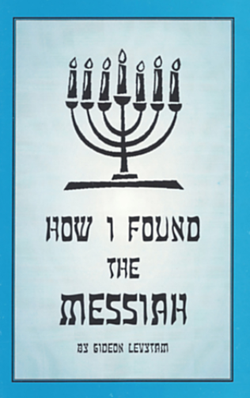
Follow Gideon Levytam's journey and discover how he was led by God, through a series of exciting circumstances, to find the One his people are still waiting for.
Past Episodes

Featured Offer
Follow Gideon Levytam's journey and discover how he was led by God, through a series of exciting circumstances, to find the One his people are still waiting for.
About Holy Scriptures and Israel
As time passed by, the Lord Yeshua took dear brother John Van Stormbroek to himself. The ministry of Holy Scriptures and Israel continued with additional development. In the early 1990’s, a weekly morning Bible class began which brother Gideon Levytam led regularly in the City of Toronto. This weekly open Bible class was held in the Willowdale assembly meeting hall. Eventually, a second mid-week evening Bible class was added. In April 2002, the need for an additional outreach Bible teaching meeting arose. We begun a Saturday (Shabbat) ministry meeting in which a systematic teaching of God’s word is presented to all who attend. Together we learn God’s Word, pray for each need and the salvation of Israel, and sing songs of worship unto our God, praising Him and our Lord Yeshua the Messiah.
In Mid 2004 we started to air on Joy 1250 Radio station a 15 minute Bible teaching program called "The Holy Scriptures and Israel" with Gideon Levytam. The broadcast teaches God’s word from a Hebrew Messianic perspective and has proved to be a blessing to many. It's now aired seven days a week. Our prayer is that many more of our Israeli people will have a clear understanding of who Yeshua is, why we all need him, and come to know him as their Lord and Messiah.
About Gideon Levytam
Contact Holy Scriptures and Israel with Gideon Levytam
426 Simcoe Street
Niagara-on-The-Lake
Ontario L0S 1J0
Canada
(905) 325-1234