

Daniel 7:1-10, Part 2


Daniel’s Vision: Four Beasts Part 2
Guest (Female): Shalom. Holy Scriptures and Israel is a ministry designed to share with the Jewish people the good news of the Lord Jesus Yeshua the Messiah and to instruct Christians on the Jewish roots of their faith. And now, teaching God's word from a Hebrew Messianic perspective, here is Gideon Levytam.
Gideon Levytam: The study of Daniel chapter seven. If you know Israel, in the north, we have Syria. In the south, we have Egypt. In the east, you have Jordan. In the west, you have what you call the Mediterranean Sea. It's called in the Scripture the Great Sea. I want to give you some verses to prove that if you just leave your finger here and go to the book of Numbers.
Go to the book of Numbers chapter 34. Some of the borders, Numbers 34 gives us the borders of Canaan. God had given to the people of Israel a promise of a land, a land that he is going to provide for the nation of Israel. Israel was going to enter into this land, and it's a land flowing with milk and honey. Of course, the reason that they haven't enjoyed that land yet fully is because of disobedience. God had eventually to cause the diaspora, and the Jewish people are dispersed, waiting for the day when they are going to be restored in the second coming of the Messiah.
Notice what it says in Numbers chapter 34, verse six. Numbers chapter 34, verses six and seven: "And for the western border, ye shall have the great sea for a border: this shall be your border. And this shall be your north border: from the great sea ye shall point out for you mount Hor." Just this expression, the Great Sea, it has to do with the Mediterranean Sea. If you think about the land that God had given to Israel, the Great Sea has a reference to the Mediterranean Sea.
Turn to the book of Joshua now, chapter one. Joshua, Judges, Joshua chapter one, and verses three and four, where God is saying to Joshua: "Every place that the sole of your foot shall tread upon, that have I given unto you, as I said unto Moses. From the wilderness and this Lebanon even unto the great river, the river Euphrates, all the land of the Hittites, and unto the great sea toward the going down of the sun shall be your coast."
So you see the Great Sea, when you read it today and you look at the map, has a reference to the Mediterranean Sea. That is the vision that Daniel sees. What does he see? The Mediterranean Sea, if you will, is being in agitation. It is interesting in chapter seven, verse two, Daniel spoke and he said, "I saw in my vision by night, and, behold, the four winds of heaven strove upon the great sea."
There was striving. It seems to be that there is a chaotic situation. There is a striving situation. So out of this Great Sea, what does this symbolically speak to us? Because not only physically if the Great Sea speaks of the Mediterranean Sea that God had given to the people of Israel, in a spiritual way, the sea in the Scripture often has a picture or a spiritual lesson which speaks to us of the nations, the Gentile nations of the world.
You will notice how clear it is as we're going to read some other passages. Every time in the Scripture it has a reference to the sea in Scripture, oftentimes it has a reference to the Gentile nations of the world. I'll give you an example. Again, put your finger here and go to the prophet Isaiah now in chapter 17.
Isaiah chapter 17, verses 12 and 13: "Woe to the multitude of many people, which make a noise like the noise of the seas; and to the rushing of nations, that make a rushing like the rushing of mighty waters!" Notice how God in the Scripture makes a reference to the seas, having a reference to many people, to many nations, like the mighty rivers.
Daniel, of course, laying in his bed, receiving a vision from God. What does he see? The sea agitated, and out of this sea, which represents the Gentile nations, come four beasts, four beasts out. By the way, if you want some more references to the sea that speak of nations: Matthew chapter 13, verses 47 to 50; Revelation chapter 13 and verse one; and Revelation chapter 17, verses one and 15. That has a reference to many nations.
In fact, I just want to read that last passage in Revelation. Revelation chapter 13 and verse one: "And I stood upon the sand of the sea, and saw a beast rise up out of the sea, having seven heads and ten horns, and upon his horns ten crowns, and upon his heads the name of blasphemy." Chapter 13 and verse one has to do with that beast that we're going to talk about later on, that's rising out of the sea, again, out of the nations of the world.
In Daniel chapter seven and verse three now, out of this sea, what does he see? He sees four great beasts come up from the sea, diverse one from another. He sees coming out of the sea four animals or four beasts coming out. Every one was different, and he says here it was a very unique kind of beasts, very unique. Out of that sea, symbolically and spiritually what we learn here is that out of the Gentile nations, he is looking and he sees coming out of the sea, coming out of the Gentile nations, four beasts, diverse one from another.
Then notice now, he begins to give us a description of every one of these animals, every one of these beasts that he received from God in the visions that he has seen. Notice first of all, in verse four, the first beast that he saw is found in verse four: "The first was like a lion, and had eagle's wings: I beheld till the wings thereof were plucked, and it was lifted up from the earth, and made stand upon the feet as a man, and a man's heart was given to it."
Really, when you think about it, first of all, the lions oftentimes in the Scripture represented the Babylonian, the Babylonian kingdom. Notice that this particular lion, what does he have? He has those two wings. He has these eagle's wings, and it would speak to us of the swiftness in which the Babylonian has taken over the rule over this world. These wings really represent the swiftness, how fast the Babylonian have taken possession over the world, and they become this first empire.
But it says here in verse four, "I beheld till the wings thereof were plucked, and it was lifted up from the earth, and it was made to stand upon the feet as a man, and a man's heart was given unto it." It has been suggested that after the experience that Nebuchadnezzar had with the judgment that God had to judge him to teach him lessons, not to be proud and say that this is this great Babylon which I have made for myself, after this lesson, the Babylonian kingdom became less aggressive.
In the beginning, they began swiftly, in much power, took control, aggressive, but then later on after the Nebuchadnezzar humiliation, they became less aggressive. It says here in verse four, these wings have been plucked off and it was lifted up from the earth and he was made to stand upon the feet as a man, and a man's heart was given unto him. He became more humane dealing with those who were under their authority in a lot easier way than the way it was in the beginning.
So the first beast looked like a lion, two wings on its back, which really would speak to us of the Babylonian kingdom, beginning, of course, with Nebuchadnezzar. Secondly, notice in verse five. Verse five is the second beast. The second beast, and I want you to notice, it says, "Behold another beast, a second, like to a bear."
There is an interesting thing about that bear. It says here in verse five, "and it raised up itself on one side, and it had three ribs in the mouth of it between the teeth of it: and they said thus unto it, Arise, devour much flesh." If the first beast will represent for us, of course, the kingdom of Babylon, the second beast will represent to us the kingdom of the Medes and the Persian.
If you remember in our study of the image in chapter two, the Medo-Persia was represented by the chest and the two hands. It was a partnership kingdom. It was the together between the Medes and the Persians together, and here what we see in the bear is that the bear was being lifted up on one side a little bit higher than the other side.
That's what verse five says, "the bear, it raised up itself on one side." And that will really represent to us again while there were the Medes and the Persians who had a partnership kingdom, it was really the Persian who had a little higher authority, Cyrus and so on, over the Medes. Therefore, you can see that there is the Medes and the Persians are being represented here with the bear.
Notice, by the way, that it says here about the bear in verse five that in his mouth were three ribs. Those ribs were really a remains of the food that they have already devoured. It says here between his teeth he had it, and they said thus unto it, "Arise, devour much flesh." It had been said that the Medes and the Persian, they have, of course, took over Babylon and, in addition to that, Lydia and Egypt. By doing so, they have become that second empire.
The three ribs will represent really the three great nations that they have devoured and took over and became the second kingdom after the Babylonian. So we have the Babylonian represented by the lion, and then we have the Medes and the Persian, the Medo-Persia, which represented by the bear leaning a little bit more higher on one side because the Persian nation was a little bit more powerful than the Medes. But it was a partnership kingdom.
Then in verse six, we see the third beast. In verse six, I'm reading what we see: "After this I beheld, and lo another, like a leopard, which had upon the back of it four wings of a fowl; the beast had also four heads; and dominion was given unto it." This is also very interesting. Remember when we have studied the image in chapter two, we said that the belly and the thighs really represented the Grecians.
The Greek, of course, empire, being, of course, started by Alexander the Great, is the one who has taken control. Notice the leopard is swiftness, the way he had been taking over. It had been said about Alexander that when he died, he was a very young man, around 32 years old, he was so discouraged with the fact that he could not take more and he could not conquer even more.
So it really represents these four wings, really represent the double the speed of what we saw in the lion, which was the Babylonian. We can see that it's really would speak to us now of the Grecian empire. By the way, you notice he had also four heads. When Alexander died, his captains, if you will, those that had been his generals, the four generals have taken over and divided the Grecian kingdom into the north, south, east, and west. In other words, the four heads will really represent the four divisions of the Grecian empire into these four sections.
What we see here in verses two to six, we have the first vision, if you will. What does he see? The Great Sea, the first beast the lion, the second beast the bear, the third beast the leopard, which represent the Grecian empire. So the Babylonian, the Medo-Persian, and the Grecians represented by those three beasts.
For a minute, please just turn to a verse in the book of Psalms. I want to read Psalm 49 and verse 12. "Nevertheless man being in honour abideth not: he is like the beasts that perish." When we think about those kingdoms that we have been already speaking about in chapter two, man being in honour, the best of man and the best of kingdoms and the best of powers in this world, the Scripture says he is like the beasts that eventually perish.
This is exactly what happened when we look at the history of those kingdoms. When the next kingdom came, their kingdom status have ended and they mingle and become part, interwoven with the next kingdom, and with the next kingdom. Ultimately we're going to see that it's going to lead eventually into the second coming of the Messiah of Israel, Yeshua the Messiah himself, which will take the kingdom which will never end, will never end. But man being in honour abideth not, or endureth not, does not endure. He is like the beasts that perish.
Okay, so we have covered the first vision in verses two to six, and now we're going to go to the next vision in verses seven and eight. That is very interesting. In verses seven and eight, let me read those two verses. We see the second vision. After this I saw, notice, "After this I saw in the night visions, and behold a fourth beast, dreadful and terrible, and strong exceedingly; and it had great iron teeth: it devoured and brake in pieces, and stamped the residue with the feet of it: and it was diverse from all the beasts that were before it; and it had ten horns. I considered the horns, and, behold, there came up among them another little horn, before whom there were three of the first horns plucked up by the roots: and, behold, in this horn were eyes like the eyes of man, and a mouth speaking great things."
Now pause with me for a minute. This is interesting. You notice what he says now in verses seven and eight. First of all, he shows us in verse seven the fourth beast. What does he say? First of all, this beast, he does not give it even a name. The other three: lion, bear, leopard. But when it's come to the fourth beast, it's what we call a beast which has only the description but without a name. In fact, you notice the way he says it in verse seven: "I saw in the night visions, and behold a fourth beast, dreadful and terrible." That's what he called that beast, dreadful and terrible.
Featured Offer
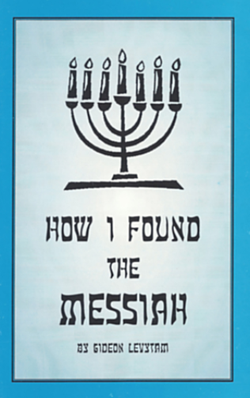
Follow Gideon Levytam's journey and discover how he was led by God, through a series of exciting circumstances, to find the One his people are still waiting for.
Past Episodes

Featured Offer
Follow Gideon Levytam's journey and discover how he was led by God, through a series of exciting circumstances, to find the One his people are still waiting for.
About Holy Scriptures and Israel
As time passed by, the Lord Yeshua took dear brother John Van Stormbroek to himself. The ministry of Holy Scriptures and Israel continued with additional development. In the early 1990’s, a weekly morning Bible class began which brother Gideon Levytam led regularly in the City of Toronto. This weekly open Bible class was held in the Willowdale assembly meeting hall. Eventually, a second mid-week evening Bible class was added. In April 2002, the need for an additional outreach Bible teaching meeting arose. We begun a Saturday (Shabbat) ministry meeting in which a systematic teaching of God’s word is presented to all who attend. Together we learn God’s Word, pray for each need and the salvation of Israel, and sing songs of worship unto our God, praising Him and our Lord Yeshua the Messiah.
In Mid 2004 we started to air on Joy 1250 Radio station a 15 minute Bible teaching program called "The Holy Scriptures and Israel" with Gideon Levytam. The broadcast teaches God’s word from a Hebrew Messianic perspective and has proved to be a blessing to many. It's now aired seven days a week. Our prayer is that many more of our Israeli people will have a clear understanding of who Yeshua is, why we all need him, and come to know him as their Lord and Messiah.
About Gideon Levytam
Contact Holy Scriptures and Israel with Gideon Levytam
426 Simcoe Street
Niagara-on-The-Lake
Ontario L0S 1J0
Canada
(905) 325-1234